Sick and unfree in America

yellow_emperor

In ancient Taoist China, a well-off family would hire a doctor, pay him as long as everybody in the family was healthy, and stop paying him as soon as somebody got sick until that person was healthy again. This, as far as I know, was the last time that a society aligned the incentives in the healthcare industry properly.

By contrast, healthcare today is upside down: You don’t pay for the thing you want (health); you pay for service when the thing that you don’t want (sickness) comes around. Hypothetically, if you had two doctors, one Taoist and one modern, and if the Taoist were good enough at his job to keep you healthy, the modern doctor would not get paid at all!

I bring this up only as a little thought exercise to illustrate something important: Healthcare is not like other industries. If the product is muesli or ball bearings, it makes sense to talk about competitive markets and such. But if you’re dealing with an industry that is fundamentally upside down, you have to be careful about using trite concepts of economics.

Another way that healthcare is different: If there were large numbers of, for example, children in society that could not get muesli or ball bearings, we could live with it. After all, they can get corn flakes instead, and walk instead of using wheels. The “market failure” would not equate to a shameful indignity. By contrast, if children (and adults, for that matter) cannot get access to healthcare, it is a shameful indignity.

(Disclaimer: As with everything on The Hannibal Blog, the opinions in this post are mine and mine alone, and may or may not overlap with the views of my magazine, The Economist.)

Healthcare and freedom

I bring up healthcare only reluctantly in my ongoing ‘Freedom Lover’s Critique of America’. I’m not qualified to talk about it and it’s not my beat at The Economist. But I decided that it belongs into this series because America’s healthcare system is so different from those in all comparable countries, and because it has such a direct bearing on freedom.

That the system is dysfunctional is well known. I won’t rehearse the familiar list of failings (many uninsured; many underinsured, et cetera). Let me just point to a few features for the subsequent discussion:

  1. American healthcare is typically American in that is it bureaucratic and adversarial. The effect on patients is alienating and dehumanizing. At the precise moment when they are most vulnerable and dejected, they are expected to go to war against their insurance company on the 1-800 numbers and phone trees to contest pieces of paper they don’t understand. But they have to, because their insurance company will contest almost every single claim–for this is built into the system!
  2. American healthcare is also typically American in being uneccessarily complex, as America’s tax system is. I’m not talking about the medical side–that is complex everywhere, because our bodies are–but about the administrative side.

Does this limit the freedom of individual Americans? Yes, and let me just give one concrete example. A free society is one in which people feel free to move and to change jobs, among other things. But a great many Americans are afraid to change or quit jobs, because their healthcare coverage is tied to an employer. So healthcare can become yet another of the shackles that makes serfs out of many Americans.

More generally, the system’s dysfunction limits freedom because it robs so many Americans of dignity. And dignity is a prerequisite for freedom. Thomas Jefferson could write “life, liberty and the pursuit of happiness” only because he lived in a relatively innocent age, the Enlightenment. A more mature constitution of liberty, such as West Germany’s after the Holocaust, begins with

Die Würde des Menschen ist unantastbar–The dignity of each human being is untouchable.

So yes, healthcare belongs into any debate about whether a country can claim to be free or not. Now let’s figure out what sort of problem healthcare poses, in general and in America.

What kind of problem is healthcare?

When the ancient Chinese paid Taoist doctors to keep them healthy, healthcare was a cost of living, comparable to food and shelter. When we turned it around and paid doctors for managing our sickness, healthcare became an insurance problem.

And there are two traditions of modern insurance:

1) Lloyd’s of London

In 1688, rich toffs started hanging out in Edward Lloyd’s coffee house in London, near where the ships came in and maritime gossip spread. They began betting on which ships would make it to port with their cargo and which might sink. They called it ‘insurance’. It was really a higher form of gambling, with huge profits when the bets went well and huge losses when they went bad. This is the origin of the Anglo-Saxon view of insurance: as a profit-business.

2) Swiss mountain valleys

In Switzerland, going back to I-don’t-know-when, villagers got together to share risk. You might say they “collectivized” it, but don’t think that they were socialists. They were freely volunteering to pool their individual risks because they noticed something that we now call

the Law of Large Numbers

Say that a Swiss village had 1,000 houses. The villagers knew from historical record that, on average, one house would burn down every year. That house’s family would be devastated. Let’s put their loss at SF1,000 to make the math simple. The other families would suffer no loss at all, but they could not tolerate the indignity of letting one family suffer and lived in fear that they might themselves be next.

So they agreed, in free assembly, to pony up SF1 each for a SF1,000 fund. The SF1,000 then went to the one family whose house burnt down to make it whole.

What had they done? They had exchanged a

large but uncertain loss

for a

small but certain one.

They were able to do this thanks to the Law of Large Numbers, which says that an unpredictable risk becomes highly predictable when it is pooled with large numbers of similar, but unrelated, risks.

Caveats

The Law does not work if the individual risks are correlated. The Great Fire of London in 1666 (below) happened because all of London’s thatched houses stood so close together that they were in fact one big house from the point of view of a flame.
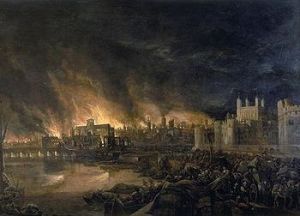
350px-great_fire_london

The Law also does not work if adverse selection spoils the risk pool. For instance, say that some of the Swiss villagers had opted out of the pool because they had stone houses. Only those families with highly flammable houses would have entered the pool, but that would mean that the 1-in-a-1,000 ratio no longer applied (it would be much higher).

The Law also does not work if moral hazard changes the way people behave once they get insurance. If some villagers get the idea that, since they are now “covered”, they might as well set their houses afire, the system breaks down.

Finally, the Law works best for risks that are high in frequency, low in devastation. Fire is a good example. It does not work well for risks that are low in frequency, high in devastation. An extinction-causing meteor is a good example. (Who would charge whom what premium for what risk?)

Back to healthcare

And where does healthcare fit in?

  • First, it is very high in frequency (everybody gets injured or sick sooner or later) and low in devastation (usually only that one life is at risk). For most illnesses–diabetes, heart disease, etc–actuaries know exactly what percentage of the population as a whole will get sick in a given year.
  • Moral hazard is not a problem, because–loonies and rock stars excepted–people do not intentionally ruin their health just because they are insured.
  • Adverse selection is a problem, because risk, and the perception of it, changes over a lifetime. The young feel immortal and would opt out to save the buck (Swiss Franc) for a beer, leaving only the geezers to pay up.

Conclusions

Healthcare seems to be altogether unsuitable for a Lloyd’s of London (Anglo-Saxon, profit-driven) insurance culture, and perfectly suited for a Swiss-mountain-valley (risk sharing) insurance culture.

The prerequisite is that everybody in the pool must participate to avoid adverse selection.This, however, would require a mandate for the majority to coerce a few unwilling individuals, and that is something that (real) liberals do not like. But many liberals (and the Swiss are freedom lovers!) make this sacrifice because they understand that it is necessary: Dignity mandates that we look after the sick even if they have opted out of participating, so some people would become free riders.

There are two simple ways to get everybody into one risk pool subject to the Law of Large Numbers:

  1. Tax everybody a little bit (the equivalent of the SF1 per village family) to cover the proportion of people being sick every year, or
  2. make people buy their own insurance, rather as we require car insurance for drivers.

The first leads to a British or Canadian-style single-payer system. (Important: Notice that the government need only manage the funding of the care, not the care itself.) Since everybody is covered, there need be no paperwork for patients. I still remember when I was visiting Britain as a teenager with a soccer team and woke up unable to move my neck one day. I dragged myself to the street, got a taxi to a hospital, and, although I was not British, got fantastic care without signing a single piece of paper.

The second leads to a system of competing insurance carriers. This is fine, although there is one problem: What if you pay premiums to one insurer while you’re young, but then you switch to another insurer when you’re old? That would be adverse selection again (for the second insurer). But in a competitive system, patients would move in both directions, and might cancel one another out. Even so, there is slightly more paperwork for patients, since the care provider needs to reclaim the money from any of several insurers.

Notice that, either way, the economic burden is the same: Every citizen pays, whether through taxes or premiums, the same amount to participate in the risk pool.

America

And now, the American way: A bit of everything, mixed together and stirred. If you’re a veteran, you participate in huge risk pool. If you’re old (Medicaid) or poor (Medicaid), you participate in other risk pools. If you buy your own insurance, you can carry your coverage around, but you are paying much higher premiums because the insurer assumes adverse selection. If you’re employed, your company arranges coverage, but only as long as you work for it. If you are none of the above, you have no coverage and go to the emergency room when you’re sick, thus leaving the provider to hike everybody else’s costs to compensate for you.

Paper, paper, paper. No law of large numbers for society as a whole. Fragmentation. Confrontation between patient and insurer. Nightmare.

And if Obama goes on to do just the “politically feasible” thing–which, in America, is to add more “options” and complexity–it will get worse.

The way to bring freedom and dignity to America is to get rid of employer-sponsored insurance and to have either  one single government-run insurance pool or mandatory individual insurance for one privately-run insurance pool. Nothing else works.

Bookmark and Share

Complexity in the American drawer

Remote controls

This is only tangentially related to my ongoing ‘Freedom Lover’s Critique of America‘; but tangent does mean touching in Latin, so this does touch the topic:

I am staying in a very American sort of place: The owner has gone out of his way to provide “conveniences”, and in America that usually involves screens–nowadays of the flat-panel variety. They must be in every room, so that you don’t ever have to miss out. Other devices must be connected to the screens so that you need not compromise on your entertainment options. You must, you see, have choice. (More on the paradoxical effect of choice on freedom here.)

And so I opened a drawer. It turned out to be the mother lode of complexity metaphors in American life. All you need to enter this American paradise was contained therein. I thought of the number of remote controls, then the number of buttons, then the number of permutations. But I’m not that good at math.

I savored the irony, then closed the drawer and opened a book.

Bookmark and Share

Let’s contradict ourselves

485px-walt_whitman_edit_21

I just got a short and witty reader letter (most aren’t!) in response to one of my pieces in the current issue of The Economist. It quotes Walt Whitman, and I love the quote. In fact, I am considering making it the motto of The Hannibal Blog and all its commenters.

Dear Sirs,

It was interesting to read about the Red and Blue and Purple and Orange of Kaleidofornia (“California Splitting”). Perhaps Walt Whitman said it best:
“Do I contradict myself? Very well, then I contradict myself, I am large, I contain multitudes. “

Sincerely,
Rama Rao
Irvine , CA

Bookmark and Share

Writers, lose your notebooks

notebook

No, I don’t mean that all of you should literally throw them away right now. In fact, I keep all of my notebooks, going back years, officially for libel-defense purposes but really out of superstition. But that’s not what this post is about. It’s really about the following anecdote.

I happen to live next door to Michael Lewis, an author of several bestsellers (Liar’s Poker, Moneyball, The Blind Side, et cetera). He and I were walking down the hill once to get some lunch. We got to talking about the time that he came back from a big reporting trip for a book, only to discover …. that his notebook was gone!

“And it turned out….”, I began asking.

“Oh, much, much better,” he said.

And we both cracked up.

When my notebook lost me

Here is a brief description of my early years as a journalist, which is the experience that made me laugh at (ie, understand) Michael’s response.

When I started, I was so enthusiastic about observing every last detail and capturing every quote by everybody I met that I agonized over my note-taking. I could not write fast enough. In the evenings, I took a night course in shorthand (Teeline). I was the only guy; all the others seemed to be young ladies training to be secretaries (somebody should have told them that this wouldn’t prove so useful in their careers). But even that didn’t help. I never got fast enough.

So I had the quintessential writer’s predicament: Do you live, absorb, participate, think, see, hear, smell, act? Or do you stop life, and write it all down?

Recording interviews, with one of those little gadgets, didn’t help either. I didn’t like fiddling with them, and they usually intruded into the conversation, pointing at my interviewee like a dart that might be poisonous. Those things distracted me, and I threw them away.

Even so, I did capture quite a lot. I observe well, and I get “good quote” out of people. So, for a while, I was writing my articles quote to quote, detail to detail. Today, I believe that was the worst writing I have ever done.

At least close it

Around that time I heard John Micklethwait give somebody advice. The lady was having writer’s block, and John, the quintessential British cavalier, said, roughly:

“First, close your notebook. Then trust that it will come.”

(These days, John is The Economist‘s editor-in-chief–ie, my boss–so the trick must have worked for him. ;))

Relax and trust

Writing, and all storytelling, is necessarily a two-step process: 1) You live. 2) You pause, re-live and tell. You can’t merge the two artificially by writing everything down as it happens. If you try, you only interfere with Part 1).

Instead, good writers know how to relax. Only when the brain is relaxed does it make the lateral connections, the quirky associations that we call creativity. And only when you are relaxed can your interview partners relax as well.

Good writers then trust. They trust that ‘it’ comes back to them. And ‘it’ does. What is ‘it’? It is whatever comes back!

By the time it comes back, it is like water that has percolated through sediment and become pure and clean and potable. A writer’s memory is therefore like a filter, provided the writer lets it be that. What it filters is the entire overwhelming world of detail, so that only a few–the right ones–run onto the screen and become life-giving, texture-giving color.

Bookmark and Share

“Color” in writing

445px-der_mann_mit_dem_goldhelm

I think this is probably my favorite Rembrandt. More than that: it is a lesson! What makes this painting so good is the same thing that makes good writing good. It is the sparing use of color and light.

For two years, I taught at Berkeley’s journalism school (thanks to Orville Schell, the then-dean, who invited me). That was the first time that I had to think about (ie, analyze, intellectualize, verbalize) writing, as opposed to just doing it for a living. And one thing that struck me is that all my students, and quite a few of the teachers there, grotesquely overdid that thing writers call “color”.

Before I go any further, so that we are on the same page, let me give you a caricature of what I mean (this is made up! No real writers are being harmed or embarrassed!):

On a bright, sunny day, John Smith was striding into his corner office, with a view of the Hudson and pictures of his three sons (Jimmy, 12, Billy, 14, and Bobby, 18) on his desk, next to a pile of Wall Street Journals and a cup of Starbucks soy latte. “I love this view,” said Smith. The Fortune 500 executive then turned…..

How many New Yorker articles have you read that started with some variation of ‘On a recent Sunday afternoon…’ or “It was a dark, overcast day when John….”, only to discover on the third of the article’s fifteen pages that these details would almost certainly prove to be of no help whatsoever?

So there I was at the J-School, getting paid to read piece after piece by bright-eyed young journalism students who were so eager to prove that they had been there (wherever there happened to be), that they had actually interviewed some guy, that they had got the color, that they were ready for the New Yorker. It got extremely tedious.

Color and substance

Am I against colorful writing? You must be mad. Of course not. I love color. By the standards of The Economist, I am a “color” guy. No child has ever said to his parents, ‘mommy, I want to grow up and write really monochrome stories’. If you have ever felt the impulse to try your luck as a writer, it was because you loved color, whether or not you called it that yet.

The problem is that color without substance is just a paint bucket that tipped over. I’m not even talking about Rembrandt versus, say, Jackson Pollock. I’m talking about Pollock’s studio floor before he cleaned it up.

Color has to be in support of something. And that something has to be an idea, a thought, a story. The mistake many writers make is to list details. Lists are boring; we use them to go shopping. Details are boring, unless they illuminate some meaning. It does not have to be epic. It can be quirky, amusing, moving, insightful, whatever. But there has to be a there there.

So the trick is to find substance, and then to take away details so that only a few splashes of light and color remain, which then filter out the entire sensual world around the reader and deliver him to that one place that you, the writer, have in mind for him. In terms of thought process, it may be the opposite of what my students were doing, and what I used to do.

I can find no better illustration than Rembrandt, above. You are drawn deep into this man. If I asked you, you would say that there is so much color in this painting, so much light. Only then would you notice that most of the canvas is dark, that very little of it is … in color.

Bookmark and Share

Big night in London for The Economist

I just got an email from my colleague Ed Carr in London, who has been attending the gala dinner at an annual ceremony where they give out these swanky journalism awards. It appears that The Economist cleaned up tonight, with four awards. (The announcement is not up on the official site yet.)

Philip Coggan won, not one, but two! Fiammetta Rocco, our delightful books & arts editor, won another. (For a profile, as she just informed me in another email, of a subject “who caused me much amusement when I discovered that he uses a condom with 39 holes in it attached to the end of a Hoover to make his finest works of art.” Must investigate.) And the fourth award, I’m happy to say, appears to me mine.

Years ago, I won another one of those. For some reason, I never get to go to the dinner, though, so it is always Ed who accepts on my behalf. That means he gets his picture taken with the trophy. When I met my wife in Hong Kong and she googled me, she came upon that picture and, because he and I sort of look alike, forwarded it to her friends as a way of introducing her new boyfriend.

Bookmark and Share

Identity in the age of bureaucracy, continued

And apropos of our recent discussion about ‘bureaucracy and alienation in American life’, here is a footnote from China, just for perspective (my emphasis):

Chinese parents’ desire to give their children a spark of individuality is colliding head-on with the Chinese bureaucracy’s desire for order. Seeking to modernize its vast database on China’s 1.3 billion citizens, the government’s Public Security Bureau has been replacing the handwritten identity card that every Chinese must carry with a computer-readable one… The bureau’s computers, however, are programmed to read only 32,252 of the roughly 55,000 Chinese characters, according to a 2006 government report. The result is that Miss Ma and at least some of the 60 million other Chinese with obscure characters in their names cannot get new cards – unless they change their names to something more common.

What would Kafka say now?

Bookmark and Share

Cleo and the chasm between promiscuity and virility

Good essay on Cleopatra by Stacy Schiff, who is working on an entire book about her.

(By contrast, Cleopatra is one of three people–the others being Hannibal and Morihei Ueshiba–who feature in one chapter, Nr 6, of my forthcoming book.)

The news, apparently, is that they are hoping to find her tomb in Egypt. But aside from that, says Schiff,

What good can be said of a woman who sleeps with two of the most powerful men of her age… Cleopatra has gone down in history as a wanton seductress. She is the original bad girl, the Monica Lewinsky of the ancient world. And all because she turns up at one of the most dangerous intersections in history, that of women and power. She presides eternally over the chasm between promiscuity and virility, the forest of connotations that separate “adventuress” from “adventurer.”

My previous musings on Cleo are here.

Bookmark and Share

The closing-Tube-door method of writing

800px-london_underground_tube_stock_1992

About ten years ago, when I was still living in London and already writing for The Economist, I got in the habit of visualizing a specific scene whenever I was preparing to write something (ie, most of the time). And I still do it today.

In this mental scene, I am saying goodbye to somebody I know and like, somebody who would not bullshit me–my wife, for instance. She has boarded her train in the London Tube (“subway”, to you New Yorkers), and just as that famous Tube voice says Mind the Gap and I pull back on the platform, she says: ‘Oh, and what’s your next piece about?’

As the doors close, I shout one single mouthful of words into the train. A few words. That’s all there is time for. Then I watch the train pull away, and I imagine her facial expression as she looks through the pane.

  • Intrigued? Good.
  • Thoughtful? Good.
  • Outraged? Good, if that’s the kind of story it is.
  • Smirking? Good, if that’s the kind of story it is.

But what if the reaction on her face is:

  • Ho-hum. Not good.
  • Bored. No go.
  • Squinting. Ouch, I must have shouted out a cliché.
  • Disgusted.

Often, I iterate story ideas in real conversations, of course. But there isn’t enough time to do that with the thousands of half-formed story ideas that teem inside my head at any given moment. And conversation has a drawback: You have time. Time to explain… and explain… and explain. The writer needs the opposite: to be constrained into one short phrase only.

So the big surprise is that this mental exercise alone usually does the trick. That ‘trick’ being:

To find something in the everything around me that is worth telling, because somebody will react to it.

Our nomenclature

At The Economist, we have a ‘flytitle’, ‘title’, and ‘rubric’ above every piece, and sometimes a ‘dateline’. In this article, for instance, these are:

The Filipina sisterhood [flytitle]

An anthropology of happiness [title]

Dec 20th 2001 | HONG KONG [dateline]

Out of misery, some extraordinary lessons [rubric]

ONCE a week, on Sundays, Hong Kong becomes a different city. Thousands of Filipina women throng into… [text]

I chose this example because it’s one that worked. Spoken through closing Tube doors, this trio of flytitle, title and rubric would have done the trick. I would know that I’m ready to start writing the pice.

The rubric, Out of misery, some extraordinary lessons, actually came from the editor of that piece, Ann Wroe (usually our Obituary writer, and one of our best). She had taken whatever phrase I had put there, probably a grammatically complete sentence, and chopped it into this open-ended, verbless and … inescapable line. (Notice the alluringly modest some)

So that’s what I do, day in and day out, I think of rubrics and titles. The world is full of things and events and people and sensual inputs. Those are not yet stories. To become stories, they have to fall into place in a way that is interesting. And an essence has to emerge out of them. That becomes the rubric.

The rubric is not a summary (that’s where I used to get it wrong for a long time). It can, but need not be, a thesis, bluntly put. It can be a question, inviting the reader to go on a journey of discovery. Or anything else. The best ones are Haikus, full of attitude. I thought this one, for instance, worked okay, although it bordered on gimmicky:

Google

What a lot of wheatgrass

Jun 30th 2005 | SAN FRANCISCO

Psst, there is news about Google, but don’t tell

IT IS hard to know whether to be impressed, suspicious or amused…..

Really, all it does is to inform you that I’m about to ‘take the piss’, as the Brits would say, on the general subject of Google. If you expect serious analysis after this, it’s your own fault.

Anyway. I happen to believe that this rubric-shouting through closing Tube doors works for all writing at all length. Short blog posts, long essays, even entire books. If you don’t know what that center of gravity is toward which you want your readers to be pulled, you’re not ready yet.

Which makes me wonder, of course, whether I have found the title and rubric of my forthcoming book (which I happen to care about more than about any article I’ve ever written.) You may recall that I recently sent the manuscript to my editor at Riverhead, and that for all sorts of reasons, having to do with the American marketplace, I do not yet know the title and subtitle. It will be determined by the editor, “in consultation” with me. And so I wait.

Lots of Tube doors opening and closing in my mind. Mind the Gap.

Bookmark and Share