To: Subscribers by email

It appears that those of you who are getting my posts by email did not get the last one.

(That means, of course, that you might not be getting this one either — in which case, you won’t even be able to read this post to know about it. Hmm. How postmodern.)

I asked WordPress Support about this, but they have no answer. Anyway, just letting you know. Perhaps it was a one-off.

Searching for heroines (II): Psyche

Psyche

In the previous post, I gave you one model of how heroines might be similar to, but also different from, heroes. Here is another model for the archetypes of femininity and heroism. It is the story of Psyche.

Right away, the heroine’s very name might get our attention. Psyche is of course what we call mind or (as in the Greek meaning) soul. Clearly, the story of Psyche promises to be about more than intrigue, sex, love, fear and overcoming (although it certainly has all those in plenty). There is something universal and large hiding in the story. Your task is to find it.

Before I tell the story in brief and analyze it, here is the context for newcomers to this blog: This post is part of a series exploring heroes and heroism. The premise is the monomyth theory, according to which all of humanity shares certain archetypes of storytelling that appear again and again in every culture and age. After I featured several male heroes, the question arose: What is female heroism?

This post, like the previous one, is based on a lecture course by Grant Voth, who in turn borrows from research by Meredith Powers and others.

To make the heroic pattern more explicit, I’ll break the story into “chapters” with “titles” taken from some of the archetypes as Joseph Campbell described them. (Here is the list.)

The call to adventure

Psyche is the youngest of three daughters of a king, and the most beautiful woman of her time, so beautiful that she rivals even the goddess Aphrodite.

Aphrodite naturally becomes jealous and wants to punish Psyche. So she tells her son, Eros (known to the Romans as either Cupid, desire, or Amor, love), to shoot one of his little arrows into Psyche so that she might, perversely, fall in love with the nastiest and ugliest creature alive.

When Psyche’s father, the king, asks the Oracle of Apollo about Psyche’s future, he receives a dreadful reply (which I took from here):

On some high crag, O king, set forth the maid,

In all the pomp of funeral robes arrayed.

Hope for no bridegroom born of mortal seed,

But fierce and wild and of the dragon breed.

He swoops all-conquering, born on airy wing,

With fire and sword he makes his harvesting;

Trembles before him Jove, whom the gods do dread,

And quakes the darksome river of the dead.

Psyche’s marriage, in other words, is to be a funeral; love is to be death; and the groom makes even hell tremble!

The threshold

Psyche and her parents submit to the oracle’s command in sorrow, and Psyche is brought in a funeral procession to the mountain top. But instead of plunging to her death, she is wafted by gentle winds to a valley where she falls asleep.

When she wakes up, she finds herself in a beautiful palace, where voices invite her to dine and bathe. This looks more like paradise than hell.

At night, in total darkness, her groom comes to Psyche’s bed to consummate the marriage. Psyche cannot see him and he leaves before dawn.

This happens night after night. Psyche quite enjoys the love-making, but she has no idea with whom she is making love.

After a while, her two sisters come looking for her. Psyche’s husband, whoever he is, does not want Psyche to see them. When he finally relents, he makes Psyche promise never to let her sisters talk her into trying to find out who he is.

The sisters (also archetypes: picture the step sisters in Cindarella, for instance) arrive and are impressed by the splendor of Psyche’s palace. They themselves are in bad marriages with husbands who are much older and no fun. They envy Psyche.

Psyche makes up a story that her husband is away all day hunting.

The sisters leave. The next time they visit — Psyche is pregnant by now — they try harder to find out who Psyche’s husband might be. Psyche, who has forgotten her previous story, tells them that he is a rich merchant, away on business.

The sisters realize that Psyche is lying. Still envious, they want to spoil her fun. They remind her of the oracle and tell of alleged rumors that her husband is really a terrible serpent who will eat both Psyche and whatever child creature she will bear.

They persuade Psyche, who is suddenly full of doubt and fear, to bring a knife to bed for self-protection and also an oil lamp so that, when her husband falls asleep after love-making, she might shine a light on him and see who he is.

Entering the “belly of the whale” (ie, the danger zone)

The next night, after Psyche and her husband make love and he falls asleep, Psyche lights the oil lamp. This is the first heroic moment: It is an act of choosing knowledge and self-awareness, a daring shedding of light into the dark places of the unconscious, whether the heroine is ready or not.

To Psyche’s great surprise, she beholds not a monster but the most handsome man she can imagine, the god Eros. She immediately falls in love. Wanting to make her love eternal, she deliberately pricks herself on one of his arrows.

But as she does so, a drop of oil falls from her lamp and wakes Eros. Eros must now tell his story.

He tells Psyche how his mother, Aphrodite, issued her cruel order, how he came to execute the command, and how he, upon seeing her, fell in love with Psyche, deciding to take her as his own wife.

But he thereby subverted his mother’s wishes, which is very, very dangerous. And now the truth is known. Devastated, Eros abandons Psyche.

Eros returns to his mother and confesses all to her. (Archetypes are a Jungian thing, but the Freudians among you might have fun analyzing the relationship between Eros and Aphrodite.)

Aphrodite is livid. She wants revenge. She wants to punish “that whore”, Psyche.

Initiation and trials

Psyche at first tries to kill herself, then decides, like the hero(ine) she is now becoming, to rise to the challenge and seek out her enemy, Aphrodite, in order either to placate her or to die in the attempt.

What Psyche wants, of course, is her husband. (As the soul forever wants to be reunited with love?) Psyche is thus on a love quest.

Aphrodite, however, wants to humiliate Psyche, to make her fail by giving her seemingly impossible tasks. (These seem to be very close analogs to the labors of Hercules, so if there ever was any doubt, we are definitely in a hero story.)

Psyche must, for instance:

  • sort a pile of mixed seeds (= the Augean stables? Certainly reminds me of Cindarella again!), which she does with the help of ants;
  • fetch wool from a lethal sheep (Hercules’ Nemean lion?), which she does with the help of a reed growing by the river;
  • fill a vial of water from a spring that is guarded by dragons and runs into Styx (Hercules’ Hydra?), which she does with the help of Zeus’ eagle; and
  • go to the underworld, Hades, to bring back in a box a bit of Persephone’s immortal beauty, which she does with the help of a tower that tells her how to get to Hades and back.
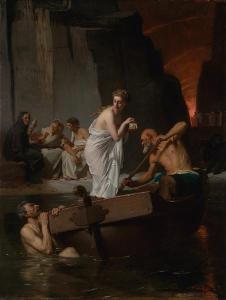
She is now in exalted company indeed. Hercules, Theseus, Odysseus, Aeneas, Orpheus — only the greatest heroes get to go to Hades and back, to die and be reborn in a more aware state, to cross the ultimate boundary in both directions.

She’s been warned not to open Persephone’s box. But (compare Orpheus) curiosity overcomes her, and she does open it. She falls into a deep coma and seems dead (≈Sleeping Beauty?).

Her lover and husband, Eros, finds her and pricks her with an arrow. This wakes Psyche. Eros now pleads with Zeus to let them be reunited.

Zeus sympathizes. He gives Psyche ambrosia, thus making her immortal (as he also made Hercules immortal).

The return and the boon

Psyche has now become one of the family, as it were. She has been accepted. Aphrodite, too, must embrace her as part of the family. And thus, there is finally the proper wedding and a feast.

Psyche soon gives birth. The baby is Voluptas, either joy or pleasure.

The harmony of the new, or newly reunited, family and the gift of joy and pleasure is Psyche’s boon, her gift to mankind. She has thus completed her heroic quest, quite as a male hero might have done.

The feminine twist

But we might observe two subtle differences between Psyche’s apotheosis and those of the male heroes we have been comparing her to:

1) Psyche has not killed anybody! It was not expected of her, not a prerequisite of her heroism.

The only two people in the story who die are her sisters (and they kill themselves, after coming to the mountain top again, greedy to revisit their sister’s palace, then plunging down, only to discover that this time no gentle wind wants to catch them).

2) The goal of Psyche’s quest was not individual triumph but family reunion and group harmony.

Postscript

A Freudian might see this entire tale as a “family romance”, as the story of a young woman coming of age and overcoming her repression about sex and intimacy until her mate is no longer bestial and loathsome but lovable and desirable.

But the monomyth theory, which dates back to Jung and regards archetypes as “collective dreams”, sees in Psyche’s story universals:

  • the human journey toward self-awareness,
  • our yearning to unify sex and love, body and soul, individual and family,
  • our striving for harmony.

Viewed this way, Psyche plays the same heroic role that Arjuna plays in the Bhagavad Gita (recall that Arjuna really stands for the noble part of our own soul, in battle with our sordid instincts).

Finally, Psyche is clearly a very powerful archetype. Variants of her seem to appear in countless stories through the ages. I leave you with the familiar image of just one: Beauty and the Beast.

Searching for heroines (I): Hester Prynne

What exactly is a female hero — ie, a heroine? In this post and the next, I’ll put forward two possible models.

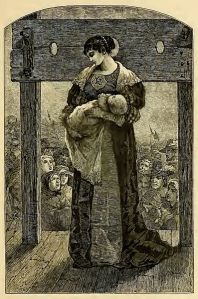
Today: The model of Hester Prynne (above, with her baby Pearl) and Demeter (below).

Even though one is a character in 19th-century American fiction and the other a Greek goddess, you may, by the end of this post, agree that they tap into the same archetype of female heroism.

Recap

So far in this series exploring heroism, we breezed through all sorts of mythical and timeless heroes, both Western (Greek) and Eastern (Indian). The presumption has been that they are all different and yet all the same, because they tap into archetypes of human storytelling (this is called the Monomyth theory).

But along the way we repeatedly slammed into the “problem” of women. Is there a female version of heroism?

(We’re not, by the way, just talking about an individual being brave, or admirable, or good. You can be all of those things and yet not be a hero.)

I engaged the topic with an opening salvo on Joan of Arc, but the prodigious debate that ensued in the comments taught me, and I think all of us, that we were in an intellectual cul-de-sac. We need an entirely different way of approaching the topic of feminine heroism. We cannot just graft male archetypes onto female protagonists to declare them heroines.

Female as opposed to male heroism

Implicitly, the monomyth relies on male archetypes of heroism:

  1. A young man proves himself to be unusual in some way, usually by passing a test by, or for, or against, his father. (For example, Theseus moves the boulder to find the sword left there by his father, King Aegeus.)
  2. The lad then receives a call to adventure, and follows it.
  3. He leaves society in an act of autonomy and individualism, crossing thresholds (for Theseus, the dangers along the road to Athens) to emphasize this separation.
  4. He meets women along the way, but they are probably temptresses, femme fatales or helpmates (Ariadne, for Theseus).
  5. He finally succeeds in his quest (in Theseus’ case, killing the Minotaur, liberating Athens), and
  6. returns to society, bringing it a boon (Athenian democracy).

(Now you might be able to see why I looked into the story of Joan of Arc, even though she was a historical rather than mythical character: her journey hewed closely to these male archetypes.)

A female version would look quite different. Meredith Powers apparently explored this in her book, The Heroine in Western Literature. I haven’t read it, but I listened to some lectures on mythology by Grant Voth, which he bases on Powers’ book.

Here, according to Powers and Voth, are the differences:

  1. Instead of some tense situation between father and son which marks the son as hero, it is now the deep connection between mother and child, and probably mother and daughter, which marks the mother, not the daughter, as the heroine.
  2. The ‘call to adventure‘ takes a totally different form than for men. It is probably some oppressive inflexibility in patriarchal society that threatens the mother/daughter dyad.
  3. In answering the call, the heroine does not leave society in an act of (male) individualism, but stays within it. As Powers puts it: “alone, apart, she accepts herself as a living critic” of her society.
  4. The heroine then form new bonds of solidarity with other women and
  5. also gives a boon to society in the process, a civilizing gift of a communitarian nature that is good for the group.

Example 1: Demeter and Persephone

Demeter was not, of course, a heroine but a goddess, but for Powers she establishes the archetype. Demeter (the Romans called her Ceres, whence our word cereal), was the goddess of grain and agriculture. She was the sister of Zeus, Hades and Poseidon, and the mother of Persephone.

Demeter

The love between mother and daughter is our archetypal starting point. So what is the call to adventure?

It comes in the form of a deal between her brothers, Hades and Zeus, whereby Hades is allowed to abduct Persephone and take her as his wife in the underworld. This is classic patriarchy: Zeus is the mightiest of the gods as well as Persephone’s father; Hades is Persephone’s uncle.

Demeter is beside herself with maternal grief and for one year becomes barren — meaning that the crops fail. Her brother Zeus realizes that he has destabilized Olympian society and tries to placate her.

But Demeter does not accept the abduction. Nor, however, does she confront or attack Zeus or Hades in a test of power. Nor does she exile herself from the Olympian family. She stays within it.

As she does so, she wins the solidarity of other women, including her (and Zeus’ and Hades’) grandmother, Gaia, and mother, Rhea. Together they sway the men to soften their stance.

Finally, they reach a compromise. Persephone is to spend half of each year with her mother and half with her husband. The first half becomes spring and summer, the second becomes autumn and winter.

Thus Demeter gives her boon to the world: It is called agriculture, and introduces the rhythms of fertility, where every death (Persephone’s departure) leads to a rebirth. Everybody is better off.

Example 2: Hester Prynne

Those of you who are American and have read Nathaniel Hawthorne’s classic The Scarlet Letter, probably already see how its heroine (for that is what she is!), Hester Prynne, is really a Puritan Demeter.

Hester bears a child, named Pearl, out of wedlock in 17th-century Boston. This makes her an adulteress, so she must wear a prominent and scarlet letter A to bear the public shame.

Here, too, the archetypal love between mother and daughter is our starting point. And again, the call to adventure arrives from an inflexibility of patriarchal society: the community demands to know who Pearl’s father is. Hester goes to prison, then stands for hours on a scaffold in Boston. But she accepts the call to adventure: she does not divulge the father.

Again, Hester is, in Powers’s phrase, “alone, apart, a living critic of society.” She embroiders the Scarlet A as though to emphasize it. She does not leave Bostonian society (although she will later go to Europe before coming back). Nor does she attack it.

Instead, she reaffirms the act that created her daughter and the relationships around it.

And she changes society in the process. Years later, she returns to Boston with her boon. She does charitable work. Society now respects and admires her. Everybody is better off.

More British humor from The Economist

From time to time, I try to give you glimpses into the most distinctive aspect of our corporate culture at The Economist, which is, of course, humor.

So yesterday I received an email. A colleague had sent it to “All Editorial”, requesting some help with what appears to be a story idea he or she is developing. Here it is:

Dear all,

I’ve noticed a tendency for companies to expect/demand that their employees enjoy their jobs, and give visible signs of so doing–being happy, wacky, fun and funny…

Has anybody else come across examples of this depressing and obnoxious trend? I’d love to hear from you if you have….

Steinbeck, grapes, wrath, success, writing

I) Grapes

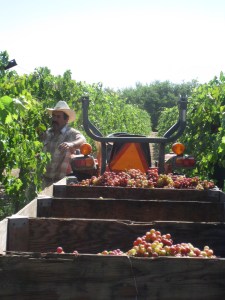
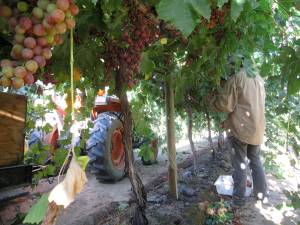
Here I was the other day in California’s San Joaquin Valley, with a crop buddy, after a day of picking grapes. It was 105 Fahrenheit (40 Celsius). I was drenched in toxic pesticides, which I was unable to avoid while picking.

What on earth was I doing there?

Well, it’s part of a little literary project, something longer-term. Can’t say much more yet.

We happened to be standing a few hundred yards away from the location of a Depression-era government camp for migrant farm workers which became the basis of John Steinbeck’s fictional Weedpatch Camp in his unforgettable novel The Grapes of Wrath. This was the camp that took in the Joad family and gave them brief respite from their harsh existence.

Was my location a coincidence? Not entirely. Nor was it entirely planned. (Sometimes, “accidents” help in the creative process.)

In any event, I took the occasion to re-read The Grapes of Wrath and also to read a bit about Steinbeck’s writing of it.

II) Writing

In 1963 Steinbeck said:

I wrote The Grapes of Wrath in one hundred days, but many years of preparation preceded it. I take a hell of a long time to get started. The actual writing is the last process.

This fits my own experience: The actual writing (sadly) is almost an afterthought, the easiest and most pleasant and shortest part of conception.

(But Steinbeck wrote longhand, of course. His 200,000-word manuscript took up 165 handwritten pages of a lined ledger book.)

Steinbeck apparently wrote fast, paying little or no attention to spelling, punctuation, or paragraphing. All that was cleaned up later. That, too, fits my experience.

III) Anger

In a 1952 radio interview, Steinbeck also said something else:

When I wrote The Grapes of Wrath, I was filled . . . with certain angers . . . at people who were doing injustices to other people.

And six years later, he told a British interviewer:

Anger is a symbol of thought and evaluation and reaction: without it what have we got? . . . I think anger is the healthiest thing in the world.

I had to think about that for a minute. But then this also fit my experience as a writer. Anger is a great motivational spur. It focuses the mind and leads to energetic storytelling. And isn’t writing a wonderful channel for anger to be released? Way better than any alternative, methinks.

IV) Success

Also of obvious interest to me (given that I’m writing a book about success and failure being impostors) was what the mind-boggling success of The Grapes of Wrath did to Steinbeck.

Critics, agents, publishers — the whole world naturally wanted him, as one said,

to write The Grapes of Wrath over and over again.

(That reactive and retroactive instinct in publishing also strikes me as familiar.)

But Steinbeck refused, saying that

The process of writing a book is the process of outgrowing it… Disciplinary criticism comes too late. You aren’t going to write that one again anyway. When you start another—the horizons have receded and you are just as cold and frightened as you were with the first one.

In another interview, he said that

I have always wondered why no author has survived a best-seller. Now I know. The publicity and fan-fare are just as bad as they would be for a boxer. One gets self-conscious and that’s the end of one’s writing.

Here, of course, I have nothing to add (not having scored a best-selling success yet). But it does rhyme beautifully with what Amy Tan said on the same subject.

Below, by the way, you see my perspective as I was picking grapes: I was crouching below the vines, because the best bunches grow in the middle and underneath. (“Low-hanging” fruit are not necessarily “easily picked’ fruit, I discovered.) And that tractor constantly moves alongside you. Several times I almost had my feet run over, and it banged into my shins so often that I could barely walk at night.