About the book


Bookmark and Share

Hannibal and me*

Timeless lessons about life, success and failure

Meet with triumph and disaster and treat those two impostors just the same. So a father tells his son in If, a beautiful poem by Rudyard Kipling. The line shot into my head one day as I was jogging in a park near my home, and it stayed there. Even though I had read the poem decades ago in school and promptly forgotten it, this one phrase suddenly resurfaced and offered to explain my life. Then I thought about the lives of other people. People I knew, people I read about, people famous and people obscure, people alive and people long dead. With his two impostors, Kipling had clearly put his finger on a (or the) classic storyline: 1) Life is about reversal. 2) How somebody responds to triumph and disaster, success and failure, ups and downs, is that person’s most important trait.

I’ll get to the life of Hannibal in a moment (obviously), but first just think of some other people that you may be more familiar with. Lance Armstrong discovered in his twenties that he had testicular cancer, lost one testicle, fought through chemotherapy, faced death, and then came back to win the Tour de France seven times. Steve Jobs got fired from his own company, Apple, at the age of thirty, then spent a lonely decade in quasi-exile before coming back to Apple and leading it to its (and his) greatest successes yet, because of what had happened to him during that decade in the wilderness. Eleanor Roosevelt was cleaning up her husband’s stuff one day when she found bundles of love letters between him, Franklin Delano Roosevelt, and her own social secretary, Lucy Mercer. Her “bottom dropped out” of her life, as she would recall, but the very same disaster also forced her to “face the world honestly for the first time” and made her arguably the most successful woman of the twentieth century.

Then there are people like Albert Einstein, who broke through intellectual barriers at the age of twenty-six, and again at thirty-seven, but then entered a strange conceptual prison for the rest of his life, as if his success had killed off the same powers of imagination that had produced it. Tennessee Williams finally scored a smash hit with his play The Glass Menagerie and found himself living in a luxury suite of a hotel, not thrilled but panicking at what he called this “catastrophe of success”. Meriwether Lewis became an American hero with his partner William Clark for exploring the wilderness of the Louisiana Purchase, received a huge reward from President Jefferson and became governor of the new territory, but soon drank himself into oblivion, failed in his new office and committed suicide in a sordid Tennessee tavern.

In short, impostors everywhere. Triumphs that become, indeed cause, disasters. Failures that turn into, and enable, successes. What to make of such stories? What do they mean for our own lives?

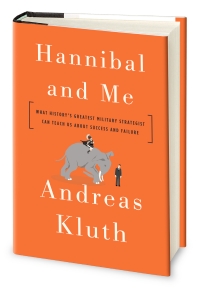
My book explores the two impostors through a sort of composite biography in which the main story is the astounding tale of Hannibal, the Carthaginian general who, twenty-two centuries ago, led an army of elephants and African and Spanish warriors over the Alps to invade the land of his enemies, the Romans. He beat the Alps, and then the Romans, again and again, in three of the greatest battle victories in human history. He personified success in every way, and for fifteen years roamed around Italy undefeated, and indeed seemingly invincible.

Yet this same Hannibal ended up losing the war and his country, and spent his final decades in foreign courts of exile before committing suicide by drinking poison. A generation later, the Romans sailed over to his city, Carthage, and razed it to the ground so thoroughly that modern archeologists had quite a time just locating the site. What had happened to him along the way? Was it inevitable? Was there a mistake that we can learn from?

Hannibal’s story is also the story of his enemies. One was Fabius, an old Roman senator nicknamed Warty for the big wart on his lip, who was in every way the opposite of the dashing Hannibal. Fabius was the first– indeed for a time the only–Roman who understood that Hannibal’s triumphs–Rome’s disasters–might be impostors, provided that the Romans did the right thing. The Romans did not do the right thing and ignored Fabius. And more disaster followed. Eventually, they listened to Fabius, and their fate changed. What did Fabius know that we too ought to know?

The other was Scipio, a handsome and sophisticated Roman aristocrat who was in many ways a younger version of Hannibal. Scipio began his adult life witnessing one disaster after another. He fought on the losing side of Hannibal’s battles. His father and uncle, both Roman generals, were killed fighting against Hannibal’s brothers.

But just when it seemed that he had lost everything, Scipio felt an invigorating and paradoxical sense of freedom. He picked up from where Fabius had left off. He did not hate Hannibal but studied him. Then he changed the game, by turning old situations upside down. He would become Rome’s greatest hero, and ironically a deep but ambiguous friend of Hannibal. But his success too would be an impostor, and he would die in the same year as Hannibal, also in internal exile. What would Scipio tell us about the impostors in our lives? What do all these people want us to know?

Publisher: Riverhead

Publication date: sometime next year.

7 Comments

  • [...] 18, 2008 *Alright, so I’ve given you this teaser about the book, and I had to give the page a provisional title. But Hannibal and me is not actually the title of [...]

  • Since we’re in the age of self-help mania, I suggest: “How to learn from Hannibal’s mistakes”.
    Nick Hornby succumbed to this temptation with “How to be Good”, and sold a great many more books that way, he said, in an interview.
    Since it’s non-fiction, though, you probably need something grandiose and eye-catching in front of the “how to” bit. Perhaps: “Digesting the elephant of success”.

  • I hear you, Helen. :)
    In fact, there was one publisher, especially known for self-help books, who had an interest in the book during the bidding, and I had to contemplate going in that direction. I just can’t do it! Option a): Go for the banal, vulgar and cliche, and (maybe) sell lots of books. Option b): Write a great book–subtle, sophisticated, witty–but (maybe) not sell a lot of books.
    I’m still hoping that this is a false dichotomy (there must be a way to write a non-corny book that sells well). But it scares me. I’ll be posting lots more about this in due course.
    For now, Helen, consider “Digesting the Elephant of Success” formally entered into the contest….

  • [...] 22, 2008 Back to the book: Remember, the whole book is a long story woven around Rudyard Kipling’s poetic insight that triumph and disaster are [...]

  • [...] 25, 2008 So, I had a witty comment from Helen under the elevator pitch for my book, where she humorously suggests some titles. Perhaps Digesting the Elephant of Success, followed by [...]

  • [...] July 27, 2008 I return to one of my threads, which is: What on earth were you smoking, Andreas, when you decided to write … a book?!? [...]

  • [...] About the book Shakespeare’s “Like You Like It” & my favorite grammar felony [...]

Leave a Reply