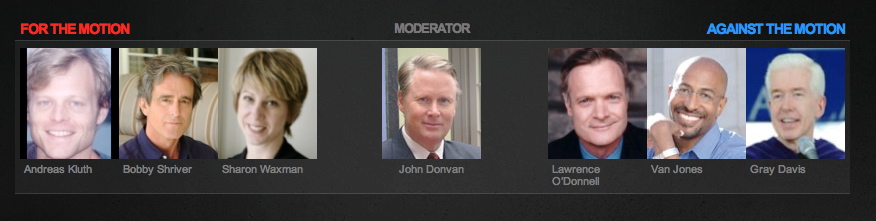
Here we are (I’m on the left, Bobby Shriver is in the middle, Sharon Waxman on the right), as the vote comes in, telling us that we “won” last night’s debate against Gray Davis, Lawrence O’Donnell and Van Jones.
The motion, as a reminder, was:
California is the first failed state
and we argued For.
We won because we moved more audience members in our favor.
Before the debate, 31% voted For the motion, 25% Against, and 44% were Undecided.
After the debate, 58% voted For, 37% Against, and only 5% were still Undecided.
I’ll be posting the full video here on Friday (Update: I have now posted the video), but just a few remarks.
First, it was great fun. As soon as the debate was over, we went to dinner together (“we’re living a Woody Allen movie,” somebody said as we descended into the quaint, subterranean New York restaurant) and had a great time. I talked for a long time to Gray Davis and his wife Sharon, and they were much more interested in discussing California (and that recall) than the debate proposition. I learned a lot.
Second, as you will have guessed already if you’re a regular reader of The Hannibal Blog, I was savoring the irony of the evening: I’ve been writing a lot about “good and bad conversations”, both here and in The Economist, and have argued that conversations in which one side tries to win are what Socrates considered “eristic” and thus “bad,” whereas conversations in which all participants are looking for the truth are “dialectic” and thus “good.”
Well, we were all trying to “win” last night, but now that it’s over it’s time to say that this was just a great, fun game. The real way to “win” was to edify and entertain the audience and ourselves, to spar and to learn, and we apparently did that. (If you were in the audience, feel free to agree or disagree below. ;))
So the goddess Eris was there, but she had her tongue in her cheek.
Second, and unrelated: What a difference a year makes! A bit over a year ago, I was telling you how I heroically resisted mile-high connectivity. Well, I’m posting this from the sky, in a Virgin America plane back home. And everybody around me is working on their laptops. We are all now Nomads, as I predicted. Don’t shrug because you’ve already done this, too. Don’t take it for granted yet. Join me, as Albert Einstein would, in wonderment.
I’ll have a thorough post-game analysis of the debate later this week.
Tiger, Tiger, Tiger. You’re making me … re-write my manuscript.
My book, as a reminder, is about success and failure and how the two can be, as Kipling put it so poetically, impostors. The main character is Hannibal, and his story introduces the various themes that come up in the course of a life, each of which is then illuminated with other lives, ancient or modern.
Here is how I went about it:
Mainly I chose relatively obscure people for my characters studies, which is to say people who are interesting or known for a good reason but not ‘famous’.
When I did include somebody conventionally famous (and there had to be a good reason!) I focused on an obscure or non-obvious aspect of that person’s life.
Well, Tiger falls into that latter category. I examined one aspect (I won’t say which) that he shared with Hannibal, and one that he didn’t, both of which made him unbelievably successful.
And now… the babes. So many of them. They’ve started keeping a cheat sheet to keep track of them. Plus: Wives swinging golf clubs after mid-night car crashes; cable-TV know-it-alls pontificating about morality; coy mea culpas and a career inter- and perhaps dis-rupted.
What can I say? I notice that everybody suddenly has a strong opinion about this young and immature genius. Tragic hero? Victim of hubris? Pervert?
Somebody from Pakistan informs us that it is entirely normal to have lots of women if you can. Somebody else explains why black women are not mad at Tiger. And so on.
My own default position in these matters is to be cavalier. But Tiger’s self-immolation now looks to be epic in scale. And tragic if the flames sear his children.
Among athletes, Diego Maradona comes to mind–the best in his sport, only to waste it all in decadence. Among politicians (well, where do you start?), perhaps Eliot Spitzer.
Yes, they were successful. Yes, their success was an impostor, by goading them, psychologically, into self-destruction. Is it simply the old Greek theme of hubris? Was it a character flaw? More subtle?
One thing is clear: I have to adjust my manuscript.
And one other thing should not be forgotten: Kipling said triumph and disaster are impostors. Tiger is young, as is his wife (not to mention their kids). As a great advertisement featuring Tiger (before his fall) once put it:
You can be too good at something, too successful, so that somebody else, an upstart, undercuts and topples you, turning your success into failure. That’s because of a fundamental asymmetry between your view of the world and your upstart’s. And it makes you vulnerable.
It should be immediately obvious how this notion relates to Kipling’s idea that triumph and disaster can be impostors, which is also the idea that my forthcoming book is based on.
But the idea comes not from the worlds of philosophy or psychology, but from the world of business, which I usually consider unbearably boring and banal. (If it surprises you that a correspondent for The Economist, who has written a lot about business, would say such a thing, well, there it is. I said it.)
The professor is Clay Christensen, and IMHO he is the only business writer who has ever written a book that is not painfully obvious and banal but simple and profound. He doesn’t quite make it into my pantheon of great thinkers, but almost.
What Christensen observed in one industry after another is, first, an incumbent. That is the most successful company in the industry, the leader. This company improves, year after year, by adding features to its products and listening to its best customers and meeting their demands. At some point, however, this company’s products get so good that they are more than good enough for most people, and too complex or expensive for the least demanding consumers, or people who don’t even use the product at all yet.
Eventually, Christensen observed, a disruptor comes along. This is a scrappy new company, not worth the attention of the incumbent. It makes products that are clearly “inferior” to the incumbent’s products. They are more basic, simpler, cheaper.
For precisely those reasons, the disruptor will have different customers than the incumbent. The demanding customers stay with the incumbent, whereas people who never used the product at all, or who used it very little, will try out the disruptor’s products.
The incumbent will thus not only shrug at the disruptor but enjoy his presence. That is because the incumbent can now shed the low-value customers and serve only the most demanding customers, charging them more and making more profits. Things seem to be going better than ever.
The disruptor is also enjoying himself. He is not, at first, competing with the incumbent at all, but aiming at people the incumbent never served. He sees the world in a different way. A small new market, with tiny revenues, looks fantastic to the disruptor, whereas it would make the incumbent yawn. This is the asymmetry in worldview.
But something else is going on, unnoticed: All the while, the disruptor, too, is making improvements. And at some point the products of the disrupter become good enough for everybody. This is when the impostor drops his guise.
The high-end customers suddenly start wondering why they have been paying for all those strange features they never use anyway. They defect. The incumbent is toppled and falls. The disruptor takes its place. It becomes a new incumbent, until it, too, is disrupted.
Incumbents: Microsoft (Windows + Word, Excel, Powerpoint); Apple (fancy, snazzy laptops and such)
Disruptor: Google and many smaller companies (WordPress included) that provide free or cheap services over the internet.
For years, Microsoft “improved” Word (to take just that example) by adding features, then made us pay more moolah to install a new version. Microsoft was listening to its most demanding customers–the ones who, say, pretended to need a multi-color, rotating, animated table in their letterhead.
The rest of us hated Word because we just wanted a clean white page that does not disappear every time a laptop breaks. Most of the rest of us (the young and indigent, the poor in Latin America, Asia and Africa) could not afford Word at all, and so we did not use it.
Along comes Cloud Computing. You can now type, save and share simple text documents on the internet, free. This has advantages: several of you, in different places, can work on the same document at the same time. You can access the document from any phone or computer. If your computer breaks, you no longer care.
It also has “disadvantages”: You cannot get that multi-color, rotating, animated table in your letterhead. (More seriously, I could not write my book on Google Docs because it does not support endnotes yet.)
But who cares? Almost nobody, it turns out. So, right now, the poor, the savvy, the un-demanding are the ones using Google Docs most. The suits are still using Word.
Wait a few more years (months?). Then Word as we know it will disappear.
Enough business, back to life!
That is the most I have ever talked about business in my private life, and I feel so yucky that I might have to take a shower. But I was just setting up a different point: Why should Christensen’s insight not apply to … art, science, sports, love and life?
As I write this, I am coming up with examples from all these spheres of life. In due course I will accost you with them. But in the mean time, please feel free to suggest your own in the comments.
Interesting two-punch quotes about success and failure, the topic of my forthcoming book, in today’s New York Times.
The “quotation of the week” is by Neil Simon, one of the most successful playwrights, whose play Brighton Beach Memoirs nonetheless turned out to be one of the biggest flops in Broadway history and closed after one week:
I’m dumbfounded. After all these years, I still don’t get how Broadway works, or what to make of our culture.
Jeffrey Katzenberg
Elsewhere in the paper, they interview Jeffrey Katzenberg, a very successful film producer, formerly at Walt Disney (Shrek, etc) and now at his own DreamWorks Animation:
In order to succeed at the high end of the movie business, you must be original and unique. Now if you were putting an equation up on the white board and you wrote “original + unique = what?” Then the answer would have to be “risky.” And if you said, “risky = what?” The answer would be “some failure.” It has to, by definition, just sort of in the most fundamental way.
Obviously, this applies not just to film-making or Broadway but also to (ahem) writing–a blog, an article in The Economist, a book. And to war (Hannibal and Scipio). And to love. And to science. And to …. life.
As you may have noticed, The Hannibal Blog has been unusually quiet for a couple of days. That’s because I had to move the family to a new city, as part of my new beat at The Economist. Well, I’ve moved a good dozen times in my life, as has my wife, so we have more than a score of moves between us. We’re pros. Except not.
This was our first move with children. (If you don’t have any, you don’t know why I would bother to point this out.)
Now, as regular readers know, The Hannibal Blog can be relied upon to put forth profound analysis of important things; or, depending on availability, profound analysis of things; or, barring that, analysis of things.
So let me put forth a tentative theory of failure:
The probability of failure increases with the number of permutations (see: complexity).
Once the number of permutations rises above eight or nine, failure is assured.
Thereafter, the devastation of the failure increases with the number of permutations.
Eventually (this is the only good news) it doesn’t matter anymore, or seems not to.
PS: You obviously got me on that kind of day. For a more illuminating theory of failure (and success), wait for the book. 😉
So-and-so “won the peace,” my wife says to me. We say that often to each other. It has become part of our private spousal language, a shortcut to an expansive world of meaning. The context? Life, and success of the genuine, authentic, meaningful sort.
Failure is often the result of succeeding at the wrong thing (eg, choosing the wrong “battles” and “wars” to win, as Pyrrhus did). Ironically, success is therefore often the result of failing at the wrong thing, and thus having an opportunity to “return” to the right things.
But Success, capitalized, tends to be about being clear about what matters, about the ends you are ultimately pursuing in life, and then using little successes only as means. Means and ends. In short, it is about strategy as taught by Clausewitz. Those who Succeed in Life “won the peace”.
What might Clausewitz say today about America’s double-war in the Middle East during this decade?
I was very tempted not to write a post on this. After all, in my forthcoming book I am ‘only’ using success and failure in war (ie, the one Hannibal and Scipio fought) as a primal metaphor for other contexts in life such as sports, love, business, relationships, exploration, reproduction, art and thought.
(Incidentally, I’m impressed by the feedback I’ve gotten from that little post. Clausewitz is very topical, it seems. For instance, Mike Lotus emailed me to point out his recent roundtable on Clausewitz, which will become a book this fall.)
I am also aware that there is little to be gained from yet another analysis of where we went wrong in responding to 9/11. Everything has been said. Worse: in contrast to, say, the Korean War or the Second Punic War, our current wars are still going on and our society is still split, so it is too early to talk dispassionately about them.
But I’ve decided that if I bring up Clausewitz and strategy, I would be chicken not to take a stab at Iraq and Afghanistan. So here goes.
The situation as it appeared on September 12, 2001
Al-Qaeda attacked us; 3,000 of us are dead; 300 million of us are shocked, angry and scared.
1) From Al-Qaeda’s point of view
Student of Clausewitz?
For Al-Qaeda, this was an ideal alignment of tactics and strategy: With little effort and cost, it caused disproportionate levels of terror (hence ‘terrorism’) in the Western world that appeared (politically and psychologically) certain to provoke us to go on an offensive. (Notice ‘an’, not ‘the’.)
Clausewitz believed that defense was much easier than offense, because whoever is attacking will eventually reach a ‘culminating point‘ point at which he is overextended and exhausted, and the defender can counterattack with devastating ease. So if we play offense and Al Qaeda plays defense, that helps them. (This is the opposite of what Cheney thinks.) Al-Qaeda was pleased.
Clausewitz also believed that, to win a war, you need to find your enemy’s center of gravity and defeat him there. Defeating him elsewhere is pointless or counterproductive. (For Clausewitz the obvious example was Napoleon‘s mistaking Moscow for Russia’s center of gravity, an error that was the beginning of his end.) Al Qaeda knew
that its center of gravity was not one that we were trained or able to identify militarily, because it had no capital and no army that we could bomb; and
that we were likely to miss its ultimate center of gravity, which is its support among Muslims at large.
Al-Qaeda might have believed (although we might be giving them too much credit) that our center of gravity was … us! If we could be terrorized into compromising our values then we might forfeit any appeal we might have for moderate Muslims around the world.
“War is nothing but the continuation of policy with other means,” Clausewitz said, and Al-Qaeda’s overarching policy was and is to defeat moderate or secular or Shia Muslims in Muslim countries. Any tactic (or means) that would weaken the moderates in those countries and strengthen the extremist Sunnis would therefore fit into its strategy (or end).
If we could be provoked into disarming (ie, no longer offering appealing values to moderate Muslims) and attacking the wrong center of gravity (=Napoleon to Moscow), then a Wahabi-Sunni caliphate, united against Shias and the West, would become more likely. Al-Qaeda would consider this victory.
2) From our point of view
Clause which?
For us, 9/11 was a wake-up call. There were people who were trying to kill us, and even though they had only box-cutters (and hence our planes) they might get nukes. We had to keep nukes and other WMDs out of their hands, and to keep our enemies out of our countries altogether. Strategically speaking, so far, so good.
Problem Nr 1: Offense or defense? Clausewitz said that defense was better. Even in this case, he might be right. After 9/11, there was a global outpouring of sympathy for America. In Europe, Asia, even in the Middle East, reasonable people were on our side. For Al-Qaeda, this might have been an early culminating point, an act of over-reaching that could have united us with our allies and even some enemies and estranged moderate Muslims from Al-Qaeda, thus leading to its defeat.
But defense was not an option, for reasons of domestic politics and psychology, and Al-Qaeda knew that. Hence…
Problem Nr 2: Since we were going on the offense, what was the enemy’s center of gravity?The difference between going on the offensive as opposed to an offensive is one of aim: if we hit, it’s the; if we miss, it’s an. So was the center of gravity
Osama?
Afghanistan?
Al-Qaeda everywhere and anywhere?
Its sympathizers anywhere?
Muslims?
The arms, ie the WMD, wherever they were, that might fall into Al-Qaeda’s hands?
You see the difficulty. As it turned out (but we could not have known that then), any item on the list above that seemed easy and straightforward subsequently turned out to be hard and elusive.
We thought we could get Osama quickly (but worried even then that he personally was not the center of gravity–correctly, I think). But here we are and he is, well, somewhere.
We thought we could do better than the Soviets, and as well as Alexander the Great, and just subdue Afghanistan. And we did. But then we didn’t. Or did we?
What we should have realized even then is that the center of gravity was the rest of that list.
“Al-Qaeda everywhere,”
“its sympathizers anywhere,” and
“Muslims”
were and are three disctinct but fluid and overlapping populations. If we were to “win over” Muslims, then there would be fewer sympathizers, and thus also fewer (new) members of Al-Qaeda.
What would that have entailed? Borrowing a bit from Lao Tzu, we might have done a lot less, because Al-Qaeda is so appalling to most Muslims. (Most of the people Al-Qaeda kills are Muslims.)
We might also have contemplated a full-fledged “Muslim Marshall Plan”, on the scale of the one that we brought to Germany and Western Europe after the war (against our then-new enemy, Communism). The earthquake in Pakistan and events like it were great opportunities, largely overlooked, to show them what we can be and what Al-Qaeda is not.
We did neither of those things. Instead, we got more active than Al-Qaeda, and blew up more than we built up. That was a strategic mistake, but not nearly as big as the following:
The arms (ie, the WMD)
No, I am not talking about merely getting our intelligence about Iraq wrong (as tragic as that was). At the time (defined as: after Colin Powell’s presentation to the UN) we all thought that Saddam was making WMD.
But so what? The strategist (Clausewitz) would step back and look at the overall situation:
a risk of loose nukes in the former USSR. Must secure as fast as possible!
Pakistan, which is Muslim and next to Afghanistan, having nukes. Must support and stablize country! Check back in often.
North Korea, which was on the verge of getting nukes, but still had our (IAEA) monitors inside the country. Must contain and engage! Otherwise consider pre-emptive strike!
Iran, which was far behind North Korea in progress toward nukes, domestically complex, our enemy but also Al-Qaeda’s enemy. Must attempt to turn into potential ally against Al-Qaeda!
Iraq, which was furthest behind, mostly dabbling in chemical and biological WMD (I’m still quoting what we thought then), which are infinitely less dangerous (harder to deliver, less lethal). Our enemy, but also Al-Qaeda’s natural enemy. Must attempt to turn into tool against Al-Qaeda!
I’m guessing that several of those points caused you whiplash (the bits in italics). But remember that the idea of Nixon going to China would have caused you whiplash too.
What we did not do, but should have done, is to think strategically about the world’s nukes. A clear hierarchy of danger existed, with North Korea at the top and Iraq not even on it.
What we also did not do, but should have done, is to think strategically about enemies and allies (as Nixon and Kissinger did). The biggest enemy was Al-Qaeda. Iraq and Iran were holding each other in check (thanks to Bush senior who, in a masterly and subtle gesture, pulled back in the first Gulf War just at the point that would allow Iraq to keep holding Iran in check.)
More importantly, Iran, being Persian and Shia, and Iraq, being secular and Baathist, were both natural enemies of Al-Qaeda. Duh!
I will never forget the day I came back from the slopes in Whistler on a ski holiday with my fiancee (now wife), turned on the TV and watched the news of North Korea kicking out our monitors. That was it. That was the moment I knew we had screwed up. (And we did not even know yet that Iraq had no WMD.)
Kim Jong-Il was watching what we were about to do to Saddam and decided to make a run for it–ie, for the nukes. Until we invaded Iraq, we had everyone in a tense stalemate: Saddam could not move and had monitors in every orifice, Kim Jong-Il had monitors, and Iran was worried about Iraq as much as us. After we invaded Iraq, North Korea and Iran called our bluff: We were not going to “pre-empt” anybody again.
The rest is history
We invaded Iraq and found no weapons, even as we watched North Korea get nukes and Iran follow close behind.
We weakened Muslim moderates in their own domestic debates against extremists by becoming what Al-Qaeda needed us to become: torturers, abusers of Muslims at Abu Ghraib, bombers of civilians. We gave them a Feindbild.
At home, once we realized we were not advancing our strategy–indeed, not even formulating it properly–we began confabulating other war aims. Suddenly, it was about “democracy”, and bringing it to a region at gun point. This was somehow going to solve everything. This is when I became disgusted.
Summary: We kept sympathy for Al-Qaeda alive longer than was necessary and allowed nukes to get into the hands of people who might yet trade them to Al-Qaeda. Strategically speaking, an utter disaster.
Fortunately, the story is not over yet and, with luck, we will look back at the Bush years as merely lost time, not an irreversible defeat.
Kenneth challenges my view that Truman and MacArthur can be seen as archetypes for strategy and tactics, and frames them instead in the perennial tension between civilian and military leadership. In the comments, he then refines that into the idea of operational versus non-operational war-making.
This immediately reminded me, obliquely, of a great (incisive and entertaining) TED talk by Thomas Barnett, a great strategist. His thesis is precisely about how strategy affects operations–ie, the ‘boring’ bits of the Pentagon and State Department.
In a nutshell: The strategic situation of the United States today is one of
In this context, Barnett means that our military is so strong that nobody is willing to fight us in the “ordinary” way anymore. So what do we do with all our power?
The pattern (Iraq, etc) is this: We kick ass in war, then fail in peace. Because we are bad at the transition. What we have, according to Barnett, is
A Leviathan force.
What we now need to add is a
sysadmin (system administration) force … or a “Department of Something Else” between war and peace
to manage the messes we create. Speaking like a true strategist–indeed, as I believe Clausewitz would have spoken–Barnett says:
Don’t plan for the war unless you plan to win the peace
So, to me, this is still all about ends and means, strategy and tactics. Here is the talk:







 Hannibal and Me: life lessons from history