One day almost twenty years ago, I bounded out of The Economist’s modernistic “Plaza” in London’s St. James’s, skipped past a few of the street’s posh gentlemen’s clubs and ran into Green Park, where I let out a primal scream. Aged 27, I had just got a job offer from The Economist. A dream was coming true.
Since then The Economist has sent me from London to Hong Kong, Silicon Valley, Los Angeles and Berlin. But wherever I was, I worked with more or less the same people. People who are quirky, humorous and unusually talented–in some cases genius. We have been a family of sorts, sometimes dysfunctional, usually functional, but always tight. It is no exaggeration to say that The Economist, where I spent half of the life I remember living, is part of my identity.
That’s why it was terrifying even to contemplate leaving The Economist when I was approached with an opportunity to do something risky, new and exciting. But it was also terrifying to say No and live with the regrets of “What if”. I’m exactly half-way between the start of my career and retirement. Lots to contemplate.
Helpfully, my wife and few other people reminded me that not too long ago I wrote a book about people who made just such life decisions (and who made them for the better as for the worse). In particular, they pointed me to chapter 8 (“The Prison of Success”) and chapter 10 (“The Threshold of Middle Age”) in Hannibal and Me.
And so, last week I returned to the Plaza in St. James’s–probably for the last time, because The Economist is moving out this summer after 52 years–to say goodbye. We rented a dungeon in a pub around the corner and got sentimental and boozy. The ale and humor flowed as it only does at The Economist. (At least the humor. By the way, I can now finally stop writing “humour”.)
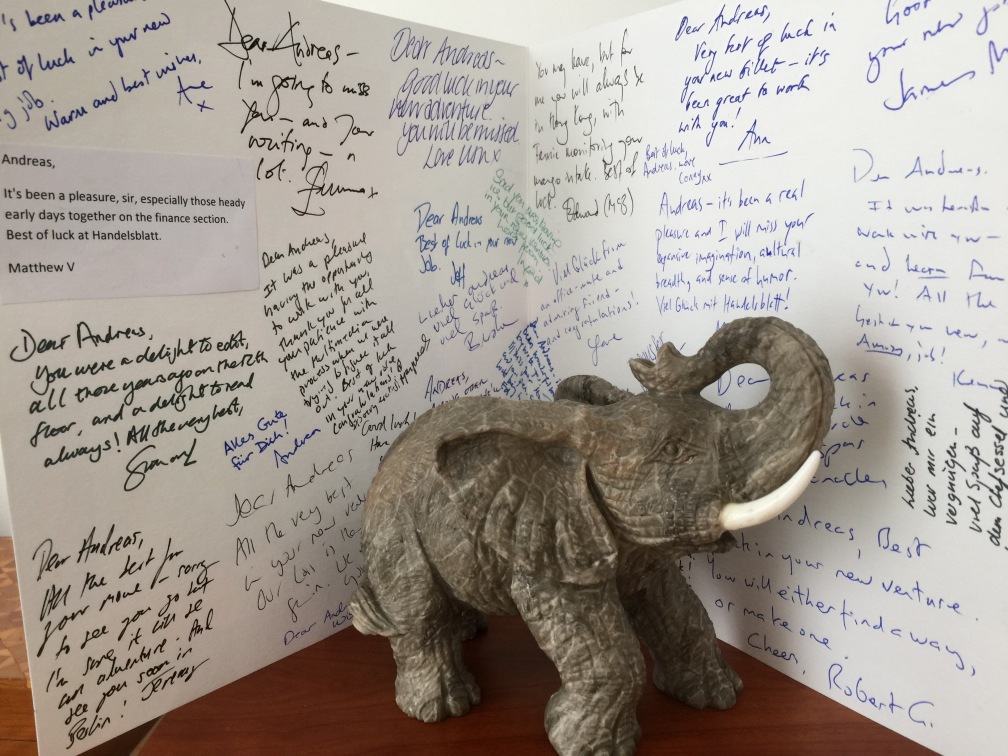
Here is the little gift they sent me off with. An elephant. Surus, presumably, the one Hannibal rode. They didn’t specify whether I’m mounting it on the way to Cannae or Zama.
So here I go. Within a few weeks, I will become, still based in Berlin, editor-in-chief of Handelsblatt Global. It is the young and insurgent English-language edition in a much older and larger group of German publications, including Handelsblatt (roughly the German equivalent of the Wall Street Journal) and Wirtschaftswoche (the analogue of Business Week). I’m not sure exactly what awaits me, and that’s somewhat terrifying–and hugely exciting.
I took the expiry of the copyright of Mein Kampf as my excuse to reflect on how the Germans have over the past 70 years dealt with the shadow and legacy of the Führer.
Recall that in 2012 I moved from California to Germany to cover the country for The Economist. In that time (through 2015) I must have written a couple of hundred articles of all lengths, in print and online. So I want to select just a few here on my blog, in a series of posts grouped by themes. And the first theme must be remembrance.
I’ve always been fascinated by German Vergangenheitsbewältigung. That one long word means coping-with-the-past, and it’s telling that only the Germans would need such a term. Germany is cursed with the worst past to cope with. But coped it has. In the process, Germany has transformed a curse into a sort of blessing. All other countries, and even individuals, can learn from it in this respect.
The question, for a country and a person, is: how does one confront the worst in one’s past to atone for it and eventually to transcend it by becoming good in the present?
The answer is: with relentless honesty and everlasting sensitivity so that the act of remembering always connects one with, rather than divides one from, those one has harmed and allows new connections in the present. (That aspect of re-connecting is salient in the Stolpersteine piece below.)
Articles I have written that touch in different ways on this theme of remembrance and Vergangenheitsbewältigung, in reverse chronological order:
This is a piece I wrote for The Atlantic on how Germany uses its public architecture “to blend the tragedy of the past with redemption in the present and renewal in the future.”
Wednesdays are our deadline days at The Economist. This means that correspondents have filed their copy to editors, who are subbing the pieces and going back and forth with correspondents and fact-checkers.
Every now and then it gets hairy, but most of the time it just means lots of overeducated people sitting around doing the same thing and needing relief.
And then these grown men and women–senior editors, book authors, award winners among them–will descend into activities such as the email trail below, which is unfolding right now, in real time, and which I reproduce here without further comment:
Email 1: … A quick request from the kitchen…if you have a fork from upstairs (the stainless steel ones with beading) please could you return it….
Reply 1: Forking hell.
Reply 2: As Yogi Berra once said: when you come to a fork in the road, take it.
Reply 3: It’s a tiney problem in the big scheme of things.
Reply 4: May the forks be with you, always.
Reply 5: Just a reminder: Guy Forks night tomorrow.
Reply 6: Well, the fork is strong with this one.
Reply 7: Saw one of these acting suspiciously outside the building [attaches picture of fork lift]
Reply 8: There both is and is not a fork in my office, depending on which path we are on in the garden of forking paths
Reply 9: Oh, fork crying out loud, everyone…
Reply 10: No more! You’re driving me forking crazy!
My employer, The Economist, is 170 years old. Another British publication, the Financial Times, turned 125 today.
It turns out that we are
loosely affiliated in some complicated corporate way and
very dearly affiliated in a personal way, because I, for instance, share an office space with them in Berlin.
By pure coincidence, their Berlin Bureau Chief, Quentin Peel, has exactly the same deep, sophisticated British voice and accent that one of our editors in London (Xan Smiley, if you must know) has, so I keep doing double takes whenever Quentin is on the phone, expecting Xan to come waltzing in. I digress.
The first of my points, if this post has any, is that the FT is a spring chicken by our standards. I mean, we were friggin’ middle-aged when they were born. But what’s a half-century or so among friends?
The second point is that it can be strangely revealing to go back in time to what journalism back then was like. And so I indulged myself during my coffee break today by reading their first front page, the one from February 13, 1888.
As was the custom at the time, the articles were listed (no pictures, it goes without saying) in unadorned columns. And so my eyes alit, after the headline on “Russia and Finance” and before the one on “Speculation in Copper,” on an article that began as follows:
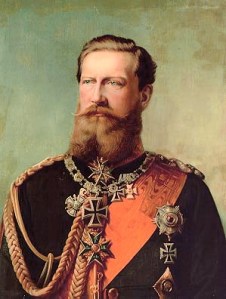
The Crown Prince
What is to be the result of the very serious operation which has been performed on the throat of the Crown Prince of Prussia? This is not a mere question of ordinary politics, but one which vitally affects the peace and prosperity of Europe. It is not merely that the Crown Prince is the son of our ally, the Emperor of Germany, and the husband of England’s eldest daughter, but he is a Prince of pacific tendencies, though not less a soldier than the rest of the Brandenburgers. The operation only took ten minutes to perform…..
For those among you who are, or are related to, hacks, let’s just savor such themes as:
The World Universities Debating Championship (WUDC) is going on right now in Berlin, with more than a thousand very talented students from all over the world testing their arguments and wit — and having a rather good time after hours as well. (You can watch the live stream of their debates here.)
They asked me to give the opening speech on Friday, with some thoughts on debating. Nothing too heavy.
A grainy video is attached below. (I start after the, yes, Alpine horns, at about minute 9.) But here is a shortened and approximate transcript of what I said:
___
Patrick just told me that The Economist is considered “the debater’s bible”. Wow. I had no idea. When you catch me in the halls later, maybe you can explain to me why that is.
Right now, I want to make only 4 simple points:
Debating is fun
It helps to be British
Thou shalt remember Athens
Debating is not enough, and does not automatically lead to truth
1) Debating is great fun.
I spend my whole life debating. At The Economist, every conversation we have is really a debate. In my family every conversation I have is really a debate. Especially with my children.
Let me tell you about a particular kind of debate we have at The Economist that you can’t know about because it’s not public:
The Monday morning meeting.
This takes place every Monday morning, when the various section editors read out the list of planned stories. We sit very casually, often on the floor, around the desk of our editor in chief. After the lists are read, we discuss what the Leaders should be. “Leaders” is our name for opinion editorials. So we talk about what they should say. Basically, we debate.
When I joined The Economist in 1997, this was the event of the week, the institution, that most inspired me. Because it was such a joy to listen, and to participate:
The humor,
the reductio ad absurdum,
the overstatement
the understatement.
I’ve learned so much just from sitting in those Monday morning meetings. And I hope that you guys here also get to sit in rooms like that, perhaps even here in Berlin in the coming days.
And that leads me to my second point:
2) It helps to be British.
I mean that a bit tongue in cheek. But in my experience, it’s sort of true. The level of debate in those Monday morning meetings is probably the highest anywhere, and part of the reason must be that most of the people in the room are British.
Several politicians here in Germany have told me that they like to watch House of Commons debates on YouTube, because the debating there is at a much higher level than the debates in the Bundestag. And I’ve heard similar statements in Washington DC and Sacramento CA and other places.
Part of it is, I think, that the Brits have that tradition more than any other culture in world history.
For the British upper classes, part of growing up has always been to speak in front of people, and to use humor and charm, so that when those people later grew up they seemed to do public speaking naturally.
In other modern countries, I think you’d have to go back to the debates between Alexander Hamilton and James Madison to get anything of that quality. Then again, those two Americans were really ALSO Brits. 😉
Now, I’m NOT British. And most of you are NOT British. But that’s OK. Because we can learn from them. Fortunately, their language is now our common world language.
3) Athens
Before Britain, there was of course ancient Athens. And I think a quick look back at Athens is a great way to make my other two points about debating.
First, the Athenians demonstrated the inherent link between debating and democracy, or debating and freedom.
What is a democracy?
It is basically a society that makes its decisions after lots and lots of debate, one in which power and influence therefore come mostly from skill at debating. As opposed to brute force, for example.
In Athens during the time of Pericles they applied that idea very literally: the free men of the city met physically on one large rock to debate every topic.
They had no “government” and no “opposition” (as you do in your debate format here) because they had a pure democracy, ie a rule of the people. The people WERE the government. And they had no parties either. So leadership came down purely to skill at public speaking. Whatever was decided on that rock after all the speakers had spoken was the law.
The greatest example of a leader was Pericles. And I strongly, strongly urge all of you to read his Funeral Oration, which is one of the greatest speeches ever written.
Athens during the following century, the fourth century, when Phillip and his son Alexander rose to power and threatened Athens, was another great example.
At that time, some of the most consequential decisions in world history were taken as a direct result of the outcome of debates between, basically, two men:
Those debates culminated in the so called Philippics by Demosthenes against Philip. That was the same Demosthenes, and the same Philippics, that later inspired Cicero in Rome, and really every great speaker and debater since.
So that’s another suggestion I have for you here: read the short biography of Demosthenes by the Greek writer Plutarch. it’s fascinating, because the man had a speech flaw, so he made himself a great debater by overcoming his greatest weakness. He:
built himself a cave underground where he hid for months at a time, just practicing his speech.
He shaved one half of his head, then the other, so that he would be too ashamed to come out.
He recited speeches while running up hills.
went to the shore and orated against and over the breaking waves.
put pebbles under his tongue and then enunciated over the roaring surf.
But Demosthenes more cautionary lessons for you debaters as well:
he was a coward in battle and fled the field
he basically led the Athenians into a wrong course against Philipp and Alexander, and
he ended by committing suicide after his life work had failed.
And that leads to my fourth and last point today:
4) Debating is not enough, and does not automatically lead to truth.
The best argument doesn’t always win. Sometimes, the best delivery wins.
By the way, it was Demosthenes who, when asked what the three main element of rhetoric were, answered: “delivery, delivery, delivery.”
We call that demagoguery instead of democracy.
That was the problem that inspired maybe the greatest works of literature ever, namely Plato’s dialogues. In those, Socrates argues against the Sophists.
The sophists were people whom rich Athenian fathers hired to teach their sons debating.
You guys here would LOVE to have a sophists working with you.
Because the sophists could teach you to take
one side of an argument and win,
and then to take the other side of the argument and win.
And that’s what bothered Socrates. Because he believed, or hoped, that there really was some objectively better or more reasonable position. And to Socrates, THAT was supposed to be the purpose of debating. To find the best answer.
So Socrates hated the Sophists, and ridiculed them with his style of questioning. He thought the Sophists interfered with truth finding because they were only interested in delivery, delivery, delivery.
the bad way was a debate where the debaters want to win. He called that eristic argument, after the Greek goddess of Strife, Eris, who started the Trojan War by leaving that Golden Apple for the goddesses to fight over.
The good way was what he called dialectic: a debate where the debaters all want to learn, rather than win. So in theory, all debaters end up with a position that none of them took at the outset. Someone starts with a thesis, the others bring up antitheses and so on and so on, until they arrive at a synthesis.
Well, Socrates was condemned to death by an Athenian Jury of about 500 men after a truly terrible, but famous, … debate.
So there you are. Let’s recap: Debating is…
above all, fun.
And it is useful.
And it will help you in your career and your life.
But keep in mind that little voice from Socrates and Demosthenes: debating is not enough.
you still have to be brave,
you still have to love truth, and
you still need to know when to stop trying to win and starting trying to figure something out.
But not during this tournament. So now try to go and win.
In our double issue for the Christmas holidays, I’ve once again let my hair down and indulged myself with a cheeky but (hopefully) not silly historical comparison. This time:
those aforementioned cheeky historical comparisons: Socrates in America, now the Holy Roman Empire, .. (and of course Hannibal and Me!)
Anyway, study this beautiful map we made. As you know, I’m a map geek.
And then get a glass of some Malbec-Cabernet mixture and ponder whether you think I was right to draw some analogies to the Holy Roman Empire. Would love to know what you think.
—
PS: Sorry for having been a lazy blogger these past months. For those of you who want to follow my ongoing weekly story output, I’ve started tweeting my articles. The Twitter feed also appears here, in the right side bar.
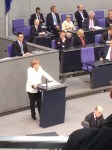
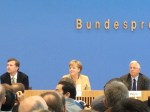
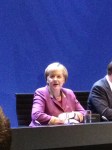
A good bit of my job these days (as Berlin Bureau Chief of The Economist) is to follow people like Angela Merkel around. Sometimes I find myself right behind her (1), other times looking down on her in the Bundestag (2), yet other times with the hack pack in a press conference (3), or in a small circle (4), or just before or after some exhausting negotiation (5), or plugging some old buddy’s new book (6).
As you can see, she always wears the same uniform, which comes in beige, white, tan, pink, grey, beige again….
What is she like? More fascinating than you would think. Publicly, she has become a rhetorical robot, reusing the same over-rehearsed phrases (platitudes?) on any given topic, saying exactly the same thing whether she is “on” or “off” the record, staying relentlessly “on message”.
But when the group gets smaller, she shows tiny hints of her old witty side, which I’m told she has in spades. From what I hear, in private she can be hilarious. But politics and the euro crisis have beaten that spontaneity out of her.
Anyway, I’m just observing. Every gesture, every phrase, every involuntary smirk. Even if the only difference is that there is a “the” where last time there was an “a”. If Machiavelli were alive today, he would be sitting right next to me, doing the same thing, doing his homework.
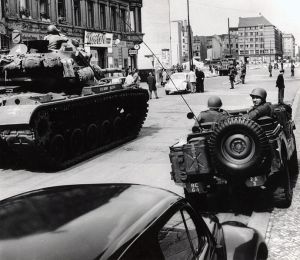
In the late 80s, when we still thought the Iron Curtain and the Berlin Wall were as good as eternal, my friend Matt Lieber and I, fairly fresh out of high school, traveled around Germany and got a visa for a few unforgettable hours in Communist East Berlin. We entered through Checkpoint Charlie (pictured above in 1961, during one of the many standoffs). Then we walked up the famous Friedrichstrasse toward the equally famous Unter den Linden.
I’ll never forget those first few blocks behind the Iron Curtain.
Crosstreets:
Krausenstrasse
Leipzigerstrasse
Kronenstrasse
Mohrenstrasse
Taubenstrasse
II)
Just a few years later, in 1993, I was back on that same stretch of that same street: Friedrichstrasse, between Taubenstrasse and Mohrenstrasse.
Except this time I was an unpaid intern for CNN, that (then-) unbeatable American, Western, Capitalist media success story. By sheer luck, n-tv, a German start-up that wanted to be, and indeed became, the German CNN, had just opened in the same building and CNN owned a part of it. In the utter chaos of n-tv‘s first weeks, I did all sorts of jobs for both companies that I was entirely unqualified for and benefitted hugely from.
III)
Now, many years later again, I will be back once more at that same stretch of that same street. This time (as of mid-June, 2012) I am Berlin Bureau Chief of The Economist. Our office is right at a corner that Matt and I walked past all those years ago.
When I visited the office the other day, before the actual move from Los Angeles, I loitered a bit on those blocks, looking for something familiar from the past.
Wasn’t this where that East German cop stopped Matt and me for jaywalking?
And wasn’t that where, in 1993, that god-awful East-Germanesque sausage snack bar was?
I simply couldn’t tell. Yoga, Starbucks, Gucci, banks, BMWs. Physically, the street had become aggressively 2012, and nothing else.
I remembered how somebody once told me about visiting, in 1978, a tiny fishing village north of Hong Kong. It was called Shenzhen. Three decades later he went back to try to find the spot where he stood. Well, you know.
But even that did not capture the feelings I had while standing again at that particular corner of the world. In my imagination, I rewound and fast-forwarded through life on that spot. From its Slavic time through its Prussian time, to its Wilhelmine and Twenties time, its Nazi time, its Cold-War time, its Wende time. Then I opened my eyes again.
V)
Why do people become journalists? For different reasons. But many, I am guessing, want to feel that they lived history.
This year and in the coming years, Europe seems likely to be making history again, and Berlin seems likely to play a big role in that history. If I do my job right, and even if I just do it mediocrely, I’ll see a good bit of it up close.
My piece in The Economist this week is about Native Americans, and in particular about the puzzling concept of their national “sovereignty” as individual tribes.
I had a great time researching this one, mainly because I ended up visiting the White Mountain Apache tribe in remote Arizona.
But why did I go to the Apache? I could have chosen from 334 reservations and 565 tribes.
Well, there were a couple of reasons, some journalistic, others logistical. Also, just getting an interview with any tribal leader can be difficult — the tribes have been burnt so often by us whites, including by white hacks, that they don’t trust any of us. As Ronnie Lupe, the chairman (≈ chieftain) said to me:
“We see a white man snooping around, we all have the same thought: is he good or bad?”
I was the one snooping around.
But this post is really about the other reason why I chose the Apache, which is meant to be a bit frivolous and yet sentimental.
You see, it’s because I, a dual citizen, was once a … German boy!
All about Winnetou
Being a German boy means, statistically, being very likely to be obsessed with American Indians in general and the Apache in particular. Let’s just take my case.
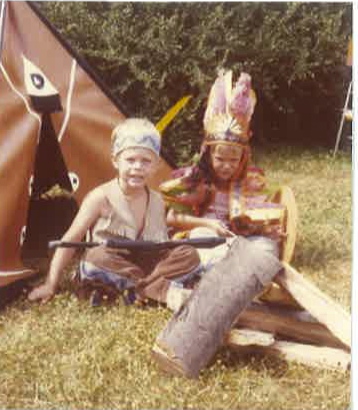
In this grainy shot above from the mid 1970s, my friend Patrick and I (left) happened to be Sioux, Cheyenne or Arapaho. This is obvious from the:
teepee (not wigwam or wikiup), and
feathers
You see, we German boys took take these details quite seriously. When playing, one just does not mix genres between, say, the Iroquois/Mohawk and the Great Plains or southwestern tribes. God forbid.
But most of the time we did not wear feathers. Instead, Patrick and I looked more like this:
Here Patrick is dressed as Old Shatterhand and I (left again, with wig and paint) am the Apache chief Winnetou. (Our moms made the outfits, since you ask.)
Who are Winnetou and Old Shatterhand? I will tell you. But first, here is how we imagined them:
Click for credits
This is a poster for one of the Winnetou films that we were watching in the 70s. Here you see them, the two enemies-turned-blood-brothers and best friends, Old Shatterhand and Winnetou. To us, they were the noblest heroes.
See if you can spot how Patrick and I tried to approximate the look of the characters (played by Lex Barker and Pierre Brice).
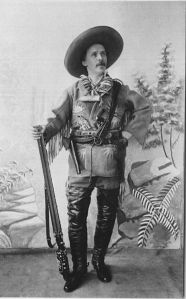
But long before those films, German boys had been reading the novels. They were written by Karl May, perhaps the best-selling German author of all time. (Take that, Luther, Mann, Nietzsche, …) May died 100 years ago this year.
In his imagination May dreamed up exotic worlds and heroes that have enthralled millions since. The best comparison I can think of for you Anglo-Saxons is this: Karl May was really Germany’s J.K. Rowling.
Here May is dressed as he imagined his hero, Old Shatterhand:
In any case, what does any of this have to do with my research for this week’s article?
Well, boys become men, and then sometimes foreign correspondents, based in the southwest. But they’re still boys.
I knew my story was fundamentally about a tragedy: the context and background is always the poverty, unemployment, alcoholism, diabetes and crime that is the fate of so many Native Americans on reservations. I was determined to see that reality, and yet to see, in my mind’s eye, another reality at the same time.
As I drove through the Salt River Canyon (picture the Grand Canyon but without people) to enter the vast Apache reservation I was of course imagining Winnetou again. Perhaps I was Old Shatterhand this time, riding to meet my friend.
“I’m sorry I wrote you such a long letter. I didn’t have time to write a short one.” So Blaise Pascal, a French mathematician and philosopher, allegedly excused himself once. Or perhaps it was Mark Twain or George Bernard Shaw.
It’s witty, it’s ironic, it’s true: that’s why any of them might have said it.
Here is how I know that: I write for The Economist, and most of our articles are short. I’ve opined on the subject of optimal length in writing before, but in this context, let’s just say that it is the shortening that takes all of the time.
Because I have so little time, I got into the bad habit of not shortening, and not cleaning up, my emails. You see, there were too many emails, and I was too busy to take time for any one of them. (Bear with me. You’re supposed to find an irony building.)
But why were there so many emails in the first place? Oh yes, because all sorts of people (mainly PR people, but also others) are writing me emails. And those are all busy, busy, busy people, with very little time. So their emails are long and sloppy. They refer to an attachment that is missing. They invite me to an event on the wrong date, or omit the date, or the place, even as they somehow find paragraphs of other things to say.
So then, since we are all so very, very busy, we shoot the emails back and forth to clarify this and rectify that, and the threads grow and take more of our time, making us even busier and requiring us to write even faster, thus making our emails longer and sloppier….
So, for a few months, I’ve been trying an experiment. I respond less fast, and often not at all. When I do email, I take more time. I actually read through emails before I push Send. I check that phone numbers and dates are correct, and that all the information is there. I think about what is extraneous and what I can cut.
Lo, the threads are getting ever so slightly shorter, the iterations fewer, the decisions more decisive.
Fewer words → more meaning
Less activity → more action
To my surprise, I am finding that, by slowing down, I have more time. If, like Pascal, I need to write a letter, I might now be able to make it … shorter. I hope I can keep this up.








 Hannibal and Me: life lessons from history