More primatology

The folks at 850 KOA, a Colorado news-radio channel, called me up this morning to chat more about friendship and human group size in the age of Facebook. Here is our conversation.

(If you’re just arriving, this is about a piece I wrote in The Economist called Primates on Facebook. I blogged about the back story here.)

Update: Cameron Marlow, whom I described as Facebook’s “in-house sociologist”, has now posted his back story with lots, lots more data and detail and analysis.

Bookmark and Share

In praise of wonderment

Amazing, isn't it?

Amazing, isn't it?

Cheri’s comment about my use of the word wonderment made me … wonder. And so, a brief paean.

Einstein (on page 387 of this biography), once said:

The most beautiful emotion we can experience is the mysterious. He to whom this emotion is a stranger, who can no longer wonder and stand rapt in awe, is as good as dead, a snuffed-out candle.

I’ve talked before about Einstein’s love of simplicity and his non-conformity as keys to his astonishing creativity. But I should have started with his famously child-like ability to wonder.

Wonderment is the origin of every creative act. The natural flow of Hmms leads to questions and inquiries that are usually never quite answered but become signposts on a great journey, a great story.

People sometimes ask journalists how we get our ideas for stories and I’ve never had a good answer. There is no shortcut, no ten-steps process, no secret vault. Instead, it always starts with simple–and yes, child-like–curiosity and wonderment.

An ability to wonder is of course also what the reader/listener/viewer of a story needs. If you don’t find your own life and its ups and downs somewhat mysterious, you probably won’t enjoy my book when it comes out.

So here’s to wonderment, and its official inclusion in our thread on story-telling. Every good story begins and ends with it.

Bookmark and Share

Our Roman world, 2009

450px-mta_station_wall450px-us_treasury_07110005

What’s that peeking through the urban thicket of New York? Why, the New York Stock Exchange, where your savings are currently being lost. And what about that patriotic-looking edifice on the right? That’s the US Treasury, where your savings are also currently being lost. But I digress. What’s my point?

By now I shouldn’t even have to make it explicit. It is that those buildings, like thousands of libraries and state capitols and what not, are explicitly and intentionally built to look … Roman!

And what would America look like if Hannibal, ie Carthage, had won? Exactly. We have no idea. We don’t know what Carthaginian columns and buildings looked like because the Romans were too thorough in wiping it off the map.

And what do we speak? English, a Germanic tongue, admittedly, but one that got half its vocabulary from Norman French, an offshoot of Latin. To our north and south in this hemisphere, they speak French, Spanish and Portuguese, other offshoots of Latin.

And what would the Americas sound like if Hannibal had won? Exactly. We have no idea. Perhaps remotely like Hebrew or Arabic, since Punic was a Semitic language, but we can’t say because it’s been dead so long.

We could go on and on. We have Senators because our founding fathers wanted to model themselves after the Rome that Polybius described, the one that survived and overcame Hannibal. Toga parties, Caesar’s Palace, …. Please don’t expect me to go there.

The point of all this, of course, is to instill in you a retroactive sense of wonderment about the mysterious events between, roughly, the death of Alexander and the Roman double-sack of Carthage and Corinth. Recall that Alexander had never heard of Rome but had Carthage in his sights, because it was the superpower of its region. Recall that, 177 years later, those Romans of whom he had not heard razed Carthage and Corinth to the ground and began to turn the world into what we know today.

Those epic and mysterious events that explain the mystery are the backdrop–the context or scene–for the astonishing individual and human stories of the main characters in my book, who proved with their own lives that triumph and disaster are impostors.

Bookmark and Share

The nomadic reader

What a page turner

What a page turner

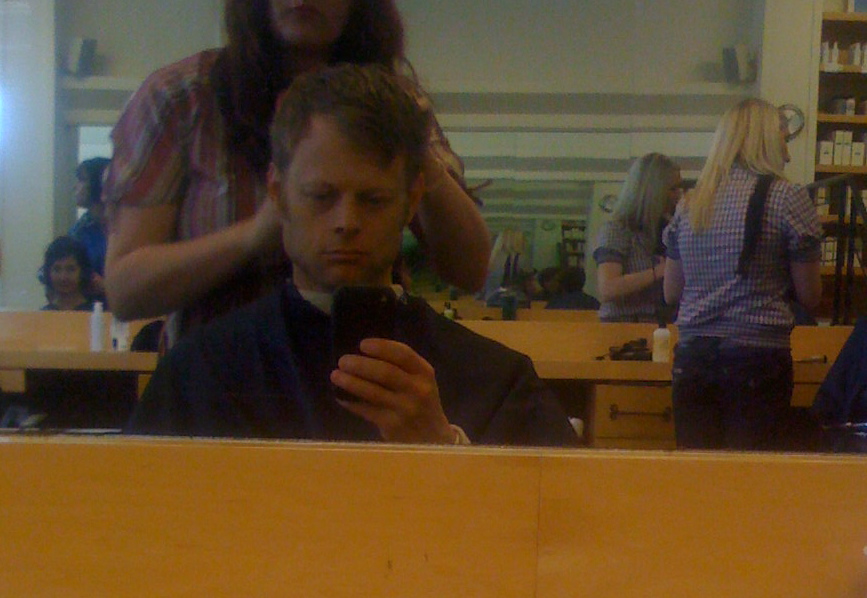
Here I am yesterday, reading a book on the new Kindle for iPhone app while, you know, being worked on. (My editor Tom and I must have been among the first to download the new app that day.) Later I got home, picked up my actual Kindle, the one I reviewed last month, and kept reading from the page I got to during the haircut (the two devices had automatically synced).

Now, this sort of think should make you think. It is the latest installment in what I called “the new nomadism” in The Economist last year. New behaviors and social contexts are arising out of, not so much new gadgets, but new expectations about connectivity. Big, very big, sociological change is afoot, I believe. And, of course, as an aspiring author I have much to contemplate on the topic of books in particular…

Bookmark and Share

A tale of two cities’ disappearing

What is the following description about?

… they threw timbers from one [house] to another over the narrow passageways, and crossed as on bridges. While war was raging in this way on the roofs, another fight was going on among those who met each other in the streets below. All places were filled with groans, shrieks, shouts, and every kind of agony. Some were stabbed, others were hurled alive from the roofs to the pavement … No one dared to set fire to the houses on account of those who were still on the roofs, until [the commander showed up]. Then he set fire to the three streets all together, and gave orders to keep the passageways clear of burning material so that the army might move back and forth freely.

Then came new scenes of horror. As the fire spread and carried everything down, the soldiers did not wait to destroy the buildings little by little, but all in a heap. So the crashing grew louder, and many corpses fell with the stones into the midst. Others were seen still living, especially old men, women, and young children who had hidden in the inmost nooks of the houses, some of them wounded, some more or less burned, and uttering piteous cries. Still others, thrust out and falling from such a height with the stones, timbers, and fire, were torn asunder in all shapes of horror, crushed and mangled.

Nor was this the end of their miseries, for the street cleaners, who were removing the rubbish with axes, mattocks, and forks, and making the roads passable, tossed with these instruments the dead and the living together into holes in the ground, dragging them along like sticks and stones and turning them over with their iron tools. Trenches were filled with men. Some who were thrown in head foremost, with their legs sticking out of the ground, writhed a long time. Others fell with their feet downward and their heads above ground. [Army transports] ran over them, crushing their faces and skulls, not purposely on the part of the riders, but in their headlong haste. …

The Americans taking Fallujah in 2003? Street fighting in World War II? Nope. It’s the Romans wiping Carthage off the map, as described by Appian here.

The year was 146 BCE, and in that same year the Romans also destroyed Corinth in Greece. One city gone in the west, one in the east. A very Roman gesture.

In the previous post in this thread, I talked about Alexander looking west from his deathbed in 323 BCE and seeing a mighty city, Carthage, but not seeing a city called Rome, because there was nothing much to see yet. In this scene, 177 years later, that nation of which Alexander had not heard, Rome, was laying waste and subjugating the two great Mediterranean civilizations that Alexander had known, the Carthaginian-Punic and his own, the Greek.

Clearly, a lot had happened in those intervening years. Events that we today see all around us–by what we see, speak and think, and by what we do not see, speak and think. I will explain that in the next post.

And just as a reminder: The story of what happened between those dates–Alexander’s death and Rome’s domination of west and east–has, of course, everything to do with the main characters in my book: Hannibal, Fabius and Scipio.

Bookmark and Share

Those who don’t get Twitter

I wrote about Evan Williams and his innovations, including the then-young Twitter, way back in 2007. And it’s my job to be up to date. But I must say that I just don’t … get it this time. Not the technology part, but the sociology. Why?

My editor feels the same way, and we feel guilty about it. So it came as a great relief to see that Jon Stewart is on our side.

Bookmark and Share

The view west from Alexander’s death bed

You're next, Carthage

You're next, Carthage

One month before his 33rd birthday, on June 11th, 323 BCE, Alexander died in a sumptuous palace in Babylon, in today’s Iraq. He had been drinking with his friends and might have been poisoned. Or he might have had malaria, or typhoid fever, or any number of other ailments.

In twelve short years–during his twenties (what were you doing in your twenties?)–this young man had completely changed the world. Indeed, you might say that he had unified the world for possibly the first and only time. (I’m talking about the world known to him). Recall that the Greeks had had, for at least a century and a half, a keen sense of East (alien, soft, depraved) and West (Greek, civilized), with assorted barbarians living on the periphery. Alexander brought East and West and its major civilizations together into one realm, with a remarkably cosmopolitan vision of governing by including rather than oppressing the non-Greeks.

But that is not the subject of today’s post. Instead, I want to choose June 11th, 323 BCE as the date with which to begin a new thread on The Hannibal Blog: In the next series of posts I want to “set the scene”, the historical context, for the main plot and main characters in my forthcoming book.

What did Alexander not see to his west when he died?

This is the question of today’s post. The answer should be surprising. If it is not, I will help you to be surprised in the coming posts.

First, a map of what we think he should have seen (click to enlarge):

800px-alexander-empire_323bc

What Alexander saw was Carthage. This man, who was said to have cried once when he thought he had run out of countries to conquer, was apparently planning to conquer the entire western Mediterranean when death intervened, and the western Mediterranean, as far as Alexander knew, was a pond with two main cultures: 1) His own (Hellenistic) and 2) the Carthaginian-Punic one. So he was planning to take on Carthage, that mighty and wealthy port on the tip of northern Africa, settled by Phoenicians whose mother country (in today’s Lebanon) already belonged to Alexander’s empire. Once he had Carthage, Alexander would truly be able to say that ruled the whole world.

And here is what he did not see: Rome! Alexander had apparently never even heard of the place. Rome may have been among a few Italian towns that sent representatives to his court, but he personally seems never to have taken note of the place. And why should he have? It was a sleepy town in the middle of Italy. Clearly not of any consequence. More in the next post.

Bookmark and Share

Meet The Eco Team

And here is my piece in this week’s issue, Primates on Facebook, translated into Chinese. Brought to you …. not by The Economist, but by a group of enterprising Chinese amateurs (in the literal sense of lovers) called The Eco Team.

I learned about this in the New York Times today and find it very funny. Basically, a 39-year-old Chinese insurance broker who wants to beef up his English got a group together that translates my magazine just for fun. Without asking us for permission, of course, although my boss has apparently met the guy and winked.

Ah, how that takes me back to my memories of trudging around China, dodging the waiban (Foreign Affairs Bureau), those kind people who assigned “drivers” and “translators” to me whenever I wanted to interview, well, anybody. And that time when I walked for an eternity to get to a 5-star hotel to see my piece in that week’s issue, only to discover that it was among the pages that had been, ahem, torn out by some accident in the delivery process.

The Eco Team, apparently, is also careful not to translate those articles in The Economist that might, you know, be interesting in that way in China.

Anyway, I’m glad that people are learning the sort of English somewhere that complies with our style guide. 😉

Bookmark and Share

Primates on Facebook

I got 500 friends on Facebook

I got 500 friends on Facebook

A lot of bloggers are picking up my piece in today’s issue of The Economist on the possible bio-sociological conclusions to be drawn from Facebook data. A few examples are here, here, here, here and here.

The point of the piece: to add a tiny bit to the research debates about human group size.

Just a few words on the backstory of this article: I got the idea in December while chatting to Sheryl Sandberg, the COO (“chief operating officer”) of Facebook. We were just shooting the breeze when I thought of the Dunbar Number, one of my favorite talking points, and a conceit that I’ve used before. Robin Dunbar, an anthropologist, hypothesized that primates form groups to the extent that their brains can compute the many relationships among group members. I think what I like about it is the originality of extrapolating from the ratio of neocortex size to group size among other primates to Homo Sapiens.

Anyway, we all went off over the holidays, and when we came back from the break, Larry Yu at Facebook put me in touch with Cameron Marlow. He had got some complicated PhD title that amounted to, in his words, “computational sociology” and is now the “in-house sociologist” at Facebook. (Since Mr Crotchety and I think alike–great minds?–he serendipitously emailed me an article about the rise of computational social scientists that same week. If you don’t know Mr Crotchety, you haven’t been reading The Hannibal Blog enough.)

What I wanted from Facebook was numbers that might advance the debate on human group size. It was really difficult. Marlow and his team came back with one set of charts that I could not decipher without help. “Simpler“, I said, which will not surprise regular readers. Eventually, they produced a chart that I thought was simple enough.

Here it is: economist-median-network-size (Incomprehensibly, WordPress does not allow me to embed an PDF chart into my blog, so please click through.)

I like it. It shows three diverging lines: the blue for the number of people we track passively (by clicking on their profiles or status updates, say); the green for the number of people to whom we respond (by commenting on a status update, say) but who don’t respond back; and the red for the number of people with whom we communicate two-way (by chatting, emailing, exchanging wall posts, etc).

The conclusion: the more active or intimate the network, the smaller and more stable, no matter how many “friends” you have on Facebook. I wrote my piece around that chart.

To my surprise, my editor then took an extreme interest in gender differences. So I went back to Facebook and had Marlow produce another chart, this one: active-relationship-size-by-gender

It was still simple, but broke out the same information by gender. Yes, just as you thought, women are more social than men.

To my surprise, the editor didn’t go with any of the charts. What can you do? So I went back to Facebook to get actual numbers. (It was like getting blood out of a stone at this point.) And so we ended up putting those numbers in the text.

Long story short, the piece has no chart but it still gets the point across: No matter what technology you use, we still seem to interact with the same small number of people as ever before. Hence the rubric (subtitle):

Even online, the neocortex is the limit

Anyway, if you’re interested look at the charts and see if that gives you more ideas.
Bookmark and Share

Lavinia and Aeneas

Ursula LeGuin

Ursula LeGuin

You’ve heard of Dido and Aeneas (and Purcell, Virgil and all that). Well, a well-known author named Ursula LeGuin decided to pick one of the most obscure but potentially interesting characters of the whole Aeneid and give you Lavinia and Aeneas. The novel is called Lavinia, and I just finished it.

The book came to my attention through my wife. Her book club, having heard that NPR considers the book one of last year’s best, decided to read it. So my wife read it. “You would get more out of this,” she kept saying to me, since there was all this, you know, ancient and Roman stuff in it. I was intrigued.

But when she finished it she and her book club weren’t so convinced. My wife’s verdict: “Sloooow start, but she made the Aeneid accessible to me.”

So I picked it up. And this came to mind:

464px-alfred_hitchcock_nywts

Always avoid cliché.

So I remember Alfred Hitchcock saying in some interview I once saw. The Hannibal Blog has of late been exploring what makes good storytelling good. But I haven’t said much about the enemies of good stories. I think cliché is the most dangerous of them.

And this is the dilemma of Lavinia: Fantastic conceit for a novel! Really. Exactly the sort of idea that I have time for; indeed not that far away conceptually from the book idea that I myself had. But what a shame about the corny bits.

Here is the genius of the conceit: Aeneas survives the sack of Troy and escapes with his father and son (but not his wife, who perishes in Troy) to wander the Mediterranean. He has a torrid affair with Dido, the wily queen of Carthage, but leaves her and she burns herself (presaging, I might add, what Scipio’s–and Aeneas’–heir will one day do to all of Carthage). Aeneas ends up in Italy, Latium, where his destiny is to found a people, later to become Rome. But it’s not easy. He has to make alliances and fight local wars first. Enter Lavinia. She becomes his second wife (after Creusa in Troy), with whom he will sire the Roman race.

Virgil only mentions her in a line or two. So does Livy. And yet she seems to be so important. A Rutulian king named Turnus had the hots for her and felt upstaged when Aeneas swooped in, and that–ie, she–is what set off the bloody wars. (Shades of Helen?) Oh, and Lavinia is implicitly the mother of the Roman race.

So LeGuin bravely sets out to make Lavinia come alive. And she succeeds in part, but only after page 100 or so. For the first 100 pages LeGuin colors in this woman about whom we know nothing by making her the eternal damsel in distress, slightly hippie, slightly dreamy, chaste but yearning, right out of a B movie. Everything about this Lavinia is a cliché.

Once Aeneas arrives on the scene and we finally have some mythological material to work with (Virgil’s), it gets good. But what gets good is, in effect, the last part of the old Aeneid.

More accessible, yes, as my wife said. In fact, she recommends the book, and so do I, by a hair.

Still, the last word that wants to roll of the tongue of the reviewer is the one that is so devilishly hard for the storyteller to avoid, the one that no storyteller wants to hear said: cliché.

Bookmark and Share