Letting go, in small ways and big

800px-Saimiri_sciureus-1_Luc_Viatour

One way to catch monkeys–or so I once saw in a documentary–is apparently to dig a hole in the ground just big enough for a relaxed monkey hand to go in and just small enough for a monkey fist not to come out.

Then you put some goodies in the hole and wait. The monkey then catches itself. It sticks its hand in, grabs the goodies, makes a fist and refuses to let go, even as it sees the hunters casually sauntering up to take it in.

Primates, in short, have a problem with letting go, and that’s how this relates to The Hannibal Blog‘s current thread on stuff. I rarely, these days, find anyone prepared to argue that clutter/stuff is a good thing. Nor, however, do I know a lot of people who have actually done anything about it. It may be that I hang out primarily with primates.

It’s our (ie, primates’) loss, because this not letting go is what makes us so miserable. That’s true in the context of physical stuff piling up, but also of mental clutter.

The Dalai Lama, at the end of this conversation, says that

True happiness doesn’t mean trying to acquire things, so much as
letting go of things.

Not coincidentally, therefore, a primary meditation technique consists of trying to let thoughts go. You sit still and observe dispassionately what pops into your mind. You don’t try to suppress bad, mean, nasty, stupid thoughts, because that would only make them come more–eg, you would feel guilty and angry about not ceasing to feel guilty and angry.

Instead, you “label” the thoughts (‘Aha, anger again.’) and then let them pass out, replaced by whatever comes next.

It’s quite surprising how much crap shows up this way. Even more surprising is that after a while of doing that, the parade of thoughts slows down. Eventually, it might even come to complete stillness, which is how Patanjali defines yoga (union). At that point, you have indeed let go.

So: stuff, clutter, things, illusions, attachments: it’s all there to be let go. Unfortunately we have evolved to hold on to it. Hence passion, literature, civilization, stories … and misery.

Bookmark and Share

The manuscript is in a pouch to me

Things are about to get really interesting: My editor at Riverhead just emailed to say that he has finished putting his comments into my book manuscript and will send me (the old-fashioned way, this being the book industry) the pages next week.

That’s when I begin my favorite part of writing: the re-writing. Research, whether for The Economist or my book, can be a hard slog, and filled with anxiety. The first draft is then a way of cleansing the anxiety by letting it out and giving it shape. But beauty happens in the re-writing, as Khaled Hosseini (also with Riverhead) said so well.

I sent off the manuscript a few months ago, and have since (deliberately) not even looked at it. In my mind and memory, the text has settled. Parts have receded, parts have become amplified. When I look at it fresh next week, things will jump out that I was blind to in February.

When I talked to my editor a couple of weeks ago, he sounded very happy with the book. My agent is happy too. That’s a good reaction, if it is half of the reaction. The other half must be the assumption that it can be made even better. That’s what I’m going to do in the coming weeks.

Then, after I send it back to Riverhead again, we will find the best title, and the date of publication.

Bookmark and Share

Stuff and clutter on web pages

Mostly, in this thread on stuff and clutter, I’m talking about actual, tangible stuff, stuff you can throw out or hit your toe against. But stuff can be non-material too, cluttering up our brains or … web pages. Mark Hurst is a usability thinker, and has this anecdote from a recent consulting trip to a company–let’s call it Acme–with a snazzy web site:

…Anyway. Acme had a problem: research showed that their website was completely, unforgivably, disastrously hard to use for their customers. And *ugly*, on top of that, as if it was spat from a template circa 1996. So I sat down with the executives, everyone with a stake in the online presence, to help them improve the business metrics by improving their website.

Here’s an excerpt of the meeting transcript, more or less.

Me: One thing customers complained about was the home page navigation. To quote one customer we talked to, “I can’t figure this thing out and I’m leaving right now.” I think it had something to do with the flaming chainsaw animation that follows the mouse pointer around the screen. Is it possible we could remove that?

VP Marketing: Oh right, the flaming chainsaw animation. I’d love to take that off the site, really I would, but I just think it’s so neat, and besides it aligns with our brand message of innovation here at Acme.

Me: But customers would shop more, and buy more, if it wasn’t there. Wouldn’t you like to reconsider that animation?

VP Marketing: Here in Marketing we have to adhere to our brand guidelines, and innovation is central to that, so I’m afraid the animation has to stay.

Me: OK – next up is the customer complaint about the 18-level-deep flying dynamic navigation sub-menus. Several customers said all the menus zipping around the screen made them dizzy.

VP Technology: I know what you’re referring to. That menu system took our technology team six months to code up, and I have to say it’s the most advanced implementation I’ve ever seen, really an awesome job.

Me: The technology is impressive, for sure… I mean, I’ve never seen 18 nested levels all flying in unison like that.

VP Technology: Thanks, man.

Me: Uhh – sure thing. But I’d just like to push back a little on this – the customers did say that the menus were confusing. How about a simpler menu, maybe just a few links to the top-level categories, and that’s it?

VP Technology: Listen, I’m all for simplicity and ease-of-use and all that, I hear you. I really get it. But I have to tell you, Web technology is moving fast, and if we don’t keep up, we’re going to look like Google or something. A bunch of blue links. Borrring.

Me: Allllright. Now we’ve covered the flaming chainsaw and the flying menus, let’s move on to the logo graphic. Some customers complained that they didn’t want to scroll down a full page just to get past the logo, the large stock photos, and the slogan.

VP Branding: What did they say about the color scheme? I’m just wondering, because the green and fuscia palette is really supposed to, you know, bring forth assocations of innovation and holistic thinking, all while blending in with the flames from the chainsaw.

Me: I think I have a plane to catch. (Exit conference door right)

Bookmark and Share

Stuff and sex: It’s a female thing

160px-Female.svg180px-Male.svg

The elephant in the room whenever you’re discussing stuff and clutter is sex.

(That’s sex as in gender, although our style guide at The Economist urges us to use gender only for words and sex for people. So the gender of ein Mädchen is neuter, whereas her sex is female.)

I believe we can stipulate that:

women need and keep and hoard, and cannot let go of, stuff much more than men do

Is this controversial? It shouldn’t be. It’s mostly women I’ve talked to who have said as much. If you go into a random house and count things, the odds are that “hers” outnumber “his” (although that need not apply to total weight or size, of course). It’s women who agonize over getting rid of things, not men.

(To pre-empt a Larry Summers situation, this is the time to remind everybody that I’m making a statement about averages and statistical dispersion. Of course, there are individual men who keep more stuff than individual women.)

So the question is: Why?

  1. One possibility is our hunter-gatherer past, which accounts for almost all of our time as a species. Whereas Neanderthal men and women hunted together, our ancestors sent the men to hunt and the women to gather, and benefited from this division of labor. A hunting party travels light. The less you carry the more fiercely you will wield what you do carry, and the more likely you will be to bring your prey back, which is the point. Stuff would only interfere. By contrast, gathering is about stuff, the collecting of it.
  2. Another possibility is that the nesting instinct shows up in females even outside of pregnancy, though perhaps to a lesser extent. Get a male (we’re not necessarily talking about our own species) to build a nest, then fill it up. All the way up. Don’t drop anything.
  3. The previous two points might just add up to a third possibility: That women have a stuff brain but men don’t. I read research somewhere (which applies eerily in my case) that men are usually better at, for example, such tasks as rotating an imaginary object in space, whereas women are better at remembering and locating objects in a crowded drawer that is briefly opened and shut. Men can’t find anything, women seem to find everything. (When I need something, I usually ask my four-year old daughter, and she always knows.)


Bookmark and Share

Socrates on trial

Death_of_Socrates

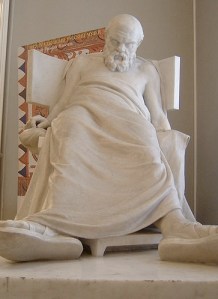
And here he is, the great man, dying of the hemlock coursing through his veins. Throughout this thread on Socrates, we’ve been pondering all the ways in which he–his life, his thoughts, his arrogance, his eccentricity, his genius and humor–speaks to us today, timeless in his relevance. But of course we always knew what happened next, the full stop that ended the sentence of his life. His trial and martyrdom is rivaled, in notoriety and historical importance, only by that of Jesus.

It is more than just another fact in the text books: It is one of the greatest mysteries in all of history, and an eternal challenge and reprimand to democracies and freedom lovers everywhere. The question is:

Why?

Why did the Athenians, the most ardent freedom lovers of all time, turn against their gadfly when he was 70 years old? For his whole life they had tolerated, mocked, enjoyed, hated and loved him. But then something changed. One of their 500-man juries, the sort that they were so proud of, found him guilty of two silly–laughable, stupid, banal!–charges and gave him death.

Let’s try to find out what was going on.

Bookmark and Share

Entropy in your home, life, body and mind

Like Fritjof Capra, I instinctively see Eastern philosophy and Western science as yin and yang. They rarely disagree and usually reinforce each other, the East using the vocabulary of metaphor, the West that of empiricism. So indulge me as I apply this instinct to my current thread on stuff.

The Feng Shui view is that stuff, ie clutter, blocks the flow of energy (qi) in your house and, since you are not ultimately separate from the space around you, in you.

The relevant Western analog is that clutter wants to increase all by itself. You have to expend energy to keep your stuff from spreading, multiplying, breaking, rotting.

This idea is called the Second Law of Thermodynamics. “Clutter”, in the argot, is entropy, the amount of disorder in a system. Disorder will increase as surely as water flows downhill (from a high-energy state to a low-energy state). The “system” in question can be:

  • your body, in which entropy manifests as aging and breaking,
  • a glass of warm water that cools (trading the “order” of warmth here and cold there for the “disorder” of lukewarmth everywhere)
  • your house or home office as it mysteriously gets submerged in stuff,
  • the entire universe (which is incredibly bad news for us, since there is no other system that we can decamp to), and
  • almost anything else.

Now, you might object that you can make water flow uphill, and you can warm a glass of water even in a cool room. Yes. But the key insight is that this takes energy, which must be added into the system. You have to pump, or boil, et cetera.

Hence the dilemma of stuff: First the clutter increases, thus (according to Feng Shui) blocking our energy, which is thus unavailable to reverse the cluttering, and so the shit–sorry, stuff–just happens.

Bookmark and Share

The changing nature of wealth: stuff is out

800px-Claude_Vignon_Croesus

Let’s return to Croesus for a moment. That’s the guy who gave us the phrase “rich as Croesus” and who learned the hard way about the ups and downs of life. Today I want to use him, the richest of the rich, to begin a brief meditation on wealth, as a way of understanding our modern problem with stuff. Because stuff is what we’re trying to figure out in this thread.

It used to be that wealth was a thingy thing, a state of having lots of stuff, especially stuff that others wanted and did not have. Let’s savor for a moment a brief passage from Herodotus, in which he dwells lovingly on the details of Croesus’ stuff/wealth. This was the porn of the fifth century BCE.

Croesus, in this passage, wants to impress the Delphic oracle, so he gives it lots of stuff:

three thousand of every kind of sacrificial beast, and besides made a huge pile, and placed upon it couches coated with silver and with gold, and golden goblets, and robes and vests of purple…. The king melted down a vast quantity of gold, and ran it into ingots, making them six palms long, three palms broad, and one palm in thickness. The number of ingots was a hundred and seventeen, four being of refined gold, in weight two talents and a half; the others of pale gold, and in weight two talents. He also caused a statue of a lion to be made in refined gold, the weight of which was ten talents…

On the completion of these works Croesus sent them away to Delphi, and with them two bowls of an enormous size, one of gold, the other of silver… Croesus sent also four silver casks, which are in the Corinthian treasury, and two lustral vases, a golden and a silver one… Besides these various offerings, Croesus sent to Delphi many others of less account, among the rest a number of round silver basins. Also he dedicated a female figure in gold, three cubits high, which is said by the Delphians to be the statue of his baking-woman; and further, he presented the necklace and the girdles of his wife.

Necklace and girdles? That sounds like the junk we just got rid off at the yard sale.

This, in other words, was the age of things, of stuff. Almost all people had extremely little of it, so to get any stuff at all was a stroke of fortune, and immediately imposed the need to hoard it and the anxiety of losing it. When you gave people gifts (and I’ll have more to say about gifts in another post), you gave things/stuff, because that’s how worth and sacrifice was defined.

All that is over, at least for the middle and upper classes of the rich countries today. (If you’re reading blogs, you belong to that set.) Our wealth is no longer thingy/stuffy. If anything, an excess of things is a mark of poverty. Any household today, even a trailer in Appalachia, is filled with gadgets that would have made Croesus green with envy.

What has taken the place of things? Two things:

  1. Time. We have so little of it, and so much stuff, that the exchange rate between the two has shifted hugely toward time. If you have money/things but no time, you are poor. Time is now one definition of worth and sacrifice, so when you really want to give a special gift, you give your time. You volunteer, or you spend a few hours of totally focused playtime with your children, or you take time to talk, really talk, with a friend/lover.
  2. Experiences. While the people in the Appalachian trailer haul in more TVs and fridges and toasters, the wealthy now buy themselves and their children experiences. Education is the big one, and that includes piano and tennis lessons, the trip to Europe and the Louvre. In my twenties, wealth was having hiked the Annapurna Circuit, say, or having sat in on a session of the House of Commons. Now, in my thirties, wealth is giving my children the experience of snow in the winter, seawater in the summer, and so forth.

So stuff is obsolete. Out of date. Unnecessary. Not worth anything. Which raises the question: Why do most of us hang on to it anyway, ruining their Feng Shui and making themselves miserable? I’ll try to tackle that anon, but I’m sure you’ve all got your ideas, so let’s have them.

Bookmark and Share

Stuff = Dead space: The Feng Shui view

335px-Feng1shui3

As a way of getting deeper into our new thread on stuff, here is a basic way of understanding why clutter is so bad for you: it “kills” space and blocks the flow of energy around your house and in your mind.

That’s how a Feng Shui guy explained it to me when I lived in Hong Kong.

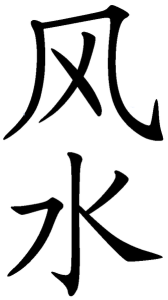
Feng Shui, if you’re new to it, means wind water (characters above), which is entirely unhelpful in understanding what it is. It’s the ancient Chinese version of geomancy–figuring out how to place buildings, furniture and other features of interior and exterior living in such a way that they make us feel healthier, more energetic and positive.

Feng Shui shares the fate of most things Eastern that are becoming fashionable in the West. That is: there are all sorts of quacks and weirdos eager to sell it to you as modern snake oil. If you know somebody who suddenly put mirrors, crystals and fish tanks all over his house, he probably became a Feng Shui victim.

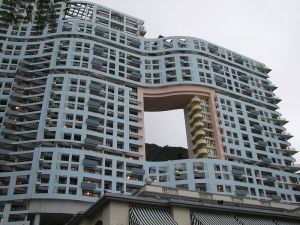
800px-RepulseBay_holeOn the other hand, if you encounter buildings such as this (right behind a great beach I used to go to), you know you’re in Hong Kong. In this case, Feng Shui (ie, the hole that allows better energy flow) makes for idiosyncratic local architecture.
But if you’re lucky, you meet an expert who treats Feng Shui as the subtle application of common sense. I was lucky.

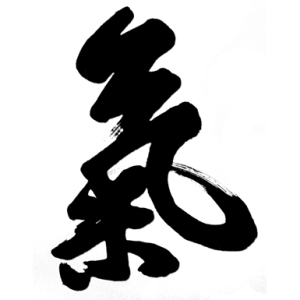
Ki-hanjaLike Chinese medicine (and indeed Indian Ayurveda), Feng Shui tries to optimize the flow of vital energy, or qi.

That qi is the ki in Aikido and the chi (different transliteration) in Tai Chi and the qi in Qigong. In Sanskrit it is called Prana. It behaves a little like electric energy, as it flows between a positive and a negative “pole”, Yang and Yin. When they stick needles into you in acupuncture, they are using the tiny conductors to amplify the flow of qi along certain conduits (called meridians in Chinese medicine, nadis in Ayurveda and Yoga).

What, you may be asking, does any of this have to do with stuff?

Stuff = dead energy

The way this Feng Shui master explained it to me, clutter in your home or office blocks the flow of qi in that space. The space becomes not just dusty but in effect dead.

Think of a corner of your house, or a drawer or a basement or a tabletop, that is hopelessly cluttered with stuff. (I’m using stuff to mean extraneous things here.) You don’t even want to look into that direction because it makes you feel bad. It reminds you that you should clean it up. Perhaps it reminds you of things on your to-do list that you never did because you didn’t want to, and now they’re piling up in that corner. Perhaps there are really important or useful or sentimental things hidden underneath that crap, but how would you ever know, without digging through it? Just thinking about all this makes you …. go somewhere else–anywhere else–and run away from the clutter once again.

And so your house becomes deader and deader with each cluttered corner. You walk through it as through a graveyard. The constricted space constricts your thoughts, perhaps your breathing (in Sanskrit, Prana means both breath and qi.)

So, to you hoarders: It’s not true that storing stuff costs nothing. It costs you more than any accountant could tally up.

Bookmark and Share

Socrates’ Athenian jury

Orestes and the Furies

Orestes and the Furies

Slowly, in this thread on Socrates and his surprising relevance to us today, we are leading up to his jury trial, the most famous in all of history. So a word is in order about Athenian juries.

I am skeptical of jury-systems, as I have hinted before and as I may eventually spell out more coherently. But that is neither here nor there today. Today I want to look at what juries meant to the Athenians, and how they worked.

Above, you see a strapping but unfortunate lad named Orestes being beset by the Furies. He is one of the main characters in the Oresteia, a famous trilogy of tragedies by Aeschylus, the oldest of the three great Greek playwrights (the others being Sophocles and Euripides). It is a heart-rending story about a truly haunted family that, generation after generation, goes from bad to worse until it ends …. in the world’s first jury trial!

Background

Very quickly: Several generations of disastering downstream, a king (Agamemnon) continues the pattern by sacrificing his own daughter (!) so that he can take an army to Troy to get his brother’s wife (Helen) back. More than a decade later, he comes back–victorious, as it were. But his wife is humping another man and hates her husband for killing her daughter and takes revenge: she stabs him in the bath tub.

Now the disastering moves on to the next generation: The remaining children of Agamemnon and his wife, Orestes and Electra, must avenge …. well, whom exactly? Their sister, whom their father had murdered? Or their father, whom their mother had murdered? They settle for the latter, and Orestes kills his mother. The Furies are beside themselves and go to work on Orestes.

What could possibly happen next? It would seem that everybody has to keep slaughtering everybody forever, were it not for…

The Athenian Jury

Aeschylus now did something very cheeky. The Trojan War took place, if indeed it did, around 1250 BCE. It was already ancient mythology for the Athenians of the fifth century BCE. But Aeschylus modernized the story. He added a patriotic Athenian twist: They do not keep slaughtering one another. Instead, they settle things in an Athenian jury trial!

The jury, as it happened, was split. Half thought Orestes was in the wrong, the other half thought he had had no choice. So Athena herself had to join in to break the tie. She voted to acquit, thus setting the precedent for all subsequent Athenian trials that a tied vote meant acquittal.

And so the days of blood feuding were over. The scary Furies turned into something else: the benevolent and beautiful Eumenides (“kind ones”), whom the Athenians would revere among their gods. Civilization had begun. Athens had begun! She stood for freedom and justice.

Practicalities

A few other things are worth mentioning:

  1. The juries were huge, numbering about 500. Sitting on juries and in the assembly was all that Athenian citizens did (slaves and women did what we would call work).
  2. Anybody could bring an indictment.
  3. There were two rounds of voting: First, to decide whether the defendant was guilty or innocent of the charges; second, if guilty, to decide between the punishments proposed by the prosecution and defense.

But the most important point is the one you’re supposed to infer from Aeschylus: the Athenians loved their jury courts, their assembly, their free speech, their democracy. The worst thing that could happen would be for something to call these institutions into doubt. And that’s what happened when an Athenian jury put Socrates to death.
Bookmark and Share