It’s all Greek to me

That’s what we say in English when we don’t understand something. (Probably thanks to Shakespeare, who had Casca saying to Cassius in Julius Caesar, Act I, Scene II, that “it was Greek to me.”)

But what do other people say–above all, ahem, the Greeks? Well, somebody has now mapped it.

Bookmark and Share

Fraught suspense in The Economist’s plaza

I still have doubts about free trade

A primate without valid ID has been spotted loitering in the “plaza” in front of our London headquarters, the modernist tower that The Economist inhabits in the heart of the “clubland” of St James’s Street.

My colleague Tom Standage immediately snapped photos and shared them on Facebook. The individual was reading The Economist, then switched to CFO, also owned by The Economist Group.

My options are under water

Suggestions that the individual is in fact an American expatriate in London, formerly in the business of collateralized debt obligations, have not been corroborated.

After several days of his vigil, the writers passing by every day are now beginning to accept his presence. Our science correspondents consider him family, and believe that he fled a hostile environment in America to be among people who are sympathetic.

Will he go? Will he stay? Will he edit?

Bookmark and Share

Another book based on Kipling’s If

By now you all realize that the idea for my entire (forthcoming) book came out of two powerful lines in a powerful poem, If, by Rudyard Kipling. “My” lines are

… If you can meet with Triumph and Disaster
And treat those two impostors just the same…

Well, it turns out that I’m not the only one getting book ideas from lines in that moving poem. Craig Mullaney, a pretty impressive young man, is just out with The Unforgiving Minute. (He’s with Penguin Press, the corporate sister of my publisher, Riverhead.) Here he is on the Daily Show, talking to Jon Stewart.

“His” lines from the poem, which made it into the title, are the final four:

If you can fill the unforgiving minute
With sixty seconds’ worth of distance run,
Yours is the Earth and everything that’s in it,
And-which is more-you’ll be a Man, my son!

As Mullaney says, it’s a book

about growing up to be a man; starts at West Point when I was seventeen, ends when I sent my brother off to war.

I have not read it yet, so I can’t review it. (I’m swamped with books at the moment for a particular reason, which I’ll tell you about in the coming week or so.) But could we just, you know, have a moment for Kipling? He fell pretty far out of fashion in the past century. And yet: a sudden outbreak of young authors feeling so touched by his words that they conceive entire books. Not bad, Rudyard, not bad. Dare I say that whatever slump your reputation suffered in the previous century, it is fast turning out to have been an … impostor?

Bookmark and Share

Fear and the English Language

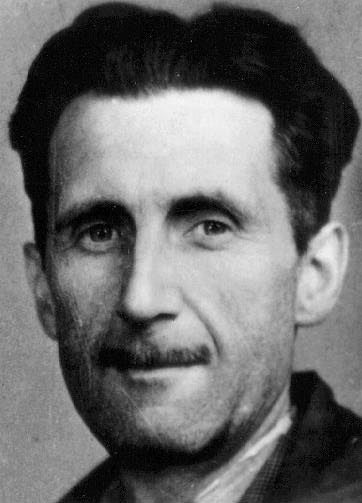
georgeorwell

Fear and the English Language is my attempt at a meaningful pun on George Orwell’s Politics and the English Language, one of the most important essays ever written.

You may remember that our own Style Guide at The Economist begins with Orwell’s six cardinal rules of good writing, taken from this essay. And now a reader of The Hannibal Blog has written, and shared with me, a very thoughtful Socratic dialogue based on this same essay (Orwell is Socrates in this dialogue, speaking to a student.) So I decided to re-read Orwell’s essay, which is always a good idea.

What is Orwell’s bigger point? Let me try to put it this way:

Thought + Intention → Words and Words → Thought + Intention

That’s why words are so important. They reflect thoughts and intentions. If your thoughts are jumbled, vague or absent, the words will come out badly, even if the intention is good. If your intention is insincere, the words will come out badly, even if you have a good thought. It also works in the other direction: If you get in the habit of using insincere or evasive words or talking nonsense, you will probably start thinking that way.

And so we can state, as confidently as Orwell did 63 years ago, that most of the words we read and hear by politicians, businesspeople, PR people, academics and celebrities are bad, embarrassingly bad.

Here are the two qualities common to this sort of language, according to Orwell:

The first is staleness of imagery; the other is lack of precision. The writer either has a meaning and cannot express it, or he inadvertently says something else, or he is almost indifferent as to whether his words mean anything or not.

Orwell makes fun of the sort of monstrosity that this led to in his day by “translating” a famous verse from Ecclesiastes,

I returned and saw under the sun, that the race is not to the swift, nor the battle to the strong, neither yet bread to the wise, nor yet riches to men of understanding, nor yet favour to men of skill; but time and chance happeneth to them all.

into “modern” English:

Objective considerations of contemporary phenomena compel the conclusion that success or failure in competitive activities exhibits no tendency to be commensurate with innate capacity, but that a considerable element of the unpredictable must invariably be taken into account.

What might that be today? Oh, pick your category. (You can come up with your own best worst phrase in the comments.) Let’s take the businessmen or PR people that I regularly deal with. They might turn Ecclesiastes into:

Whilst it is important to proactively leverage one’s core competencies, market conditions and timing largely determine what becomes a game-changer and what not.

Again, Orwell’s point is that

The whole tendency of modern prose is away from concreteness.

But why?

1) Laziness, often.

Speaking or writing clearly takes enormous effort because you first have to think, clarify and simplify. On the other hand, speaking or typing words, especially in hackneyed phrases you’ve heard others use thousands of times, takes vastly less effort and fills the time. Yesterday I was interviewing one of the people running in next year’s Californian gubernatorial race: what a torrent of words, in response to every question, and how little I had in my notebook at the end!

2) Fear or cowardice, more often.

This is the real answer, I believe. If you speak or write clearly you end up producing incredibly strong words. If they are noteworthy at all, they are sure to offend somebody. Are you up for that? Most writers are not, which is why they reserve their most honest writing for the grave, as Twain quipped. Usually, people want to speak or write without bearing any consequences. So, as Orwell says, you let your words fall upon the world

like soft snow, blurring the outline and covering up all the details.

This amounts to insincerity. You are really using words to hide. Typically, this is when the mixed metaphors and clichés come out. (By the way, I am not endorsing that American genre–you know who–of writers who see offending people as their niche. You can’t just be offensive, you still need a genuine thought.)

So: good writing, good language, good style comes down to, yes, having something to say and saying it as simply as you can, but above all to the great courage that this takes. That’s why good writing is so rare.

Bookmark and Share

Carthage and Rome: murderous twins

Hey Dido, say we EACH had a city....

Hey Dido, say we EACH had a city....

I left off in this thread on the historical background of the main characters in my forthcoming book by asking you to savor a certain sense of mystery:

At the beginning of the so-called Hellenistic era (ie, the death of Alexander), Carthage was a superpower and Rome all but unknown. 177 years later, Rome was the superpower, and Carthage was completely razed. And our world would forever after be Roman. What happened in those 177 years?

Before I go on, please, remember that my book will not be a history lesson; it is a story of characters, from Hannibal and Scipio to modern people you know, who illustrate a theme that you, I hope, will recognize in your own life.

That said, in these posts I’m amusing myself with a bit of history. And so back to the mystery. It actually gets more mysterious for a while, because Carthage and Rome were … friends.

That might be overstating things, but they were a) extremely alike in some ways and b) entirely tolerant of each other for many centuries.

If you believe Roman legends, the two cities were founded almost at the same time–Carthage in 814 BCE by the beautiful and wily queen Dido, and Rome a few generations later by the descendants of Aeneas, a Trojan survivor and Dido’s erstwhile lover. Dido and Aeneas are pictured together above. (The lewd version is here.)

Rome and Carthage then evolved almost as twins: two polytheistic city-states that shook off tyrants and became proud republics, with popular assemblies, councils of elders, and two annually-elected presidents–the Romans called them consuls, the Carthaginians suffetes.

Carthaginian empire

Carthaginian empire

To the extent that they were also different, this actually helped them to get along. Rome was agrarian, provincial and essentially land-locked in central Italy. It had no navy at all! When it had to fight, it drafted all male citizens. Carthage, by contrast, was maritime, controlled a vast sea empire and made profits from trading. When it had to fight, it hired mercenaries to do the fighting on the citizens’ behalf.

So for centuries the Romans worried about their neighbors in Italy, and the Carthaginians about their profits and sea routes, and both sides were happy. They had treaties of friendship. There seemed to be no problem.

To be continued.

Bookmark and Share

More primatology

The folks at 850 KOA, a Colorado news-radio channel, called me up this morning to chat more about friendship and human group size in the age of Facebook. Here is our conversation.

(If you’re just arriving, this is about a piece I wrote in The Economist called Primates on Facebook. I blogged about the back story here.)

Update: Cameron Marlow, whom I described as Facebook’s “in-house sociologist”, has now posted his back story with lots, lots more data and detail and analysis.

Bookmark and Share

In praise of wonderment

Amazing, isn't it?

Amazing, isn't it?

Cheri’s comment about my use of the word wonderment made me … wonder. And so, a brief paean.

Einstein (on page 387 of this biography), once said:

The most beautiful emotion we can experience is the mysterious. He to whom this emotion is a stranger, who can no longer wonder and stand rapt in awe, is as good as dead, a snuffed-out candle.

I’ve talked before about Einstein’s love of simplicity and his non-conformity as keys to his astonishing creativity. But I should have started with his famously child-like ability to wonder.

Wonderment is the origin of every creative act. The natural flow of Hmms leads to questions and inquiries that are usually never quite answered but become signposts on a great journey, a great story.

People sometimes ask journalists how we get our ideas for stories and I’ve never had a good answer. There is no shortcut, no ten-steps process, no secret vault. Instead, it always starts with simple–and yes, child-like–curiosity and wonderment.

An ability to wonder is of course also what the reader/listener/viewer of a story needs. If you don’t find your own life and its ups and downs somewhat mysterious, you probably won’t enjoy my book when it comes out.

So here’s to wonderment, and its official inclusion in our thread on story-telling. Every good story begins and ends with it.

Bookmark and Share

Our Roman world, 2009

450px-mta_station_wall450px-us_treasury_07110005

What’s that peeking through the urban thicket of New York? Why, the New York Stock Exchange, where your savings are currently being lost. And what about that patriotic-looking edifice on the right? That’s the US Treasury, where your savings are also currently being lost. But I digress. What’s my point?

By now I shouldn’t even have to make it explicit. It is that those buildings, like thousands of libraries and state capitols and what not, are explicitly and intentionally built to look … Roman!

And what would America look like if Hannibal, ie Carthage, had won? Exactly. We have no idea. We don’t know what Carthaginian columns and buildings looked like because the Romans were too thorough in wiping it off the map.

And what do we speak? English, a Germanic tongue, admittedly, but one that got half its vocabulary from Norman French, an offshoot of Latin. To our north and south in this hemisphere, they speak French, Spanish and Portuguese, other offshoots of Latin.

And what would the Americas sound like if Hannibal had won? Exactly. We have no idea. Perhaps remotely like Hebrew or Arabic, since Punic was a Semitic language, but we can’t say because it’s been dead so long.

We could go on and on. We have Senators because our founding fathers wanted to model themselves after the Rome that Polybius described, the one that survived and overcame Hannibal. Toga parties, Caesar’s Palace, …. Please don’t expect me to go there.

The point of all this, of course, is to instill in you a retroactive sense of wonderment about the mysterious events between, roughly, the death of Alexander and the Roman double-sack of Carthage and Corinth. Recall that Alexander had never heard of Rome but had Carthage in his sights, because it was the superpower of its region. Recall that, 177 years later, those Romans of whom he had not heard razed Carthage and Corinth to the ground and began to turn the world into what we know today.

Those epic and mysterious events that explain the mystery are the backdrop–the context or scene–for the astonishing individual and human stories of the main characters in my book, who proved with their own lives that triumph and disaster are impostors.

Bookmark and Share

The nomadic reader

What a page turner

What a page turner

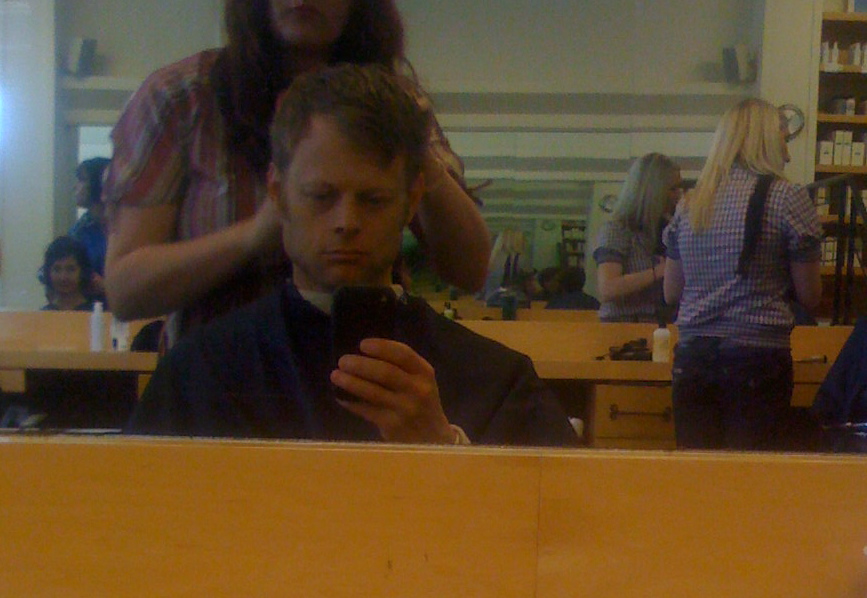
Here I am yesterday, reading a book on the new Kindle for iPhone app while, you know, being worked on. (My editor Tom and I must have been among the first to download the new app that day.) Later I got home, picked up my actual Kindle, the one I reviewed last month, and kept reading from the page I got to during the haircut (the two devices had automatically synced).

Now, this sort of think should make you think. It is the latest installment in what I called “the new nomadism” in The Economist last year. New behaviors and social contexts are arising out of, not so much new gadgets, but new expectations about connectivity. Big, very big, sociological change is afoot, I believe. And, of course, as an aspiring author I have much to contemplate on the topic of books in particular…

Bookmark and Share