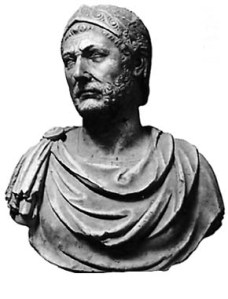
Archimedes between Carthage and Rome

"Don't disturb my circles."

"Don't disturb my circles."

Above you see a 78-year-old Greek man drawing mathematical diagrams into the sand, a split second before a Roman soldier stabbed him to death in a war against Carthage. The old man’s name, of course, is Archimedes, and when the Romans ran toward him he apparently said, simply, “Don’t disturb my circles.”

I have been thinking about how to illustrate for you, in one terse but punchy anecdote, the essence of the Hellenistic era that I wrote about in the previous post. And this is it.

Remember: This was an era when 1) two mighty powers, Carthage and Rome, clashed and changed our world forever and 2) the entire known world, including Carthage and Rome, was simultaneously taking its cultural, linguistic, artistic, scientific and aesthetic cues from the Greeks. (Oh, and it was the era that forms the backdrop to the main story in my forthcoming book, a book that is really about the ups and downs in your life.)

But why this moment, the stabbing of Archimedes?

Because it was a microcosm of the larger situation. Consider:

  • Archimedes was stabbed in 212 BCE, just as Hannibal, the Carthaginian commander who is my main character, was in Italy, killing Romans (he killed about one quarter of all free Latin men at the time!).
  • The Romans, who were losing, were worried that Sicily, the ethnically Greek island between Italy and Carthage which they had wrested from Carthaginian control in a previous war might go over to Carthage again, thus giving Hannibal a base for supplies and reinforcement and sealing their likely fate: extinction.
  • So the Romans, while fighting Hannibal in Italy itself, attacked and laid siege to the Greek city of Syracuse on Sicily, once a Roman ally but now flirting with Carthage.
  • But Syracuse, a proud and ancient Spartan Corinthian colony, was a more refined–ie, Hellenistic–culture than either Rome or Carthage. It was Greek, rich, old, full of art and learning. And it was the home of Archimedes!
  • Archimedes, using Hellenistic values of science and thought (as opposed to brute Roman force) helped his city to keep the Romans at bay for two years.
  • He figured out a way to use mirrors to focus the sun’s rays onto the Roman ships until they burnt–the Hellenistic form of Star Wars. He designed cranes that, using the principle of leverage, lifted the Roman ships out of the water and let them crash down.
  • Eventually, the Romans got into the city and had their Roman way with it. But the swash-buckling Roman commander, Marcellus, gave orders to save the great man, Archimedes–a gesture that was itself a sign of the Hellenistic Zeitgeist. Alas, the young legionaries did not recognize Archimedes and killed him.
  • And so Sicily stayed Roman and did not become a base to resupply Hannibal in Italy. Hannibal would later kill Marcellus in Italy, and things would take their course…

So there you have it: the three civilizations–Greek, Roman and Carthaginian–meeting in one spot at one time. But there is another reason to choose Archimedes.

Archimedes perfectly epitomized his Hellenistic time and his Greek culture. He was curious, full of wonderment, inquiring into everything. As he was taking a bath one day, he noticed how his leg, moving in and out, displaced the water, which gave him the idea for measuring the volume and density of any object. He was so excited that he ran out into the streets, stark naked and dripping, screaming what might be the the best and ultimate slogan for Hellenism itself:

Eureka!

Bookmark and Share

It was all Greek to them. No, literally.

diadochen1

I left off in my thread on the general historical backdrop to the main story in my forthcoming book with a nod to Hellenism. That is because my main characters, Hannibal (Carthage) and Scipio (Rome), clashed, with consequences for us today, during the third century BCE, the height of the so-called Hellenistic era.

This may sound weird. Hellenism is named after Hellas, Greece, but what we know about this epic clash is that it happened between the two superpowers of the day, Rome and Carthage. What does Greece have to do with this?

This is what I want to explain, briefly and simply, in this post.

“Greece” was never, in antiquity, a country. Even Homer, writing about the Trojan War that was the mythological foundation for all Greeks, never once used the word Greeks! (Instead, he called the Greeks Argives, Achaeans, Aetolians, and so on.) During the Classical era, the Greeks had independent city states (Athens, Sparta, Thebes etc) that constantly fought against, or allied with, one another.

But although they never thought of themselves as a country, they always thought of themselves as a civilization. The definition of Greekness was simple: if you were allowed to send competitors to the Olmpic Games, you were Greek. And who was allowed? Broadly, those who spoke Greek. All other languages sounded to the Greeks like “bar bar bar bar”, hence barbarian.

Then, in the fourth century BCE, something big happened: While the Greek cities kept fighting each other about rather petty things, as usual, a new power rose to the north. This was Macedonia. Whether the Macedonians were Greek was at first controversial, but might made right, and Philip, then his son Alexander, became not only Macedonian but also Greek.

Alexander, completing the dream his father had dreamt when he was murdered, then swept ferociously across the Hellespont to the east, reversing the direction of the earlier Persian invasions, and conquering most of the known world. In the process he brought Greek language, culture, philsophy, theater, art and architecture to the entire “Middle East”. His name lives on in many garbled city names, such as Kandahar.

Then Alexander died, prematurely. His generals carved up his huge empire and for the next couple of centuries, huge and powerful kingdoms with Greek aristocracies ruled the area. The two biggest were the Seleucid and the Ptolemaic empires. The last Greco-Macedonian queen was, of course, Cleopatra (who happens to be another of the characters in my book.)

What did this mean? It meant that in the whole Mediterranean and “Middle East”, there was one cosmopolitan, urban culture, which was Greek–ie, Hellenistic. There were lots and lots of other peoples–Phoenicians, Romans, Gauls, Numidians, Illyrians etc–who abutted on this Greek pond from all sides, and they each had their own culture and language. But the haute couture, the lingua franca, the aesthetic style, the entire outlook and sensibility of the era–all this was Greek.

There are no perfect parallels in history for this astonishing cultural dominance. The reach of Han Chinese culture during the Tang Dynasty and “Anglo-Saxon” culture today (from English-as-a-second-language to Hollywood films) are the two that seem to come closest.

So there. Hannibal spoke Punic, Scipio spoke Latin, but both of course also spoke Greek. Scipio, in fact, loved Greek culture so much that his political enemy, Cato the Elder, a sort of Roman Joe McCarthy, even tried to spin a scandal out of it.

It was a culturally refined and complex era. A fascinating era.

Bookmark and Share

Our Roman world, 2009

450px-mta_station_wall450px-us_treasury_07110005

What’s that peeking through the urban thicket of New York? Why, the New York Stock Exchange, where your savings are currently being lost. And what about that patriotic-looking edifice on the right? That’s the US Treasury, where your savings are also currently being lost. But I digress. What’s my point?

By now I shouldn’t even have to make it explicit. It is that those buildings, like thousands of libraries and state capitols and what not, are explicitly and intentionally built to look … Roman!

And what would America look like if Hannibal, ie Carthage, had won? Exactly. We have no idea. We don’t know what Carthaginian columns and buildings looked like because the Romans were too thorough in wiping it off the map.

And what do we speak? English, a Germanic tongue, admittedly, but one that got half its vocabulary from Norman French, an offshoot of Latin. To our north and south in this hemisphere, they speak French, Spanish and Portuguese, other offshoots of Latin.

And what would the Americas sound like if Hannibal had won? Exactly. We have no idea. Perhaps remotely like Hebrew or Arabic, since Punic was a Semitic language, but we can’t say because it’s been dead so long.

We could go on and on. We have Senators because our founding fathers wanted to model themselves after the Rome that Polybius described, the one that survived and overcame Hannibal. Toga parties, Caesar’s Palace, …. Please don’t expect me to go there.

The point of all this, of course, is to instill in you a retroactive sense of wonderment about the mysterious events between, roughly, the death of Alexander and the Roman double-sack of Carthage and Corinth. Recall that Alexander had never heard of Rome but had Carthage in his sights, because it was the superpower of its region. Recall that, 177 years later, those Romans of whom he had not heard razed Carthage and Corinth to the ground and began to turn the world into what we know today.

Those epic and mysterious events that explain the mystery are the backdrop–the context or scene–for the astonishing individual and human stories of the main characters in my book, who proved with their own lives that triumph and disaster are impostors.

Bookmark and Share

A tale of two cities’ disappearing

What is the following description about?

… they threw timbers from one [house] to another over the narrow passageways, and crossed as on bridges. While war was raging in this way on the roofs, another fight was going on among those who met each other in the streets below. All places were filled with groans, shrieks, shouts, and every kind of agony. Some were stabbed, others were hurled alive from the roofs to the pavement … No one dared to set fire to the houses on account of those who were still on the roofs, until [the commander showed up]. Then he set fire to the three streets all together, and gave orders to keep the passageways clear of burning material so that the army might move back and forth freely.

Then came new scenes of horror. As the fire spread and carried everything down, the soldiers did not wait to destroy the buildings little by little, but all in a heap. So the crashing grew louder, and many corpses fell with the stones into the midst. Others were seen still living, especially old men, women, and young children who had hidden in the inmost nooks of the houses, some of them wounded, some more or less burned, and uttering piteous cries. Still others, thrust out and falling from such a height with the stones, timbers, and fire, were torn asunder in all shapes of horror, crushed and mangled.

Nor was this the end of their miseries, for the street cleaners, who were removing the rubbish with axes, mattocks, and forks, and making the roads passable, tossed with these instruments the dead and the living together into holes in the ground, dragging them along like sticks and stones and turning them over with their iron tools. Trenches were filled with men. Some who were thrown in head foremost, with their legs sticking out of the ground, writhed a long time. Others fell with their feet downward and their heads above ground. [Army transports] ran over them, crushing their faces and skulls, not purposely on the part of the riders, but in their headlong haste. …

The Americans taking Fallujah in 2003? Street fighting in World War II? Nope. It’s the Romans wiping Carthage off the map, as described by Appian here.

The year was 146 BCE, and in that same year the Romans also destroyed Corinth in Greece. One city gone in the west, one in the east. A very Roman gesture.

In the previous post in this thread, I talked about Alexander looking west from his deathbed in 323 BCE and seeing a mighty city, Carthage, but not seeing a city called Rome, because there was nothing much to see yet. In this scene, 177 years later, that nation of which Alexander had not heard, Rome, was laying waste and subjugating the two great Mediterranean civilizations that Alexander had known, the Carthaginian-Punic and his own, the Greek.

Clearly, a lot had happened in those intervening years. Events that we today see all around us–by what we see, speak and think, and by what we do not see, speak and think. I will explain that in the next post.

And just as a reminder: The story of what happened between those dates–Alexander’s death and Rome’s domination of west and east–has, of course, everything to do with the main characters in my book: Hannibal, Fabius and Scipio.

Bookmark and Share

Traveling again, but thinking of Hannibal ….

And I’m on the road again. But I’ll try to keep posting. In particular, I’m trying to think of ways to get back on message, the main “message” being the book that I’ve just delivered to my editor at Riverhead.

You recall that my dilemma is the following: I’m not ready yet to start giving away parts of the book as such. (I don’t have a publication date yet and want to start doing that closer to the time.) But I love the story and topic so much that I started an entire blog with the intention of discussing it, not just ahead of but forever after the book launch.

So maybe I’ll start by setting the scene, in a more cerebral and less narrative way, for the main plot and the main characters. The main plot, you recall, takes place during the Second Punic War between Carthage and Rome, and the main characters are Hannibal and Scipio. (For some of the more modern characters that appear inside the individual chapters, browse my tags.)

Since the Punic Wars are not exactly common knowledge nowadays (I was born in the wrong generation, by the way), I might start by setting those in context on The Hannibal Blog. What were they? Why were they? How are they still visible all around us today?

Would that be fun?

PS: One of you has let me know via email that he is working on a graphic book about Hannibal. How cool is that? Whenever you’re ready (I don’t “out” people who contact me via email), please share the excitement here on The Hannibal Blog. I’d be honored and want to be the first to link to you…
Bookmark and Share

Livy and Polybius

I got an email from Fabrizio Dinatale, who is writing a dissertation at the University of Reading (UK) on Polybius and Livy. He asked my opinion on the “qualities/defects” attributed to each of them.

Fabrizio, I replied to your email but I keep getting error messages. (“550 550 unrouteable address (state 14)”)

Here is what I said:

Hi Fabrizio,

your dissertation sounds fascinating. Send me a link once it’s finished and I might link to it. You will be the expert on the topic. I am, as you may have picked up from the blog, not a historian, just a writer who’s having fun with Hannibal and Scipio as the main characters in a book about, well, you and me.

That said, Livy and Polybius are my main ancient sources, so I do have some impressions, as I said here and here.

Polybius took Thucydides as his model, Livy Herodotus. Which is to say: Polybius believed in thorough research, fact-checking, original reporting, less embellishment. He personally interviewed eye witnesses and traveled the routes that Hannibal took, even over the Alps. He had a personal connection in that he was the tutor and friend of Scipio Aemilianus (Scipio Africanus’ adoptive grandson) and stood next to him when the Romans burnt Carthage to the ground.

Polybius was writing for his fellow Greeks to explain how the most momentous event in history up to that time–Rome’s rise to superpower status–could have happened. And the biggest step in that rise was Rome’s near-death experience but ultimate victory over Hannibal.

Livy was completely different: somewhat lazy (he did not travel), and unconcerned about originality (ie, he plagiarized Polybius freely). He embellished liberally. Above all, he was writing less a history than propaganda, as you said. And for Romans, in Latin. His mission was to narrate the past, mythical and actual, in a coherent way that appeared inexorably to lead to … Augustus! Rome as the chosen people, you might say.

In that sense, he was not unlike Virgil, who went one step further in the Aeneid and implicitly tied Augustus to Aeneas as though everything had all been preordained all along.

Have fun. Again, i’ll be interested in what you end up concluding in your dissertation.

Bookmark and Share

Why I chose to write the book I’m writing

Here is David McCullough, author of fantastic biographies and histories including Truman, which is in my bibliography, speaking words that might have come out of my own mouth verbatim.

So, when somebody asks why I chose Hannibal, Fabius, Scipio (and Cleopatra, Ludwig Erhard, Truman, Eleanor Roosevelt, Carl Jung and the rest of them)–as the characters for a book about success and failure today, I could just play this clip:


Hannibal: The limerick version

When I said "poetry" I mean epic, not Limerick!

When I said "poetry" I meant epic, not Limerick!

Loyal readers of the Hannibal Blog will by now be familiar with the wit of one Mr Crotchety, who visits regularly. He has, in this comment, expressed the epic life of the main character of my book–why yes, he has indeed–in the following limerick.

There once was a General named Hannibal,
‘til the Romans found his army untenable.
His tactics were dodgy and favored by chance:
like his father, he walked behind elephants and never wore pants.

Subsequently, Mr Crotchety discovered that the correct rhyme scheme of a limerick is apparently AABBA, and the syllable count 9-9-6-6-9.

With that intelligence, I crafted my own initial response to this impertinence, which was this:

There once was a lad named Hannibal
and I don’t mean that one, the cannibal,
The Alps this one crossed,
then Romans he tossed,
As though he were staging a carnival.

Since that entirely omits the central thesis of my book, I then decided to have another crack at it:

From Carthage he came, the Alps he crossed,
Romans he routed in Trebia’s frost,
he seemed to have won,
at Cannae again,
until it was clear he had instead lost


Ruined by success

Syd Barret

Syd Barret

Thanks to Abhishek for pointing out a life story that fits the theme of my book, which is that success and failure can be impostors, as Kipling would say. Abhishek emailed that

The other day, I downloaded a documentary on Syd Barret [the co-founder of the band Pink Floyd] from You tube. This is a classic story of Hannibal of the 1970’s. A 22 year old Barret was at his peak as the lead singer of Pink Floyd and then he lost it all to LSD. During concerts, he stood on the stage stoned and out of sorts strumming his guitar playing all the wrong notes. His colleagues would somehow cover it up, but one fine day they had to pick up their bags and leave him behind…

Now, this actually not a “story of Hannibal,” because Hannibal’s life trajectory had more twists and turns and was more perplexing. But I do have a chapter where I explore this–ie, Barret’s–sort of life trajectory, which we might call “premature success.”

Contemplating his premature success

Contemplating his success

Contemplating Barret, I think of people like Diego Maradona, who soar to fame, success or some other kind of triumph in their field, but apparently too early in life to be able to cope with it. Then they fall apart. Drugs, alcohol, or less obvious but equally insidious lapses of personal discipline. They become wrecks.

The book in my bibliography in this regard, which I recommend, is Stephen Ambrose’s Undaunted Courage : Meriwether Lewis, Thomas Jefferson, and the Opening of the American West.

Meriwether Lewis, you recall, is the first half of the Lewis & Clark expedition that explored the North American continent west of the Mississippi and to the Pacific after Thomas Jefferson bought those lands from Napoleon. Lewis is, in many ways, an American Hannibal: a young, dashing hero who did what many thought was impossible.

Meriwether Lewis

Meriwether Lewis

But what came next? Whereas his friend William Clark, upon their return, married and lived happily, Lewis fell apart. He couldn’t handle the fame. No luck with women. Booze, later even morphine. He did not publish his famous Journals. Jefferson made him governor of the territory he had explored, but he failed in every respect, defaulting on his debts and drinking himself into oblivion. In his mere thirties, only a few years after his breathtaking success, he killed himself in a dingy Tennessee tavern (although the event remains a bit of a mystery).

Impostor triumph indeed. To me, this sort of tale is not the end of a story but the beginning of one. What happens to these people?


Bookmark and Share

Visit ANCIENT Rome!

This qualifies as breaking news, if you’re writing my kind of book. Watch:

It arose out of this great project.

This where Fabius and Scipio walked. This is where the Romans bewailed their dead after Hannibal’s victories at the Trebia, at Trasimene and at Cannae. This is where Scipio celebrated his Triumph after defeating Hannibal at Zama…..

So, you know where I’ll be hanging out–Google Earth. Oh wait. There weren’t enough hours in the day to do the things I’m supposed to do before this came out. Should I take it out of sleep hours? Dangerous. Perhaps necessary, though.


Bookmark and Share