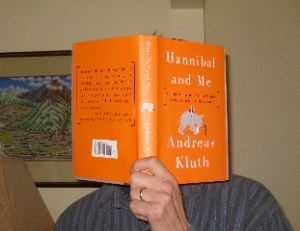
‘Drinks with’ me on Zocalo Public Square

Andres Martinez

Andres Martinez is a great journalist, writer and now think-tanker. And he’s had a career of Sophoclean ups and downs that could have been a storyline in my book.

He and I had drinks the other day. Now Andres has penned a “Drinks With” column about me on Zocalo Public Square, an intellectual gathering point for the Los Angeles area.

It’s more about me than about the book. But Andres does use a phrase I will steal from now on when telling people what type of book it is:

genre-bending

Thank you, Andres!!

Hannibal and Me … and Mr Crotchety

There are reviewers, and then there are reviewers. And then there is … Mr Crotchety.

Who is Mr Crotchety?, you ask.

He (and I am reasonably confident that he is indeed both human and male, as allegedly pictured above) first presented himself to me in 2008, when he wrote a reader letter to The Economist about a piece I had written (about “Slow Food”). Here is that letter:

Date: 16 September 2008

To: letters@economist.com

Subject: slow food

Regarding: (11 Sep 08) Revolutionaries by the Bay

Many years ago I sat down in a Slow Food restaurant in New England. It seems like only yesterday when I walked out. The food was not memorable, but the service was glacially slow and inattentive (this was before global warming). Does the service have to be European also?

Mr. Crotchety

That set the tone for all that was to follow. Mr Crotchety, possibly encouraged by me, poured himself into the blogosphere and, under his increasingly notorious nom de guerre, began spreading his wit more widely.

Here on The Hannibal Blog, for example, we were soon turning the epic tale of Hannibal the Carthaginian into its … limerick version. (Read through the comments in that post, too: We expanded the mission to Zen Senryus.) In retrospect, it is hard to believe that both Polybius and Livy overlooked such an obvious literary device.

But Mr Crotchety never over-indulged himself with his blog commentary. Sometimes he crotched, sometimes he didn’t. Over time, I became aware that an entire subculture of the blogosphere was secretly yearning for one of his ambushes. They bestowed the ultimate kudos.

All of which is a long-winded way of saying that this same Mr Crotchety has now, via Sprezzatura, written his own and inimitable review of Hannibal and Me. Follow the link, and may the kvetching and crotching continue over there….

Talking with Fiammetta about Hannibal & Me

Fiammetta Rocco

Here is an 8-minute podcast of a chat between Fiammetta Rocco, our Books & Arts editor at The Economist, and me, about Hannibal and Me.

We were all over the place in our actual conversation, but our colleague Lucy Rohr did a Herculean job of editing it down to 8 minutes.

Topics covered: Tiger Woods and Eleanor Roosevelt, in particular, plus some Meriwether Lewis and the rest of the gang. 😉

(And if you want an amusing visual of how I tape these interviews with London, go back to this old post.)

Life reversals: the case of the White Moustache

And now: something completely different, and much more important — indeed, rather uplifting, in the spirit of the season.

We are, obviously, talking about … yogurt.

Way back in May, I wrote a story in The Economist called Red Tape in California: Beware of the yogurt. The title says it all, really. But if you need additional context, my favorite line from the article is:

The tale thus went from Kafka to Catch-22.

In a nutshell, it is the tale of a Zoroastrian father-daughter team (pictured above) in Orange County who make fantastically good “artisinal” yoghurt — or would make it, if it weren’t for California’s bureaucrats. Go read the rest.

Why do I bring this up now? Because there has been an epilogue, which is unfolding still.

A few weeks after the article appeared, Homa (the daughter) emailed me that

… we were requested by two news sources a Chilean newspaper “Las Ultimas Noticias” (a conservative daily based in Santiago), and Fox Business News “America’s Nightly Scoreboard” to give an interview…. We were written up in HaAretz, an Israeli paper, which was basically a translation of your article, except with the headline: “U.S. against Iran– now the scene of yogurt”… A film-maker has asked us for the movie rights, he wants to call the documentary: “The Curdled Crusaders” — Catchy. Tons of people have commented on our FB page and send individual e-mails of support. A few consultants who want to help us more to other states (Tennessee, Texas, Mexico). Some wanting to know where to buy the yogurt (clearly, they didn’t pay attention to the article).

Pretty good, don’t you think?

And now, just the other day, Homa emailed again:

Dear Andreas,

I hope this letter finds you well. There have been quite a few developments for us (specifically in the last three weeks) which most definitely relate back to the piece you wrote on us. Most pleasantly, Secretary of State for Oregon Kate Brown read The Economist piece in November and thought “This shouldn’t happen. Let’s get her to make it up in Oregon.” And so she invited me up, introduced me to regulators and business recruiters and even though their regulations are similar to California, their attitude has been: How can we make this happen for you?” It has been such a nice change.

Also, nine months of begging for an audience, Karen Ross of The CDFA has finally agreed to meet with us (today!) and tell us what exactly the public risk is of using already pasteurized milk.

Ironically, I’ve only made yogurt twice in this whole time. An ideal time, I figured, to experiment with the paleo diet.

Best,

Homa

The books we (at The Economist) wrote this year

I’m not the only one at The Economist to launch a book “this” year.

(As you know, my launch is technically on January 5th, but Hannibal and Me is already available for pre-order, so that counts as 2011.)

Here is a list of the books my colleagues and I wrote this year. A pretty broad range of genres and topics, wouldn’t you say?

Cross-posting: My 9/11 etude

(Throughout the day today, The Economist’s Democracy in America blog will be sharing various impressionistic thoughts and recollections on 9/11 by us, the correspondents. Mine is here, and again below:)

ON SEPTEMBER 11th, 2001, I had already been a correspondent for The Economist for four years and, as we are wont, had moved around for the publication, just then finding myself living in Hong Kong and covering Asia. It was already evening in Hong Kong and I had just returned, somewhat tired from a long day, to my flat on the 25th floor of a skyscraper in “Mid-Levels”, with a view of Hong Kong, the harbour and Kowloon. Just then my assistant called and said simply: “Turn on the TV.” For the rest of my night, which for America was that endlessly long morning and day, I watched.

The next morning, I walked to my office and stopped by my usual coffee bar in Lan Kwai Fong, Hong Kong’s expat playground. All the regulars were there, and in each conversation, people of various nationalities were trying to make sense of what this world was now to become—now, as of September 12th, as of the day after. Anger, worry, confusion, fear—all these emotions were mixed together. I knew right away that the main significance of this dreadful event lay in what would happen next, not in what had already happened. How would America react? China? Muslims? Everybody?

There was a lot of nonsense said in those early days, as always when people must talk about something but have little new to say. I was suddenly getting lots of eager advice to cancel a trip to Indonesia. A Muslim country, you see. I went, and it was my favourite trip ever to that mystical place, easier for the lack of other travelers and just as welcoming as ever. The Schadenfreude of many mainland Chinese was harder to stomach. The unfocused jingoism of some Americans (“nuke’em back to the stone age”) even harder.

The first casualty of war is truth, it is often said. Instead, it is nuance. Every individual flees to his in-group and becomes susceptible to its caricatures of the respective out-group, to what the Germans call a Feindbild, a perception of The Other as enemy. This is already an act of de-humanisation. Bad laws, more oppressive bureaucracy (at borders, in courts, in daily life), distrust in interpersonal relations invariably follow, just as one apocalyptic horseman inevitably rides close behind the one before.

Did September 11th teach us about the risks of terrorism? It should not have. The existential threat of a suitcase bomb, a rogue nuclear event, already existed before and exists still. On the other hand, September 11th itself killed about as many Americans as die each year as a result of texting while driving. Homo sapiens are bad at understanding risks relative to one another, and worse at responding proportionately. The world became a worse place on that day. In part because the terrorists made it that way. In part, because the rest of us then did the same.

__

For the regulars here, some of these thoughts might strike you as “in-character”, such as those on

Interview tips for ships that pass in the night

Henry Wadsworth Longfellow

Ships that pass in the night, and speak each other in passing, only a signal shown, and a distant voice in the darkness; So on the ocean of life, we pass and speak one another, only a look and a voice, then darkness again and a silence.

These words by Henry Wadsworth Longfellow popped into my mind this week, as I read an internal email from The Economist‘s “brand communications manager” that landed in my inbox. It began:

As more and more of you are doing broadcast interviews now, I thought it might be useful to re-circulate these hints and tips…

I have indeed, over the past 14 years, been doing more and more broadcast interviews, and made more than my share of mistakes. So I began perusing these tips with an open mind. Many were about the mechanics (wear plain shirts on TV, no patterns, no black; don’t fiddle with your hands; etc). But the important ones were about content. And, as I kept reading, I grew somewhat pensive.

That’s because, as I see it, the tips were simultaneously

  1. good — ie, anybody doing media interviews is well advised to heed them — and
  2. awful — ie, heeding them is what makes our political, public and personal conversations increasingly pointless and frustrating.
I shall explain, in two parts:

1) The tips

I was slightly suspicious of the Powerpoint-style pseudo-acronyms (this email came from the “business side”, after all), but could not argue with the advice:

Prepare beforehand – decide what it is you really want to get across, having stats to hand will usually be useful. Know your:

  • Audience
  • Messages (focus on three key things to say)
  • Evidence (third party endorsement is good e.g. quotes or research)
  • Negatives (what’s the “worst” question they could ask?)

(AMEN, get it? Oh dear.)

Then:

Get in early with your messages/evidence – don’t wait for the perfect question, it may never come

Translation: Ignore the question, just say whatever the heck you want to say, which is probably whatever you said in your last article in The Economist.

More tips:

Avoid being question-led so the interviewer gets a neat segment that fits their preconceptions but you don’t get to say anything really interesting or useful.

Add value. Don’t feel forced to answer a question at length that you feel is unclear or irrelevant. You are the expert, talk about what you think is most significant.

If you are asked a difficult question:

1. Acknowledge it (“I understand that view…” / “we need to look at this issue in the light of..”)

2. Bridge back and communicate what you want to say.

3. Don’t repeat any negative language – if the audience is only half-listening, that’s all they will hear.

4. Don’t fake it if you don’t know, bring the conversation back to where you feel comfortable.

Translation: In case you didn’t get the first translation, ignore the question (but be suave about it) and say whatever the heck you want to say….

2) The consequences

I did say, right up front, that I had contradictory reactions to this advice. I know too well how utterly demoralizing it is to be on the radio or on TV, and to go off on that tangent that might become so very sophisticated in just a few minutes but dies suddenly and ignominiously when the interview is … over.

‘Wait, you mean, you don’t want to hear all my complex thoughts on this issue?’

No, they don’t.

If you don’t seize the conversation, they, or it, will seize you.

On the other hand, what kind of “conversations” are we talking about?

The worst kind: the eristic kind, as Socrates would say, the kind that obstructs communication and discovery of truth.

And so we all — journalists, politicians, consultants, pundits — become “media-trained”, talking right past one another, just like ships that pass in the night.

Declaration of bad writing

When in the Course of human Events, it becomes necessary for one Writer to parody the Words which are written by most others, and to assume among the Powers of the Earth, the separate and equal Station to which the Laws of Nature and of Nature’s God entitle him, a decent Respect to the Opinions of Mankind requires that he should produce a representative Sample of the Words which impel him to the Mocking. He holds these Truths to be self-evident:

  • that what follows is bad writing indeed and will make you cringe or smirk,
  • that it is bad not in an egregious (and thus unrepresentative) way but in a small, ordinary, quotidian, commonplace (ie, representative ) way,
  • that it serves as partial proof to the thesis advanced in the previous post about Writing with Fear (although the role of fear as the cause deserves to be developed in a later post).

I) The run-of-the-mill press release/PR email

Below I reproduce, the first PR email I saw in my inbox this morning. It is chosen for being the day’s first, not for being the day’s worst.

Hi, Andreas –

I’m reaching out with a new executive leadership announcement from [COMPANY]. [COMPANY] is continuing its expansion into the [OMITTED] sector with the addition of several new members to its key management team. … [COMPANY] announced today that it has added several key members to its senior management team. …

Exegesis:

  1. For heaven’s sake, stop “reaching out” already. You can ask me, remind me, alert me, tell me, or you can simply … tell me without telling me that you will tell me, but keep your hands to yourself. Reaching out is in 2011 what proactive leveraging was circa 1995. (My colleague on The Economist’s language blog has covered this adequately.)
  2. How is “continuing an expansion” different from “expanding”?
  3. Since you mention the company’s “key management team”, please clarify which management team(s) is (are) non-key.
  4. Thanks for repeating the phrase, thus adding depth. I notice that the “key members” are now being added to the “senior management team”. Are they key but junior? Or key and senior? Are any of the senior ones non-key?

II) Examples chosen by Johnny

The subsequent examples are taken from our Style Guide, which is written by Johnny Grimmond, who has long been both a key and a senior editor of The Economist.

(Johnny has made three other explicit appearances here on The Hannibal Blog — when he clarified like vs as, when he decried bad editing as ‘desophistication’,  and when he busted me for using “co-equal” — and one veiled appearance, when he was just being British as an after-dinner speaker.)

Herewith:

1) Pompous blather

From the Style Guide’s entry for Community (a concept to which I also devoted a post):

If further warning is needed, remember that community is one of those words that tend to crop up in the company of the meaningless jargon and vacuous expressions beloved of bombastic bureaucrats. Here is John Negroponte, appearing before the American Senate:

“Teamwork will remain my north star as director of national intelligence–not just for my immediate office but for the entire intelligence community. My objective will be to foster proactive co-operation among the 15 IC elements and thereby optimise this nation’s extraordinary human and technical resources in collecting and analysing intelligence. We can only make the United States more secure if we approach intelligence reform as value-added, not zero-sum….”

This short passage might be the motherlode of bad expression (“foster”, “proactive”, “optimise”, “resources”, “value-added”, “zero-sum”,…). And yet it is actually ordinary enough still to be representative.

Here is another example, this one from the entry for Jargon:

The appointee … should have a proven track record of operating at a senior level within a multi-site international business, preferably within a service- or brand-oriented environment…

Johnny seems to have found this in a job advertisement by … The Economist Group! I’m guessing that gave him a frisson.

Next example:

At a national level, the department engaged stakeholders positively … This helped… to improve stakeholder buy-in to agreed changes…

This phrase came out of a report from the British civil service.

In the next passage, an esteemed think tank, Chatham House, explained that

The City Safe T3 Resilience Project is a cross-sector initiative bringing together experts … to enable multi-tier practitioner-oriented collaboration on resilience and counter-terrorism challenges and opportunities.

In the next passage, some British policy maker tried to say that teachers who agree to test their students will get money from the government. Here is how:

The grants will incentivise administrators and educators to apply relevant metrics to assess achievement in the competencies they seek to develop.

Try to guess what this phrase was supposed to express:

A multi-agency project catering for holistic diversionary provision to young people for positive action linked to the community safety strategy and the pupil referral unit.

Answer: Go-karting lessons sponsored by the Luton Educational Authority (London).

2) Political correctness

Political correctness has it own entry in our Style Guide, but I will instead quote from the entry for Euphemisms, because I think Johnny just says it all here:

Avoid, where possible, euphemisms and circumlocutions, especially those promoted by interest groups keen to please their clients or organisations anxious to avoid embarrassment. This does not mean that good writers should be insensitive of giving offence: on the contrary, if you are to be persuasive, you would do well to be courteous. But a good writer owes something to plain speech, the English language and the truth, as well as to manners. Political correctness can go.

Female teenagers are girls, not women. Living with mobility impairment probably means wheelchair-bound. Developing countries are often stagnating or even regressing (try poor) countries. The underprivileged may be disadvantaged, but are more likely just poor (the very concept of underprivilege is absurd, since it implies that some people receive less than their fair share of something that is by definition an advantage or prerogative). Enron’s document-management policy simply meant shredding. The Pentagon’s enhanced interrogation is torture …

My opinion about my opinion

Debate in progress

A while ago, I had a little email exchange with one of my editors in London (The Economist’s HQ). I had written an article and the question was whether or not I should also write a Leader (ie, an editorial). In other words, should The Economist, through my words, opine, and how exactly?

The editor wrote to me:

I was very intrigued by the idea, and there was a lot of interest in the meeting. The problem is the prescription. I think you’re inclined to [subject omitted]; but I’m not inclined to go as far as that….

As you see, I excised the actual topic of discussion, because it is utterly irrelevant to my point here. Here is what I replied:

I’ve actually (as usual) got no clear “prescriptions” in my mind at all. I just made up some stuff to pitch a Leader outline to you. I’m always surprised by how interested we at The Economist are in our own opinions. Personally, I’m 99% interested in understanding the problem, and quite flexible in the other 1%…

Because the editor and I know each other well, I knew my cavalier tone would not be misunderstood. (In the end, there was no space in that week for that Leader anyway.) But then I realized that my point was perhaps more fundamental. How so?

The searcher and the preacher as archetype

You know you’re in trouble when somebody begins a monologue with “There are two kinds of people…”. But we might indeed stipulate that, yes, there are two kinds of people: searchers and preachers. You might even consider them Jungian archetypes (about which we haven’t talked for a while).

The preacher:

  • This sort really, really cares what he or she believes (rather than knows).
  • It matters to him what his opinion is, and also what your opinion is. That is because, to preachers, individuals are defined by their opinions.
  • Whether the opinions are based on good information or bad, whether they conform to reality or not, whether they acknowledge or exclude good alternatives — all this is by no means irrelevant, but of at best minor interest to a preacher.

The searcher:

  • He might or might not be interested in his own opinions, because he is forever in the process of forming one. This process (essentially one of learning) is much more interesting than any opinion that might temporarily emerge from it.
  • The searcher is also, as Walt Whitman might say, aware of the internal contradictions in any given opinion and quite intrigued by them, in an almost flirtatious way.
  • Much more important is the search for good information and the discrimination against bad, and a proper understanding of all conceivable alternative views.
  • If the preacher secretly hopes to achieve consensus on a single “story”, the searcher always hopes that all “other stories” keep circulating simultaneously. (As in: the Single versus the Other Story.)

And yes, of course, we’re all a bit of both, but in different proportions. Personally, for once, I’m not that confused about what I am: a searcher.

Which is to say: I have lots of opinions, but the opinion I’m proudest of is my opinion about my opinions. Generally, I’m quite suspicious of them. I interrogate them, and they answer back. Fascinating conversations.

Quite a few of us at The Economist are, individually, searchers. And yet, The Economist itself, as a whole, is clearly in the preacher camp. An interesting point to ponder.

For one week, not writing but speaking

It’s been an exhausting but satisfying and edifying week. I spent all of it speaking, rather than writing, and I learned a lot about the difference.

I) The written word

The occasion was my Special Report on “Democracy in California”, which was on the cover of the previous issue of The Economist, a cover as cheeky as one might expect of us (see above). The cover of the actual report (which is an insert of 11,000 words, eight chapters) looks like this:

It’s my fifth Special Report (we used to call those things “Surveys”). I usually urge people to read a Special Report on paper, or as a PDF, because it is really one single narrative, with each chapter leading to the next and none meant to be read in isolation. Online readers often land on one chapter and don’t realize it is part of something bigger.

Here are the chapters:

  1. The People’s Will
  2. Direct Democracy: Origin of the Species (I had the most fun with this one)
  3. Proposition 13: War by Initiative
  4. Stateside and abroad (this is a short box comparing other states and countries)
  5. California’s Legislature: The withering branch
  6. Education: A lesson in mediocrity
  7. How voters decide: What do you know? (The second-most fun, and most suprising)
  8. What next: Burn the wagons

I tried to remember and list all the sources here, but it’s inevitable that I forgot somebody, so apologies.

II) The spoken word

Once the report was published, two of my colleagues — Amy Jaick and Dayna De Simone, our brand enhancement geniuses — ferried me around California to “market” the report.

As you might remember, I’ve long been pondering the difference between the written and the spoken word, so it was constantly on my mind this week. The two are really completely different. You can write well but speak awfully, or speak well but write awfully. (You can also be good or bad at both, of course).

All of which is to say that this was really a great warm-up for the speaking I’ll probably be doing in January when my book comes out.

In particular, I now appreciate the importance and difficulty of being a good “accordion”. Which is to say: You have to be able to expand and contract at will — ie, to speak equally well about (in this case) all 11,000 written words in

  • 1 minute,
  • 2 minutes,
  • 10 minutes,
  • 30 minutes and
  • 1 hour.

And that takes quite a bit of practice, especially since I don’t believe in using any written notes at all.

The only reason, as far as I can tell, why somebody might want to hear a writer speak (as opposed to just reading his writing) is spontaneity, which equals authenticity. If you’re speaking from written notes, how can you be spontaneous? Whenever I’m in an audience and a speaker uses written notes, the oratory is dead and boring.

So I speak “naked”, as it were, which can, admittedly, be a bit nerve-racking. I did get sidetracked a couple of times. But as the week went on I got better at my pacing. Every talk was partly the same and partly different, and Amy and Dayna gave me great feedback on what worked and what didn’t, so that “the speech” kept improving.

And the reaction from the various audiences was fantastic. At every event, we ended up having a lively debate. I was learning a lot from the audience. And learning is really my main hobby. So I guess it was a good week.