Join me for a moment in having fun with this map below.
It comes to us, via the Wikimedia Commons, from Frank Martini, a cartographer in the Department of History at the United States Military Academy.
There are two ways of looking at this map–one obvious and one surprising and cheeky–and I will avail myself of both. Bear with me. First the map, and the obvious:
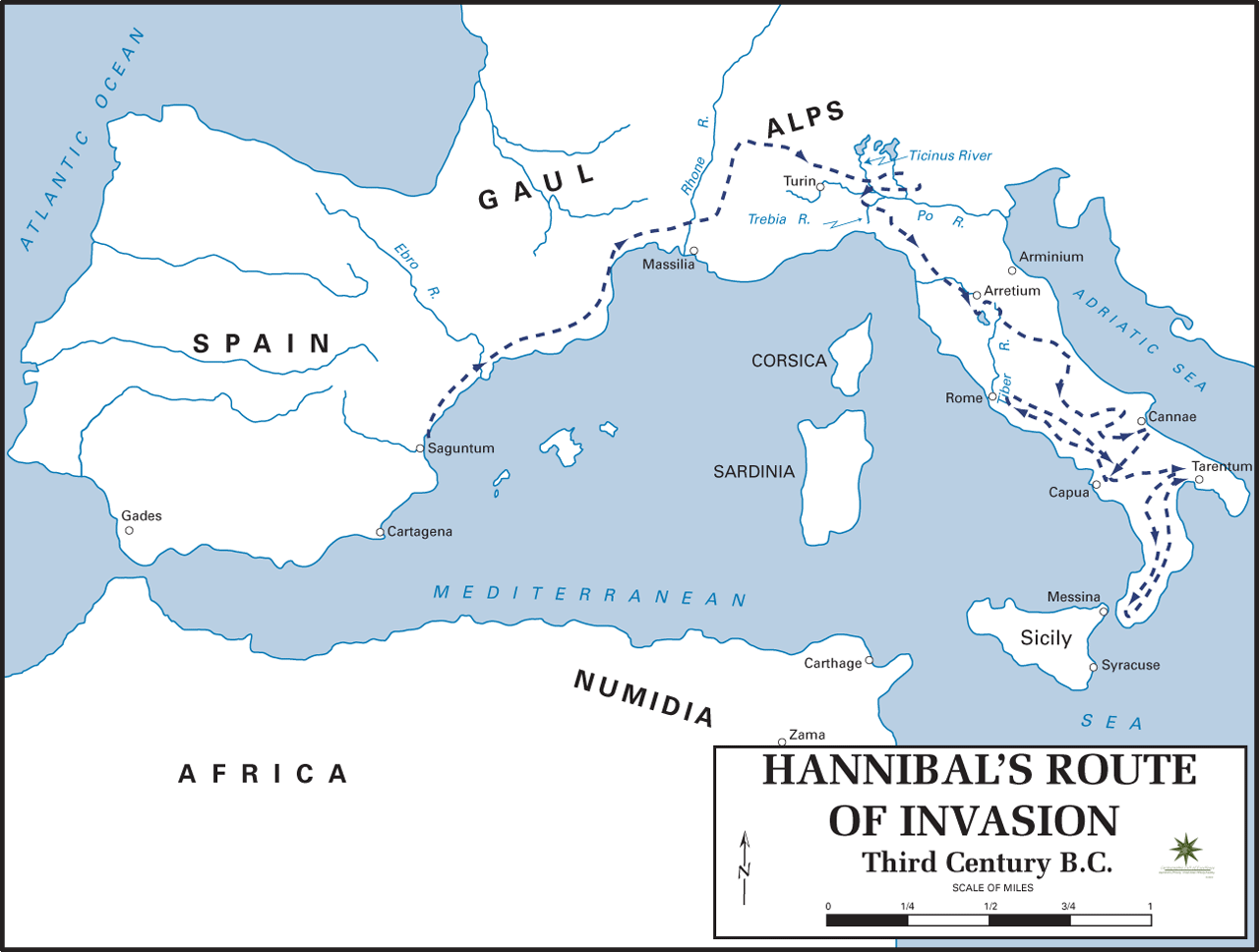
What we see here, obviously, is the western Mediterranean at the time of the Second Punic War (the “Hannibalic War”). Notice Carthage at the tip of northern Africa (in today’s Tunisia); Cartagena or “Little Carthage” in Spain, which I mentioned in an earlier post; Gades, which is today’s Cadiz; Saguntum (Sagunto), which was ethnically Greek; Massilia (today’s Marseilles), also ethnically Greek; Turin (Torino) which was not yet party of “Italy” but part of Gaul; and Ariminum (Rimini), the Roman colony at the edge of their frontier with the Gauls.
Now look at Hannibal’s march itself. In 218 BCE he crossed the Pyrenees and into Gaul. The line casually crosses the Rhone, even though this involved one of the most colorful operations in history (of which more in a later post–think elephants on rafts), and then, equally casually, crosses the Alps (of which much, much more in later posts).
You then see where Hannibal won his famous victories, at the Ticinus (more of a skirmish), at the Trebia, at Lake Trasimene and at Cannae. And then you see the line of his path getting…. confusing!
Now the less obvious way of looking at this map: Squint! As you squint, look only at the line of the march. It is a fitting life trajectory for Hannibal himself. It rises early and steeply, peaks, then declines and loses itself completely in a confused and erratic hairball.
How would you draw the map if it were proportionate to time, rather than distance? The entire stretch from Cartagena to Cannae, his greatest victory, took a little over two years. All the twists and turns after Cannae (there were actually far too many to draw on a map) took…. fourteen years!
After those fourteen years, Hannibal lived another nineteen years until he committed suicide, but most of that took place on a different map, in the eastern Mediterranean.
And yet, if you read the existing histories, you would think that 90% of Hannibal’s life took place in those initial two years.
Those years are the impostor years. The next thirty-three are the story of how and why he realized that his triumphs had been impostors. And this, in my book, is where his life becomes universal and directly relevant for our own lives today.
Now, let’s have even more fun and turn the map around:

Now you have, more or less, the life trajectory of the Romans, in particular Fabius and Scipio, my two other main characters.
Kipling’s impostors, you see, visited with them in mirror image.
Why and how did all this happen over all those decades? In exactly the same way as it happens to most of us in our much smaller(-seeming) lives, it turns out. That’s why I’m writing a book about it.

 Hannibal and Me: life lessons from history