Gladwell reviews a book: what happens to it?

My wife and I were talking about Malcolm Gladwell’s review of Chris Anderson’s new book, Free: The Future of a Radical Price. We were trying to decide whether the review was merely lukewarm or devastating. Here is Gladwell’s last sentence:

The only iron law here is the one too obvious to write a book about, which is that the digital age has so transformed the ways in which things are made and sold that there are no iron laws.

Ouch. That seems to be Gladwell’s way of saying that the book should not have been written, because to be correct it would have had to be too obvious, and to be non-obvious it ended up being non-correct.

(And this in an industry with a preponderance of  inappropriately positive reviews.)

This is of interest to me for two reasons:

  1. My own book will soon come out (no, I don’t yet know exactly when), and I hope to have reviews, and above all good reviews, and simultaneously wonder how I would deal with bad reviews.
  2. Chris is a former colleague of mine at The Economist (he is now editor of Wired), and we are friends. Gladwell, on the other hand, is as close as you get in the writing world to a celebrity.

Chris has already responded to the review, in a remarkably measured tone. I couldn’t help but notice the parenthetical phrase

… Gladwell (who, by the way, I both like and admire, so let’s call this an intellectual debate between corporate cousins)…

The “corporate cousins” reference is to the relationship between the New Yorker and Wired, both of which are owned by Condé Nast. But I couldn’t help but wonder whether the “both like and admire” bit, which is indubitably true, was put there with the subtext “please don’t hurt me even more”.

Bookmark and Share

Elitism: Socrates’ Athens to Palin’s America

Snob

Snob

Socrates was a snob, an unabashed elitist. How I love him.

Now, I know it’s not fashionable to be an elitist in today’s America–every four years, a Palinesque figure emerges to tell you that you don’t belong to “real America”. Elites, in some vague and unspecified way, then become those people out there who conspire to keep the honest folks down.

Socrates had none of it, and he too eventually ran into the Palin faction of his time. So this is yet another way in which Socrates, with his life and thought and personality, speaks to us across the ages, as we are discovering in this thread.

The mob and the experts

As ever, we must see Athens as his analog of America. So how did the Athenians see themselves? Above all, as free. Their word for their city was polis, a free and self-governing state. That’s where we get our word politics.

So the non-slave, male Athenians of a certain class lounged around the Acropolis and Agora, debating in their assemblies and deliberating in their huge juries–participating in this and that and every way.

To Socrates they were a dumb herd of sheep. It’s not that he was against democracy per se. It’s just that, as I.F. Stone puts it in his work of investigative journalism about the trial of Socrates (about which more in later posts), Socrates believed in

rule neither by the few nor the many but by the one who knows.

In short, he was neither oligarch nor democrat, but elitist! An Athenian, he always loved and admired Sparta, the elitist enemy of Athens.

(The orginal Greek meaning of aristocrat was “rule of the best”, similar to our meritocrat. How strange that we need to mix Latin and Greek roots together to understand a word properly. See: television.)

So Socrates thought it was just as ridiculous for the Athenians to expect masons and smiths to “govern” and “judge” in the assembly and jury-courts as it would be for them to hire a mason to build a ship. Obviously, they’d get a shipwright. So too they should get a properly qualified statesman for the ship of state.

Better, therefore, to look for the best, then train them, then pick the best again, then train them even more. What you are doing is eligere in Latin, to elect in English, élire in French, and that last variant is where elite comes from.

Americans in particular love this kind of market selection. When they step onto plane and hear from the pilot, when they send in the Marines overseas, when they appoint and compensate CEOs, they are proudly rooting for members of the respective elite.

Just don’t tell Americans that they love elites. When it comes to politics, nothing has changed since, well, the polis. Some sort of Nietzschean slave morality, a ressentiment against anybody who might think of himself as uppity, seizes Americans. This is when you get, say, billionaires posing for the cameras chowing hot dogs and slurping beers, to prove that they are ordinary enough to be president.

The downside of Socrates’ elitism, if we had ever tried to put his ideas into practice, may have been that we would have got a totalitarian society. Indeed, that’s not good.

The downside for Socrates personally was that they gave him hemlock. We’ll get to that.

Bookmark and Share

A theory of failure

IMG_0327

As you may have noticed, The Hannibal Blog has been unusually quiet for a couple of days. That’s because I had to move the family to a new city, as part of my new beat at The Economist. Well, I’ve moved a good dozen times in my life, as has my wife, so we have more than a score of moves between us. We’re pros. Except not.

This was our first move with children. (If you don’t have any, you don’t know why I would bother to point this out.)

Now, as regular readers know, The Hannibal Blog can be relied upon to put forth profound analysis of important things; or, depending on availability, profound analysis of things; or, barring that, analysis of things.

So let me put forth a tentative theory of failure:

  1. The probability of failure increases with the number of permutations (see: complexity).
  2. Once the number of permutations rises above eight or nine, failure is assured.
  3. Thereafter, the devastation of the failure increases with the number of permutations.
  4. Eventually (this is the only good news) it doesn’t matter anymore, or seems not to.

PS: You obviously got me on that kind of day. For a more illuminating theory of failure (and success), wait for the book. 😉
Bookmark and Share

More trouble with “truth”: Religion

In opening this thread on Socrates and his relevance to our modern lives, I mentioned “an oddly serendipitous string of events”: Several of you had, independently, emailed me with links and thoughts that, directly or indirectly, touched on issues that Socrates raised.

Here is one example, which segues from the previous post on Socrates’ negativity, his apparent sacrifice of gentleness at the altar of unvarnished truth. A few weeks ago, Joel Rotem, a reader of The Hannibal Blog, emailed me this TED talk of theologist Karen Armstrong, in which she puts forth a theory of “good” religiosity. Joel was sceptical and asked philosophically:

Is it OK to misinform your listeners in order to get to a noble target? Do the ends justify the means?


As you see, Armstrong wants to persuade us that religion is not really about “believing” this or that, but about behaving in a certain way: with compassion. All religions, she argues, have at their core a version of the Golden Rule (“Do unto others as you would have them do unto you”). Hatred, she infers, is alien to true religiosity and a form of “hijacking” religion.

Now, this is of course a Rorschach test of sorts. Those who would like to exonerate religion will tend to confabulate ways to agree with Armstrong, those who would like to indict religion will do the opposite. Joel is in the later camp, as I tend to be. But that is not the point.

The point, as Joel said in our impromptu debate (because Socratic dialectic seems to come naturally and effortlessly to readers of The Hannibal Blog ;)) is this same tension between true and good that got Socrates into so much trouble. Joel’s words:

In western thought, we often equate truth with good (both very subjective terms). Telling the truth is good. Lying is bad. We must always strive to reveal the truth. We have book and movies dedicated to heroes struggling to reveal the truth. Some of our (my) heroes fighting to reveal the truth include: Woodward and Bernstein, Galileo and hey, how about that Superman guy fighting for truth, justice and the American way. Seems pretty open and shut until you listen to a Karen Armstrong. Is it better to paint Islam as the religion of humility and peace or to [point to] Islam’s bloody roots and doctrines?

Joel did not single out Islam but implicated all religions. He then listed other topics, beyond religion, where “truth” will get you into a world of hurt. For instance, race: What if we were to discover a truth that we would find just too apalling to entertain? We seem to need lies to maintain civilization. The problem, as Joel said,

is of course the slippery slope. Who says what lies we should believe for the common good?


Bookmark and Share

The original “gadfly”: Socrates’ negativity

783px-Horse_fly_Tabanus_2

Socrates saw himself as “a gadfly to a horse”, where the horse was Athens–a “sluggish horse” in need of a bit of “stinging”. This the origin of our cliché. As we keep discovering in this thread on Socrates, the old man is still with us all the time, whether we are aware of it or not.

Socrates also liked to compare himself to a midwife. (Perhaps that metaphor came to him because his mother was a midwife.) What he meant by it was that, through his dialectical questioning and conversation, he “birthed” the thoughts that his conversation partners were already pregnant with. Put differently: He felt that he brought something out of people: he led (Latin ducare) something out (ex), ie educated.

But how did others see him?

Cicero, a few centuries later, said that Socrates practiced a “purely negative dialectic which refrains from pronouncing any positive judgment.”

Hippias, one of the sophists (teachers) Socrates interrogated, said that “You mock at others, questioning and examining everybody, and never willing to render an account yourself or to state an opinion about anything.”

Meno, another conversation “partner”, tells Socrates that “You are extremely like the flat torpedo sea-fish; for it benumbs anyone who approaches and touches it… For in truth I feel my soul and my tongue quite benumbed.”

In short, it is hard to avoid concluding that Socrates left everybody feeling bad. If you were lucky, he merely belittled or embarrassed you; if you were unlucky, he exposed and humiliated you. He never made anybody feel confident or good. In our lingo, he left everybody 😦 and nobody 🙂 .

What if Socrates had talked to Patanjali?

This is quite worth thinking about.

You recall that Patanjali was my nomination for the title of “the world’s greatest thinker ever“. He was the original sage of Ashtanga Yoga. Which is to say: Whereas the Bhagavad Gita outlines Ashtanga Yoga (which it calls “Raja Yoga”: “regal union” or “kingly discipline”) in a narrative form, Patanjali was the first to analyze the “how to”, step by step.

As it happens, he had a lot to say about something that Socrates valued: truth, or Satya in Sanskrit. It is one of the Yamas, or ethical principles, that yogis must adhere to if they want to embark on the journey that leads to enlightenment. Don’t lie, in Commandment language, to others or yourself.

But Patanjali is more subtle than Socrates. Another of the Yamas is Ahimsa, non-violence: Don’t hurt people (others or yourself), physically or psychologically.

The subtlety lies in understanding that Satya and Ahimsa, truth and gentleness, often conflict. It may be true that you are ugly, but do I need to tell you that and hurt you? In Socrates’ case, it may have been true that his interlocutors were, if not ignorant, at least far less wise than they pretended. But did he need to humiliate them publicly?

There was widespread consensus that his negativity helped the cause of truth only insofar as it tore down certain falsehoods. That’s a step forward! But Socrates did not then build on the rubble with a positive truth.

Patanjali might ask Socrates: What, sir, were you trying to accomplish by humiliating your opponents in your dialectic? Did you not forget your own distinction between eristic dialogue, in which the parties try to win, and proper dialectic, which brings people closer together in the common search for truth?

Sometimes, in life and world history, one must be violent in the name of truth. Other times truth is not worth violence. There must be a higher purpose, a positive goal. Otherwise a gadfly is just another gnat that bites to feed on the blood of others.

Bookmark and Share

Socrates and the original think tank

Aristophanes

Aristophanes

And so we continue this thread on Socrates, and the profound ways that he is still with us today.

We’ve been looking at his ideas about conversations, good and bad, and his skepticism toward writing (as opposed to oral conversation). But what did this in fact lead to, in practical terms?

It led to a weird, perambulatory kind of school, as Socrates walked around with various people, mostly younger, engrossed in conversation. This would ultimately get him in trouble, of course. But before it got him killed, it merely raised eyebrows.

Aristophanes, the greatest comedian of ancient Greece and Socrates’ most cutting parodist, invented a word for this kind of purposeful and moderated conversation, in his play the Clouds: a thinkery (phrontisterion).

A think tank, in other words.

Indeed, think tanks are among Socrates’ legacies. His student Plato took over a grove dedicated to Athena, the goddess of wisdom, and founded his Academy, which lasted for three hundred years, throughout the entire Hellenistic era.

One of the people perambulating and thinking and conversing at that Academy was Aristotle, who eventually took over another grove, dedicated to Apollo, the god of wisdom (and other things), and also started a think tank, called the Lyceum.

In time, Academy and Lyceum became the roots for “school” in many languages, depending on whether the insitution leant toward Platonism or Aristotelianism. But the more direct descendants today might be the likes of Heritage, Cato and Tellus.

But we’re getting ahead of ourselves. We need to start looking at whether Socrates actually practiced what he preached in his peculiar style of conversation. Stay tuned.

Bookmark and Share

Was Jesus black, Jewish or female?

Willie Brown

Willie Brown

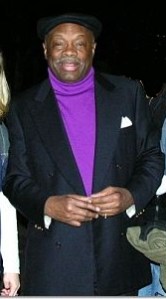
Willie Brown, the only black mayor San Francisco has every had, as well as a California state assemblyman for donkey’s years, many of them as speaker, tells a good joke in his latest column:

There are three good arguments that Jesus was black: He called everyone brother, he liked gospel, and he didn’t get a fair trial.

But then, there are three equally good arguments that Jesus was Jewish: He went into his father’s business, he lived at home until he was 33, and his mother was sure he was God.

But then, there are three equally good arguments that Jesus was Californian: He never cut his hair, he walked around barefoot, and he started a new religion.

But most compelling of all are the three arguments that Jesus was a woman:

He fed a crowd at a moment’s notice. He kept trying to get a message across to a bunch of men who just didn’t get it. And even when he was dead, he had to get up because there was work to do.


Bookmark and Share

The Atlantic on the success of The Economist

Michael Hirschorn

Michael Hirschorn

Our success at The Economist continues to baffle and intrigue an entire industry.

Where some postulate that it is our tone (analogous to coffee beans “shat out be a civet cat“), others are analyzing our position as simultaneously niche and global, which is no longer oxymoronic but suddenly à la mode.

Michael Hirschorn in The Atlantic is the latest. As he puts it,

The Economist has become an arbiter of right-thinking opinion (free-market right-center, if you want to be technical about it; with a dose of left-center social progressivism) at a time when arbiters in general are in ill favor.

This is the American part of any article about us, which is always amusing, since there is a one-word synonym for the convoluted phrase “free-market right-center, if you want to be technical about it; with a dose of left-center social progressivism”: That word is liberal.

But Hirschorn is really interested in why we are doing well when Time and Newsweek, which are trying to copy us, are not.

The easy lesson might be that quality wins out. The Economist is truly a remarkable invention—a weekly newspaper, as it calls itself, that canvasses the globe with an assurance that no one else can match. Where else, really, can you actually keep up with Africa? But even as The Economist signals its gravitas with every strenuously reader-unfriendly page, it has never been quite as brilliant as its more devoted fans would have the rest of us believe. (Though, one must add, nor is it as shallow as its detractors would tell you it is.)

Here he is expressing what I’ve observed to be a persistent sour-grapes, cringing, squinting snobbishness toward The Economist from American journalists at the “good” publications: They always feel compelled to call us “smug”.

Indeed, he does:

At its worst, the writing can be shoddy, thin research supporting smug hypotheses.

I don’t actually disagree. But Hirschorn then comes around to what I’ve been saying internally at The Economist for a while now:

The Economist prides itself on cleverly distilling the world into a reasonably compact survey. Another word for this is blogging, or at least what blogging might be after it matures.

This of course leads to an irony that we at The Economist all savor:

For a magazine that effectively blogged avant la lettre, The Economist has never had much digital savvy…. most of the magazine’s readers seem to have no idea the site exists. While other publications whore themselves to Google, The Huffington Post, and the Drudge Report, almost no one links to The Economist. It sits primly apart from the orgy of link love elsewhere on the Web.

As it happens, this missing “link love” was the topic of my presentation at our internal powwow last fall in Danesfield. The title of my talk was “Google Juice”. I was offering thoughts on how to increase our link love, but Hirschorn thinks that our relative dearth of it

turns out to have been a lucky accident. Unlike practically all other media “brands,” The Economist remains primarily a print product, and it is valued accordingly. …

By that he means that we are really friggin’ expensive. He then signs off with an interesting thought:

General-interest is out; niche is in. The irony, as restaurateurs and club-owners and sneaker companies and Facebook and Martha Stewart know—and as The Economist demonstrates, week in and week out—is that niche is sometimes the smartest way to take over the world.

I like that. That’s exactly what I might try to do when my book comes out.

Bookmark and Share

The spoken and the written word

Socrates_teaching

So Socrates loved good conversations, which he called dialectic, and disdained bad conversations, which he called eristic, as I described in the previous post of this series on Socrates. But that actually opens up lots and lots of fascinating and difficult issues.

For instance: the relative value of the spoken and the written word.

Since I happen to write words for a living, I spend quite a bit of time pondering this, as you might imagine.

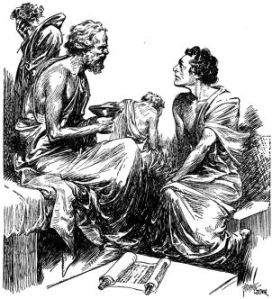
Socrates never wrote a single word. He did not believe in it. Why waste your time killing words (since to write them down was, to him, to kill them) when you could send them back and forth in intimate conversation such as the scene (with him on the left) above?

His student Plato was more schizophrenic on the point. He agreed with Socrates but also, obviously, felt that he should write things down to make them immortal, to reach more people, to make Socrates’ wisdom ‘scalable’ in our lingo. So he compromised, you see: He “wrote” by transcribing … conversations!

One generation on, and we get to Aristotle, who clearly did not agree at all, and wrote what we would consider genuine philosophical treatises. No qualms about the written word at all!

Why did Socrates disdain the written word?

He sort of tells us in one of his (ie, Plato’s) dialogues, the Phaedrus. He takes several shots:

  • He tells a legend from Egypt, in which a god gives a king the gift of writing as an aid to memory. The king, however, observes that writing things down is likely to be a remedy for reminding, at the expense of remembering, and thus will lead to less wisdom, not more.
  • He then compares writing to paintings, which “remain most solemnly silent” whenever you question them, and just say the same thing over and over, stupidly and dumbly. People wise and ignorant alike will look at them and understand and misunderstand them. And they (the words/pictures) cannot talk back, defend themselves, explain themselves.

So text has several problems, in Socrates’ opinion:

  1. It is not a conversation, not dialectic, because it cannot go back and forth and climb toward something higher, such as a truth.
  2. An author has no control over what idiots or assholes might read his text, whereas somebody in oral conversation does control with whom he speaks.
  3. Words outside of their original context (ie the intention of the person using them, and the way a listener might hear them) can mean anything, and thus nothing at all.

Ultimately, Socrates disdained writing for a subtler reason that unifies all these points: It’s just not what life is about!

Instead, life is about communing with others and discovering yourself and truths in conversation. Not about recording this or that, or propagating this or that. Socrates believed that you can’t find yourself when you write, only when you converse.

Where does that leave us writers?

In a tight spot, it would seem.

Then again, we have moved on 2,400 years, and few things are becoming clearer. Here is how I would converse with Socrates on the matter if he were to visit us today:

The need for conversation…

First, I would tell him that he is mostly right, even and especially for writers. Only a tiny part of “writing” consists of typing words–5%, if I had to guess. The other 95% consists of living, experiencing, interviewing, discussing, talking, reading what others have written, and so on. The ideas and stories that end up on pages don’t come out of nowhere. They still come out of conversations.

… but also for order

But writing, which should never replace conversation, has something to contribute: order. Real conversations–and Socrates’ own dialogue with Phaedrus is a great example–run all over the place, like foals on a meadow. That’s the fun. But it can also be frustrating when you want structure and discipline about one particular issue. Writing can simply be a way of forcing yourself to structure the thoughts that came up in conversations.

Why not written conversation?

This is one bit that Socrates overlooked. You can converse in written form.

Some of the greatest conversations in history have been exchanges of letters. Just think of Voltaire and Frederick the Great.

Today there is a fascinating technological twist. In 400 BCE, it was impossible to imagine ‘place-shifting’ (via tele-phony, far-hearing) or time-shifting conversations. But time-shifting is exactly what we do when we …. blog!. I write words, and those then turn into conversations in the comments below, or on other blogs that link to them. So the words are not dead at all. They can talk back. Writing can be conversation.

Indeed, by time-shifting the back-and-forth of a real conversation, the dialectic can become better. All of the people who talked to Socrates must have felt, a few hours later: “Doh! If only I had said…..” Well, now it’s possible to take a moment to think–without the distractions of, say, a famously ugly face such as Socrates’, or body odor, or wind, or sun–and then to come back with a clearer thought.

The inevitability of context

But Socrates was right on at least one point: The written word without context, as provided by conversation, is treacherous. Just take this notorious example, which we call the 2nd Amendment:

A well regulated Militia, being necessary to the security of a free State, the right of the people to keep and bear Arms, shall not be infringed.

Does that mean that a people has the right to keep an armed militia, or that every shmuck in the people individually has a right to bear everything from a pocket knife to nukes, whether there is a militia anywhere to be seen or not?

Socrates would find the author and … converse!

Bookmark and Share