The “rabbit” in a marathon (and healthcare)

321_marathon_runners

I was talking yesterday to Eron Ferreira, a former marathon runner. Eron is Brazilian, grew up poor and could not afford shoes, so he ran barefoot, as many Kenyans do. Later, when he was able to afford shoes he realized that they were soft, mushy and pointless, so he kept running barefoot. But he still had to make a living, and in the 1990s he did that by being a “rabbit“.

Now bear with me: As Eron was telling me about his time as a rabbit, I suddenly understood why Obama’s health care plan, which includes a controversial public-sector insurance option alongside private plans, is correct.

In the context of marathons, Eron explained to me, a rabbit is somebody whom the event organizer pays to run quite fast for the first half of the race. It is understood that the rabbit wears himself out this way, and he can stop running in the second half.

Now, why would the event organizer do such a silly thing–ie, pay somebody … to run fast in a running race? (!)

Apparently, because without such a pace setter, the other runners would hang back tactically and not run fast. It would be boring for the spectators. It would be bad sport. In any other industry, including health care, we would call this a market failure. In theory, it should not happen, but in practice, it does.

1) Success for Eron

In Eron’s case, this once led to his big break in life. One day, during a marathon in France, he was being a rabbit and running quite fast for the first half. He felt great that day, and it occurred to him that he did not technically need to stop, or even to slow down, at all. All the other runners knew he was “just the rabbit”, so they had allowed him to get ahead a bit. Eron looked back, saw that they were far behind him, and just kept going till … he won!

2) Success for health care

And what does this have to do with Obama’s health care proposals? Well, you may have heard that the health care industry and Republicans are preparing to gun down his plan because it will have a new, public insurance option alongside private health insurers. How un-American! How unfair for the private insurers! How socialist!

(For my general thoughts about health care, look here.)

Need I say more? In theory, all the private health insurers should be running fast to win the marathon and make spectators happy. In practice, they are all hanging back tactically. What this sport needs …. is a rabbit!
Bookmark and Share

Life in the taxi to Treasure Island

“If you absolutely need to put it in the GPS, please pull over,” I said from the back seat. “You’ll kill us if you do it while getting on the highway. Besides, I’ll guide you all the way.”

“Sorry, you’re right,” he said with a polite and embarrassed voice. “It’s just that I’m new to driving a taxi, and I feel more confident if she guides me.”

After an endless and grueling travel day, with tight meetings and rental cars and wrong on-ramps and security checks and delays and an unexplained nose bleed at the most inopportune moment, I had finally landed and was on my way home to wife and kids. Only minutes separated me from them now. I wanted to speed it up.

But I couldn’t help noticing the taxi driver. He looked Middle-Eastern, twenty-something, intelligent and curious, tastefully dressed, out of place outside the empty, dark Oakland airport terminal.

“I’ll show you the shortcut to the Berkeley hills,” I said from my back seat, talking to his rear view mirror. “It’ll come in handy for future rides.”

“Thanks. That would be nice,” he said, smiling back into the mirror.

“If you’re new to driving a taxi, what were you doing before?” I asked.

I had just finished The Grapes of Wrath on the plane, that classic about suffering and dignity in Great-Depression California. Was this–the life I saw in the rear view mirror–such a tale in the making?

“I moved here from Minnesota to take the bar exam,” he said. “But I failed. 55% failed. I was one of them.”

“Try again,” I said.

“I will,” he said. “The next one is in July. That’s why I took this job. It doesn’t pay much. But I spend so much time sitting in front of the airport that I get to study and read.”

“Can you pay your bills?”

“Not at the moment. They told me that Oakland canceled half its flights. And there are so many of us driving cabs these days. Plus, there is this cab monopoly in Oakland. You lease the car from them; they get paid no matter what. There’s nothing left over after expenses.”

The missed exit

“Shit,” I said. “I was so absorbed in our conversation that I missed the exit I was going to show you. We’re already in the port.”

“I’m so sorry,” he said. “I’m turning off the meter. This was my fault. I’m really sorry.”

“Don’t touch the meter,” I said. “I said I was going to guide you. There is one other exit we can take. I should have … There! Take that exit now…”

We were already in the chevrons of the exit. He would have one split second to decide whether to swerve out. He stayed the course. We went past it.

“I’m so sorry,” he said. “Now I’m turning off the meter. I feel terrible. This is embarrassing. I’m not good at this job yet.”

“Looks like we’re going over the bridge to San Francisco,” I said.

Philosophy between exits

For a few moments, as the car wound down the lonely turnpike through a dark and dangerous-looking Oakland port, we sat there silent. He felt terrible and did not want to be here, neither in the big sense–driving a taxi for a living–nor in the small sense–going to the wrong city with the meter off.

In the backseat, I felt annoyance rising. I had prepared mentally to be home now, kissing my children in their sleep. It would take a lot longer now. I had a headache and chapped lips. I did not want to be here.

Then I had a clarifying thought. This might well get a lot worse. My driver was terrified with embarrassment. We had, together, already compounded one mistake with a second–although he had saved us from something far worse by not swerving. If he remained mortified and I annoyed, we were likely to make several more mistakes now.

I thought of several of the characters in my book who met with disaster in life. Often, things had first taken a turn for the barely-noticeably worse, which they had found intolerable and made much, much worse, unnecessarily worse, irreversibly worse.

“You did the right thing back there,” I said. “You kept your cool. That was good driving.”

“I still feel terrible,” he said. “I’m paying the toll.”

“Never mind the toll,” I said, pressing a bill into his hand. “I know the flat rate between Oakland and my house. I’m paying that and a tip. Now let’s concentrate on not making this worse.”

He started fiddling with his GPS. “I’d feel better if I heard her talking to us.”

“There might be a way we could cut this short,” I said. “There is this little island, Yerba Buena or Treasure Island or whatever, between Oakland and San Francisco. I’ve never got off that exit, but I’m sure we could get around to the lower deck and head back to Oakland.”

“OK, if you think so.”

Silently, we took the exit onto the island.

The foggy windshield

“Thanks for being cool about this,” he said as we turned into a dimly lit hairpin turn. There was a cop car pulling somebody over. Otherwise, everything was black and empty now.

“I’ve done far worse in new jobs in my time,” I said.

We kept going. We had no idea where we were. He was leaning forward, hyper-alert, with all his adrenalin glands open. He was scared to take his eyes off the road. I noticed that our windows were fogging up and we could barely see. Would I humiliate and stress him by saying something?

“Is that our turn?” he asked.

“No idea,” I said. “Doesn’t look like a real street.”

Now we were down by the water. Everything was empty, except for a few people having some sort of get-together. Some boys, some girls. Tacky clothes. A stretch limo. Jewelry on the men. I looked in the rear view mirror and saw that my driver was scared.

“We missed it,” he said. “I’m doing a U-turn.”

“Sounds good,” I said.

We went back. The on-ramp to Oakland was closed and barricaded.

He stopped the car. We were all alone, under the bridge. I was scared now, because I could see that he was really agitated. I decided that I had a role in this. I would calm him and give him confidence, because he had to drive me home.

“Never mind,” I said. “Let’s go back again to the water and ask. Maybe we can find the treasure on the island.”

He gave me a nervous smile in the mirror, backed up and went back to the water.

“I’ll ask one of these guys,” I said. “No, I should probably do that,” he said. “Sure,” I said. He had dignity and I liked it.

I watched him exchange a few words outside, then he jumped back in.

“We can only go to San Francisco,” he said.

“That’s where we should have gone in the first place,” I said. “My mistake for taking the exit. By the way, your windshield is fogged up.”

“Oh, yes. Thank you.” He blasted the hot air onto the window and we moved off.

Finding the right turn

Soon we were back on the bridge, going to San Francisco. Away from our destination but relieved. It would take a while longer now, and I could see that he was afraid of making yet more mistakes, afraid that this night would never end.

“Let’s shut up completely and just concentrate on the road and the next turn,” I said.

“Yes. Thanks.”

Thanks? He really seemed grateful. I could see him relax. Perhaps he felt that I was taking the pressure off.

We stayed silent for a long time.

“I know the San Francisco exit like the back of my hand,” I said, “but I think you’d feel better hearing her.”

He smiled into the rear view mirror and then typed some Oakland address into his GPS from the device’s memory. That universal female voice that soothes all male drivers and never criticizes said “Prepare to exit on the right.”

Before long we were at last heading in the right direction. “You did great,” I said. “You kept your cool. There were actually about ten or twenty worse mistakes we could have made.”

“Thanks for saying that.”

“Why did you leave Minnesota?” I asked. “Is the recession even worse there?”

“I just thought there would be more opportunity here. I’m interested in immigration law and bankruptcy. I’m on file with all the temp agencies, but there are no legal jobs at all right now.”

“I can get out here,” I said in the Berkeley hills. I shoved a few bills into his hand, rolled together so that he could not count them right away. “A receipt please.”

He gave me receipt but did not fill it out.

“Good luck with the exam in July. You’ll be a good lawyer,” I said.

“Thank you so much,” he said. “So much.” He waved as I went up the hill.

Bookmark and Share

Postcard from (yet another) Mount Olymp

This is where I am at the moment.

In Rome, you ask? The home of Scipio, one of the two heroes in my coming book? The place that Hannibal almost took, almost destroyed, but not quite, and which, as a direct result, took over the world–our modern world–instead?

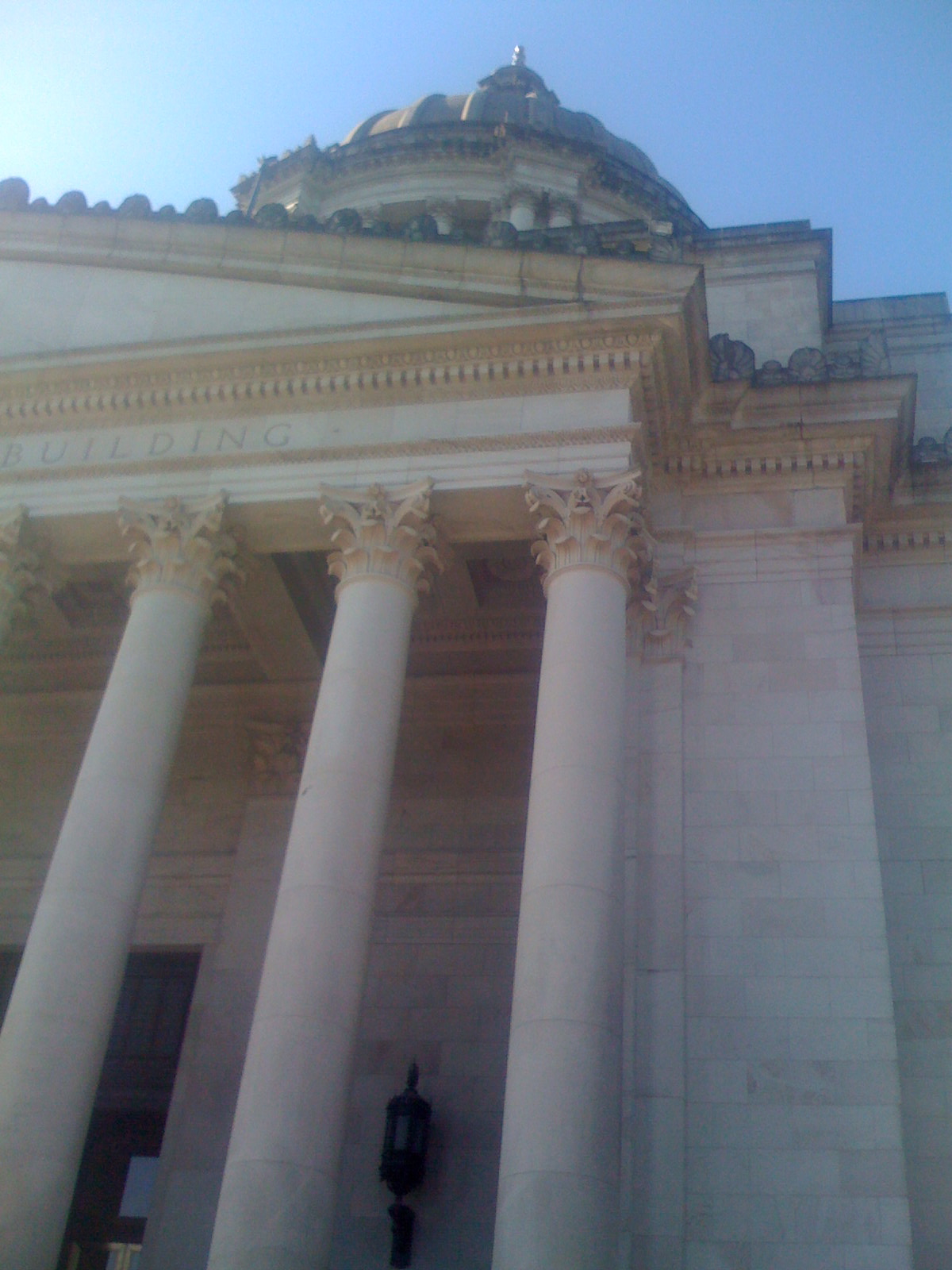
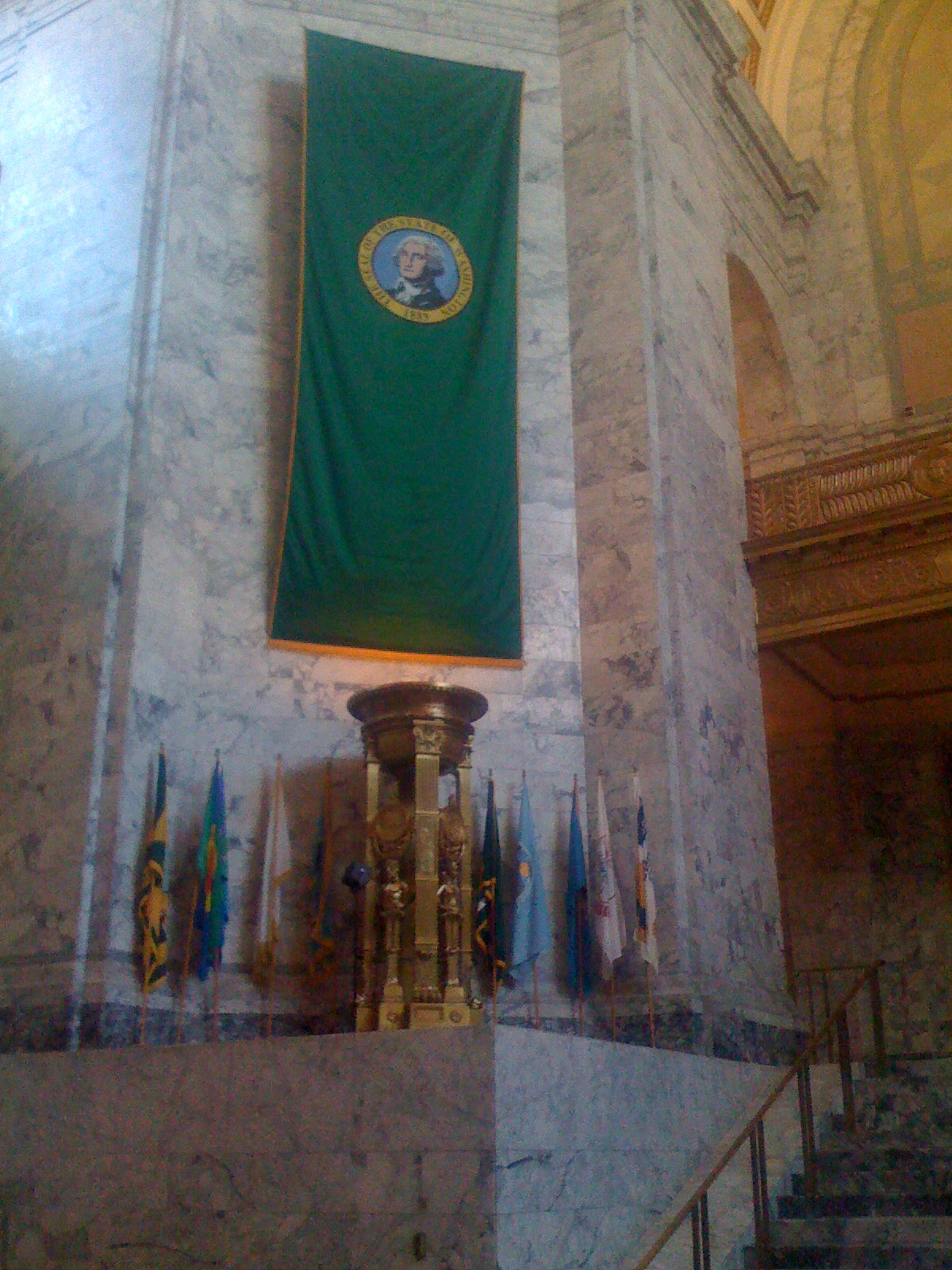
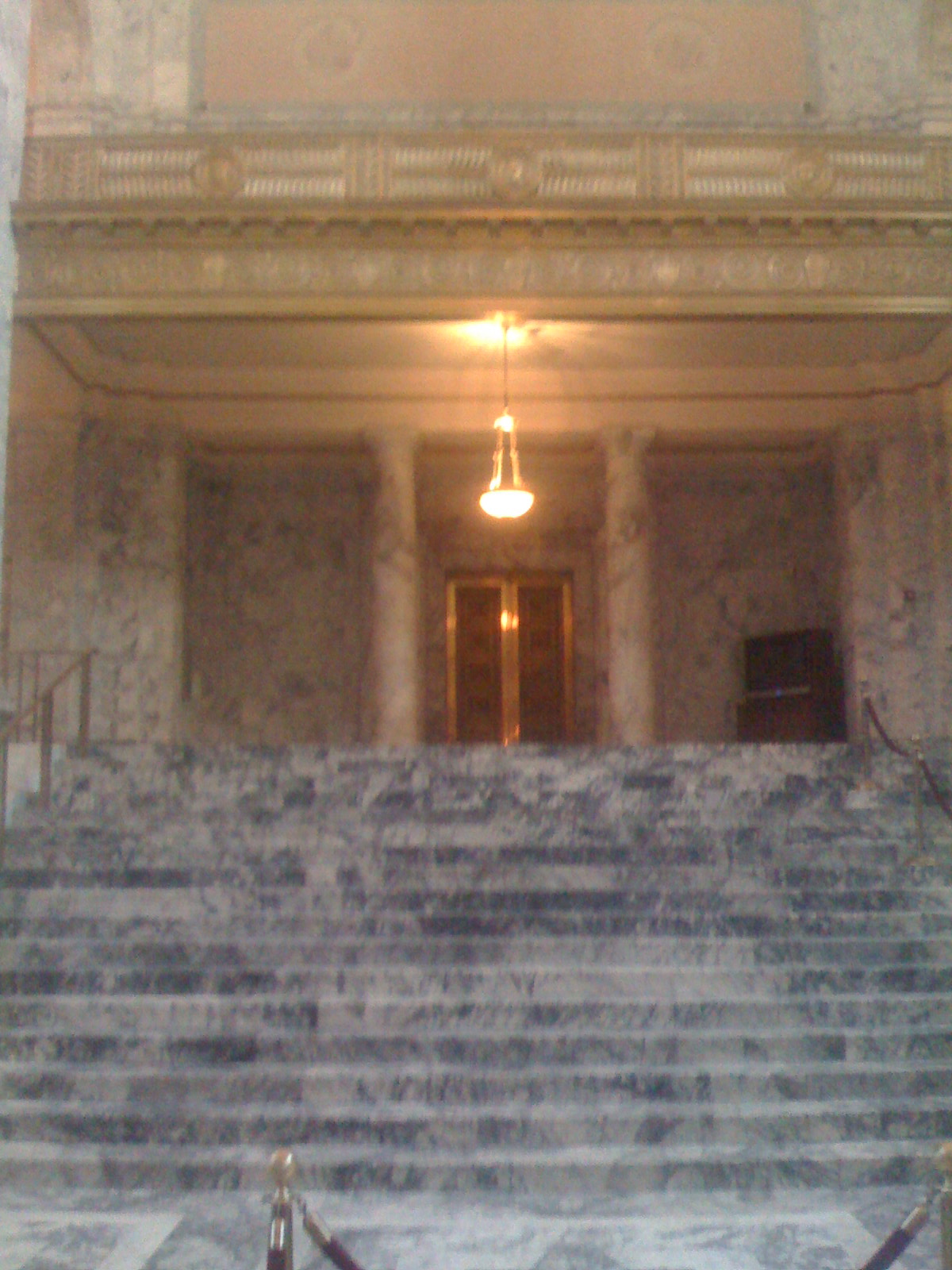
No, actually. I’m in a sleepy little state capital called Olympia. That’s Olympia, as in the abode of the Greco-Roman gods, the place my four-year-old could tell you all about.

Some of the people that I’ve been talking to in these buildings are very aware indeed of the heritage that their architects intended to remind them of, each and every time they walk in and out of their offices. Sam Reed, Washington’s erudite secretary of state (and apparently a direct descendant of Charles Sumner) could go toe to toe with me on Polybius.

Others here look at me blankly when I opine that it must have been quite a controversy to decide between … Doric, Ionic and Corinthian. (But even then they inform me proudly, as three people have now done, that Olympia’s Capitol has the fourth largest masonry dome in the world.)

In any case, I quite savor these improbable links–visual, symbolic, cultural–to our common Western heritage, and to the world of my imagination, peopled as it is with the likes of Fabius, Scipio, Hannibal, Polybius and all the others who are in my book and in our world.

Bookmark and Share

Traveling: Light posting, but pondering Clausewitz…

Yes, Clausewitz. You might have heard of him or not. I intend to convince you that he is relevant to your life….

Stay tuned.

The Economist: “shat out by a civet cat”

An amusing discussion on why The Economist does so well while other magazines are hurting: According to Tom Ascheim, the boss of Newsweek, it is because we:

  • are non-American and thus necessarily global in outlook,
  • have high subscription rates, and
  • snob appeal

But the fun is in this quote attributed to Vanity Fair writer Matt Pressman:

The Economist is like that exotic coffee that comes from beans that have been eaten and shat out undigested by an Indonesian civet cat, and Time and Newsweek are like Starbucks — millions of people enjoy them, but it’s not a point of pride.

Would that make me the shitting civet cat?

Bookmark and Share

Become creative: Leave the country!

Adam Galinsky

Adam Galinsky

William Maddux

William Maddux

I’ve posted quite a bit about creativity, which fascinates me, but it had never occurred to me, until now, that living abroad could enhance it!

So it does, according to two psychologists: William Maddux and Adam Galinsky.

A colleague of mine wrote about their research in The Economist, and others have reported on it before.

Living abroad (as opposed to just traveling, say) makes people more open to new experiences, among other things, Maddux and Galinsky found. That in turn makes people more creative.

I’m thrilled to hear this, of course, because I have been a permanent expat almost all my life.

Other expats:

Indeed, let me add one more:

Hannibal: born in Tunisia; grew up in Spain; succeeded in France, Switzerland and Italy; failed in Tunisia; worked in Syria, Lebanon, Turkey, Greece and Armenia; killed himself in Turkey. Other expats may skip the last step.

Bookmark and Share

A peek under the New Yorker’s kimono

newyorker-logo

For many sophisticated people, heaven is “an uninterrupted day or five to go through my … pile of The New Yorker magazines.” The publication has a special cachet: very different from–though no greater or less than–The Economist‘s, and indeed highly complementary. (We know from research that many coffee tables in many homes have both the New Yorker and The Economist on it.)

So I found myself fascinated by a rare lifting of the New Yorker’s kimono, as Dan Baum, a writer who got fired from the magazine, told his tale. (Thanks to Jag for pointing me to it.)

The first thing of interest is that Baum did this on Twitter. Yes, he tweeted his story in 140-character increments. If I may say so (redoubling my skepticism about Twitter), that part did not work. Twitter may be a great medium for some things, but not for storytelling. But Baum then consolidated the tweets here.

And what a very different culture the New Yorker‘s is from the one I live in at The Economist. First of all, the writers do not make a good living:

you’re not an employee, but rather a contractor. So there’s no health insurance, no 401K, and most of all, no guarantee of a job beyond one year. My gig was a straight dollars-for-words arrangement: 30,000 words a year for $90,000. And the contract was year-to-Year. Every September, I was up for review. Turns out, all New Yorker writers work this way, even the bigfeet.

Why do they put up with it? Apparently, because they are all convinced that

writing for the New Yorker is the ne plus ultra of journalism gigs.

This it may be. Certainly, the New Yorker’s writers can expect to rise to fame with their bylines and become stars, selling books and going on lecture tours. We at The Economist, of course, have no bylines. As a result, we ‘don’t do’ the star thing.

Another contrast: The offices of the New Yorker, according to Baum, are an eerie place where

Everybody whispers. It’s not exactly like being in a library; it’s more like being in a hospital room where somebody is dying. Like someone’s dying, and everybody feels a little guilty about it. There’s a weird tension to the place. If you raise your voice to normal level, heads pop up from cubicles.

That is not how I would describe the merrily eccentric and light-flooded Tower that serves as our head office in London. Is it the time the science correspondent came into the editorial meeting in drag, with nobody even batting an eyelid, that springs to mind? Or the time I had to duck as I passed a senior editor’s office to evade a flying object, dispatched with a scream that made the windows vibrate, only to hear the same editor invite me in with a cheerful and jovial demeanor, since he had just loosened up a bit and now felt envigorated?

The whole way they pitch stories at the New Yorker is one I do not recognize. They apparently write elaborate treatises just for the pitch, then wait to have it rejected or accepted. Baum even puts his successful and failed pitches up on his site. We on the other hand might casually mention or email a half-formed and tongue-in-cheek phrase (something that I might shout through a closing Tube door), and off we go. The other day I was skyping with my editor and said two words (“whither [name]”) under my breath. I just saw it on the official planning list.

But the most subtle and interesting bit in Baum’s account was the psychological tension between him and his editor, which he blames for his firing. They were discussing story ideas, and the writer knew more about his subject than the editor (which is inevitable). Baum thinks he made a mistake, because

I made him feel uninformed.

Granted: Baum got fired and is looking for reasons to apportion blame. But he is not slinging mud. This is the closest he gets to it.

In my twelve years, I cannot remember a single conversation at The Economist where one party felt threatened if the other ‘knew more’ about something. We thrive on talking to people who know more. How boring the obverse tends to be.

I am a fan of The New Yorker. It is a special place. So are we.

Bookmark and Share

Croesus learns about success and happiness

800px-Claude_Vignon_Croesus

I mentioned that A.E. Housman might have got the idea for his poem, To An Athlete Dying Young, from his study of the classics, in particular Herodotus. I had one particular story from Herodotus in mind when I said that. It is the story of King Croesus.

(The story almost made it into my coming book about success and failure in life, but then it got a bit crowded and I cut it out.)

1) Croesus the happy

In the sixth century BCE there was a king named Croesus in Lydia (today’s Turkey). He was so rich that we still today say “rich as Croesus”. But he always wanted confirmation from others that he was indeed the richest, the most successful, the happiest man alive. Why would he need confirmation? One wonders. But people always do.

As it happened, Solon, the man who had given the Athenians their laws and who was the wisest man in Greece at the time, came for a visit. This was exactly the sort of man Croesus wanted to impress.

I paraphrase (the text is here):

Croesus: ‘Welcome Solon. You’re the wisest man in Greece. I’ve heard so much about you. Please take a tour of my palace and look at all the gold and silver, the women and slaves and fruit, and all my splendor. Isn’t it wonderful? Tell me: who is the happiest man in the world?’

Solon: ‘Tellus of Athens, sire.”

Croesus: [Blank look. Silence.] ‘Sorry, but… Who?’

Solon: ‘Tellus, sire. He was this guy who lived when his country was prosperous, and he had two sons and some grandchildren.’

Croesus [still uncomprehending]: ‘Right. So what? What does that have to do with anything?’

Solon: ‘Well, you see, he died on the battlefield, and the Athenians gave him a proper funeral. So he died knowing that everything was good in his life.’

Croesus [rather miffed, irritable]: ‘Well never mind. Who is the second happiest man in the world?’ [smiles and nods, leans forward]

Solon: ‘Cleobis and Bito.’

Croesus [jumpy, shocked]: ‘Who the hell are Cleovice and Vico?’

Solon: ‘Cleobis and Bito, sire. They were these two young lads in Argos. Their mom wanted to go to a festival but couldn’t find any oxen to pull her cart. So the two sons put the yoke on their own necks and pulled the cart to give their mother a ride. The whole town was watching and everybody loved them for it. Their mom was really proud. Later that night, both her sons fell asleep and never woke up. What a wonderful way to die.’

Croesus: ‘You’re supposed to be a wise man, Solon! What is this gibberish you’re talking? I asked you who the happiest man in the world is. Look around, for god’s sake. Look at me! What about me?’

Solon: ‘You? How would I know? You’re doing well right now. But wealth and success don’t last. And what comes next, nobody knows. I will know whether you were successful and happy after you die.’

Croesus thought Solon was a senile idiot and sent him home. Then he went back to enjoying his life.

2) Croesus the miserable

He fell from happiness in stages.

It started with a bad dream. In it, one of his two sons, his favorite, was killed by an iron weapon. Croesus immediately banned all iron weapons and tools from his palace. But his son soon got bored and went with his friends into the woods for a boar hunt. They cornered the boar and one man hurled a spear. It missed the boar and killed the prince. Croesus was devastated.

But he still had his kingdom, his wealth and another son, even though that son was mute. Even so, that was a lot to be happy about.

At this time, Persia was a rising empire in the east, and Croesus wanted to know his future. So he asked the oracle of Apollo some questions:

  • Will my surviving son ever speak? Answer: ‘You will rue the day when he speaks.’
  • Should I launch a preemptive war against the Persians? Answer: ‘If you march, a great kingdom will be destroyed.’
  • How long will I rule? Answer: ‘Until a mule rules over Persia.’

Apollo, you see, always said enough to be interesting and not enough to be helpful. (Ask Oedipus.) Croesus couldn’t figure out the bit about his son at all. He loved the second answer, since he was apparently fated to destroy the Persian kingdom. And he liked the third answer, since the Persians, as far as he knew, did not obey mules.

Off he went to war. The Persians won and stormed Croesus’ city, Sardis. A great kingdom was destroyed.

As the Persian soldiers were running through the streets to slaughter, Croesus took his son by the hand and ran for his life. One Persian grabbed Croesus and flashed his blade. Suddenly the mute boy screamed: “Do not kill him, for this is Croesus, king of the Lydians.” You will rue the day when he speaks.

So Cyrus, the Persian ruler, had Croesus, his defeated enemy, brought before him. Cyrus was half Mede, half Persian–a mutt. A mule.

A pyre was built, and Cyrus took his throne to watch the spectacle. Croesus was about to be burnt alive. The flames were already licking his feet.

Croesus on the pyre

Croesus on the pyre

3) Croesus the wise

Death was near, and Croesus suddenly thought of Solon. He started moaning:

“Solon, Solon, Solon!” “Solon, Solon, Solon!”

Cyrus sat up. What was this man muttering? This was not the name of a god. Just then it started raining. Cyrus looked up. Whatever Croesus was muttering seemed to be effective.

“Stop the fire. Bring him down. I want to ask him a question!”

Croesus was brought before Cyrus.

Cyrus: “Tell me what you were moaning.”

Croesus: “Solon, sire. He was a man who offered me wisdom and I spurned it.”

Cyrus: “What wisdom is that?”

Croesus: “He said to count nobody happy until the end is known.

Cyrus [thoughtful, empathetic, reflective]: “You may have spurned Solon then, but you seem to be a wise man now. I would be foolish to be the one spurning the wisdom now. I will let you live. I want you to be my adviser.”

Bookmark and Share

California as case study in dysfunction

On principle, I do not use The Hannibal Blog to advertise my articles in The Economist, but my piece in the new issue does fit into one of my running threads: ‘the freedom lover’s critique of America‘.

The piece is about “the ungovernable state”–this being California. Consider it a case study that grew out of my thoughts here.

In it, I have fun chronicling the dysfunction, and in the process touch on several themes that I’ve mentioned on this blog before, such as:

My conclusion: I endorse wholeheartedly the growing movement for a Constitutional Convention, which would throw out that ungainly tome and start from scratch to create something clean, elegant and simple.

Bookmark and Share