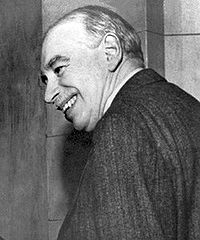
Hayek and Keynes walk into a bar …

Actually, Hayek and Keynes first walk into a hotel, and then into a bar. And they rap.

You have to be a geek to find this amusing, and regular readers of The Hannibal Blog are likely to qualify.

I’ve only mentioned Friedrich von Hayek tangentially so far, and Keynes hardly at all, although both men really belong into my pantheon of great thinkers. In due course, I’ll give them their own posts.

But for now, just enjoy the seven-minute version:


Bookmark and Share

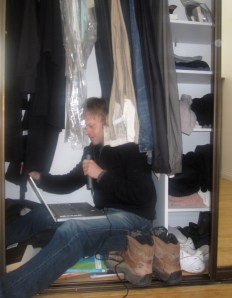
Your correspondent, in his closet

I climbed into our closet yesterday, with a laptop and a Flashmic. This was much less kinky than it might appear. In fact, I did so in the line of duty.

At The Economist, as at most other media organizations, we correspondents are being encouraged to produce occasional videos alongside our reporting pieces. So I did that this week: I wrote a piece about California’s “petition industry” for ballot initiatives, and produced an accompanying video.

Allow me to regale you with the rather comical process involved, and with some observations about technology.

First, I should point out that print journalism is as distant from video journalism as a Bach concerto from a a Salsa bar. You can excel at one and suck at the other. I stipulate that The Economist has been quite good at print for 167 years, but that we have not transferred that success to other media (for instance, when we tried to do television in the 1990s).

That said, multimedia seems to be the future, so it makes sense for us to buy a call option (ie, to risk a small amount for the potential of a big upside).

So a cameraman, Eric Salat, and I joined John Grubb, Tyler Vanderbilt and the team of Repair California as they collected signatures to put two measures on California’s ballot later this year. Eric then sent the footage back to London, where Marguerite Howell edited it. The first thing she did is to take me out. (You still see me briefly in a few frames.) That’s because, for the time being, we must stay on brand, you see. Meaning: anonymous. Apparently, you are allowed to hear my voice in the “voice-over”, as long as you don’t know my name.

Now, about that voice-over:

Marguerite wrote a “script” that would fit with the footage she selected. The first thing we had to do was to edit that script together. In the old days, we would have emailed a Word document back and forth. This time, I just clicked on “Open as a Google Doc” in my Gmail, then “shared” the doc with Marguerite.

This meant that we were now able to edit the script together — she in London, I in California — as though we were typing at the same computer. We weren’t even pressing “save” or “refresh” in the browser. Whatever change one of us made, the other saw in almost-real time.

“Please tell the others in London how easy life could be,” I begged Marguerite, aware that some of our colleagues are not yet ready to abandon their … typewriters.

Then it was time for me to read the script out loud. Skype is not good enough for this sort of thing, so I used the Flashmic, with Marguerite on speaker phone.

“You sound hollow, echo-ey,” she said. “Can you go somewhere with fewer bare surfaces?”

I took the laptop and mike and sat on our bed, amid the pillows and blankets. Still not good enough.

“There’s always the nuclear option,” said Marguerite. “Would you consider climbing into your closet?”

I did. Miraculously, that took care of the echo.

On cue, some of my wife’s items, stacked in a female way, descended on me from above — the sound effects of which Marguerite on speaker phone seemed to enjoy. It occurred to me that I was lucky my wife’s high heels were on the other side of the closet — I was in the hiking-boot section.

Once you actually voice-over, you have to keep fiddling with the script to fit the timing of the video footage, and I kept thinking how cool it was that I could simply look at my laptop screen, without even touching it, to see Marguerite in London change my words in the Google Doc.

I have been on American radio a few times, where producers always pester you to exaggerate and over-enunciate your syllables, CNN style, and to say words with shock and concern, especially when those words are banal. I’ve never mastered that tone. Now, however, to my pleasant surprise, Marguerite said: “Don’t worry about that. Just speak however you feel.” Great place, The Economist.

And so it was done.

Now, a few closing remarks:

1) Don’t despair (yet)

You will be tempted to point out all the obvious ways in which our website is bad at displaying multimedia content. For instance, I was not able to embed the video in this blog (even though there is a deceptive “embed” button?!). I was barely able to get the permalink — in fact, I’m not sure the link works even now. The print story does not obviously refer you to the video, nor the video to the story. Et cetera.

Rest assured, that those and other shortcomings are just as apparent to us as to you. And we are fixing them.

The problem, I am told, is our existing content-management system, which we are phasing out, with difficulty. The new system is called Drupal, and it rocks. Soon, very soon, the website will be great, in all the obvious ways.

2) Technology conclusions

Based on this little experience, I am able to endorse two technologies.

  1. Google Docs, and cloud computing in general.
  2. Closets.

Bookmark and Share

The “story” of Iceland and Greenland

Once upon a time, war broke out among Norwegian Vikings. One band launched the boats and fled. They discovered a green island and settled. Afraid that their enemies might pursue them, they sent word back to Norway that their island was actually an ice-land, but that another island — more distant, larger and indeed covered by ice — was inhabitable green-land. And so the green island became Iceland, and the icy island became Greenland.

This story is fiction, which is to say false.

The true (non-fiction) story of Iceland’s founding is more complicated and had something to do with Ingolfur Arnason (above), a Norse chieftain who founded Reykjavik in 874.

Greenland, meanwhile, was not “discovered” (by Norsemen, that is) until a century or so later, when a Norwegian who was sailing to Iceland was blown off course. It was later named “green land” by Erik the Red, another Norwegian, who really was fleeing from Norway and first went to Iceland before settling in Greenland. He wanted to bring more settlers and was obviously good at branding and marketing — “green jobs” for his “green economy”, if you will.

Fiction trumps non-fiction

I heard the first version — ie, the fictional account — at some point when I was young and I never forgot it. Even when I learned that the real history was different, I could never quite keep its details together in my memory and returned in my mind to the fictional account. To me, that’s how it happened. And that is odd.

Melanie Green

I was reminded of this when I read about the research of Melanie Green (perhaps the “green” did it). She is a social psychologist at the University of North Carolina at Chapel Hill, and another of the researchers in the Scientific American article I discussed in the previous post.

She found that when information is presented as “fact” or non-fiction, people switch on their critical-analysis brain, whereas when information is presented as fiction, they switch on their story brains. And story brains are much more receptive and open than analytical brains, as mine was when I first heard the story about Iceland and Greenland. (In fact, I tried to “prime” your story brain, too, by opening with Once upon a time).

But once we accept a fictional story, it is in us and affects the “real” world. The article gives the example of the 2005 film Sideways, in which a cranky but lovable wine snob refuses to stoop to Merlot. Well, Merlot sales plummeted after the film, because people (like me) had accepted the story. We all started drinking Pinot Noir. I’m slightly embarrassed by it, in fact.

Lesson (for all areas of life): Never underestimate the power of narrative.

Other tidbits

A few other points of interest or research areas mentioned in the article:

Theory of Mind

Our human brains appear to be wired for stories. The key is our human Theory of Mind, our ability to attribute awareness and intent to other creatures and even objects (which most other animals seem not to have).

Children develop Theory of Mind around age four or five. Which perhaps explains why picture books for two-year-olds are not yet stories but pictures of objects without much connection. Once the kids have Theory of Mind, however, everything becomes a story, whether it involves trains (Thomas!) or worms or blocks.

Empathy and immersion

The best stories captivate us so much that psychologists speak of “narrative transport.” That’s what we authors all hope to achieve, in part by empathizing with our audience, as I have written previously. But it’s actually the audience who must empathize, and

the more empathetic a person, the more easily he or she slips into narrative transport.

Social cohesion

I’ve mentioned Robin Dunbar before, when I talked about Facebook and human group size. Well, Dunbar also has a lot to say about storytelling, it turns out. As our ancestors evolved to live in groups, apparently, they kept track of — and reinforced — their complex social relationships through … storytelling.

Maslow’s hierarchy of needs

I’ve written before about Abe Maslow and his hierarchy of needs, and have even compared that hierarchy to the chakras in Yoga. Well, I should have extended the idea to storytelling.

Patrick Colm Hogan, a professor of comparative literature at the University of Connecticut, has found three narrative prototypes in almost all human stories:

  1. Romantic scenarios, (= the trials and travails of love)
  2. Heroic scenarios (= power struggles).
  3. “Sacrificial” scenarios (= agrarian plenty or famine)

These correspond neatly to the lower three chakras (survival, sex, power), or the bottom of Maslow’s pyramid of needs. No surprise there, I suppose.

Heroines and “literary Darwinism”


Helen and Paris


Ask people to name a woman in the Iliad, the story of the Trojan War, and they will name Helen, the cause of that war, who was known for her beauty.

Ask people to name a man, and they will not name Paris, also known for his beauty but otherwise considered a pansy even though Helen eloped with him. Instead, they will name Achilles (or Hector, Odysseus etc), who were heroes.

So: beauty for women; strength for men (see Hercules). Right?

I began contemplating this when Solid Gold commented under a recent post in my thread on heroes and heroism that

the real question is whether a woman can be a hero.

I think that question deserves books. But I thought I’d share a tidbit from an article about storytelling (another big thread on The Hannibal Blog) that attempts an answer. (Thanks to Jag Bhalla for the link.)

It cites research by a professor of English at Washington & Jefferson College named Jonathan Gottschall, who is apparently one of the scholars known informally as “literary Darwinists.” (The ideas of that great thinker seem to be infinitely extensible.)


Gottschall


As far as I can tell, these literary Darwinists have corroborated the thesis of Carl Jung and Joseph Campbell that all humans in all cultures and ages tend to re-tell fundamentally the same archetypal stories. But whereas Jung and Campbell used psychological logic, the literary Darwinists are using the (Darwinian) logic of relative reproductive success.

And so Gottschall analyzed “90 folktale collections, each consisting of 50 to 100 stories,” ranging from industrial nations to hunter-gatherer tribes, and found overwhelmingly similar gender depictions:

  • strong male protagonists (aka “heroes”) and
  • beautiful female protagonists.

We couldn’t even find one culture that had more emphasis on male beauty,

Gottschall is quoted.

In all, the stories had had three times more male than female main characters and six times more references to female beauty than to male beauty.

Why?

That difference in gender stereotypes, [Gottschall] suggests, may reflect the classic Darwinian emphasis on reproductive health in women, signified by youth and beauty, and on the desirable male ability to provide for a family, signaled by physical power and success.

Let me try to make this Darwinian logic more explicit:

  1. Let’s say you have two hypothetical tribes, each reflecting its values through the stories it tells.
  2. Tribe A values male beauty and female strength whereas Tribe B values male strength and female beauty.
  3. We might assume that, over time, Tribe B not only reproduces more than Tribe A, but even that it does so at the expense of Tribe A (resources, conflict, etc).
  4. Ergo, we, who are by necessity descendants of Tribe B, live to retell its stories, the B stories.

Discuss.

Bookmark and Share

Not seeing the obvious

Apparently, pre-schoolers and adults were asked whether this bus is traveling left or right.

Left … or right?

Most of the adults had no answer.

90% of the preschoolers had the correct answer (in the comments).

Strange that we lose the ability to see the obvious as we know more.

Bookmark and Share