They can’t stop writing about Hannibal

It has been 2,200 years, and yet we can’t stop thinking about, and writing about, that man.

My book — about our own lives as seen through Hannibal’s — is essentially ready (but still awaiting a publication date from Riverhead, which is killing me). Meanwhile, others are coming out with their books.

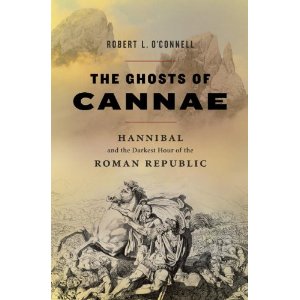
The latest is historian Robert L. O’Connell, whose new book is called The Ghosts of Cannae: Hannibal and the Darkest Hour of the Roman Republic.

Here he is on NPR, talking about it.

Separately, geomorphologists (people who study the features of the earth) and archeologists are still debating which route Hannibal took with his army and elephants over the snowy Alps in October 218BC.

(Thank you to Peter Practice for the link!)

William Mahaney, a Canadian researcher, and his team now think that the likeliest pass is the Col de la Traversette in France. They believe they have located geographical features — such as a gorge where Hannibal was attacked by Gauls, or a rock fall that blocked his way — that either Polybius or Livy described.

Their main “rival” is Patrick Hunt at Stanford, who thinks that the Col de Clapier is the likeliest route.

What all these boffins of course hope to find is … evidence. Coins, swords, poop, bones, sandals, elephant tusks, … anything. Whoever finds any dropping of the Punic army is sure to become our era’s Heinrich Schliemann.

Bookmark and Share

Justice: by truth or victory?

Credit: Javitomad

Which sort of judicial system, generally speaking, is more likely to lead to justice? One that:

  • looks for the truth, or
  • lets two sides fight it out to see who wins?

You might think that I’m setting up another facile thought experiment, but I am not. Most of the world has, through the fascinating and mysterious quirks of history, chosen one or the other of these underlying approaches to justice.

The first philosophy — justice as a search for truth — we call the inquisitorial system (because a judge sets out to inquire after the facts of a case, ie the truth).

The second philosophy — justice by duking it out until one side is left standing — we call the adversarial system (because two adversaries and their lawyers meet in court, and a judge merely makes sure that the rules are observed).

We generally find the inquisitorial philosophy undergirding the civil law systems of continental Europe and its former colonies and the countries that have adopted it voluntarily. That turns out to be most of the world — all the countries in blue on the map above.

And we find the adversarial philosophy mainly in the common law systems of England and all the lands it ruled at one point or another — ie, the countries in red or brown on the map. (Let’s leave the countries with Islamic Law, in yellow, and Mongolia, in green, out of this post.)

Because justice, and therefore law, is so fundamental to freedom (which is one of my favorite topics) I have for some time been pondering the question I opened with. So I challenged Richard, a frequent commenter on The Hannibal Blog and a veteran English lawyer, to compare the two systems. Somewhat to my surprise, he did.

In this rigorous series of posts, Richard introduces the systems in turn, proceeding methodically and cautiously to unveil — somewhat coquettishly, I might add 😉 — his preference. (I won’t spoil the fun: Go and find out for yourself.)

Here now is my modest contribution.

A brief history of the systems

Historically, the adversarial system descends from the brute medieval practice of trial by combat.

You did me wrong! → Let’s fight.

It is, in short, the law of the stronger.

Click for credits

Right from the start, especially whenever ladies were involved, the adversaries were allowed to appoint champions to fight on their behalf.

Like its gruesome medieval judicial cousin, trial by ordeal, trial by combat made no pretense to truth. Somebody prevailed, that was all. So it was efficient. But we would not call that justice.

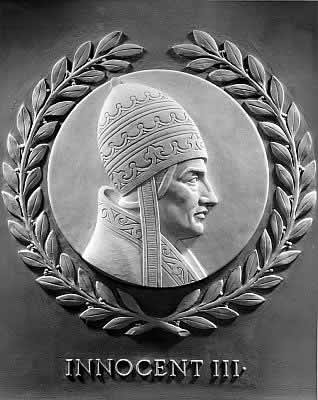
In 1215, Pope Innocent III wanted to change that. So he reformed the court system administered by the Catholic Church across Europe (ie, the ecclesiastical courts, from Greek ekklesia, assembly or church).

The idea was that an ecclesiastical court could take the initiative and summon and interrogate witnesses even without an accusation by one adversary against another.

Trial by combat was now forbidden in the ecclesiastical system. On the continent, this ecclesiastical tradition then became the basis for the subsequent evolution of secular courts.

But in England, Henry II had, during the 1160s, established parallel secular courts. When the church-administered courts in England switched to the inquisitorial system, the secular courts remained adversarial, and those in time became the courts of England. Hence the split.

Henry II

Critique

I) The adversarial system

The adversarial system makes me — intrinsically, philosophically, emotionally — uncomfortable because it was not originally designed to ascertain truth, merely the supremacy of one side.

That said, it has evolved in such as way that truth is now the implicit and desired by-product of the adversarial struggle. If the rules (of evidence, testimony, presumption of innocence et cetera) are sophisticated, it is hoped, the truth is revealed in the process and the “right” side wins, so that the outcome is indeed just.

Nonetheless, there are troubling remnants of the system’s combat origins:

1) The undue role of the “champions”

Today, we call those champions lawyers (attorneys, solicitors….). In the adversarial system, they are the stars. What do you tell a friend in trouble in an adversarial country? “Get a good lawyer.”

Some people try to get a good lawyer, but end up with a bad one, or at least one less good than the adversary’s. Other people cannot afford a good one. Others can afford entire armies of lawyers, and usually win. So money plays an unsavory role.

If the truth really wanted to be revealed, why should it matter so much which lawyer you have? But we all know that it does matter.

2) The undue emphasis on winning

An inquisitor wants to find the truth. But a prosecutor wants to win. To him, that means to convict.

A couple of days ago, I was chatting with Steve Cooley, the district attorney of Los Angeles County and a candidate for attorney general of California. How does he compare himself to his rival, Kamala Harris, the district attorney of San Francisco? Through the conviction rate, of course. Whether or not the convictions were just does not even come up for discussion. (How would you even discuss it?)

In practice, said Cooley, about 95% of convictions come through plea bargains, an inherent part of the adversarial system. (Ie, the two sides come to an agreement even before an independent judge or jury evaluates the truth of their arguments.)

Well, I recently mentioned Harvey Silverglate’s book detailing the various excesses to which prosecutors can go in the pursuit of victory. You can make anybody break down by piling more charges on him until he pleads. That does not make it just.

II) The inquisitorial system

The inquisitorial system makes me uncomfortable in a different way.

In theory, it is splendid to task somebody with inquiring after the truth. Take the example of plea bargains cited above: In the inquisitorial system, a guilty plea does not automatically lead to conviction. It is merely one more piece of evidence. (The inquisitor might decide to ignore the plea if he suspects, for instance, that the pleader is trying to protect somebody else, or is insane, et cetera.)

In practice, however, you have to choose an actual human being to find out the truth, and how is that likely to go?

There is a reason why we (or at least I) hear bad connotations in the word inquisition. It reminds us of the Spanish Inquisition, a time when the system went awfully wrong. The inquisitors, as it happened, were altogether more concerned with pleasing Ferdinand and Isabella than with ascertaining the truth. And they subscribed to the notion that you can get any truth that suits you; it’s just a matter of how you ask.

So an inquisition into truth can become corrupt. Notice, however, that this is a problem common to both the inquisitorial and the adversarial systems: The judiciary must be absolutely independent from political pressure. That includes not only the executive branch of government but also the mob. Ask black people in the Jim Crow South how well the adversarial system worked for them.

The subtler but more profound critique of the inquisitorial system has to do with what Richard calls “over-confidence in the expert”:

If you have a trained magistracy, ostensibly expert in discerning and charged with discovering the truth, there is the risk of over-valuing their work.

And why would that be a problem? Because experts are experts precisely because they have seen lots and lots of cases. And so they are likely to slip into a thought process that says “Hmm, this case X reminds of Y, and I should be consistent so I will…”. No. The facts (truth) of case X must be considered on its own merits alone.

Perhaps experts are less able to do that. As Richard says,

Justice is the art of espying the exception.

Which leaves us, unfortunately, where we started: with questions.

Who, expert or lay, is more likely to espy the exception?  Who is most likely to be free and fair? Which process — a search for truth or a struggle that reveals it — is more just?

Bookmark and Share

Greatest thinkers: Greeks or Germans?

The Hannibal Blog has featured many thinkers — in the threads on Socrates and Great Thinkers among others.

Inevitably, Greeks and Germans have been somewhat disproportionately represented.

So it is time to revisit the most scientific and conclusive confrontation between Greeks and Germans to date.

Not new but timeless:

Bookmark and Share

How Muhammad created Europe

Historians are still arguing about why and how (and even when) the Roman Empire fell — and by extension why, how and when the “Middle Ages” and “Europe” (ie, northwestern Europe as we understand it) began.

One theory is that the answer is to be found, somewhat surprisingly, not in northwestern Europe but on the opposite side of the former Roman Empire. This story-line involves Muhammad, Islam and the Arab conquests in the century after Muhammad’s death in 632. The stages of those conquests you see in the map above.

In this post, I want to introduce that thesis to you and the one it tried to replace.

I do this not in order to endorse either thesis, but in order to celebrate the elegant and imaginative beauty of the thought processes of the two historians who produced them.

These two thinkers are

  • Edward Gibbon and
  • Henri Pirenne,

and I am hereby including them into my pantheon of the world’s greatest thinkers.

(Which reminds me: Scientists and philosophers are currently over-represented on my list, so I am also retroactively including the historians Herodotus, Polybius, Livy and Plutarch. Thucydides is already on the list.)

And at the end of the post, I’ll ponder what this eternal debate about Rome tells us about intellectual theorizing in general.

My source, besides the books of Gibbon and Pirenne, is Philip Daileader’s excellent lecture series on the Early Middle Ages.

I) Edward Gibbon

Edward Gibbon

Gibbon was a typical specimen of the Enlightenment. He hung out with Voltaire, considered religion (and especially Christianity) a load of superstitious poppycock, trusted in human reason and was enamored by the classics.

Being a man of independent means, he was able to devote all his time and energies to investigating what he considered the great mystery of antiquity. Why did the Roman Empire fall?

The result was an epic work of beautifully written English prose called The Decline and Fall of the Roman Empire. The first of its six volumes came out in the year of America’s Declaration of Independence.

The book was so powerful that its thesis turned into what we would call a meme. Ask any semi-literate person today why the Roman Empire fell and he is likely to answer something like this:

Barbarians invaded → Rome fell

Gibbon’s thesis in more detail

Charlemagne

In brief, Gibbon believed that the Roman Empire was

  1. in part a victim of its own success, having prospered so much that its citizens had become soft, and
  2. in part a victim of Christianization, which replaced the pagan warrior ethic with an unbecoming concern for the hereafter.

As Gibbon famously said, Rome’s

last remains of military spirit were buried in the cloister.

This corrosion of morals or values, according to Gibbon, left the Western Roman Empire (Diocletian had divided it into two halves, east and west, for administrative purposes) vulnerable to the blonde hordes from the north.

And thus, federations of Germanic tribes crossed the Rhine and Danube and ransacked the Roman Empire, eventually sacking Rome itself and deposing the last (Western) Roman emperor in 476.

The Ostrogoths and Lombards took Italy, the Visigoths took Spain and the Franks took Gaul (→ Francia, France).

Within a few generations, one Frankish family, the Carolingians, seized power. Under Charlemagne (= Carolus Magnus, Karl der Grosse, Charles the Great), the Carolingians then united much of western Europe, an area that happens to overlap almost perfectly with the founding members of the European Union.

In the nice round year of 800, Charlemagne, the king of Francia, became a new Emperor. He sparked a small cultural and economic recovery (the “Carolingian Renaissance”), but his descendants bickered about inheritance, and the Carolingian empire split into what would become France, the Low Countries and Germany.

And there we have it: “Europe”.

II) Henri Pirenne

Henri Pirenne

Like Gibbon, Henri Pirenne was a man of his time. But that time was the late nineteenth and early twentieth century. Historians now felt that “moral” explanations of history were a bit woolly and preferred to think in terms of impersonal, and primarily economic, forces rather than great individuals or events.

And this led Pirenne, a Belgian (and thus a Carolingian heir), to a very different, and extremely original, thesis. The title of his monumental book, Mohammed and Charlemagne, essentially says it all.

The Pirenne thesis begins with a view that, first of all, nothing noteworthy “fell” in 476. Who cares if an emperor named, ironically and aptly, “little Augustus” (Romulus Augustulus) was deposed in that year? Roman civilization went on exactly as before. To most Europeans, nothing whatsoever changed.

That civilization was

  1. urban
  2. Mediterranean and
  3. Latin in the West

The Germanic tribes in fact came not to destroy but to join this civilization. They had entered the Roman Empire long before 476 to live there in peace, but were forced repeatedly to move and fight. When they eventually deposed the Romans, the Barbarians settled in the Roman cities and gradually adopted Latin (which was by this time, and partially as a result, branching into dialects that would become Catalan, Spanish, French etc).

Most importantly, the Mediterranean (medius = middle, terra = land) remained the center of this world, and trade across its waters enriched and fed all shores, north and south, east and west.

So what changed?

What changed was that Muhammad founded Islam, united the Arabs and then died. Suddenly, the Arabs poured out of the desert and conquered everything they encountered.

Look again at the map at the very top. In effect, the Arabs conquered the entire southern arc of the former Roman Empire until Charles Martel (Charlemagne’s grandfather) stopped them near Poitiers in France.

The Arabs thus split the Mediterranean in two. Suddenly, the “Mediterranean” was no longer the center of the world, but a dividing line between two worlds.

Ingeniously, Pirenne then inferred the rest of his thesis from archaeological finds: In the years after the Arab conquests, papyrus (from Egypt) disappeared from northwestern Europe, forcing the northerners to write on animal hides. Locally minted coins disappeared, too. Gone, in fact, was everything that was traded as opposed to produced locally.

The Arabs, Pirenne concluded, had blockaded and cut off northern Europe from the rest of the world. Europe thus became a poor, benighted and involuntarily autarkic  backwater.

This, finally, amounts to the “fall” of Roman civilization in northwestern Europe. Roman cities, administration and customs disintegrated. Europe becomes a small and isolated corner of the world.

It is within this then-forgettable corner that the Carolingians rise and create “Europe”. As Pirenne famously said:

Without Islam, the Frankish Empire would have probably never existed, and Charlemagne, without Muhammad, would be inconceivable.

III) So who was right?

I promised to ponder what this debate might say about intellectual theorizing in general. Well, here goes:

1) Nobody needs to be wrong

As it happens, neither Gibbon nor Pirenne have ever fallen out of favor. Both are still considered to have got much of their interpretation right. The caveat is merely that their theses are considered … incomplete.

We encountered such a situation when talking about Newton and Einstein. Einstein in effect proved Newton “wrong”, and yet we have never discarded Newton, just as we won’t discard Einstein when somebody shows his thinking to have been incomplete.

2) Progress = making something less incomplete

Although both Gibbon’s and Pirenne’s theses were incomplete, they add up to an understanding that is less incomplete, so that others can make it even less incomplete.

This, in fact, is what has been happening. Subsequent historians have wondered why, if their theories were true in the West, the Eastern Roman (ie, Byzantine) Empire did not fall for another millennium.

Regarding Gibbon: The East, too, faced Barbarian invasions (from the same tribes). And the East was even more Christian than the West. So something must be missing in Gibbon’s explanation.

Regarding Pirenne: The East, too, was cut off from the south by the Arab conquests (though perhaps not as much).

IV) One possible omission: depopulation

So, even though both Gibbon and Pirenne, may well have been right, that there had to be at least one more factor: disease.

Perhaps it was smallpox arriving from China, and later plague. Perhaps it was something else. (The theory of massive lead poisoning is now discredited. Again: They had lead pipes in the East and the West.)

Whatever the disease(s), the population of the Roman Empire collapsed. And the West, which had fewer people than the East to begin with, became largely empty.

Its cities were deserted. Rome’s population was 1 million during the reign of Augustus but 20,000 by the time of Charlemagne. People used the Roman baths of northern cities as caves. New city walls were built with smaller circumferences than older city walls.

Fields and land lay fallow, too. We know this because taxes were levied on land (not labor), and tax revenues fell due to agri deserti, “abandoned fields”.

Viewed this way, both the Germanic invasions that Gibbon focussed on and the Arab invasions that Pirenne focussed on were perhaps not a cause but a symptom of the fall of Rome. It seems likely that the Germans and Arabs showed up because there were few people blocking their way, and conquered for that same reason.

If we ever find out the complete answer, it will be because Gibbon and Pirenne pointed us in the right direction.
Bookmark and Share

Hair in politics

Credit: Bloomberg

Here is a little relief on the light side, reblogged from my post on The Economist’s Democracy in America:

NO SOONER had Carly Fiorina won the Republican nomination to challenge Democrat Barbara Boxer for her Senate seat than the race became hair-raising. Probably unaware that a microphone was on, Ms Fiorina relayed “what everyone says” about Ms Boxer, which is, of course: “God, what is that hair. So yesterday.”

Hair has factored in politics at least since the Roman Republic. The enemies in the Senate of an up-and-coming young general, Publius Cornelius Scipio, tried to derail his rise by implying that he grew his hair un-Romanly long, in the Greek style that seemed soft and suspicious; Scipio went on to defeat Hannibal anyway and, balding, became Rome’s saviour. Julius Caesar was famously touchy about his receding hairline. And Julian the Apostate, Rome’s last pagan emperor, grew a shaggy beard to make an anti-Christian statement which became so controversial that Julian wrote a satire called Misopogon, “The Beard Hater”, in his own defence.

Hair remained political for the Holy Roman Emperors, from Charles the Bald to Frederick I Barbarossa (“red beard”). In the modern era, Kaiser Wilhelm II twirled his mustache just so. China’s top Communists have always amazed with hair that is ink-black at any age. Ronald Reagan’s was impressive, though he is now arguably outdone by Mitt Romney, who during the 2008 campaign warned fellow Republican Mike Huckabee “Don’t touch the hair.”

Women have it harder. Their hair, above all Hillary Clinton’s, is more analysed and yet they are not supposed to bring it up, lest they seem petty or catty. This was the charge against Ms Fiorina last week. Please. “My hair’s been talked about by a million people,” responded Ms Fiorina defiantly. Of late, that’s because she lost all of it while fighting and beating breast cancer. Her hair is now growing back. It is a short, strong statement.

Bookmark and Share

Roman Jefferson v Carthaginian Hamilton

Thomas Jefferson

I’ve mentioned a few times just how much our Founding Fathers were influenced by — and saw themselves as heirs to — republican Rome. That’s why both our federal and state buildings tend to look like Roman temples.

Two excellent books I’ve been reading lately have brought home to me just how direct that influence was for specific Founding Fathers such as Thomas Jefferson. Not only did Jefferson “inherit” certain Roman political ideals (as he understood them) but he also adopted the hatreds and propaganda of republican Rome. This meant:

  • Rome = good = America
  • Carthage = bad = Britain

Here Jefferson talks about Britain (from Richard Miles, Carthage Must Be Destroyed):

Her good faith!The faith of a nation of merchants! The Punica fides of modern Carthage.

Punica fides means Punic faith. The Romans and Jefferson used the term ironically to mean faithlessness.

The Romans looked down on the Carthaginians (who were Phoenician traders) as merchants, and Jefferson inherited that attitude as well. (Napoleon, too, condescended to the English as “shopkeepers.”) Romans and Americans, Jefferson implied, were above such corrupt Carthaginian and British habits as commerce and banking.

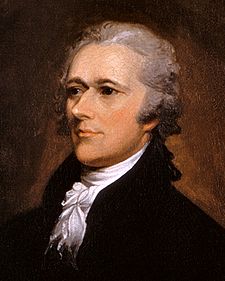
Alexander Hamilton

When Jefferson, Madison, Monroe and other “republicans” (they deliberately named their faction to evoke republican Rome) began their hysterical conspiracy to bring down Alexander Hamilton, who in their fantasies had British and monarchical leanings, one of Hamilton’s friends warned him thus (from Ron Chernow, Alexander Hamilton, p. 391):

Delenda est Carthago, I suppose, is the maxim adopted with respect to you.

Delenda est Carthago means Carthage must be destroyed. It was the infamous phrase with which Cato the Elder ended every speech he gave until Rome indeed decided to destroy Carthage.

So to Jefferson, Hamilton was a sort of Hannibal?

Much more about all this in later posts. But you can already infer where my sympathies would have lain in this Founding Father soap opera.

Bookmark and Share

The importance of the first reader

Eliza Hamilton

Every writer has, or ought to have, a more or less special first reader. For me it is my wife.

My wife is the first person to see every article I write for The Economist and every draft of my book manuscript. (I don’t show her my blog posts or emails, obviously, which may explain why those are so much worse.)

This is a very important and intimate relationship. The first reader is, in effect, the first editor, and also the sanity test, the acoustics check, the aesthetic focus group and the umpire of taste.

The first reader must be so confident of the underlying relationship as to be above flattery and fear of (lasting) repercussions.

Both writer and first reader must protect their credibility. My wife is probably most impressed with me when she gives a brutal but vague critique of something I have written … and I come back to her shortly after, having done even more brutal violence to my own words. This is known as “crucifying your darlings,” and it is what gives me credibility.

So it is fun to learn how the great writers of the past viewed that relationship.

Molière apparently tested his writings on his nurse to get her reaction. And Alexander Hamilton, my favorite Founding Father as well as by far the most prolific writer among them, had his wife, Eliza Hamilton. (Get ready for a new thread on Hamilton soon!)

On page 508 of this fantastic biography of Hamilton (recommended by Thomas Stazyk), Eliza recollects, 40 years after the fact, how her husband wrote George Washington’s famous farewell address. (Yes, most of “Washington’s” writings are in fact Hamilton’s.)

He was in the habit of calling me to sit with him that he might read to me as he wrote, in order, as he said, to discover how it sounded upon the ear and making the remark, “My dear Eliza, you must be to me what Moliere’s old nurse was to him.” The whole or nearly all the “Address” was read to me by him as he wrote it and a greater part, if not all, was written by him in my presence.

I probably appreciate more than most people how important Eliza Hamilton therefore was for American and world history.

Bookmark and Share

The wrong heroine: Joan of Arc

What does Joan of Arc — Jeanne d’Arc in French — say about our notions of heroism?

I’ve been pondering this for a while. So far in this thread on heroism, all the heroes have been male (and mythological). So the question of feminine heroism, raised but not satisfactorily addressed, has become more urgent.

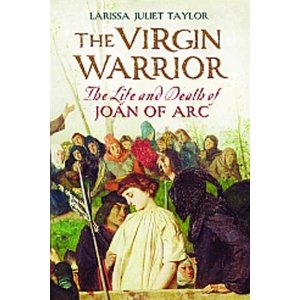
So I read Larissa Juliet Taylor’s biography of Joan: The Virgin Warrior: The Life and Death of Joan of Arc.

Taylor takes the dry — quite dry! — historian’s approach to Joan, and that was the approach I wanted for my purpose. Who was the actual woman, rather than the “saint” and statue that we have made of her. (Yes, in 1920 she officially became a saint.)

So here is I) the background, II) her story, and then III) my interpretation:

I) Historical background

Click for attribution

Joan lived her short life — she was executed at 19 — in the 15th century, during what we retroactively call the Hundred Years’ War between England and France.

The most important thing to understand about this time is that nations or countries as we understand them did not yet exist. Instead, there were kingdoms and dynasties, shifting constantly depending on which royal married and procreated with which other royal.

“England” was ruled by French-speaking Norman royalty which, to complicate matters, frequently married royals from “France”, which were in turn more or less descended from Frankish (Germanic) royalty. (I venture to say that the common people neither understood nor cared who ruled them.)

As Joan was growing up, the English king claimed also to be King of France and held most of northern France, including Paris. He was allied with Burgundy, another originally Germanic kingdom that we today consider “French”.

Another contender to the throne, Charles Valois, considered himself dauphin but was considered wimpy and weak. The map above shows the lands under his control as “France”. This portrait of him, I believe, says it all:

Charles VII

II) Joan

Joan was born into a family neither poor nor rich — we would say “middle class” — in the Anglo-Burgundian part.

She was different from the other girls. She didn’t go dancing with them, and seems to have been a bit of a killjoy. She was constantly praying, and obsessed with the Virgin.

Starting at the age of 13, as she later claimed, she began hearing “voices.” The voices told her to go “to France.” She decided that the voices belonged to angels or saints.

Also around this age, she vowed to remain a virgin for the rest of her life. No reason given. She just did. This later became part of her mystique: She became La Pucelle (The Maid), which implied not only virginity but nobility and purity and innocence.

She became what we could call deranged. If she were alive today, she might be a suicide bomber. Guided by her voices, she wrote a famous “letter to the English”. In it, this teenage girl informed them that she would have mercy on them (!) if they did exactly as told, but that

you will not hold the realm of France from God, the King of Heaven, son of Holy Mary, for it will be held by King Charles, the true heir, because God, the King of Heaven wants it to be so, and this has been revealed by the Maid.

So there.

In 1429, aged 17, she set out to meet the dauphin Charles — ie, she left the “English” part of France and traveled to the “French” part, specifically a chateau on the Loire where Charles was staying. Already, she had short hair and wore only male clothing, as she would from then on.

When she arrived at the chateau, Charles’ advisers reacted as we might: They thought she was loony. They questioned her for a while. Joan told them that she was on a mission

  1. to lift the English siege of Orléans, an important town at the time, and
  2. to lead Charles to Reims (in English-controlled territory) to be crowned king of all France.

So the counsellors admitted her to see Charles. Charles also thought she was mad, or at least suspicious. But she was offering to make him king, and he had no other plan.

So Charles sent Joan to another town for a month for a thorough “theological validation.” This was their equivalent of psychoanalysis — the churchmen being the shrinks. Joan conducted herself well. Even her claims to virginity survived, ahem, examination.

So Charles saw her off to Orléans and put her in charge of some troops. Joan put on shining armor and set off. In the picture above, she is entering Orléans.

She sent another letter to the English:

… King of England, … if [the English forces] do not obey, I will have them all killed. If they obey, I will show mercy. I am sent here by God, the King of Heaven, to kick you out of all of France….

She perplexed but also fascinated every man there, both “French” and “English”.

She had one mode only: Charge!

She did not know doubt.

So she told the defenders to charge, and charge they did. In confused fighting, with Joan even getting wounded by an arrow, the tide turned and the English retreated from Orléans.

Suddenly, everybody either feared (if “English”) or adored (if “French”) the Maid.

Joan now led a laddish camp life. She was one of the guys. She got most angry whenever female “camp followers” came near her boys. She personally attacked the ladies with her sword to keep her soldiers pure.

Apparently feeling invincible, Joan led Charles’ forces to several more victories. Then it was time to bring Charles to Reims for his coronation. And thus the dauphin became Charles XII, King of France.

Charles, however, distrusted Joan more than ever. She seemed just plain deranged to him. Furthermore, Charles now had to begin the adult and mature business of negotiating with Burgundy and England to settle this mess in a civilized way. Joan, however, was constantly going on about her voices from the angels. She appeared not to understand the geopolitical context she was in. Which would be understandable: she was a teenager.

Joan, knowing only her one mode (Charge!), kept charging until she fell off her horse and was captured. In 1430 she was brought to Rouen, English-held Normandy, and put on “trial”.

The English did not prosecute or judge Joan. Instead, it was the French and Burgundian churchmen. Yes, they were aware that the power of the land, England, considered Joan a political problem. But their main bugbear seems to have been more Freudian-patriarchal. Joan threatened … something.

The obvious problem was to find something to accuse her of. What had she actually done?

The trial notes show the church, if not all religion, as silly, petty, ridiculous, irrational, vindictive and dumb. The inquisitors asked questions that were stupid, and Joan made fools of them.

The charges, when read, compensated for vagueness with length. Joan was to be tried

as a witch, enchantress, false prophet, a caller-up of evil spirits, as superstitious, implicated in and given to magic arts … [She was] scandalous, seditious, perturbing and obstructing the peace … [and she] indecently put on the ill-fitting dress and state of men-at-arms…

Sounds like everything I like to do in my spare time. 😉

Up on the scaffold she went, and onto the stake. They burned her. She died of smoke inhalation before she burned, but it was a cruel spectacle nonetheless, and nobody enjoyed it.

Her legend was born in the decades and centuries after her death.

She became, to different people at different times:

  • a martyr
  • a saint
  • a patriot and symbol of France.

Indeed, her retroactive importance is largely that she helped to bring about this concept of “France”.

So, was she a heroine?

III) Interpretation

Hua Mulan

Joan seems to belong to a small category of heroines who choose to remain virgins, dress up as boys and then fight with the boys.

China’s Joan, for example, might be Hua Mulan (pictured). Greece’s Joan might be Atalanta; Rome’s might be Camilla (who fought and died in the Italian wars against Aeneas).

But there is an obvious problem with such hermaphroditic or asexual heroines: Their heroism seems in large part to require denial of their femininity. That would suggest that heroism really is a male thing and the girls can play with the boys only if they pretend to be boys. I don’t like that at all.

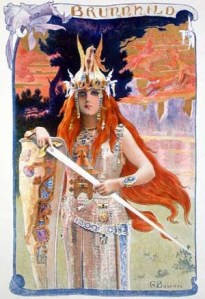
Contrast that with a variation on her theme: the hyper-sexual warrior woman.

Here, for instance, is Brunhilde of Norse myth, with considerable Va Va Voom:

Then, of course, there are the Amazons, who not only fought but slept with male heroes, including Theseus and Hercules.

These women are seductive and fertile as well as brave and strong, and thus the direct primal equivalent of their male counterparts. As heroines they celebrate their sex rather than hide it. In fact, the Amazon queen, Hippolyta, seems to have been the model for Wonder Woman:

So Joan does not do it. She was a clueless teenager fired by inappropriate certitude (which describes pretty much every teenager) who never had the chance to grow into a whole person and become a genuine heroine.

But there are plenty of those out there, and The Hannibal Blog intends to find them

Bookmark and Share

The Alexandrian Solution

A lot of people have a very famous story … wrong.

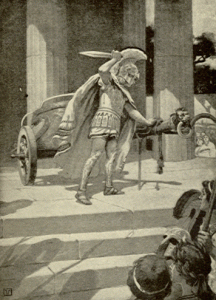
The story is that of the Gordian Knot and precisely how Alexander the Great loosened it. Most people imagine Alexander slashing the knot with his sword, as pictured above. But he did not.

In the nuance of how he really untied the knot lies hidden a worldview: the supremacy of simplicity and elegance over brute force and complexity. The true “Alexandrian Solution” was, for example, what Albert Einstein was looking for in his search for a Grand Unified Theory — a formula that was simple enough (!) to explain all of physics.

I’ll give you the background and the nuance of the story in a moment, but first another fist bump to Thomas for reminding us to make the association.

We are, remember, talking about complexity. The Gordian Knot is the archetypal metaphor for mind-numbing, reason-defying complexity; Alexander’s triumph over the knot is the archetypal metaphor for triumphing over complexity. Now read on…

I) Background

a) Phrygia

The Gordian Knot was, as the name implies, a knot in a city called Gordium. It was in Phrygia, an ancient kingdom in Anatolia (today’s Turkey).

The Phrygians lived near (and may have been related to) those other Anatolians of antiquity: the Trojans and the Hittites. They were Indo-European but not quite “Greek”. Their mythical kings were named either Gorgias or Midas (and one of the later Midases is the one who had “the touch” that turned everything into gold). Later, they became part of Lydia, the kingdom of Croesus. And then part of the Persian Empire. And then Alexander showed up.

b) The knot

Legend had it that the very first king, named Gorgias, was a farmer who was minding his own business and riding his ox cart. The Phrygians had no leader at that time and consulted an oracle. The oracle told them that a man riding an ox cart would become their king. Moments later, Gorgias parked his cart in the town square. In the right place at the right time. 😉

So fortuitous was this event and Gorgias’ reign that his son, named Midas, dedicated the ox cart. He did so by tying the cart — presumably by the yoke sticking out from it — to a post.

And he made the knot special. How, we do not know. But Plutarch in his Life of Alexander tells us that it was tied

with cords made of the rind of the cornel-tree … the ends of which were secretly twisted round and folded up within it.

It was a very complicated knot, in other words, and seemed to have no ends by which to untie it.

Lots of people did try to untie it, because the oracle made a second prophesy. As Plutarch said,

Whosoever should untie [the knot], for him was reserved the empire of the world.

II) Alexander, 333 BCE

Alexander, aged 23 and rather ahead of me at that age, arrived in (Persian) Phrygia in 333 BCE. The knot was still there, un-untied.

Alexander had already subdued or co-opted the Greeks, and had already crossed the Hellespont. But he had not yet become divine or conquered Egypt and Persia. All that was to come in the ten remaining years of his short life. And it began with the knot, since he knew the oracle’s prophesy.

Here he his, his sword drawn, approaching the knot:

Did he slash?

No, says Plutarch (ibid,. Vol. II, p. 152, Dryden translation):

Most authors tell the story that Alexander finding himself unable to untie the knot, … cut it asunder with his sword. But … it was easy for him to undo it, by only pulling the pin out of the pole, to which the yoke was tied, and afterwards drawing off the yoke itself from below.

III) Interpretation

I leave it to the engineering wizards among you to re-create the knot as it might have been. But what we seem to have here is a complex pattern that was nonetheless held together by only one thing: the beam.

It was, Einstein might say, like quantum physics and gravity: intimidatingly complex and yet almost certainly reducible to one simple reality.

Alexander, being Great, understood this. He saw through the complexity to the simple elegance of its solution, and pulled the peg.

This is how I understand “the Alexandrian Solution.” I intend to look for it in all of my pursuits. 😉

Bookmark and Share

Complexity and collapse

Joseph Tainter

As you know, The Hannibal Blog is fascinated by the issue of complexity in modern society.

That is, “fascinated” as you might be in a horror movie: simultaneously freaked out and intrigued.

If I had to give a working hypothesis in my evolving thinking, it would sound a bit like the answer by that character in The Sun Also Rises:

How does complexity enslave us? First gradually, then suddenly.

In other words, complexity can increase slowly for a while but then suddenly becomes catastrophic. This view seems to be in the Zeitgeist. Here, for instance, is just a tiny sample of intellectuals I’ve recently come across who seem to be exploring versions of it:

I

Clay Shirky

Clay Shirky, a new-media visionary whom you’ve met here before, takes another look at the fascinating work of Joseph Tainter (above), an anthropologist at Utah State University. (Somewhat surprisingly, he then tries to apply that to … business models in the television industry!)

Tainter’s 1988 book The Collapse of Complex Societies looked at the abrupt implosions of ancient Rome, the Mayas et cetera.

As Shirky summarizes it, Tainter’s thesis is that societies become more complex because

early on, the marginal value of this complexity is positive—each additional bit of complexity more than pays for itself in improved output—but over time, the law of diminishing returns reduces the marginal value, until it disappears completely. At this point, any additional complexity is pure cost.

Tainter’s thesis is that when society’s elite members add one layer of bureaucracy or demand one tribute too many, they end up extracting all the value from their environment it is possible to extract and then some.

… Why didn’t these societies just re-tool in less complex ways? The answer Tainter gives is the simplest one: When societies fail to respond to reduced circumstances through orderly downsizing, it isn’t because they don’t want to, it’s because they can’t.

In such systems, there is no way to make things a little bit simpler – the whole edifice becomes a huge, interlocking system not readily amenable to change. …

When the value of complexity turns negative, a society plagued by an inability to react remains as complex as ever, right up to the moment where it becomes suddenly and dramatically simpler, which is to say right up to the moment of collapse. Collapse is simply the last remaining method of simplification.

II

Niall Ferguson

Niall Ferguson, a history professor at Harvard, argues in a piece called “C0mplexity and Collapse” in Foreign Affairs that the great powers don’t rise and fall gradually (as everybody from Herodotus to Paul Kennedy has assumed) but disintegrate abruptly:

Empires do not in fact appear, rise, reign, decline, and fall according to some recurrent and predictable life cycle. It is historians who retrospectively portray the process of imperial dissolution as slow-acting, with multiple overdetermining causes. Rather, empires behave like all complex adaptive systems. They function in apparent equilibrium for some unknowable period. And then, quite abruptly, they collapse.

(I was somewhat surprised not to see a reference to Tainter’s work in Ferguson’s article, but there you go.)

III

David Segal in the New York Times takes that impetus and applies it to our strategy in Afghanistan, the financial crisis and much else.

***

It seems to me that there is an opportunity in this topic of complexity to find something original (and simple) to say, a new “theory of complexity”, as it were. I’m going to start looking for it.

Bookmark and Share