The first “almost modern” hero: Aeneas

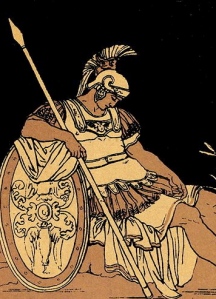
Aeneas

It’s time to tie together three of my threads:

So what role did Aeneas play in the history of hero stories? What sort of hero was he?

A revolutionary one, it seems to me. He was a classical Homeric hero (literally mentioned in Homer’s Iliad) whom Virgil made into a recognizable modern hero, but with one interesting twist that still alienates him from us today.

I) The “weak” hero

In the Aeneid, we first meet Aeneas (and first meetings are important) in the middle of a storm that Juno has orchestrated in the hope of killing him and his Trojans. As the wind and waves tear his ships apart (sinking 7 of the 20),

Aeneas on the instant felt his knees go numb and slack, and stretched both hands to heaven, groaning out: ‘Triply lucky, all you men to whom death came before your fathers’ eyes below the wall at Troy! Bravest Danaan [ie, Greek], Diomedes, why could I not go down when you had wounded me, and lose my life on Ilium’s [Troy’s] battlefield? (I, 131-139)

This is an astonishing departure, a brave literary innovation, in ancient storytelling. We could not imagine, say, a Hercules or Theseus, or even a Jason, in despair — frightened to death in the sense of wishing to die.

Right from the start, therefore, we understand that Aeneas’ heroism will not consist only of strength — expressed as the overcoming of enemies or monsters — but, more importantly, of an inner struggle with himself.

So Aeneas is the first western hero whose internal journey is as important as his external journey. Virgil thus invites us, his readers, to empathize with Aeneas more than we would ever empathize with Hercules, Theseus or Jason.

II) The tender hero

Virgil also wants us to empathize in another way: Aeneas is the first hero (aside from Orpheus, arguably) who is presented to us as a whole man, a man who not only has a public duty but also private loyalties to:

  • father,
  • son,
  • wife,
  • and even lover.

Hercules, Theseus and Jason also had parents, wives and offspring, of course. But their stories never dwelt on these relationships.

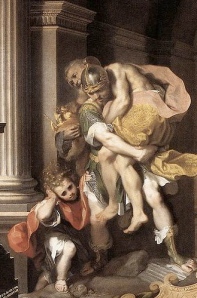
Aeneas carries his father and son out of Troy

By contrast, Aeneas’ proto-Roman deference and respect for his father, Anchises, and his tender nurturing of his young boy, Ascanius, are deliberately touching. Here is Aeneas as Troy burns and its inhabitants are being slaughtered by the Greeks:

‘Then come, dear father. Arms around my neck: I’ll take you on my shoulders; no great weight. Whatever happens, both will face one danger, find one safety’…. Over my breadth of shoulder and bent neck, I spread out a lion skin for tawny cloak and stooped to take his weight. Then little Iulus [another name for Ascanius] put his hand in mine and came with shorter steps beside his father… (II, 921-924)

Aeneas loses his first wife, Creusa, in the genocide of Troy, but he makes clear how painful this is for him. Having rescued his father and son, he goes back into the burning city to look for her:

I filled the streets with calling; in my grief time after time I groaned and called Creusa, frantic, in endless quest from door to door. (II, 999-1000)

Aeneas also feels tenderness for his lover Dido, even after their “break-up” and her eternal hatred. We see this as Aeneas descends to Hades to seek advice from his dead father. In passing, he sees the shade of Dido (who has committed suicide, as Aeneas has guessed but does not know). Aeneas

wept and spoke tenderly to her: ‘Dido, so forlorn, the story then that came to me was true, that you were out of life, had met your end by your own hand. Was I, was I the cause? I swear by heaven’s stars, by the high gods, by any certainty below the earth, I left your land against my will … And I could not believe that I would hurt you so terribly by going… (VI, 611-625)

This is an unusual classical hero — a man who is aware of the ramifications his actions have on others, and man who has compassion.

III) The hero without free will

But there is also a clue to the aspect of Aeneas that alienates him from us today. “I left your land against my will,” he tells Dido’s shade. This is true. The gods ordered him to leave Dido, because they had sketched out a larger mission for him, which was to found the Roman nation.

This was his duty, and Aeneas is still, above all, pius Aeneas, as he himself says. (Dutiful is a better translation than pious here.)

In fact, as Susanna Braund points out in her fantastic (and free) Stanford lectures on the Aeneid, Aeneas uses a more telling phrase:

I sail for Italy not of my own free will. (IV, 499)

There you have it: no free will.

Braund thinks that this is the reason why the Aeneid has not yet been made into a Hollywood film, even though we’ve long had to suffer Brad-Pitt-Achilleses and their like.

It seems that we like heroes to be strong and weak, tough and tender, but that we need to believe that they are free. Subtle but interesting. To be continued.

Bookmark and Share

Dido conjures Hannibal: Avenge me!

Aeneas and Dido

What role did Carthage and Hannibal play in the history of Rome as Virgil saw it — ie, in the entire millennium between the Trojan War and Emperor Augustus?

Last time in this mini-thread on the Aeneid, I tried to sketch the big historical picture of that great poem, the overarching tale of how a band of Trojan survivors arrived in Italy and merged with the Latin race to found what would become, fifteen generations hence, the Roman nation.

But I promised in that post to pay a bit more attention to Hannibal and Carthage. For Aeneas the Trojan, the three Punic Wars between Rome and Carthage would not start for another thousand years. For Virgil and Augustus, the worst memories of those Punic Wars (ie, the years when Hannibal was in Italy) already lay two centuries in the past. Did Carthage need to be in this story at all?

And how.

It is clear that Virgil and the Romans in the time of Augustus still considered Hannibal their worst enemy ever, the man who brought them closest to extinction. And so Virgil almost stuctures the entire poem around Carthage, albeit in very subtle and psychologically surprising ways. Here goes:

Juno (Hera) again….

Hera, whom the Romans called Juno, has already come up repeatedly as an almost generic source of trouble in antiquity, as when she drove Hercules mad in her jealousy. Well, the Aeneid takes place just after the Trojan War, and Virgil has Juno still seething with rage at the indignity that caused that war, which was Paris’ choice of Aphrodite (Venus) over Hera as “the most beautiful.” Venus, of course, not only went on to fight for the Trojans but was also the mother of Aeneas.

So Juno would do everything she could to torment Aeneas:

… the origins of that anger, that suffering, still rankled: deep within her, hidden away, the judgment Paris gave, snubbing her loveliness; the race she hated… (I, 38-41)

And so Virgil starts his poem, on the very first page, with Juno and her new obsession, which is Carthage (“new city” in Punic), which was just then being built, at least in this mythical version:

Tyrian settlers in that ancient time held Carthage, on the far shore of the sea, set against Italy and Tiber’s mouth, a rich new town, warlike and trained for war. And Juno, we are told, cared more for Carthage than for any walled city of the earth… There her armor and chariot were kept, and, fate permitting, Carthage would be the ruler of the world. So she intended, and so nursed that power. But she had heard long since that generations born of Trojan blood would one day overthrow her Tyrian walls, and from that blood a race would come in time with ample kingdoms, arrogant in war, for Libya’s ruin… (I, 20-32)

There, in a nutshell, you already have it all: Juno would nurse Carthage to become the world power, and yet she already knew that destiny intended, after a bloody struggle, for Rome to “overthrow its walls” and be its “ruin.”

(Tyrian refers to Tyre, Carthage’s mother city in Phoenicia, today’s Lebanon. Libya at the time referred to the inhabitants of northern Africa.)

Carthage as eastern temptress

Aeneas and his Trojans, meanwhile, are at sea, trying to reach Italy. Juno tries to kill them, by persuading the god of winds to cause a storm. She almost succeeds. 13 of Aeneas ships sink, and only 7 remain. And where do they land?

At Carthage, as it is being built. Its ruler is the beautiful and good queen Dido. Dido is more than generous to these Trojan refugees. She even offers to share her kingdom:

Would you care to join us in this realm on equal terms? The city I build is yours; haul up your ships; Trojan and Tyrian will be all one to me. (I, 776-779.)

And then she beholds Aeneas, the Trojan leader, and falls for him,

for she who bore him [Venus] breathed upon him beauty of hair and bloom of youth and kindled brilliance in his eyes…. (I, 801-803)

From the start, there is a scintillating and even erotic chemistry between “Carthage” and “Rome”, these two opposites who are yet so attracted to each other.

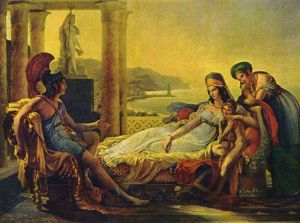
So Dido asks to hear Aeneas tell of the sack of Troy, that Greek genocide about which all people in the Mediterranean had by then heard. Aeneas describes it, in Book II of the Aeneid, in harrowing detail (in the picture above, Dido is listening to him as Ascanius, Aeneas’ little boy, sits on her lap). Aeneas also tells of his wanderings, his “Odyssey”, that brought him from Troy to Carthage.

Did0 listens and is rapt:

The queen, for her part, all that evening ached with longing that her heart’s blood fed, a wound or inward fire eating her away. The manhood of the man, his pride of birth, came home to her time and again; his looks, his words remained with her to haunt her mind, and desire for him gave her no rest. (IV, 1-7)

They get together, in a wild cave on a wild night. It must have been great, for she wants more, infinitely more. In fact, she considers herself married.

Virgil’s Roman audience at this point pictures not only the temptresses that tried to seduce Odysseus but Cleopatra, another queen in northern Africa who had very recently led astray a great Roman (Mark Antony) with her wily and erotic eastern ways. This is titillating stuff to the Romans.

Indeed, Aeneas almost seems inclined to change his plans and stay with Dido. But this is not his duty, and he is “dutiful Aeneas”, pius Aeneas. Jupiter, via Mercury, reminds him unequivocally of his destiny: to go to Italy and sire the Roman race.

Aeneas understands and decides to be on his way. But he doesn’t know how to tell Dido. Indeed he fears her. So he orders the ships to prepare to sail away at night.

Dido finds out and goes into a rage, the mother of all meltdowns. As Cheri has said elsewhere, it is not a testosterone rage as Hercules might have it, defined as violent, intense and short. No, it is an “estrogen rage”: deep, lingering, even eternal and ultimately more destructive.

Thus Dido (Carthage) ceases being Aeneas’ (Rome’s) lover and becomes instead his enemy, indeed the enemy of his entire race:

Then, O my Tyrians, besiege with hate his progeny and all his race to come: Make this your offering to my dust. No love, no pact must be between our peoples; No, but rise up from my bones, avenging spirit! Harry with fire and sword … Coast with coast in conflict, I implore, and sea with sea, and arms with arms: may they contend in war, themselves and all the children of their children! (IV, 865-875)

Then she stabs herself with a sword and hurls herself on a funeral pyre.

Every Roman of Virgil’s day would have understood whom Dido was summoning as this “avenging spirit”: Hannibal.

Indeed, just in case anybody was still confused, Virgil later, in Book X, has Jupiter himself make it more explicit. At a council of the gods on Olympus, Jupiter says

the time for war will come — you need not press for it — that day when through the Alps laid open wide the savagery of Carthage blights the towns and towers of Rome. (X15-19)

You almost get the sense that the entire Aeneid was mere prologue … to this:

Bookmark and Share

Trojan/Roman Aeneas: the historical big picture

Aeneas

What was Virgil trying to accomplish in writing his Aeneid, perhaps the greatest poem in history?

That’s the question I want to try to answer in this post.

(Since the Aeneid merits several posts, I’ll get into what its hero, Aeneas, meant for the development of Western ideas about heroism in a subsequent post.)

I propose that to answer the question, we need to understand something about

  1. Virgil’s own time, and
  2. All of history (ie, ≈1,250 years between the Trojan War and Emperor Augustus), as viewed by Romans in Virgil’s time.

1) Virgil’s own time

Publius Vergilius Maro was born in 70 BCE in the northern part of what we now call Italy, which was then still considered part of Gaul. He probably became a Roman citizen only at the age of 21, when Julius Caesar extended civic rights to the region.

Virgil was thus born in the middle of the century-long Roman Revolution, a time when the old Republic disintegrated — first gradually, then suddenly — as strongmen seized power and fought one another, murdering and terrorizing much of the population in the process. Virgil lived through several rounds of civil war. He was a scholar and spent some of these years in the relative peace of Naples. But the constant and often arbitrary slaughter terrified everybody at the time, including him.

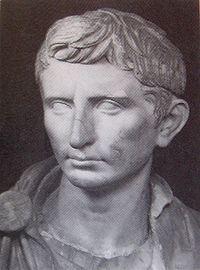
Octavian (Augustus)

Out of that chaos, like a Lotus flower out of pond muck, rose Octavian, later known as Emperor Augustus. Virgil was in Octavian’s social circle and began writing the Aeneid as Octavian consolidated his power, following his naval victory over Mark Antony and Cleopatra at Actium in 31 BCE.

Shrewd and subtle, Octavian was careful to avoid the mistakes of his great-uncle and adoptive father, Julius Caesar, who had begun to resemble a king — a dirty word to the Romans — and was murdered. So Octavian never called himself a king, but a princeps — “first head,” as in leading citizen (whence our word prince).

Over time, Octavian allowed the Senate and people of Rome — his genius manifested itself in this psychological coup — to bestow upon him ever greater powers and titles, increasingly mocking the non-use of the word king. In 27 BCE, the Senate began calling him Augustus, the august or blessed.

But to Virgil and most Romans of the time, all this was a huge improvement over the apparent alternative: more civil war. Augustus imposed peace, on Rome and on its empire. What we call the Pax Romana was really the Pax Augusta.

Augustus thus appeared to be the reluctant hero, the hero who wages war only to end war, who finally lets Rome reach its full, world-ruling and world-changing potential and mission. He seemed to be the end of Roman history, its telos.

What was needed was a story that would tell all of the past, starting before Rome even existed, as though everything inexorably led up to this man, this peace, by divine will.

And this is the answer to the question. Virgil wanted to write that story. We today might be tempted to call it propaganda, and it was. But it was sublime propaganda, in the most moving and intimate words, with allusions to all poems that preceded it. It was epic.

2) From Troy to Rome

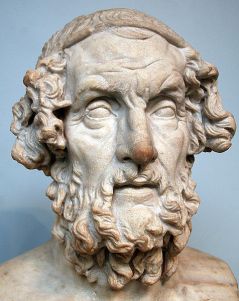
There was, of course, an earlier epic poet to whom all of Mediterranean antiquity looked for explanation of the mysteries of life. That was Homer.

Homer

In about 750 BCE, Homer wrote the Iliad, about events in about 1,250 BCE just before the as yet un-named “Greeks” sacked Troy. And he wrote the Odyssey, one of the many nostos (“homecoming”) stories, in which the nominally victorious Greek heroes struggle and sometimes fail to re-enter society at home. (Whence our word nostalgia: nostos = return home; algos = pain.)

By Virgil’s time, the Romans had, of course, conquered the Greeks and in turn been culturally conquered by them. In fact, as Virgil has Aeneas’ father Anchises predict, in a vision just after the Trojan War for the not-yet-existing Rome:

Others [ie, the Greeks] will cast cast more tenderly in bronze their breathing figures, I can well believe, and bring more lifelike portraits out of marble; argue more eloquently, use the pointer to trace the paths of heaven accurately and accurately foretell the rising stars. Roman, remember by your strength to rule earth’s peoples — for your arts are to be these: to pacify, to impose the rule of law, to spare the conquered, battle down the proud. (VI, 1145-1154)

So this contrast, this proto-Ricardian division of labor, existed: Greek culture, Roman law. The Romans saw themselves as more trustworthy and purer than the Greeks, but simultaneously as the younger descendants of that older culture, a bit as Americans used to feel toward Brits.

So a creation myth had become fashionable in Rome that linked Rome to the same Homeric tradition and yet distinguished it from the Greeks.

This introduces a fascinating psychological symmetry and twist: The Romans had to have been there, to be fighting in the Trojan War, but not as Greeks. Ergo: They were the Trojans! As they had lost then, they prevailed now.

How? Homer himself had seeded the new storyline, in Book XX of the Iliad. Aeneas, a Trojan hero and the third cousin of Hector, Troy’s greatest warrior, fought the monstrous Greek killing machine Achilles and survived. Neptune (ie, Poseidon, to the Greeks) convinced the gods to take Aeneas out of danger, because

his fate is to escape to ensure that the great line … may not unseeded perish from the world…. Therefore Aeneas and his sons, and theirs, will be lords over Trojans born hereafter.

Aeneas rescuing his father and son

So there it is. Aeneas will survive the sack of Troy, a genocide he describes in the Aeneid in harrowing detail. With his father and his son and a band of other Trojan survivors, they will sail through the Mediterranean, trying to found a new Troy.

They try, and fail; again and again. One frustrating delay or disaster follows the next. As a result, Aeneas goes on his own “Odyssey”, criss-crossing the same ocean at the same time as Odysseus does. Virgil emphasizes this. Aeneas sails past Ithaca, Odyssues’ home, and meets one of Odysseus’ men who survived their encounter with the Cyclops. Aeneas’ itinerary, (click to enlarge), looks remarkably similar to Odysseus’:

Aeneas knows all along that he has a duty to found a new city, but he only discovers the details along the way, as they are revealed to him.

This is crucial, because through these revelations we (ie, Virgil’s Roman audience) are foretold the destiny of Rome — Rome’s future in the story which is already Virgil’s past. Indeed, Aeneas and his band of Trojans gradually become Romans — Virgil has them staging games and rituals that the Romans recognized as their own.

When Aeneas descends to the underworld to talk to his dead father, he, Anchises, spells out the next thousand years. He gives Aeneas glimpses of the Gallic wars and Pompey and Caesar and Augustus.

When Vulcan (Hephaestus, to the Greeks) forges him special armor, the shield depicts all of Roman history on its front — including, of course, Octavian’s victory at Actium. Message: This is what Aeneas is fighting to make come about!

The most traumatic part of the next thousand years of Roman history (ie, the millenium between Aeneas and Octavian) occurred during the third century BCE, when Rome fought Carthage and Hannibal came close to exterminating the race of Aeneas. How Virgil deals with that is fascinating. This being The Hannibal Blog, I’ll have more to say about it, as you might imagine. But I will do that in a separate post.

So this is the context of the first six books of the Aeneid: an “Odyssey” from burning Troy to “Hesperia”, the land of the West (ie, Italy).

The context of the remaining six books is a war that must be fought once Aeneas arrives in Italy, at the mouth of the Tiber: another “Iliad”, but this time a war for the founding of a city rather than the destruction of one.

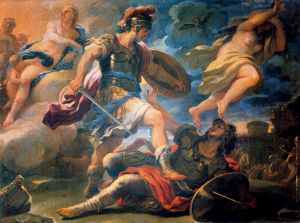
Yes, it is his destiny to found a new Troy on this land, a new race that will rule the world. But the land is already taken. Aeneas and his Trojans will have to make alliances and to defeat the Latins. As Achilles once overpowered Aeneas’ cousin Hector, Aeneas now must become a Trojan Achilles to overpower the Latin hero Turnus.

Aeneas, killing Turnus

The Aeneid ends abruptly as Aeneas finishes the job, after a grueling battle. The last lines are these:

He sank his blade in fury in Turnus’ chest. Then all the body slackened in death’s chill, and with a groan for that indignity his spirit fled into the gloom below.

But through the revelations up to that point, and of course through the history that the Roman audience knew, it was clear that Aeneas is now done with killing. The time for generating has begun. Aeneas marries the Latin princess Lavinia, and Trojans and Latins merge to become a new race, the future Romans.

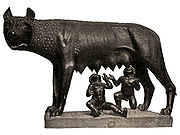
The city of Rome itself, mind you, will not be founded for another few centuries, when Romulus kills his brother Remus, both suckled as babies by the she-wolf, and starts building the city he names after himself.

But the Romans bridged those centuries in their story with genealogy. Romulus and Remus were the offspring of Aeneas and Lavinia fifteen generations downstream. If you define a generation as 25 years, this places Romulus and Remus 375 years after Aeneas. If you assume that Aeneas arrived in Italy between 1,200 and 1,100 BCE, then this fits Romulus’ customary founding date of 753 BCE.

Name is destiny

Ever wonder why the Iliad is not called the Troiad? Well, there’s a little story there that brings us full circle in this post. (This is a bonus round for geeks.)

Remember what my premise for this post is: The Aeneid was a genius work of propaganda for Octavian.

Well, Octavian was adopted by Gaius Julius Caesar, and in Roman law the son takes the name and lineage of his new father. So Octavian’s name was also Gaius Julius Caesar. We call them the first of “the Caesars” (whence the words Kaiser, Tsar, Shah, etc). But they were from the clan of the Julii.

Now, Troy and the Trojans were a city and people with many names (ditto the Greeks), depending on which ancestor you wanted to emphasize.

There was a Dardanus, so the Trojans in the Aeneid are sometimes the Dardans or Dardanians. In fact, we still call the former Hellespont, the straits that separate Europe from Asia, the Dardanelles. Troy was a few miles inland.

There was a Teucer, who married Dardanus’ daughter, so the Trojans are also sometimes called Teucrians. And Teucer had a grandson named Tros, whence Troy.

Tros had three sons: Assaracus, Ilus and Ganymede.

Ilus gave the city one of its names, Ilium. Hence the Iliad. (Ilus was also the grandfather of Priam and great-grandfather of Hector.)

Assaracus, meanwhile, was the grandfather of Anchises, who had the enormous luck to sleep with the goddess Venus (Aphrodite) and sire Aeneas. Aeneas then married Hector’s sister (his own third cousin) Creusa, and they had a son, Ascanius, also named Iulus, a form of Ilus.

Ilus, Iulus, Julius: They are all variations of the same family name. The Julii claimed direct descent from Aeneas and Venus.

Julius Caesar Augustus, you see, was Iulus, was Aeneas, was the reluctant warrior peacemaker, and Rome was the new Ilium, the new Troy.

Bookmark and Share

Hayek and Keynes walk into a bar …

Actually, Hayek and Keynes first walk into a hotel, and then into a bar. And they rap.

You have to be a geek to find this amusing, and regular readers of The Hannibal Blog are likely to qualify.

I’ve only mentioned Friedrich von Hayek tangentially so far, and Keynes hardly at all, although both men really belong into my pantheon of great thinkers. In due course, I’ll give them their own posts.

But for now, just enjoy the seven-minute version:


Bookmark and Share

The “story” of Iceland and Greenland

Once upon a time, war broke out among Norwegian Vikings. One band launched the boats and fled. They discovered a green island and settled. Afraid that their enemies might pursue them, they sent word back to Norway that their island was actually an ice-land, but that another island — more distant, larger and indeed covered by ice — was inhabitable green-land. And so the green island became Iceland, and the icy island became Greenland.

This story is fiction, which is to say false.

The true (non-fiction) story of Iceland’s founding is more complicated and had something to do with Ingolfur Arnason (above), a Norse chieftain who founded Reykjavik in 874.

Greenland, meanwhile, was not “discovered” (by Norsemen, that is) until a century or so later, when a Norwegian who was sailing to Iceland was blown off course. It was later named “green land” by Erik the Red, another Norwegian, who really was fleeing from Norway and first went to Iceland before settling in Greenland. He wanted to bring more settlers and was obviously good at branding and marketing — “green jobs” for his “green economy”, if you will.

Fiction trumps non-fiction

I heard the first version — ie, the fictional account — at some point when I was young and I never forgot it. Even when I learned that the real history was different, I could never quite keep its details together in my memory and returned in my mind to the fictional account. To me, that’s how it happened. And that is odd.

Melanie Green

I was reminded of this when I read about the research of Melanie Green (perhaps the “green” did it). She is a social psychologist at the University of North Carolina at Chapel Hill, and another of the researchers in the Scientific American article I discussed in the previous post.

She found that when information is presented as “fact” or non-fiction, people switch on their critical-analysis brain, whereas when information is presented as fiction, they switch on their story brains. And story brains are much more receptive and open than analytical brains, as mine was when I first heard the story about Iceland and Greenland. (In fact, I tried to “prime” your story brain, too, by opening with Once upon a time).

But once we accept a fictional story, it is in us and affects the “real” world. The article gives the example of the 2005 film Sideways, in which a cranky but lovable wine snob refuses to stoop to Merlot. Well, Merlot sales plummeted after the film, because people (like me) had accepted the story. We all started drinking Pinot Noir. I’m slightly embarrassed by it, in fact.

Lesson (for all areas of life): Never underestimate the power of narrative.

Other tidbits

A few other points of interest or research areas mentioned in the article:

Theory of Mind

Our human brains appear to be wired for stories. The key is our human Theory of Mind, our ability to attribute awareness and intent to other creatures and even objects (which most other animals seem not to have).

Children develop Theory of Mind around age four or five. Which perhaps explains why picture books for two-year-olds are not yet stories but pictures of objects without much connection. Once the kids have Theory of Mind, however, everything becomes a story, whether it involves trains (Thomas!) or worms or blocks.

Empathy and immersion

The best stories captivate us so much that psychologists speak of “narrative transport.” That’s what we authors all hope to achieve, in part by empathizing with our audience, as I have written previously. But it’s actually the audience who must empathize, and

the more empathetic a person, the more easily he or she slips into narrative transport.

Social cohesion

I’ve mentioned Robin Dunbar before, when I talked about Facebook and human group size. Well, Dunbar also has a lot to say about storytelling, it turns out. As our ancestors evolved to live in groups, apparently, they kept track of — and reinforced — their complex social relationships through … storytelling.

Maslow’s hierarchy of needs

I’ve written before about Abe Maslow and his hierarchy of needs, and have even compared that hierarchy to the chakras in Yoga. Well, I should have extended the idea to storytelling.

Patrick Colm Hogan, a professor of comparative literature at the University of Connecticut, has found three narrative prototypes in almost all human stories:

  1. Romantic scenarios, (= the trials and travails of love)
  2. Heroic scenarios (= power struggles).
  3. “Sacrificial” scenarios (= agrarian plenty or famine)

These correspond neatly to the lower three chakras (survival, sex, power), or the bottom of Maslow’s pyramid of needs. No surprise there, I suppose.

The unexpected page-turner: Virgil

Virgil

Of late, I’ve been worrying that I’m losing it. Specifically, my ability to concentrate and … to read. (To read, you must concentrate on what you’re reading.)

I read so much all day on screens large and small that I find myself struggling to read words on paper when they are bound into packets of a certain thickness, otherwise known as books. Perhaps that is why I struggle to appreciate tomes that others are still capable of savoring.

You will appreciate that this is an odd confession from an aspiring author. Soon, in my fantasies, I will persuade all of you to read my book, once it is published. If you’re still able, that is.

So I’ve been starting and dropping books. It’s so easy nowadays — one click on Amazon, a few seconds on the Kindle. But they can’t hold my attention anymore.

And then, I returned to an old book: Virgil’s Aeneid.

Perhaps Cheri reminded me to pick it up again when she did. Perhaps I was just looking for an excuse.

And oh, what a surprise. The pages turn themselves. The pace is fast but light, the action non-stop, the tension immediate, the storytelling riveting. My concentration is complete, my effort nil.

I am reading Robert Fitzgerald’s translation, which preserves the rhythm of Virgil’s Latin. I mentioned the other day how Virgil paid attention to his words, like “a she-bear licking his cubs.” Well, this is the result. Not a word is amiss or extraneous. The poem has speed.

Perhaps I need to get my head examined. Perhaps I am an anachronism, two millennia out of date. Or perhaps there is a reason why the Aeneid is a classic. It is so good. It made me remember how to read. If you’re like me, wondering whether “Google has made you dumb” (Nick Carr), pick up Virgil.

Bookmark and Share

Was Socrates an atheist?

Toward the end of my three-page article about “Socrates in America” in the Christmas issue of The Economist, there are these two lines:

Socrates almost certainly was an atheist. As was his wont, however, he cared more about debating, with a man named Euthrypho on the steps of the courthouse before his preliminary hearing, what piety even meant.

(This refers to one of the two charges against Socrates at his trial, which was disbelief in/disrespect for “the gods of the city.”)

By the placement of these lines, and by the word count I devoted to them (1% of the total words in the article), readers should be able to tell how interested I, as the writer, was in this particular point.

Ie, not very.

To quote I.F. Stone in The Trial of Socrates on the matter:

It was the political, not the philosophical or theological, views of Socrates which finally got him into trouble. The discussion of his religious views diverts attention from the real issues….

But I should have known better. After all, the word atheism appears!

It is a word that makes many people, but Americans in particular, go ballistic. Indeed, it is something of a Rorschach test: Mention it, and people immediately project their ideas, fears, and beliefs into the conversation. Whatever the conversation was about, it is now about something else.

Readers react

One of the online commenters, somebody named “RPB2”, tries to refute the possibility that Socrates was atheist by quoting him (presumably from English translations). Thus Socrates says in the Apology:

For I do believe that there are gods and in a far higher sense than any of my accusers believe in them. And to you and to God I commit my cause, to be determined by you as is best for you and me.

And in the Phaedo, he says:

In this present life I believe that we most nearly approach knowledge when we have the least possible bodily concerns and are not saturated with the bodily nature, but keep ourselves pure until the hour when God himself is pleased to release us.

In the Republic, he says:

[Society’s leaders] must be able to see the one in the many, to appreciate and realize the great truth of the unity of all virtues, have a genuine knowledge of God and the ways of God, and must not be content to rest on faith in traditions, but must really understand. Only in this way can they order all things for the benefit of all

From this RPB2 concludes:

You really have to work to find an atheist here; and thus, sadly, one can see that this article indicates that erudition often does not equate to understanding.

Another commenter, Michael  Bessette, offers RPB2 his support:

… Socrates repeatedly invokes not only gods, but “the god”, as in this famous passage from the Apology: “Athenians, I honor and love you, but I shall obey the god rather than you” (29d). Socrates further asserts that he has been specially chosen by “the god” to persuade the people of Athens of their ignorance (23b) and that abandoning this mission would mean also abandoning his god (30a)…

And a reader named Robert J. Farrell from Fort Mitchell, Kentucky, wrote in a letter:
… the most extraordinary statement in the piece is its labeling Socrates an atheist.  No one can read the accounts given by Xenophon or Plato without recognizing the philosopher’s piety.  His own pilgrimage to Delphi attests to this; and many, many statements exceptionlessly confirm it.  Indeed, he comes across as being very close to monotheism; for, as my tutor remarked years ago, whenever in the Memorabilia he is most earnestly referring to the divine , he speaks of “the god” (ho theos) rather than of “the gods” (hoi theoi).  To call Socrates an atheist for his coolness towards the conventional polytheism of the state is as misleading as it would be to so label Jesus because of his confrontation with the priesthood of the Temple…

Discussion

Let’s examine some of these points.

First, what does it prove if Socrates uses, in the writings of Plato or Xenophon, the word “gods”? Not a whole lot, I submit.

All sorts of atheists today scream Goddammit every time they hit the rush hour, and atheist starlets stammer Ohmigawd, ohmigawd when accepting their Oscars. We have to distinguish between a word as figure of speech, as familiar trope to facilitate communication, and as intended content.

What I find curious in the quotes above is the capitalization of the word God. It’s a loaded capital letter, to say the least. In fact, let’s use this occasion to parse some terms:

1) Monotheism:

Is it possible that Socrates believed that there was only one god? I believe we can rule this out. The Greeks did not have that concept. (Even the Jews, who invented it, were just developing at this time, in the century following the Babylonian captivity, as Robert Wright’s The Evolution of God explains quite well.)

2) Atheism:

Admittedly, the same is true for our modern concept of atheism–ie, the Greeks did not have that concept. If somebody was “godless”, that meant he had been abandoned by one god or goddess or another. It did not meant that he denied their existence.

3) Polytheism
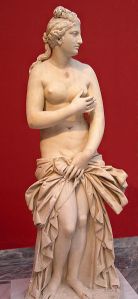
Aphrodite

Polytheism is how the Greeks (and most of the world at the time) understood divinity. Alas, this is a concept that has become quite alien to us (unless you happen to be, say, Hindu), so we are the ones struggling to understand it.

Polytheism was an infinitely stretchable and flexible spiritual instinct. A polytheist had mental room not just for many gods and goddesses but for new gods and for other people’s gods. Even the Greek pantheon included many gods and goddesses (Aphrodite, eg) “imported” from Mesopotamia and thereabouts, for instance.

4) Pantheism

So polytheists were also, by implication, pantheists. They had an expandable pantheon of gods, and divinity was to be found everywhere and in everything.

Zeus

Put differently, gods and goddesses were often personifications of things. Zeus/Jupiter/Thor/Baal of thunder, for example. Hermes of humble door-thresholds, among other things. Hestia of the hearth. Helios/Apollo of the sun. Kronos of time (→ Chrono-logy). And so on.

Names of things in effect became potential divinities. Sophia could be thought of as a goddess of wisdom, tyche (Roman fortuna) could not just mean luck but be the goddess of fortune, and so forth.

(In fact, I.F. Stone, believes that Socrates’ indictment for “impiety” referred specifically to two such personifications/divinities: The “gods of the city” of Athens may have been understood to be Peitho, a personification of “democracy” and thus a political concept, and Agora, which meant not only marketplace but also assembly, and thus dovetailed with Peitho.)

It was, in other words, a rich and metaphorical way of expressing ideas and telling stories. Eloquent people at the time were as unlikely to avoid using tropes of divinity as we are today to avoid metaphors.

“Science”

Having said all that, there was something interesting that happened in the Greek world at around this time, and we might think of it as the beginnings of “science”.

The Greeks traditionally relied on their religion (their “myths” to us) to explain the world. And they relied in particular on the corpus of stories in Homer and Hesiod.

Thus, if summer turned to winter (a perplexing process, if you think about it) it was because Persephone returned to her husband Hades, thus making her mother Demeter, the goddess of fertility and grain, so sad that she turned the earth barren for half a year. If somebody went into a rage and killed innocent people, it was because a jealous god or goddess possessed him temporarily (eg, Hera possessing Hercules). And so on.
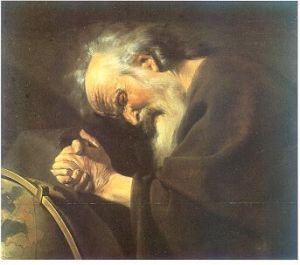
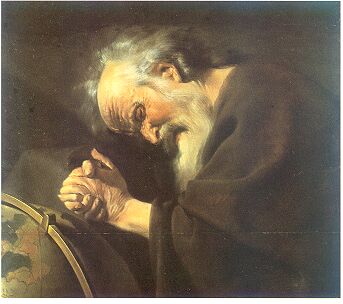
Heraclitus

But, starting about 200 years before Socrates’ trial, some (mainly Ionian) Greeks rejected these mythological explanations and tried to use direct observation of nature (physis in Greek, as in physics) and reason (logos) to explain the world.

These were the so-called “pre-Socratics”, such as Thales, Anaximander, Pythagoras and Heraclitus. They wanted to know what things were ultimately made of (fire, earth, water, etc) and how they changed. They wanted to understand the world better and differently.

So they ignored the gods. I don’t think they boycotted temples and sacrifices and other fun cultural activities, just as even Richard Dawkins today might sing along to Rudolph the Red-Nosed Reindeer. But the gods ceased, for them, to explain anything. In that sense, you might say, using a modern term, that they were atheists.

Pre-Socratic Socrates

Now let’s talk about Socrates. The first thing to know about him, as silly as it sounds, was that he spent the first half of his career as a pre-Socratic philosopher. (Obviously, “pre-Socratic” is a term we invented, not the Greeks). This is to say that he also tried to do “science”, to inquire into the nature and causes of the physical world and its phenomena.

Aristophanes

This is the Socrates, aged about 40, whom Aristophanes mocked in his comedy The Clouds. In that play, Socrates runs a “thinkery” where he examines how far flies jump and how they fart–presumably, with the Athenian audience, including Socrates, in stitches.

And Aristophanes has the Socrates in that thinkery argue that “Zeus does not exist.” “If no Zeus, then whence comes the rain?” he is asked by Strepsiades, a country bumpkin. Socrates offers another explanation for rain, and Strepsiades admits that he had always thought it was “Zeus pissing down upon earth through a sieve.” But at the end of the play, he burns down Socrates’ Thinkery, saying “strike, smite them, spare them not, for many reasons, But most because they have blasphemed the gods.”

Now, folks, this is humor. I get that. But there is more to it. Aristophanes was describing a new (proto-atheistic) worldview in a hilarious way. Socrates would, twenty-four years hence, at his own trial, say that this (ie, The Clouds) is where the charge of impiety originated.

The Socratic “turn”

At about the time of The Clouds Socrates had a wrenching midlife crisis. Apparently, he came to believe that he was not very good at being a philosopher–ie, he became frustrated by his inability to explain nature satisfactorily.

So he made his famous “turn”: away from questions about nature and toward the humanistic subjects of ethics, politics and meta-physics (literally: “beyond nature”). It is not much of an exaggeration to say that he invented all three as subjects.

Hades and Cerberus

But he brought with him his pre-Socratic proto-atheism, by which I mean his tendency to ignore myth and gods as explanations for anything.

For example, on his own deathbed he gives a moving (but confusing) speech about death and the immortality of the soul. As it happens, this should not have been necessary: Greek religion gave detailed information about what happened after death. You took a gold coin with you, went down to Hades, past Cerberus, the three-headed guard dog. Then you gave your coin to Charon, the boatman, who ferried you across the river Styx, where you would henceforth hang around as a shadow. Lots and lots of heros (Hercules, Odysseus….) had already been down there and come back to tell us about it.

But no, Socrates had none of that. No Thanatos, no Hades, no Charon. He used his reason alone. Again, I consider that proto-atheist.

Theism, Deism …

Did Socrates ever go one step further and deny spirituality or divinity? No. I doubt he was interested in that.

Did he really believe, as he claimed when addressing his jury, that his own personal daimonion (“little divine thing,” whence our daemon) talked to him to warn him of danger? Perhaps, perhaps not.

Did he consider himself a proto-atheist? Perhaps, perhaps not. The one time he could have spoken about the matter explicitly, during his trial, he reverted to form (ie, Socratic irony and dialectic) and maneuvered his accuser, Meletus, into defining atheism as both believing in unorthodox gods and no gods at all, which is impossible at the same time. He was a wise ass, in short.

So we do not know, and we will not know.

What we can agree on, I believe, is that Socrates was a highly unusual man with unusual opinions and extremely unorthodox views about everything, including religion. Whatever he believed, neither atheists nor theists today can claim his support to wage their ongoing battle.

In this respect, in fact, Socrates reminds me of another non-conformist I admire: Albert Einstein. Einstein also studied physis and inadvertantly ended up “beyond” it, in meta-physis. And Einstein also had notions about religion that still divide lesser minds today. Was he an atheist? A believer? Everybody wanted to know. So Einstein penned an answer, which concludes (page 387 in this biography):

The most beautiful emotion we can experience is the mysterious. It is the fundamental emotion that stands at the cradle of all true art and science. He to whom this emotion is a stranger, who can no longer wonder and stand rapt in awe, is as good as dead, a snuffed-out candle. To sense that behind anything that can be experienced there is something that our minds cannot grasp, whose beauty and sublimity reaches us only indirectly: this is religiousness. In this sense, and in this sense only, I am a devoutly religious man.

I believe Socrates might have said the same exact thing.

The Procrustean Bed, again

And so, I have spent as many words again on that one little sentence as I wrote in that entire article. Would I change the little sentence?

I’ve posted before about the Procrustean Bed that page layouts represent to writers: you must either stretch or, more often, amputate your text in order to fit the space an editor gives you. Socrates in America: Arguing about Death was not an article about religion. It was about how we talk to one another and the tension between individualism and democracy. Religion only came up en passant, and so I was forced to commit a journalist drive-by shooting.

When I said

Socrates almost certainly was an atheist

I had all this and more on my mind. Given another chance, I would say

Socrates may have been an atheist

or perhaps

Socrates’ views on religion were unorthodox to say the least.

And then I would have done just what I did: I would have moved on.

Tudor sex and beheadings made complicated

Henry VIII

I’m reading Wolf Hall by Hilary Mantel right now. It’s a historical novel about the efforts by Henry VIII of England and Anne Boleyn to annul Henry’s marriage to Catherine of Aragon, his first wife, so that he and Anne could marry instead and–so it was hoped–produce male heirs.

The rest, you might say, is history. What stood in Henry and Anne’s way was the Catholic Church, ie the pope, so Henry had to “fire” the church and start a new one, the Church of England, whence sprang Anglicanism and its offshoot, Episcopalianism.

The new marriage, however, was not, ahem, ideal and Henry went on to have a few more wives, while Anne, and an awful lot of other people, lost their heads.

In short, it is a fantastic topic, a fantastic story! The sort I love, because it is simultaneously:

  1. grand and important, and
  2. riveting and engrossing.

    If it were entertaining but trivial, I probably would not bother, because life is short and I want to spend it on important things. If it were important but boring, I also might not bother, because, well, life is short and I want to minimize my pain.

    Anne Boleyn

    So by being important and riveting, Mantel’s topic is exactly like the events that I chose as the main storyline in my own forthcoming book, ie the Punic Wars that led to the rise of Rome and the fall of Carthage. And this is one reason why I chose to read Wolf Hall. I wanted to see Mantel’s storytelling.

    The other reason is that the book won the Man Booker Prize, one of the most prestigious awards in the English-speaking world. I distrust prizes, but at the same time they do promise to make our lives easier by pre-winnowing some of the wheat from the chaff. Others have taken their cue from the prize and are heaping more praise. So I started reading.

    What a disappointment

    I’m half-way through the book now, at page 200-and-something, and boy, is it hard work.

    I read, I get confused, I go a few pages back to see if I missed something, discover that I did not, struggle on, get tired, fall asleep, try again the next day.

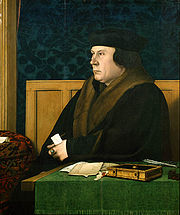
    Thomas Cromwell

    Here are the problems, as I see them:

    1. Who the heck is speaking? Dialogue is difficult to write and separates great writers from mediocre ones. Mantel tells the story through the eyes of Thomas Cromwell, an influential lawyer and wheeler-dealer behind the scenes. She therefore makes him a default he in the story. The problem is that there are lots of other hes (ie, men), and when several men are talking, we don’t know which he is thinking, talking, doing whatever he is doing. This sounds banal, but it is annoying. It does not help that everybody is named Thomas (that’s not Mantel’s fault, of course).
    2. Who are all the people and why should I care? Mantel assumes that I already know all the characters, the chief ones being Cardinal Thomas Wolsey, Thomas More, Thomas Cranmer, Jane Seymour, the Dukes of Norfolk and Suffolk and so forth. As it happens, I love history and have indeed heard of most of them before, but my knowledge of this era has got rusty. I wanted it to be Mantel’s job to re-introduce me to these people so that I don’t have to make an effort.
    3. What is the historical context, ie the import? Mantel assumes that we already know the interrelationships and geopolitical constellations between the Holy Roman Empire; the papacy; the French, Spanish and English kingdoms; and so forth. As it happens I do, sort of, know about these matters–at least more so than Mantel can expect from most readers–and it still does not suffice.

    Thomas Wolsey

    So I took time out and resorted to … Wikipedia. Yes, I did. I spent a good hour last night reading all the main characters’ entries, as well as brushing up on why, say, the Archbishop of York had less power than the Archbishop of Canterbury or who the heck a “Lord Chancellor” was again, and other matters that Mantel does not deign to make clear.

    Hilary: Is that what you want your readers to do–go to… Wikipedia????

    As it happens, it worked and Wikipedia did give me the context I need. But what an indictment of Mantel’s storytelling technique. The whole premise of books like this is that you get the history and the humanity, the importance and the drama, at the same time.

    Hilary, you seem to be too busy being ‘literary’–with complex points of view, revisionist interpretations and what not–to hold me by the hand. You were supposed to make it easy for me. You did not.

    Bookmark and Share

    The White Rose: German heroes

    In a recent conversation, I brought up the White Rose–die Weiße Rose–and was reminded that most of you (being Anglophone) have probably never heard of them. But you must know them. Now you will.

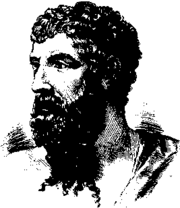
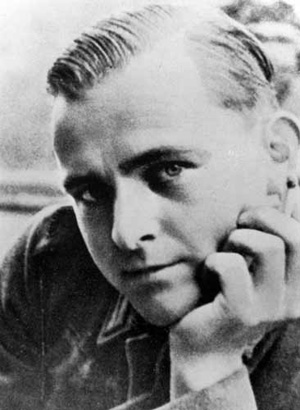
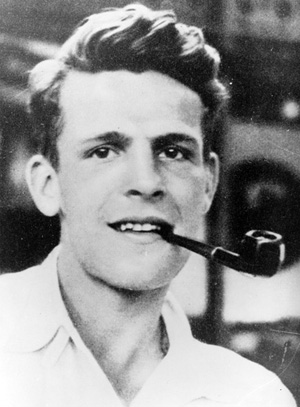
    They were a smallish group of students and one professor at the University of Munich during the Nazi era who defied and spoke out against the Nazi horrors. The middle petals of the Rose were Hans Scholl (above left) and his sister Sophie (middle) and their friend Christoph Probst (right). The group lasted less than a year until, in 1943, they were caught, “tried” and beheaded.

    This summary does not do justice to them, however. They are, to me and to all post-war Germans, synonyms for goodness, courage, humanity. They are romantic, having lived Bohemian lives of pipes and poetry. They saw crimes against humanity and resisted, knowing that this would cost them their lives. At a time when conformity turned an entire nation into a murderous mob, they remained individualists, becoming heroes of all mankind.

    The Leaflets

    Alexander Schmorell

    The Geschwister Scholl (siblings Scholl) and their friends watched with increasing horror what the Nazis said and did in the 1930s and early 40s. Then Hans Scholl and his friends Alexander Schmorell und Willi Graf were sent (nobody had a choice) to the eastern front in 1942 where they witnessed German atrocities in Poland and either saw or heard about the Warsaw Ghetto. Many Germans soldiers did, but these three were different: They decided not to stay silent but to fight the evil, which was their own regime.

    Hans Scholl

    They returned to Munich, where Sophie, Hans’ younger sister had moved to study biology and philosophy. She became friends with Hans’ friends. Never knowing whom they could trust, they formed their group, printing leaflets in secret back rooms and sending them by mail all over Germany.

    They managed to print only about 100 copies of the first leaflet. (You can read an English translation of all six leaflets here, but I’ve chosen excerpts from the German and translated them in my words. Pictures courtesy of the Gedenkstätte Deutscher Widerstand):

    Willi Graf

    … Is it not true that every honest German today is ashamed of his government? And who among us can even guess the extent …?

    … If the Germans, without any remaining individuality, have indeed become a heartless and cowardly mob, yes, then they deserve to perish…

    Goethe talks about the Germans as a tragic people, like the Jews and Greeks, but today it seems that the Germans are a shallow, mindless herd of followers (Mitläufern) whose marrow has been sucked out and who, bereft of their core, allow themselves to be led into their extinction. It seems so, but it is not so; instead, each individual–after slow, insidious, and systematic rape–has been put into a moral prison, and only once he was captive did he become aware of his dilemma. Few understood the the menace, and their reward was death….

    Each individual, as a member of Christian and Western civilization, must therefore rise up in this final hour and resist, as much as he can, against this scourge on humanity, against Fascism and every system like it. Resist passively, resist, resist wherever you are … Never forget that each people gets the government it deserves…

    Christoph Probst

    They then quoted Friedrich Schiller talking about Lycurgus and Solon (ie, ancient Greece) and Goethe, clearly reminding their readers of the previous heights of their civilization, the starker to contrast it with its present lows.

    In the second leaflet, they begin to inform the Germans of what they had seen on the eastern front, so that none might later say (as many would) that they “didn’t know”:

    … the fact that, since the conquest of Poland, three-hundred-thousand Jews have been murdered in a bestial way. Here we see the most dreadful crime against the dignity of man, a crime that compares to no other in the entire history of mankind…

    … Nobody can pretend he was not guilty. Everyone is guilty, guilty, guilty! But it is not yet too late to wipe this ugliest monstrosity of a government off the face of the earth, in order not to become even more guilty….

    .. the only and highest duty, indeed the holiest duty, of each German is to eradicate these [Nazi] beasts….

    They then quoted Laozi and closed with an exhortation to copy the flyer as many times as possible and to distribute it (in effect, demanding martyrdom from each reader).

    In the third leaflet, they exhort:

    … The foremost concern of every German must not be the military victory over Bolshevism but the defeat of the National Socialists ….

    before describing how people should resist:

    … Sabotage of the military-industrial complex; sabotage in all Nazi gatherings, rallies, festivities, organizations…. Sabotage of all scientific pursuits to further the war, whether in universities, laboratories, research institutes … Sabotage of all Fascist cultural events…. Sabotage of all the arts that serve National Socialism. Sabotage of all writings and newspapers in league with National Socialism….

    They ended by quoting Aristotle on the subject of tyranny and again exhorted readers to copy and distribute.

    Sophie Scholl

    From the fourth leaflet:

    … Every word that comes out of Hitler’s mouth is a lie. When he says peace he means war, when he says the name of the almighty he means the power of evil, the fallen angel, Satan. His mouth is the stinking throat of hell…

    They also assured readers that they took addresses randomly from phone books and did not write them down anywhere, then ended with:

    … We will not be silent, we are your bad conscience; the White Rose will not leave you alone! Please copy and spread.

    In the fifth leaflet:

    … Are we to be a people forever hated and outcast by the world? No! Therefore resist these Nazi subhumans! Prove with your deeds that you think different!

    They end with an amazingly prescient vision of post-war Germany and Europe, predicting a federalist Germany, a unified and peaceful Europe, and freedoms of association, speech and press.

    In early 1943, after the German army was wiped out at Stalingrad, they produced their sixth and final leaflet, with their biggest print run yet–about 3,000 copies. They again mailed it all over Germany.

    … Freedom and Honor! For ten years, Hitler and his thugs have twisted, raped, perverted these two beautiful German words…. They have shown what freedom and honor mean to them by destroying, throughout the past ten years, all material and spiritual freedom, all morality in the German people….

    This time they went further. For three nights, they stealthily went out and painted the walls of the university quarter: “Down with Hitler!” “Freedom!”

    Then Hans and Sophie (whom Hans had tried to keep out of the group in order to protect her but who had become passionately involved) decided to carry stacks of leaflets into the university to distribute them while lectures were in progress. This was reckless and the other members did not know about it.

    Hans and Sophie stuffed a big suitcase full of leaflets, took it to the university and put stacks on window sills and in front of lecture halls. Just as the bell rang and students were about to spill out, they threw a big pile from the very top of a staircase into the light-filled atrium (where they are immortalized today, see left). A janitor saw them and alerted the Gestapo.

    The guillotine

    Four days later, Hans, Sophie and Christoph were “tried”. Hans and Sophie asked that Christoph be spared because he was married. The request was denied. On the same day the guillotine fell on their young necks.

    Hans was 24 years old; Christoph 23; Sophie 21.

    Their houses were searched and letters and addresses discovered. Soon after, Alexander Schmorell and Willi Graf, as well as their professor, Kurt Huber, were also caught and beheaded. Alexander and Willi were 25; Professor Huber almost 50.

    Just before Hans was brought to the guillotine, he yelled out of his cell, echoing through the walls of the prison:

    Long live freedom!


    Bookmark and Share

    The “heart” of the Western Tradition: Dante

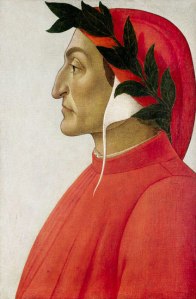
    Dante

    Nudged by Cheri, I’m re-reading Dante’s Inferno right now on my Kindle. Reading Dante is always a good idea.

    The Inferno, or Hell, is the most gripping of the three parts of Dante’s epic Divine Comedy–the more boring parts being Purgatory and Paradise. (And isn’t that interesting, by the way: As every journalist and writer knows, the awful makes for an infinitely better story than the hunky-dory.)

    But in this post I want to make a different, more historical, point about Dante: He may just be the single best illustration of a metaphor I told you about last year to explain–really, really explain–the entire Western Tradition.

    To recap that post very briefly: You can think of “Western culture” as a human body.

    • The left leg is ancient Athens and Rome, Socrates and Aristotle;
    • the right leg is Jerusalem and the Bible, Moses and Jesus;
    • the crotch is the end of the Roman empire when the two “legs” met;
    • the torso is the Middle Ages, when the two traditions became one;
    • the left arm is the Renaissance;
    • the right arm is the Reformation;
    • the neck is the Enlightenment; and
    • the head is us, ie modernity.

    (The metaphor, which comes from Professor Phillip Cary, is more subtle, so please read the older post.)

    So where does Dante fit in?

    Well, he was a product of the Middle Ages, located in the “torso” just below the left arm pit, where the Renaissance was to begin. The Renaissance, or “left arm”, in this analogy, was to be Petrarch, a fellow Tuscan and co-founder, with Dante, of the “Italian” language.

    You see this all through the Inferno: the surprising and constant mixture of Athens/Rome and Jerusalem, of the (pagan) classics and the Judeo-Christian, Bible-thumping fire and brimstone, so that the two legacies merge to form a new and distinct tradition, as two haploid gametes unite to make a new, diploid human being.

    The overall structure, both narrative and psychological, is, of course, Biblical: We are in Hell, after all. (The ancients did not have Hell, a place where we are punished for our sins. They only had a boring and gloomy place named Hades.)

    But look who guides Dante through this Hell: It is Virgil, the greatest of the Roman poets, who told of brave Aeneas surviving the sack of Troy and founding the Roman nation. Dante can think of no one nobler, and yet Virgil is a pagan, so Dante meets him, along with Homer, Horace and the other ancient greats, in the first circle of Hell. Relatively un-dreadful, this circle is the limbo where those hang out who were unlucky enough to live before there was a Christianity to be baptized into.

    Together, Virgil and Dante then descend deeper and deeper, from one circle to the next, to witness the torments of the sinners increasing with the vileness of their sin. But again, look whom they encounter:

    • Cerberus, the three-headed dog who guarded Hades (although Dante describes him slightly differently),
    • Charon, the ferryman who brought the dead souls across the river Styx for their final destination in Hades,
    • Centaurs, half men and half horses, who caused mischief in the Greek myths,
    • even historical characters such as Alexander the Great, whom we meet boiling in a river of blood in return for the blood that he spilled. (Hannibal must have been floating nearby.)

    On and on. Virgil and Dante casually discuss things such as “your ethics”, which is assumed to mean Aristotle’s Ethics (the only text on ethics that the medievals had recourse too).

    This, then, was the torso just before Petrarch emphasized its left (humanist, classical) side, thus launching the Renaissance and eventually provoking others to raise the right (Protestant, then counter-Reformationist) arm.

    Located just below the left arm pit of the Western Tradition, Dante was thus … its heart!

    Bookmark and Share