Socrates and the “town hall meetings”

Lest any of you think that I have abandoned my thread on Socrates, far from it!

Indeed, the reason that you haven’t heard much lately from me about the great and controversial and perplexing man is that I’ve decided to do a big piece on him in the Christmas issue of The Economist (large parts of which we actually produce in September).

So am I thinking about him? Every day, especially this week, as I cannot avoid, no matter how much I try, the news about these alleged “town hall meetings” on health care.

Town hall meetings?

Democracy?

America?

Oh, please. This is what the thread on Socrates has been about: Good versus bad conversation, debate that wants to find truth and climb higher versus debate that wants to win, to debase, to obscure.

PS: As I post this, I am downloading yet another lecture series by The Teaching Company on Plato, Aristotle and Socrates

Bookmark and Share

Socrates on trial

Death_of_Socrates

And here he is, the great man, dying of the hemlock coursing through his veins. Throughout this thread on Socrates, we’ve been pondering all the ways in which he–his life, his thoughts, his arrogance, his eccentricity, his genius and humor–speaks to us today, timeless in his relevance. But of course we always knew what happened next, the full stop that ended the sentence of his life. His trial and martyrdom is rivaled, in notoriety and historical importance, only by that of Jesus.

It is more than just another fact in the text books: It is one of the greatest mysteries in all of history, and an eternal challenge and reprimand to democracies and freedom lovers everywhere. The question is:

Why?

Why did the Athenians, the most ardent freedom lovers of all time, turn against their gadfly when he was 70 years old? For his whole life they had tolerated, mocked, enjoyed, hated and loved him. But then something changed. One of their 500-man juries, the sort that they were so proud of, found him guilty of two silly–laughable, stupid, banal!–charges and gave him death.

Let’s try to find out what was going on.

Bookmark and Share

Socrates’ Athenian jury

Orestes and the Furies

Orestes and the Furies

Slowly, in this thread on Socrates and his surprising relevance to us today, we are leading up to his jury trial, the most famous in all of history. So a word is in order about Athenian juries.

I am skeptical of jury-systems, as I have hinted before and as I may eventually spell out more coherently. But that is neither here nor there today. Today I want to look at what juries meant to the Athenians, and how they worked.

Above, you see a strapping but unfortunate lad named Orestes being beset by the Furies. He is one of the main characters in the Oresteia, a famous trilogy of tragedies by Aeschylus, the oldest of the three great Greek playwrights (the others being Sophocles and Euripides). It is a heart-rending story about a truly haunted family that, generation after generation, goes from bad to worse until it ends …. in the world’s first jury trial!

Background

Very quickly: Several generations of disastering downstream, a king (Agamemnon) continues the pattern by sacrificing his own daughter (!) so that he can take an army to Troy to get his brother’s wife (Helen) back. More than a decade later, he comes back–victorious, as it were. But his wife is humping another man and hates her husband for killing her daughter and takes revenge: she stabs him in the bath tub.

Now the disastering moves on to the next generation: The remaining children of Agamemnon and his wife, Orestes and Electra, must avenge …. well, whom exactly? Their sister, whom their father had murdered? Or their father, whom their mother had murdered? They settle for the latter, and Orestes kills his mother. The Furies are beside themselves and go to work on Orestes.

What could possibly happen next? It would seem that everybody has to keep slaughtering everybody forever, were it not for…

The Athenian Jury

Aeschylus now did something very cheeky. The Trojan War took place, if indeed it did, around 1250 BCE. It was already ancient mythology for the Athenians of the fifth century BCE. But Aeschylus modernized the story. He added a patriotic Athenian twist: They do not keep slaughtering one another. Instead, they settle things in an Athenian jury trial!

The jury, as it happened, was split. Half thought Orestes was in the wrong, the other half thought he had had no choice. So Athena herself had to join in to break the tie. She voted to acquit, thus setting the precedent for all subsequent Athenian trials that a tied vote meant acquittal.

And so the days of blood feuding were over. The scary Furies turned into something else: the benevolent and beautiful Eumenides (“kind ones”), whom the Athenians would revere among their gods. Civilization had begun. Athens had begun! She stood for freedom and justice.

Practicalities

A few other things are worth mentioning:

  1. The juries were huge, numbering about 500. Sitting on juries and in the assembly was all that Athenian citizens did (slaves and women did what we would call work).
  2. Anybody could bring an indictment.
  3. There were two rounds of voting: First, to decide whether the defendant was guilty or innocent of the charges; second, if guilty, to decide between the punishments proposed by the prosecution and defense.

But the most important point is the one you’re supposed to infer from Aeschylus: the Athenians loved their jury courts, their assembly, their free speech, their democracy. The worst thing that could happen would be for something to call these institutions into doubt. And that’s what happened when an Athenian jury put Socrates to death.
Bookmark and Share

Socrates, the cynics, idiots and me

Antisthenes

Antisthenes

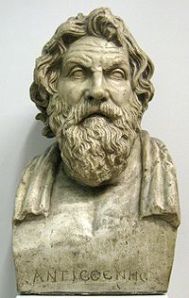
Socrates’ most famous disciple was of course Plato. But his oldest disciple was a man named Antisthenes (above), who became the first of the cynics and the teacher of that Diogenes whom I so admire and envy, because I would love the simplicity of living in a barrel.

I quite sympathize with Antisthenes, in several ways. Socrates was forever going around interrogating everybody in this intense–we would say anal-retentive–quest to come up with perfect definitions. What is virtue? What is justice? What is the good? Whatever answers others gave, Socrates dismantled them, but rarely came up with anything positive. Antisthenes eventually got rather bored and frustrated by all this.

So he concluded that these things that Socrates was obsessed with were really just names, or words. They mean what you want them to mean. 2,360 years later, French intellectuals like Derrida would say the same thing and get famous for it.

So to hell with words, said Antisthenes, and let’s get out of here. Screw society and its norms and conventions. Jury duty? Puhleeze. Vote? No way. That stuff was for those do-goody Athenians who were under the illusion that they were “free“. Antisthenes, who had a good sense of humor, regularly recommended that the Athenians should vote that asses are horses, as a way of celebrating democracy.

He, and all the Cynics, were thus what we would call apolitical: without politics, without a polis, without a city. Aristotle thought there was something pathetic about being apolitical, cityless–like being “a solitary piece in checkers”. But Socrates, Antisthenes, Diogenes and those types saw freedom in this withdrawal.

As Jag Bhalla, an expert on such matters, has already pointed out on the Hannibal Blog, the Greeks had a word for these people: keeping out of public affairs, they were private, or idiotes. In time we came to call people who cut loose from conventions idiosyncratic, but also tried to discourage that sort of thing and gave idiots a bad name.

I, for one, stick by my Diogenes dream: Being an idiot sounds great to me.

Bookmark and Share

Socrates, individualism and conformity

Here is one way of seeing the timeless relevance of Socrates for us today: Think of him as the archetype of individualism fighting against oppressive social conformity.

In this thread on Socrates, I’ve already looked at some noble and less noble aspects of the man’s character. And every time I found him to be thoroughly modern and recognizable. So too in this way.

Watch the 2-minute video above of the famous Asch Experiments that began in 1956. They were devastating: We saw confirmed what we already suspected, that people will readily surrender truth to a group.

To me, still emerging from my old Ayn Rand phase, this was always the ultimate, the most disgusting, sin. To me, this is how the Nazis perverted an entire nation, how Mao’s Red Guards did it again, how all great evil throughout history spreads.

Hence the inherent appeal of a hero such as Socrates. He told the group (the Athenians) to bugger off. In return, they killed him for it. (This will get a lot more nuanced in future posts, but let’s leave it at that for now.)

If Socrates had sat in the Asch Experiments, he would never have changed his answer.

But should the group really bugger off?

If it were as simple as all that, The Hannibal Blog would not find this so interesting. But it is not so simple. It turns out that we have moved on from the Asch Experiments somewhat. Read, for instance, Bert Hodges and Anne Geyer, two psychologists who took a new approach.

The people who might change their answer to “lie” in unison with the group were in fact facing an exceedingly difficult situation that inherently required all sorts of complex trade-offs, they argue:

  • On one hand, there is the value of truth.
  • On the other hand, there is the value of social solidarity.

In practice, most people did not conform consistently (ie, “lie” with the group every time) but varied their response in what Hodges and Geyer call

patterns of dissent and agreement to communicate larger scale truths and cooperative intentions.

In short, they were being biological organisms that keep in mind 1) their own survival in a group and 2) the survival of the group as a whole.

Now this is exactly the sort of poppycock that I used to have no time for at all. But as I get older I see more complexities. In Socrates’ case, for instance, there actually was a specific threat to the group survival of the Athenians, and I will get to that.

So we can add another timeless conundrum to the issues that Socrates raised. We already said that truth often conflicts with gentleness and kindness, and that one cannot assume truth must always win this fight. What if Hodges and Geyer are right and truth must also occasionally take a backseat to those “larger truths”– and that Socrates, failing to understand that, paid a fair price?

Bookmark and Share

The arrogance of Socrates: Apollo made me!

None wiser, says Apollo

None wiser, says Apollo

So we opened this thread on Socrates and his relevance to us today by showing the heroically positive, then nuanced that with some more ambiguous observations. We must now add (before we eventually get to the heroic again) a few more. First: he was arrogant.

Yes, an arrogant S.O.B. I mean, let’s take his personal “creation myth”, ie the story that he would later use at his trial (to which we will get) as his raison d’Γͺtre.

There are two versions of this story, one from each of the only two students whose writings we rely on to know anything at all about Socrates.

Xenophon, the less famous of the two, says that Socrates told the Athenian jury that he had sent a student/apprentice to Apollo’s oracle at Delphi, where the oracle opined that

no man was more free than I, or more just, or more prudent.

Ahem. Lest that sound a bit, you know, over-the-top, Socrates added that

Apollo did not compare me to a god [although he did] judge that I far excelled the rest of mankind.

So there, members of the jury. That’s why I have been going around humiliating and exposing you, disabusing you of your impression that you were free, undermining your self-confidence while tooting the horn of the Spartan enemy.

The more famous of the two students, Plato, wrote later and probably realized that it would be wise to tone this down a bit. Here Socrates ‘merely’ told the jury that the oracle told him that

there was no one wiser.

This is still rather cocky, but now with a twist. The twist is that Socrates is now on a divine mission. He must find out whether the oracle is right, whether anybody out there is wiser after all. So, you see, he had to make everybody look like a fool just to do justice to Apollo.

His ‘biographer’ I.F. Stone calls this one huge “ego-trip”, possibly the biggest in world history. It just so happens that I have a soft spot for huge egos, provided that they are intelligent and witty and not my editors. So on The Hannibal Blog, this is not an attack per se. It’s just, you know, ‘color’. We need to know who we’re dealing with.

Bookmark and Share

Elitism: Socrates’ Athens to Palin’s America

Snob

Snob

Socrates was a snob, an unabashed elitist. How I love him.

Now, I know it’s not fashionable to be an elitist in today’s America–every four years, a Palinesque figure emerges to tell you that you don’t belong to “real America”. Elites, in some vague and unspecified way, then become those people out there who conspire to keep the honest folks down.

Socrates had none of it, and he too eventually ran into the Palin faction of his time. So this is yet another way in which Socrates, with his life and thought and personality, speaks to us across the ages, as we are discovering in this thread.

The mob and the experts

As ever, we must see Athens as his analog of America. So how did the Athenians see themselves? Above all, as free. Their word for their city was polis, a free and self-governing state. That’s where we get our word politics.

So the non-slave, male Athenians of a certain class lounged around the Acropolis and Agora, debating in their assemblies and deliberating in their huge juries–participating in this and that and every way.

To Socrates they were a dumb herd of sheep. It’s not that he was against democracy per se. It’s just that, as I.F. Stone puts it in his work of investigative journalism about the trial of Socrates (about which more in later posts), Socrates believed in

rule neither by the few nor the many but by the one who knows.

In short, he was neither oligarch nor democrat, but elitist! An Athenian, he always loved and admired Sparta, the elitist enemy of Athens.

(The orginal Greek meaning of aristocrat was “rule of the best”, similar to our meritocrat. How strange that we need to mix Latin and Greek roots together to understand a word properly. See: television.)

So Socrates thought it was just as ridiculous for the Athenians to expect masons and smiths to “govern” and “judge” in the assembly and jury-courts as it would be for them to hire a mason to build a ship. Obviously, they’d get a shipwright. So too they should get a properly qualified statesman for the ship of state.

Better, therefore, to look for the best, then train them, then pick the best again, then train them even more. What you are doing is eligere in Latin, to elect in English, Γ©lire in French, and that last variant is where elite comes from.

Americans in particular love this kind of market selection. When they step onto plane and hear from the pilot, when they send in the Marines overseas, when they appoint and compensate CEOs, they are proudly rooting for members of the respective elite.

Just don’t tell Americans that they love elites. When it comes to politics, nothing has changed since, well, the polis. Some sort of Nietzschean slave morality, a ressentiment against anybody who might think of himself as uppity, seizes Americans. This is when you get, say, billionaires posing for the cameras chowing hot dogs and slurping beers, to prove that they are ordinary enough to be president.

The downside of Socrates’ elitism, if we had ever tried to put his ideas into practice, may have been that we would have got a totalitarian society. Indeed, that’s not good.

The downside for Socrates personally was that they gave him hemlock. We’ll get to that.

Bookmark and Share

More trouble with “truth”: Religion

In opening this thread on Socrates and his relevance to our modern lives, I mentioned “an oddly serendipitous string of events”: Several of you had, independently, emailed me with links and thoughts that, directly or indirectly, touched on issues that Socrates raised.

Here is one example, which segues from the previous post on Socrates’ negativity, his apparent sacrifice of gentleness at the altar of unvarnished truth. A few weeks ago, Joel Rotem, a reader of The Hannibal Blog, emailed me this TED talk of theologist Karen Armstrong, in which she puts forth a theory of “good” religiosity. Joel was sceptical and asked philosophically:

Is it OK to misinform your listeners in order to get to a noble target? Do the ends justify the means?


As you see, Armstrong wants to persuade us that religion is not really about “believing” this or that, but about behaving in a certain way: with compassion. All religions, she argues, have at their core a version of the Golden Rule (“Do unto others as you would have them do unto you”). Hatred, she infers, is alien to true religiosity and a form of “hijacking” religion.

Now, this is of course a Rorschach test of sorts. Those who would like to exonerate religion will tend to confabulate ways to agree with Armstrong, those who would like to indict religion will do the opposite. Joel is in the later camp, as I tend to be. But that is not the point.

The point, as Joel said in our impromptu debate (because Socratic dialectic seems to come naturally and effortlessly to readers of The Hannibal Blog ;)) is this same tension between true and good that got Socrates into so much trouble. Joel’s words:

In western thought, we often equate truth with good (both very subjective terms). Telling the truth is good. Lying is bad. We must always strive to reveal the truth. We have book and movies dedicated to heroesΒ strugglingΒ to reveal the truth. Some of our (my) heroes fighting to reveal the truth include: Woodward and Bernstein, Galileo and hey, how about that Superman guy fighting for truth, justice and the American way. Seems pretty open and shut until you listen to aΒ Karen Armstrong. Is it better to paint Islam as theΒ religionΒ of humility and peace or to [point to] Islam’s bloody roots and doctrines?

Joel did not single out Islam but implicated all religions. He then listed other topics, beyond religion, where “truth” will get you into a world of hurt. For instance, race: What if we were to discover a truth that we would find just too apalling to entertain? We seem to need lies to maintain civilization. The problem, as Joel said,

is of course the slippery slope. Who says what lies we should believe for the common good?


Bookmark and Share

The original “gadfly”: Socrates’ negativity

783px-Horse_fly_Tabanus_2

Socrates saw himself as “a gadfly to a horse”, where the horse was Athens–a “sluggish horse” in need of a bit of “stinging”. This the origin of our clichΓ©. As we keep discovering in this thread on Socrates, the old man is still with us all the time, whether we are aware of it or not.

Socrates also liked to compare himself to a midwife. (Perhaps that metaphor came to him because his mother was a midwife.) What he meant by it was that, through his dialectical questioning and conversation, he “birthed” the thoughts that his conversation partners were already pregnant with. Put differently: He felt that he brought something out of people: he led (Latin ducare) something out (ex), ie educated.

But how did others see him?

Cicero, a few centuries later, said that Socrates practiced a “purely negative dialectic which refrains from pronouncing any positive judgment.”

Hippias, one of the sophists (teachers) Socrates interrogated, said that “You mock at others, questioning and examining everybody, and never willing to render an account yourself or to state an opinion about anything.”

Meno, another conversation “partner”, tells Socrates that “You are extremely like the flat torpedo sea-fish; for it benumbs anyone who approaches and touches it… For in truth I feel my soul and my tongue quite benumbed.”

In short, it is hard to avoid concluding that Socrates left everybody feeling bad. If you were lucky, he merely belittled or embarrassed you; if you were unlucky, he exposed and humiliated you. He never made anybody feel confident or good. In our lingo, he left everybody 😦 and nobody πŸ™‚ .

What if Socrates had talked to Patanjali?

This is quite worth thinking about.

You recall that Patanjali was my nomination for the title of “the world’s greatest thinker ever“. He was the original sage of Ashtanga Yoga. Which is to say: Whereas the Bhagavad Gita outlines Ashtanga Yoga (which it calls “Raja Yoga”: “regal union” or “kingly discipline”) in a narrative form, Patanjali was the first to analyze the “how to”, step by step.

As it happens, he had a lot to say about something that Socrates valued: truth, or Satya in Sanskrit. It is one of the Yamas, or ethical principles, that yogis must adhere to if they want to embark on the journey that leads to enlightenment. Don’t lie, in Commandment language, to others or yourself.

But Patanjali is more subtle than Socrates. Another of the Yamas is Ahimsa, non-violence: Don’t hurt people (others or yourself), physically or psychologically.

The subtlety lies in understanding that Satya and Ahimsa, truth and gentleness, often conflict. It may be true that you are ugly, but do I need to tell you that and hurt you? In Socrates’ case, it may have been true that his interlocutors were, if not ignorant, at least far less wise than they pretended. But did he need to humiliate them publicly?

There was widespread consensus that his negativity helped the cause of truth only insofar as it tore down certain falsehoods. That’s a step forward! But Socrates did not then build on the rubble with a positive truth.

Patanjali might ask Socrates: What, sir, were you trying to accomplish by humiliating your opponents in your dialectic? Did you not forget your own distinction between eristic dialogue, in which the parties try to win, and proper dialectic, which brings people closer together in the common search for truth?

Sometimes, in life and world history, one must be violent in the name of truth. Other times truth is not worth violence. There must be a higher purpose, a positive goal. Otherwise a gadfly is just another gnat that bites to feed on the blood of others.

Bookmark and Share

Socrates and the original think tank

Aristophanes

Aristophanes

And so we continue this thread on Socrates, and the profound ways that he is still with us today.

We’ve been looking at his ideas about conversations, good and bad, and his skepticism toward writing (as opposed to oral conversation). But what did this in fact lead to, in practical terms?

It led to a weird, perambulatory kind of school, as Socrates walked around with various people, mostly younger, engrossed in conversation. This would ultimately get him in trouble, of course. But before it got him killed, it merely raised eyebrows.

Aristophanes, the greatest comedian of ancient Greece and Socrates’ most cutting parodist, invented a word for this kind of purposeful and moderated conversation, in his play the Clouds: a thinkery (phrontisterion).

A think tank, in other words.

Indeed, think tanks are among Socrates’ legacies. His student Plato took over a grove dedicated to Athena, the goddess of wisdom, and founded his Academy, which lasted for three hundred years, throughout the entire Hellenistic era.

One of the people perambulating and thinking and conversing at that Academy was Aristotle, who eventually took over another grove, dedicated to Apollo, the god of wisdom (and other things), and also started a think tank, called the Lyceum.

In time, Academy and Lyceum became the roots for “school” in many languages, depending on whether the insitution leant toward Platonism or Aristotelianism. But the more direct descendants today might be the likes of Heritage, Cato and Tellus.

But we’re getting ahead of ourselves. We need to start looking at whether Socrates actually practiced what he preached in his peculiar style of conversation. Stay tuned.

Bookmark and Share