Beware the Catos in your life

Cato the Elder

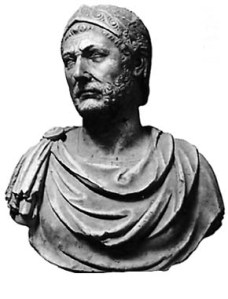
This face says it all. It is the misanthropic, miserly, humorless, prurient snout of Marcus Porcius Cato, better known as Cato the Elder.

“Hell is other people,” said Jean-Paul Sartre, and I’m sure he had people such as Cato in mind. Cato showed up in ancient Rome wherever people were having fun to make them feel guilty and sinful. Whenever anybody succeeded and earned fame or wealth or glory, Cato was there to dig up some dirt, spread a rumor, question some expense account (literally), all in order to take that person down a few notches.

If he had been alive in another era, he might have sat on the tribunals of the Spanish Inquisition. Or he might have been Senator Joseph McCarthy, or Kenneth Starr, or anybody who devotes his life to hounding others and destroying reputations.

Cato’s most famous victim was one of my heroes, and one of the main characters in my book, the great Scipio Africanus. Cato envied and hated him. So he filed charge after charge, looking through every receipt in the great Scipio’s accounts, until Scipio was simply fed up and went into exile.

After Scipio died (in the same year as Hannibal), Cato needed a new target for his venom. He chose all of Carthage, which was now a docile and submissive part of the Roman empire. Carthago delenda est! Cato said at the end of every speech he gave, no matter what it was about.

And that is what the Romans eventually did. They ethnically cleansed the entire city of Carthage and razed it to the ground.

The lesson? Many. But one premise of my book is that the same archetypal chracters appear again and again in history and in our own lives. Learn to recognize them, especially the Catos. They might be in the next cubicle, or one row behind you in the auditorium. They might be your boss or your employee, or your ex-spouse or a spurned lover. Somewhere, there is someone who hates to see you happy and successful and will exert all his energy to bring you down.

Bookmark and Share

“East” vs “West”: Where it started

Every now and then I amuse myself by taking some notion that seems so familiar that we take it for granted, and tracing it to its origin. Where did it start?

So, in today’s episode, let’s look at the notion of East versus West.

This gives me a great excuse for a  map. I love playing with maps, in case you haven’t noticed. So let’s look at today’s answer (click to enlarge):

greco-persian-wars

This is a map of the Persian invasions of Greece, ending with the Persians’ utter defeat and expulsion in 479 BC. And this is when it started. Long, long before Kublai Khan and Marco Polo and all that.

Until 500 BC, nobody, as far as I am aware, made any cultural or civilizational distinction between East and West. There had been Sumer, Babylon, Assyria, Egypt, Persia and so forth. But those thought of themselves as in the middle (as did, independently, China, the “middle kingdom”).

The first “Greek” civilization in Crete was mostly a Middle-Eastern culture. Then, when the Greeks came out of their weird and unexplained dark ages between about 1150 BC and 800 BC (Trojan war to the rise of city states), they did not yet think of themselves as “a West”.

But then the Persians started coming. They were mighty, despotic, decadent, effete and rich. We were ascetic, virile, democratic and free. And we kicked their proverbial.

At least that’s how the Greeks saw the matter. Herodotus, the world’s first historian, kicked the tradition off, Aeschylus ingrained it on the stage, and off we ran with it. The idea was born. Now it would develop.

The “West”, over the coming centuries moved further west, then north. To the Romans, the Franks, the Saxons and Normans, the Americans and then the Texans (just kidding). It became a complex mixture of all its ancestors.

The “East” kept moving further east, to Huns, Tartars, Mongols and Chinese.

And thus a “Middle East” opened up.

But the place where the “East” starts is still the same as it was in 479 BCE: the Hellespont, now called the Dardanelles.


Hannibal: The limerick version

When I said "poetry" I mean epic, not Limerick!

When I said "poetry" I meant epic, not Limerick!

Loyal readers of the Hannibal Blog will by now be familiar with the wit of one Mr Crotchety, who visits regularly. He has, in this comment, expressed the epic life of the main character of my book–why yes, he has indeed–in the following limerick.

There once was a General named Hannibal,
‘til the Romans found his army untenable.
His tactics were dodgy and favored by chance:
like his father, he walked behind elephants and never wore pants.

Subsequently, Mr Crotchety discovered that the correct rhyme scheme of a limerick is apparently AABBA, and the syllable count 9-9-6-6-9.

With that intelligence, I crafted my own initial response to this impertinence, which was this:

There once was a lad named Hannibal
and I don’t mean that one, the cannibal,
The Alps this one crossed,
then Romans he tossed,
As though he were staging a carnival.

Since that entirely omits the central thesis of my book, I then decided to have another crack at it:

From Carthage he came, the Alps he crossed,
Romans he routed in Trebia’s frost,
he seemed to have won,
at Cannae again,
until it was clear he had instead lost


What Cleopatra might have looked like

Cleopatra: Hot or not?

I like to try to imagine what the characters in my book (the ancient ones, that is) looked like. This is, for obvious reasons, a futile task, but that has never held me back.

So I’ve already weighed in on what Hannibal, and Carthaginians in general, looked like (ie: hunky but not like Denzel); and what his Numidian cavalry looked like (ie, a bit like Zidane).

Cleopatra’s look, of course, is perhaps the most fascinating mystery in history because of her legendary sex appeal. Plutarch tells us, however, that it was not her looks per se that made Caesar and Antony fall for her, but her voice, her many languages, her wit and panache, her ability to read the psyche of a man she was seducing, and so forth.

In any case, researchers at Cambridge (the British one) have tried to reconstruct her face, and this is it.

It’s plausible, because she was said to have a dark complexion and a longish, hooked nose, which she inherited from her father, Auletes.

Let it be remembered, though, that there was not a single drop of Egyptian blood in her veins. She was pure Macedonian-Greek, descended from a relative of Alexander the Great. One of Alexander’s generals, Ptolemy, founded her dynasty, and all his heirs, including Cleo’s brothers, were named Ptolemy. (Auletes, the piper, was a nickname.)

Let it also be said that she was the product of incest. The Macedonians adopted the Egyptian custom of marrying a brother and sister as co-rulers. (These then took the additional name of Philadelphus, or sibling-lover). Several Ptolemies before Cleopatra’s generation were horrendously fat and possibly otherwise genetically compromised. Cleo, however, got lucky. And although her child with Caesar was murdered, her children with Antony were allowed to live on in obscure parts of the Roman empire, breeding merrily with outsiders.


Endurance

Ernest Shackleton

Ernest Shackleton

Earlier this month, I told you how frustrating it is when, in the course of the research for my book, I follow a trail into a dead end. Back then I had been reading about Casanova until I had to admit to myself that he didn’t fit into the chapter that I was re-writing. I swallowed and moved on.

Greg Balco

Greg Balco

Well, the opposite can happen too. Almost a year ago, my friend Greg Balco (who has since proposed that I rename this blog An Inconvenient Kluth) suggested that I look into the life of Ernest Shackleton as one of my subsidiary stories. Shackleton took a ship named Endurance to explore the Antarctic, but got stuck in the ice, lost the ship and found himself and his crew, truly, facing a Disaster. What happened next was all about character!

Anyway, I read the book that Greg recommended and loved it–in part because there is a lot of Greg in it. He is a geochronologist and his idea of fun is to camp in the Antarctic ice and drill for snow, or perhaps rocks; or perhaps they just go sledding. He would know exactly what Shackleton and his men endured when they subsisted on blubber on floes of ice for a year, with no light in the winter and no darkness in the summer.

But as my own storyline was evolving Shackleton didn’t seem to fit. Now, a year later, I am reopening the middle chapters to make them perfect. Suddenly one of them has a gaping hole that cries out for a life, a character to fill it.

This is the chapter about the least known of my three main characters: Fabius, the old Roman Senator who fought Hannibal by not fighting him, until the young and dashing Scipio came onto the scene. That doesn’t tell you about the context of the chapter, or about the hole in it that needs filling. Suffice it to say that Shackleton, suddenly, seems to be a perfect fit. Endurance hereby re-enters my bibliography.


Why August (not September) is called August

What's that fat little bugger doing to my leg?

The month of July gets its name from the birthday of Gaius Julius Caesar. Fair enough. But what about August?

This one always baffled me. Octavian, who was Caesar’s grand-nephew and adopted son (as everybody discovered to great surprise when reading Caesar’s will), and who would be the future Emperor Augustus was born in September, not August.

September was also when, in 31 BC, Octavian defeated Antony and Cleopatra at the sea battle of Actium, thus ending the long civil wars and, in effect, the Roman republic, and installing himself as princeps. Before long he would be “Imperator Caesar Divi Filius Augustus”, or “Commander Caesar, son of god, the Illustrious.” I have asked my wife to address me in this fashion and eagerly await her reply.

So why the month before September?

Well, I just found out, while still reading about Cleopatra, whom I have just made a minor character in one chapter of my book. As it turns out, it had everything to do with Cleopatra. It took Octavian a good year to consolidate his gains after Actium, and he only showed up at Cleo’s capital of Alexandria–you guessed it by now–on August 1 of the following year.

A few icy gestures later, and Antony had shoved a sword into his abdomen, while Cleopatra injected herself with the venom of a snake–Virgil says “two asps”–or perhaps a comb. That was not yet all, however. Cleopatra had had a son with Caesar, nicknamed Caesarion (“little Caesar”) and he was the one man alive who might compete with Octavian in claiming to be Caesar’s heir. Cleo had sent him running as soon as Octavian was approaching, but Octavian’s thugs caught up with him. No more Caesarion.

So August was a big month for Octavian, which is why, when he became Augustus, he named it after himself. Now that I know how these things work, I’m going to try to do something, oh, next November or so. Kluthy. Kluthust. Kluthember. Details to be announced.


The Parthian Shot

Parting Parthian

Parting Parthian

You’ve heard people talk about a “parting shot”, when, for example, somebody makes a miffed exit and on the way out emits a toxic word or two. Well, that’s wrong. It’s not a “parting” shot. It’s a Parthian shot. Who were the Parthians that we name a shot after them?

I bring this up because I’m still reading about Cleopatra as research for my book. And I’m now approaching the bit where Mark Antony, her second lover (after Julius Caesar, the first), is preparing to head east to conquer those Parthians, even as Cleopatra was four or five months pregnant with their third child.

Those are the same Parthians that had succeeded the mighty Persian empire, and who had only a generation before slaughtered an entire Roman army under Crassus, after presenting him his son’s head on a stake. They were utterly not to be messed with. Indeed, Mark Antony, too, would turn back in disaster, with two-fifths of his army killed. The Parthians would remain invincible for another century and a half.

Now to the point: Their most insidious and effective tactic was the retreat, real or feigned. The mounted Parthian archers would suddenly gallop away, drawing the enemy army after them in hot pursuit. But the archers, in full gallop (no reins or stirrups needed), would turn and shoot back, arrow after arrow.

In short, a great party trick, to this day.


Strolling through Rome’s Forum with Scipio

A follow-up to my post earlier today:

Technically, the rendering shows the city as it was in 390AD, during the reign of Constantine. The main characters in my book–Hannibal, Fabius and Scipio–lived 600 years earlier. But who cares. Just wallow in your imagination and picture Fabius and Scipio arguing here, Scipio Triumphing here, …..

Bookmark and Share

Visit ANCIENT Rome!

This qualifies as breaking news, if you’re writing my kind of book. Watch:

It arose out of this great project.

This where Fabius and Scipio walked. This is where the Romans bewailed their dead after Hannibal’s victories at the Trebia, at Trasimene and at Cannae. This is where Scipio celebrated his Triumph after defeating Hannibal at Zama…..

So, you know where I’ll be hanging out–Google Earth. Oh wait. There weren’t enough hours in the day to do the things I’m supposed to do before this came out. Should I take it out of sleep hours? Dangerous. Perhaps necessary, though.


Bookmark and Share

Goldsworthy on The Punic Wars

And back again to the bibliography for my book.

We’re still in the “history” section, as opposed to the “biography” section, but we’ve mostly dealth with the ancient sources (Polybius, Livy and Plutarch). So now I’ll move into the modern writers.

Adrian Goldsworthy

Adrian Goldsworthy

If I had to choose just one book to give you a fun but thorough overview of Hannibal, it would be Adrian Goldsworthy’s The Punic Wars.

It’s actually a good idea to read the story of all three Punic Wars in one, because you can’t understand Hannibal’s war (the Second Punic War) without the other two. It would be as though a history student two-thousand years from now were trying to understand World War II without knowing anything about World War I or the Cold War.

Goldsworthy does a good job of minimizing the clutter (footnotes, parenthetical interruptions aimed at other academics and such) that usually makes academic books unreadable. He gives you great context. For instance, it’s probably not immediately obvious why sieges almost never worked in the ancient world (which is important, since Hannibal, at the crucial moment, decided not to lay siege to Rome). So Goldsworthy describes what it was like to attack and defend a city–all the tunneling and ramming and laddering and sulphur-smeared-javelin-hurling and so forth.

Being British, Goldsworthy also lets his sense of irony peek through on occasion, which brings relief. (Asked what his philosophy of life is, he tells his interlocutor here that “I’m English, so obviously do not have a philosophy.” That’s the sort of thing I mean.)

His more recent book is a biography of Julius Caesar, which I’ve also read and loved. But I’m forcing myself to leave Caesar out of my book because, as my wife has informed me, there are enough ancient dudes in it as it is.


Bookmark and Share