Writers, lose your notebooks

notebook

No, I don’t mean that all of you should literally throw them away right now. In fact, I keep all of my notebooks, going back years, officially for libel-defense purposes but really out of superstition. But that’s not what this post is about. It’s really about the following anecdote.

I happen to live next door to Michael Lewis, an author of several bestsellers (Liar’s Poker, Moneyball, The Blind Side, et cetera). He and I were walking down the hill once to get some lunch. We got to talking about the time that he came back from a big reporting trip for a book, only to discover …. that his notebook was gone!

“And it turned out….”, I began asking.

“Oh, much, much better,” he said.

And we both cracked up.

When my notebook lost me

Here is a brief description of my early years as a journalist, which is the experience that made me laugh at (ie, understand) Michael’s response.

When I started, I was so enthusiastic about observing every last detail and capturing every quote by everybody I met that I agonized over my note-taking. I could not write fast enough. In the evenings, I took a night course in shorthand (Teeline). I was the only guy; all the others seemed to be young ladies training to be secretaries (somebody should have told them that this wouldn’t prove so useful in their careers). But even that didn’t help. I never got fast enough.

So I had the quintessential writer’s predicament: Do you live, absorb, participate, think, see, hear, smell, act? Or do you stop life, and write it all down?

Recording interviews, with one of those little gadgets, didn’t help either. I didn’t like fiddling with them, and they usually intruded into the conversation, pointing at my interviewee like a dart that might be poisonous. Those things distracted me, and I threw them away.

Even so, I did capture quite a lot. I observe well, and I get “good quote” out of people. So, for a while, I was writing my articles quote to quote, detail to detail. Today, I believe that was the worst writing I have ever done.

At least close it

Around that time I heard John Micklethwait give somebody advice. The lady was having writer’s block, and John, the quintessential British cavalier, said, roughly:

“First, close your notebook. Then trust that it will come.”

(These days, John is The Economist‘s editor-in-chief–ie, my boss–so the trick must have worked for him. ;))

Relax and trust

Writing, and all storytelling, is necessarily a two-step process: 1) You live. 2) You pause, re-live and tell. You can’t merge the two artificially by writing everything down as it happens. If you try, you only interfere with Part 1).

Instead, good writers know how to relax. Only when the brain is relaxed does it make the lateral connections, the quirky associations that we call creativity. And only when you are relaxed can your interview partners relax as well.

Good writers then trust. They trust that ‘it’ comes back to them. And ‘it’ does. What is ‘it’? It is whatever comes back!

By the time it comes back, it is like water that has percolated through sediment and become pure and clean and potable. A writer’s memory is therefore like a filter, provided the writer lets it be that. What it filters is the entire overwhelming world of detail, so that only a few–the right ones–run onto the screen and become life-giving, texture-giving color.

Bookmark and Share

Big night in London for The Economist

I just got an email from my colleague Ed Carr in London, who has been attending the gala dinner at an annual ceremony where they give out these swanky journalism awards. It appears that The Economist cleaned up tonight, with four awards. (The announcement is not up on the official site yet.)

Philip Coggan won, not one, but two! Fiammetta Rocco, our delightful books & arts editor, won another. (For a profile, as she just informed me in another email, of a subject “who caused me much amusement when I discovered that he uses a condom with 39 holes in it attached to the end of a Hoover to make his finest works of art.” Must investigate.) And the fourth award, I’m happy to say, appears to me mine.

Years ago, I won another one of those. For some reason, I never get to go to the dinner, though, so it is always Ed who accepts on my behalf. That means he gets his picture taken with the trophy. When I met my wife in Hong Kong and she googled me, she came upon that picture and, because he and I sort of look alike, forwarded it to her friends as a way of introducing her new boyfriend.

Bookmark and Share

The closing-Tube-door method of writing

800px-london_underground_tube_stock_1992

About ten years ago, when I was still living in London and already writing for The Economist, I got in the habit of visualizing a specific scene whenever I was preparing to write something (ie, most of the time). And I still do it today.

In this mental scene, I am saying goodbye to somebody I know and like, somebody who would not bullshit me–my wife, for instance. She has boarded her train in the London Tube (“subway”, to you New Yorkers), and just as that famous Tube voice says Mind the Gap and I pull back on the platform, she says: ‘Oh, and what’s your next piece about?’

As the doors close, I shout one single mouthful of words into the train. A few words. That’s all there is time for. Then I watch the train pull away, and I imagine her facial expression as she looks through the pane.

  • Intrigued? Good.
  • Thoughtful? Good.
  • Outraged? Good, if that’s the kind of story it is.
  • Smirking? Good, if that’s the kind of story it is.

But what if the reaction on her face is:

  • Ho-hum. Not good.
  • Bored. No go.
  • Squinting. Ouch, I must have shouted out a cliché.
  • Disgusted.

Often, I iterate story ideas in real conversations, of course. But there isn’t enough time to do that with the thousands of half-formed story ideas that teem inside my head at any given moment. And conversation has a drawback: You have time. Time to explain… and explain… and explain. The writer needs the opposite: to be constrained into one short phrase only.

So the big surprise is that this mental exercise alone usually does the trick. That ‘trick’ being:

To find something in the everything around me that is worth telling, because somebody will react to it.

Our nomenclature

At The Economist, we have a ‘flytitle’, ‘title’, and ‘rubric’ above every piece, and sometimes a ‘dateline’. In this article, for instance, these are:

The Filipina sisterhood [flytitle]

An anthropology of happiness [title]

Dec 20th 2001 | HONG KONG [dateline]

Out of misery, some extraordinary lessons [rubric]

ONCE a week, on Sundays, Hong Kong becomes a different city. Thousands of Filipina women throng into… [text]

I chose this example because it’s one that worked. Spoken through closing Tube doors, this trio of flytitle, title and rubric would have done the trick. I would know that I’m ready to start writing the pice.

The rubric, Out of misery, some extraordinary lessons, actually came from the editor of that piece, Ann Wroe (usually our Obituary writer, and one of our best). She had taken whatever phrase I had put there, probably a grammatically complete sentence, and chopped it into this open-ended, verbless and … inescapable line. (Notice the alluringly modest some)

So that’s what I do, day in and day out, I think of rubrics and titles. The world is full of things and events and people and sensual inputs. Those are not yet stories. To become stories, they have to fall into place in a way that is interesting. And an essence has to emerge out of them. That becomes the rubric.

The rubric is not a summary (that’s where I used to get it wrong for a long time). It can, but need not be, a thesis, bluntly put. It can be a question, inviting the reader to go on a journey of discovery. Or anything else. The best ones are Haikus, full of attitude. I thought this one, for instance, worked okay, although it bordered on gimmicky:

Google

What a lot of wheatgrass

Jun 30th 2005 | SAN FRANCISCO

Psst, there is news about Google, but don’t tell

IT IS hard to know whether to be impressed, suspicious or amused…..

Really, all it does is to inform you that I’m about to ‘take the piss’, as the Brits would say, on the general subject of Google. If you expect serious analysis after this, it’s your own fault.

Anyway. I happen to believe that this rubric-shouting through closing Tube doors works for all writing at all length. Short blog posts, long essays, even entire books. If you don’t know what that center of gravity is toward which you want your readers to be pulled, you’re not ready yet.

Which makes me wonder, of course, whether I have found the title and rubric of my forthcoming book (which I happen to care about more than about any article I’ve ever written.) You may recall that I recently sent the manuscript to my editor at Riverhead, and that for all sorts of reasons, having to do with the American marketplace, I do not yet know the title and subtitle. It will be determined by the editor, “in consultation” with me. And so I wait.

Lots of Tube doors opening and closing in my mind. Mind the Gap.

Bookmark and Share

Dear Economist; REALLY dear

A truly shocking notion: If your numbers are shrinking from one of your two revenue sources, raise prices for the other revenue source.

Not so shocking perhaps, but we’re talking about the magazine industry. A lot of magazines have been charging subscribers far less per issue than a Starbucks anything, and lowering that price in the hope of getting more subscribers and thus, in theory, higher advertising revenues.

Fast forward: Depression → Ads go poof. So what to do?

They’re suddenly paying attention to … us. As this piece says,

The Economist is leading the charge on expensive subscriptions, and its success is one reason publishers are rethinking their approaches. It is a news magazine with an extraordinarily high cover price – raised to $6.99 late last year – and subscription price, about $100 a year on average. Even though The Economist is relatively expensive, its circulation has increased sharply in the last four years. Subscriptions are up 60 percent since 2004, and newsstand sales have risen 50 percent, according to the audit bureau.

Will it work for others?

Let me tell you how I buy wines.

In normal circumstances, economists talk about something called the price elasticity of demand, because when something gets more expensive, people tend to buy less of of it. But there is a quirky exception. The demand for certain things has an inverse price elasticity. As the price goes up, you buy more of it.

This explains why I, occasionally capable of rationality, have nonetheless found myself reaching for the more expensive of two otherwise indistinguishable bottles of Napa Cabernet Sauvignon. It must be …. better. How do I know? I don’t. The price led (fooled?) me into thinking it.

But: For this to work, the product must be something that is not fungible and that I value intrinsically. Having bad wine at my age is worse than no wine. Ditto my reading time: Reading crap is worse than not reading at all. By contrast, I would not reach for the more expensive of two otherwise indistinguishable rolls of toilet paper.

We may soon find out how the reading public views its news magazines.

Bookmark and Share

Grokking people: Cavaliers & Roundheads

Almost twelve years ago, when I joined The Economist, a kind and well-meaning colleague pulled me aside for an introduction to our culture. I had naively asked about an internal power struggle that had occurred many years before but involved some people who were still around. “Ah,” said my conversation partner, in a wry British way,

that’s when the Roundheads won the day.

“The what?” I asked.

Another colleague had overheard us and now joined in, closing the door to the hallway.

It doesn’t concern you, Andreas, because you’re not English. But it’s about Roundheads and Cavaliers.

You see, The Economist, being British–indeed English–has these two types within it, and out of this changing mixture comes the cocktail that is our culture.

I think my colleagues were wrong that this only concerns Englishmen. If you read on, I think you’ll agree that there are Roundheads and Cavaliers among, and inside, all of us.

Some historical context

The terms Roundhead and Cavalier go back to the English civil wars in the 1640s.

On one side were the parliamentarians, who wanted to get rid of the king. They were:

  • Puritan
  • angry, dour, outraged, earnest.
  • for Cromwell
  • a tad humorless

They also, at least in the beginning, liked to dress plainly and cut their hair short, which made their heads appear, at least to the other side, “round”. So their opponents called them Roundheads. Here is a good portrait of one:

Roundhead

Roundhead

On the other side were the royalists, who wanted, as the name implies, to keep the king. They were:

  • anything but Puritan, and indeed rather good at indulging
  • rather less good at being outraged, thanks to a certain inbred nonchalance
  • against Cromwell
  • flamboyant in style, and always ready to wink and chuckle at the insanity of it all.

Here is a good portrait of one (by the great Frans Hals):

Cavalier

Cavalier

I think you get the point. I mean, you must get the point. Just look at them.

Fast forward to today

Let’s not dwell on how the king lost his head and all that; these things happen. The reason these terms endured, at least in the English upper class, is that they describe types, and possibly archetypes.

The English brought these types to America. They sent the Roundheads to Massachussetts and the Cavaliers to Virginia. Both strands are still alive in America today. But the Roundheads won. Individual Americans may be one or the other, but American culture as a whole is reliably Roundhead:

  • earnest, literal
  • always ready to be outraged and indignant
  • not naturally given to irony

By contrast, in old England, and at The Economist in particular, the balance has tilted slightly toward the Cavaliers. These are cultures of irony, in which too much outrage and earnestness is, well, unseemly. (And yes, I think that’s why so many American Cavaliers like to read us; their home press makes them feel lonely, we make them feel at home.)

Add: subtlety

At this point, a number of you may be preparing to be, ahem, outraged. So let me introduce some nuance and preempt some misunderstandings (there’ll be a few anyway).

First, this is not about Left or Right. It’s about temperament. Let’s just take some examples from the right side of the spectrum:

Roundhead Cavalier
Thatcher Heath
DeLay Reagan

Second, it’s not either/or, whether in individuals or cultures. Rather, I think that Roundhead and Cavalier relate roughly as Yang and Yin do:

466px-yin_yangsvg

But, just as each of us is somewhat more Yang or more Yin, each of us also tends to be more Roundhead or Cavalier.

A generalist among generalists, I move on

A few of you have already noticed an unusual and almost personal rubric above my piece in the new issue of The Economist (the accompanying audio chat with Tim O’Reilly is here):

Our correspondent in Silicon Valley looks back before moving on to a new beat

So indulge me, please, as I say a few philosophical words about this idea of “moving on to a new beat”.

In a couple of weeks, I will indeed start writing about America’s West Coast generally–governance, economy, water and prisons, climate and immigration, Mexifornia and the Central Valley…. whatever strikes me as interesting. This will be my fourth beat in my twelve years at The Economist, for an average of three years in each beat. (And I do find it amusing that we journalists share the term beat with cops, hookers and drug dealers. There you go.)

As it happens, three years in a beat, give or take, is the unspoken and unwritten norm at The Economist. And isn’t that interesting? With a few notable exceptions that really prove the rule, we all move on every so often. I will go one step further: For over 160 years, our culture has been built upon moving on, thanks to an ingrained faith in generalism over specialization.

My former colleague Chris Anderson recently meditated on this tradition here. (I took over from Chris as Hong Kong correspondent in 2000, and Chris became editor of Wired Magazine soon after that.) Here, in Chris’s words, is roughly what happens to a journalist during a three-year period:

The first year after arriving to your new assignment was terrifying and exhilarating. It was a vertiginous learning curve, but you could ask dumb questions without fear and note that the emperor has no clothes.

In the second year, after the emperor had invited you in a few times to explain the subtle political dynamics that require him to go garbless for the ultimate good of the nation (but surely there were more important things to write about, such as his new elevated rail project), you would find yourself writing sophisticated analyses, traveling easily through the region, admiring your bulging rolodex and otherwise feeling very productive.

In the third year, you’d find yourself returning to stories with a certain cynicism and worldweary accounting of endless process. The elevated rail project has been delayed once again because of infighting within the opposition party. The emperor has no fiscal discipline. You understand everything all too well. It’s time to move on.

So let me offer a few stanzas in my own eulogy to generalism.

1) The avoidance of “capture”

What Chris described above is the subtle mechanism by which all sorts of professionals get “captured” by the wrong constituency.

To take a topical example, banking and insurance regulators get captured over time by the very bankers and insurers they are supposed to regulate, because they are going to fancy dinners with those types and their glamorous spouses, and not with the unglamorous account and policy holders who need regulators for protection.

I have never, personally, seen any journalist being unethical; instead, I see those journalists who consider themselves specialists being simply human. We all try to get close to our sources (politicians, CEOs, etc). And when we do get close to them, we tend to think of it as a scoop. We are flattered. Other journalists are jealous.

And lo, another specialist has been captured. Whom is such a journalist now visualizing as his audience when he or she sits down to write a piece? A reader who was not at the dinner/on the yacht/at the party? Nope. Although the specialist will deny it, he is now, ever so subtly, writing for the people he is supposed to be covering. After all, he needs to get invited back to more dinners/yachts/parties. He should have moved on long ago.

2) The freshness of fear

The wrong kind of fear leads to bad writing, as I have argued before, but the right kind of fear is a tonic for creativity. And believe me, a generalist knows fear. Taking a new beat is a terrifying experience. Each time I have done it, I felt as though I were stepping into a bee hive naked.

So you work extra-hard and you are always on edge (because, after all, you don’t know anything yet about the people you’re interviewing and the things you’re talking about).

And this is fantastic. You ask questions that make your interviewees gape. Bizarre questions, off-beat questions–questions that are either so illogical or so logical (as in obvious) that no specialist would ever dare ask them, even if he could conceive them to begin with. Now you know you’re in a good place!

3) New and unexpected associations

The generalist, if he is doing his job well, now makes unexpected lateral associations. As the specialists around him (still intimidatingly knowledgeable) stare at whatever fine print they’re staring at that week, the generalist connects things in other areas of life and the world and something new arises.

(This, by the way, is the definition of an idea or a thought: The brain does not create a new neuron; it hooks up existing neurons in a new synaptic pattern.)

4) Ability to “translate”

Specialists sooner or later start speaking the language of their specialization, to the point that they can no longer even tell that this language is foreign and must be translated.

While I was stationed in London, long ago, I was once sent off to Brussels to cover the European Union for three weeks. I showed up terrified and ignorant and wrote two good pieces in consecutive weeks. In the third week (week!) I felt excited because I thought that I now had a clue, and wrote a pompous article that mentioned a tension between the intergovernmental and supranational approaches to something or other. Everybody in Brussels uses those terms, and so I did too. My editor cut the piece to shreds, called me up and said ‘Thank God your three weeks are over. You’re coming home!”

Most specialists cannot talk intelligibly about their area of expertise. When they try to communicate with the rest of the world, it is a disaster. (The exceptions are rare, thus proving the rule, and easy to list: Paul Krugman in economics, Brian Greene in physics, Richard Dawkins in biology, etc.)

Coda: My three last beats and my book

In my own case, I now think I know why I did my past three beats (insurance, Asian business, technology) relatively well.

It was because I more than lacked expertise in each of these areas when I started: I was woefully, hopelessly and utterly unqualified! In 1997, I thought that insurance was unspeakably boring (which forced me to make it interesting.) In 2000, I thought that Asia was impossibly alien (which forced me to make it familiar). In 2003, I thought that technology was a curse on technophobes like me (which forced me to demystify and humanize it).

Put differently, all this was fantastic preparation for the book I’m now writing.

The idea is the result of a generalist’s lateral connections: A story about the ups and downs in all of our lives, told through historical characters.

Almost all of the characters in the book have their scholars and experts and specialists producing reams of expert biographies and histories at this very moment. My own qualification to write about any one of them amounts to zero.

A few of the publishers to whom I pitched the book idea noted this and asked, sensibly, ‘Why you, Andreas?’

I felt this was a very promising start.

Bookmark and Share

Rebecca, The Economist + The Sartorialist

The Sartorialist, not The Economist

+ Sartorialist, - Economist

I keep thinking about a young lady named Rebecca.

Rebecca was being interviewed in a short video at the beginning of a presentation at an event last week at Stanford University. The folks at the Knight Fellowship had teamed up with the Stanford Design School to explore cutting-edge future scenarios of journalism, and were staging a competition among three teams. Each team was to come up with one potential “next big thing” in media, to make a prototype, and then to present it to a panel of three judges. I was one of those judges.

So Rebecca appeared in that video at the start of the third presentation. She was, I think, an MBA student at Stanford, obviously super-bright and media-savvy, busy, ambitious, and all the rest of it. They asked her what her home page was. It was The Economist. So far so good.

She said a few more of the things that my colleagues and I tend to hear when people first discover that we work for The Economist. You know: global, intelligent, cosmopolitan, and things along those lines. Then Rebecca visibly got bored with her own bullshit.

So how much of The Economist do you actually read? her interviewer asked her.

Hardly anything, it turns out. And now Rebecca held forth: To be honest, she really only has The Economist as her home page because, well, that’s what one does in her circles. But she feels no connection to it at all. To her, the tone is that of some robot-like genteel alien preaching to her about what she should know for the next cocktail party. (As a good sport, I made sure that I was laughing and applauding loudest in the hall, for the record. Which was hard, because the hall suddenly seemed full of Rebeccas.)

Alright, continued the interviewer in the video, in that case, where does Rebecca go (if not, apparently, to her own home page)? She named a few sites. But the one she seems to “depend on” most, currently, is The Sartorialist.

And isn’t there a perfect symmetry to that? Officially The Economist, but really The Sartorialist. A site run by one man who

  • loves his subject–fashion in the world’s cosmopolitan cities
  • takes artful and intimate pictures
  • cares not a hoot about whether anybody agrees with his taste, and
  • is rewarded by a growing and steady following (largely from the same demographic as The Economist‘s) for precisely that authenticity.

On The Sartorialist site, Rebecca feels at home and intimate. On our site, she feels like a guest in some snobby show room, feeling (metaphorically) that she has to hold her pee until she finds a place where she is more comfortable asking for the bathroom.

So that’s what I’m thinking about. Here we are at The Economist–having powwows about the future, basking in our no-bylines eccentricities–while the Rebeccas out there politely keep us as their homepage, then bugger off to some other place that “gets” it. We would be foolish, and soulless, not to pay attention to Rebecca.

Bookmark and Share

Fraught suspense in The Economist’s plaza

I still have doubts about free trade

A primate without valid ID has been spotted loitering in the “plaza” in front of our London headquarters, the modernist tower that The Economist inhabits in the heart of the “clubland” of St James’s Street.

My colleague Tom Standage immediately snapped photos and shared them on Facebook. The individual was reading The Economist, then switched to CFO, also owned by The Economist Group.

My options are under water

Suggestions that the individual is in fact an American expatriate in London, formerly in the business of collateralized debt obligations, have not been corroborated.

After several days of his vigil, the writers passing by every day are now beginning to accept his presence. Our science correspondents consider him family, and believe that he fled a hostile environment in America to be among people who are sympathetic.

Will he go? Will he stay? Will he edit?

Bookmark and Share

More primatology

The folks at 850 KOA, a Colorado news-radio channel, called me up this morning to chat more about friendship and human group size in the age of Facebook. Here is our conversation.

(If you’re just arriving, this is about a piece I wrote in The Economist called Primates on Facebook. I blogged about the back story here.)

Update: Cameron Marlow, whom I described as Facebook’s “in-house sociologist”, has now posted his back story with lots, lots more data and detail and analysis.

Bookmark and Share

The nomadic reader

What a page turner

What a page turner

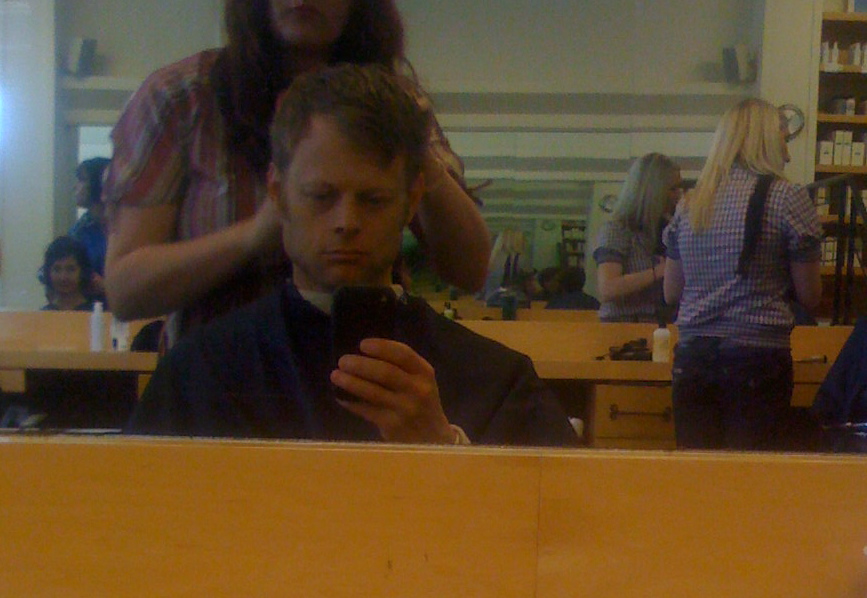
Here I am yesterday, reading a book on the new Kindle for iPhone app while, you know, being worked on. (My editor Tom and I must have been among the first to download the new app that day.) Later I got home, picked up my actual Kindle, the one I reviewed last month, and kept reading from the page I got to during the haircut (the two devices had automatically synced).

Now, this sort of think should make you think. It is the latest installment in what I called “the new nomadism” in The Economist last year. New behaviors and social contexts are arising out of, not so much new gadgets, but new expectations about connectivity. Big, very big, sociological change is afoot, I believe. And, of course, as an aspiring author I have much to contemplate on the topic of books in particular…

Bookmark and Share