Hannibal’s brother and … Mayonnaise!

Every now and then I convince myself that that I know quite a bit about ancient history, and then I stumble across something not just new but whiplashingly new. Did you know that the word mayonnaise is named after Hannibal’s youngest brother?

According to Livius, it came about as follows: Hannibal’s brother was named Mago (a common Carthaginian/Punic name), and he

… lives on in a most surprising way. On Menorca, he had founded the city that is still called Port Mahon. The typical local egg sauce that has conquered the world is known as mayonnaise.

And while we’re on the subject of Hannibal’s brothers:

Hasdrubal Barca's head, before the Romans got it

Hasdrubal's head (before Roman cosmetic intervention)

Hasdrubal, who was younger than Hannibal but older than Mago, died valiantly in battle against the Romans as he tried to bring a second invasion army to Italy to support Hannibal.

The Romans cut off his head. Then they marched it to the other end of Italy and catapulted it into Hannibal’s camp. Hannibal, who still did not even know that Hasdrubal had arrived in Italy, last saw his brother’s face …. as it rolled toward him.

So it goes, as Vonnegut would say. But those Romans sure had a way of doing things.


Bookmark and Share

Zidane rode for Hannibal

Well, this is really cool. I learned something that has long puzzled me, and I did it through blogging.

You recall that I recommended a blog post by Mathilda, in which she explains the ethnic categories of “Africans” in antiquity. (In a nutshell: “Libyan” = white; “Ethiopian” = black). All of which fascinates me because I want to form the most accurate picture possible of what Hannibal, a Carthaginian, and his Numidian and Iberian allies may have looked like.

And now somebody named Ureus left this comment (thank you, Ureus!) in which he/she explains that:

I am also a descendant of the Numidians, but nowadays we are called Kabyle Berbers.
Contrary to the Afrocentrist view; we are a white Mediterranean race. For the Afro-centrists out there: even the word Africa is of Berber origin; it comes from the word Ifriqiya, which designated the tribal territory of the Berber tribes of Northern Tunisia.

Fine, so how should we picture these Numidians, who were the fiercest horsemen of antiquity (they rode without stirrups or saddles and wrought havoc on the Romans in Hannibal’s battles)? Well, here is one Kabyle Berber you may have seen before:

Zidane, a Kabyle Berber

Zidane, a Kabyle Berber

The Beeb (BBC, for the Americans) has a Q&A on Berbers here.

Now, if somebody could please help me with the “Iberians”, please?
Bookmark and Share

Hannibal’s life in eight minutes

Well-made YouTube video (meaning: hewing closely to Polybius and Livy) about Hannibal’s life, by Wolfshead:

Interesting moment of interpretation: why Hannibal, in this version, chose not to take Rome itself, which was the single biggest decision of his life. “We are not animals,” he says here.

(Also: did I detect stirrups on the cavalry? Maybe not. There weren’t any in those days.)


Bookmark and Share

Carthaginians and “Libyans”

Great research by Mathilda about ancient Libyans here. In a nutshell, the ancients apparently considered “whites” living in Africa to be “Libyans”, in contrast to “black” Africans, who were called “Ethiopians.”

This fits my previous description of Hannibal and the Carthaginians, according to which Denzel would not be the most historically correct choice of actor.

Hannibal’s mercenary army, incidentally, contained lots of “Libyans”, alongside lots of “Numidians”, who were the most feared horsemen of their day, and “Iberians”, “Celto-Iberians” and Gauls. Then there were assorted other types, such as the renowned slingers from the Balearic islands (Mallorca, Menorca and Ibiza), who apparently trained by shooting birds out of the sky with their slingshots. I’m trying to find out more about all these ancient tribal and ethnic categories. More to come.


Bookmark and Share

The map of Hannibal’s march and life

Join me for a moment in having fun with this map below.

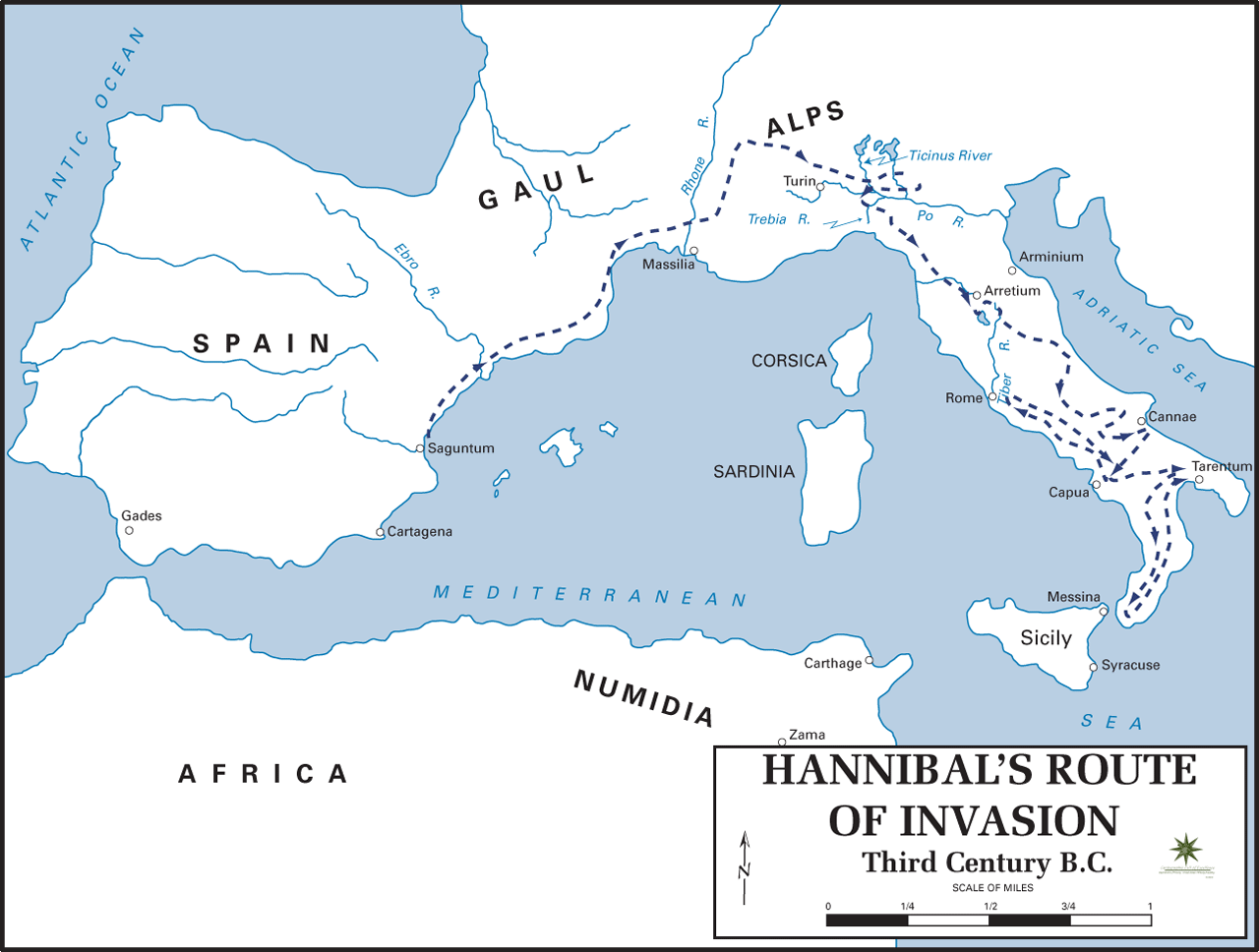
It comes to us, via the Wikimedia Commons, from Frank Martini, a cartographer in the Department of History at the United States Military Academy.

There are two ways of looking at this map–one obvious and one surprising and cheeky–and I will avail myself of both. Bear with me. First the map, and the obvious:
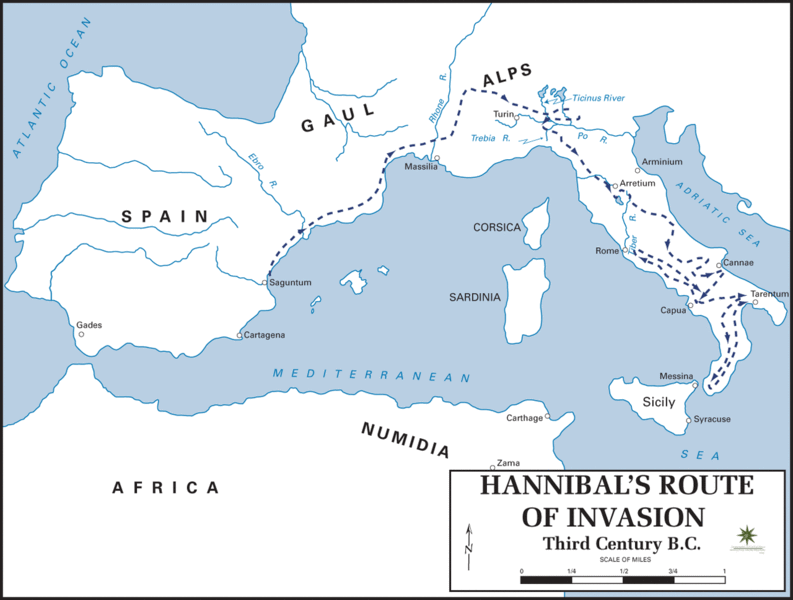
What we see here, obviously, is the western Mediterranean at the time of the Second Punic War (the “Hannibalic War”). Notice Carthage at the tip of northern Africa (in today’s Tunisia); Cartagena or “Little Carthage” in Spain, which I mentioned in an earlier post; Gades, which is today’s Cadiz; Saguntum (Sagunto), which was ethnically Greek; Massilia (today’s Marseilles), also ethnically Greek; Turin (Torino) which was not yet party of “Italy” but part of Gaul; and Ariminum (Rimini), the Roman colony at the edge of their frontier with the Gauls.

Now look at Hannibal’s march itself. In 218 BCE he crossed the Pyrenees and into Gaul. The line casually crosses the Rhone, even though this involved one of the most colorful operations in history (of which more in a later post–think elephants on rafts), and then, equally casually, crosses the Alps (of which much, much more in later posts).

You then see where Hannibal won his famous victories, at the Ticinus (more of a skirmish), at the Trebia, at Lake Trasimene and at Cannae. And then you see the line of his path getting…. confusing!

Now the less obvious way of looking at this map: Squint! As you squint, look only at the line of the march. It is a fitting life trajectory for Hannibal himself. It rises early and steeply, peaks, then declines and loses itself completely in a confused and erratic hairball.

How would you draw the map if it were proportionate to time, rather than distance? The entire stretch from Cartagena to Cannae, his greatest victory, took a little over two years. All the twists and turns after Cannae (there were actually far too many to draw on a map) took…. fourteen years!

After those fourteen years, Hannibal lived another nineteen years until he committed suicide, but most of that took place on a different map, in the eastern Mediterranean.

And yet, if you read the existing histories, you would think that 90% of Hannibal’s life took place in those initial two years.

Those years are the impostor years. The next thirty-three are the story of how and why he realized that his triumphs had been impostors. And this, in my book, is where his life becomes universal and directly relevant for our own lives today.

Now, let’s have even more fun and turn the map around:

Now you have, more or less, the life trajectory of the Romans, in particular Fabius and Scipio, my two other main characters.

Kipling’s impostors, you see, visited with them in mirror image.

Why and how did all this happen over all those decades? In exactly the same way as it happens to most of us in our much smaller(-seeming) lives, it turns out. That’s why I’m writing a book about it.


Bookmark and Share

About Hannibal’s elephants

(Note to readers: I have corrected and updated this post here.)

So the other day I get a text message from our dear friends, the Rammings, with an urgent plea to intervene in one of their heated controversies around the dinner table of their rustic farm house in hip and rural North Carolina. James Ramming, aged eleven and studying Latin (and contemplating adding Greek), was contesting whether Hannibal’s famous elephants were …. Indian or African. It’s the obvious first question to ask about his elephants, which must be why the adult experts never ask it.

I pick up the phone and report for duty. And as I talk I discover …. that I have no idea what the answer is. So I extricate myself from the conversation with James and go back to our trusted old friends, Polybius and Livy. Those two, it turns out, didn’t even know enough to ask the question. (How many elephants would a Greek and a Roman historian in those days have seen?)

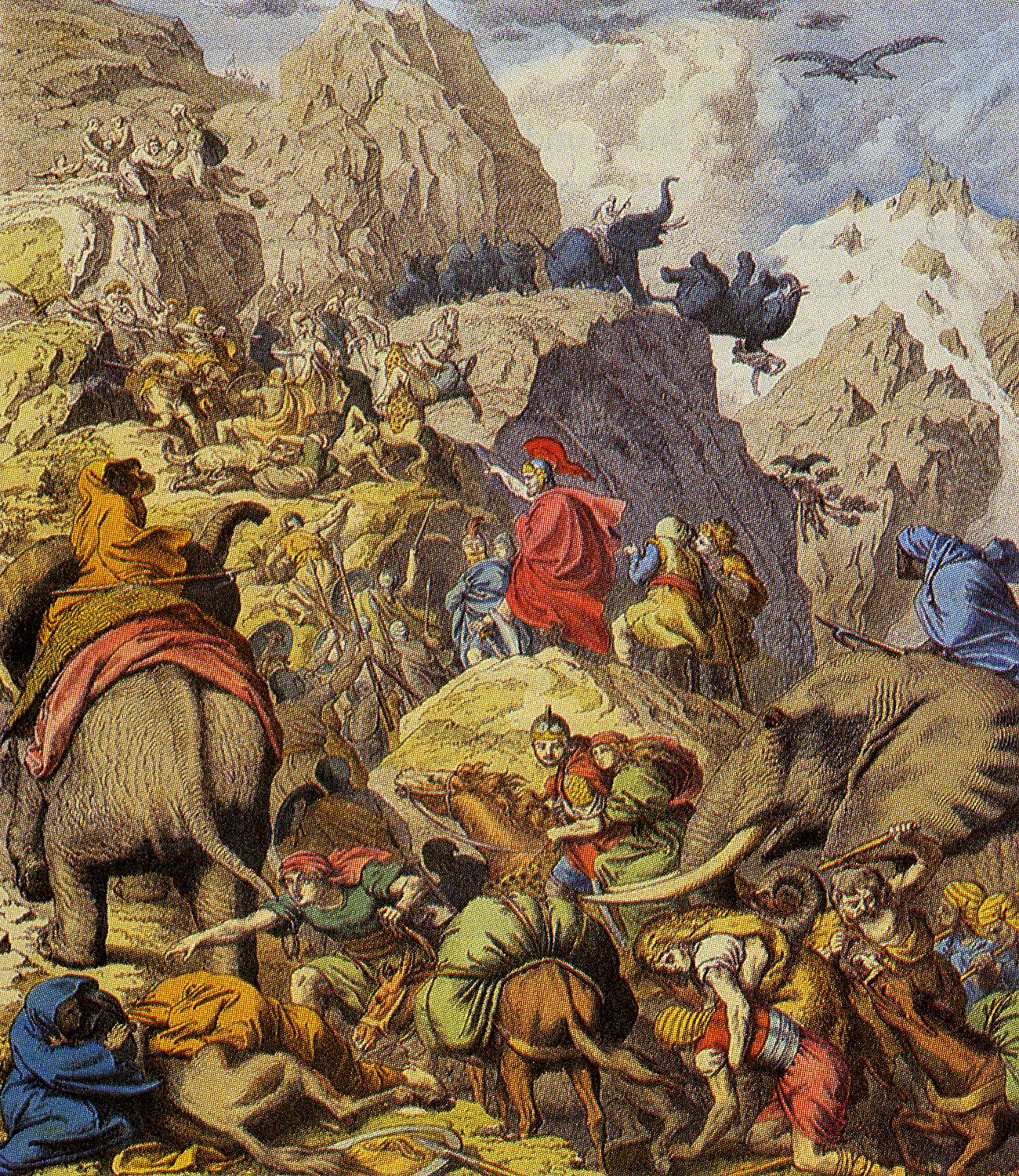
The fact that Hannibal took war elephants with him in his attack on Rome–and crossed with them over the snowy Alps–is usually the first and only thing that people know about Hannibal. It’s entered our collective lore. Above, a snivelly-nosed Hannibal on a (vaguely Indian-looking?) elephant who seems to be going shopping. Below, a more dramatic rendition of the Alpine crossing, with (vaguely African-looking?) elephants tumbling into the gorges as the mountain Gauls attack from the heights. (Actually, Polybius says that all the elephants survived.)

Well, which is it? One line in the middle of this Wikipedia entry claims that

he probably used a now-extinct third African (sub)species, the North African (Forest) elephant, smaller than its two southern cousins, and presumably easier to domesticate.

Makes sense. After all, Carthage was in Africa. Except that I don’t think so. I’ve already written about the trouble we get into when we confuse Carthage’s geography with modern notions of human race, what we might call the “Denzel trope”. I think the same applies to elephant race.

This Wikipedia article talks about the origins of war elephants in India. It is these that Alexander the Great would have encountered. Then he died and his generals, notably Seleucus and Ptolemy, carved up his empire to start their own kingdoms. They also seem to have taken over the tradition of fighting with war elephants. Carthage’s mother city, Tyre in modern Lebanon, was in the Seleucid empire, which included Syria. I think that Carthage, a naval empire oriented toward its mother city in the East more than toward the lands south across the Sahara, would have got its elephants from there. Hence, they would have been Indian.

That might explain why Hannibal’s favorite elephant–the one he was riding through the swamp when he caught the infection that blinded one of his eyes–was named Surus, “the Syrian”.

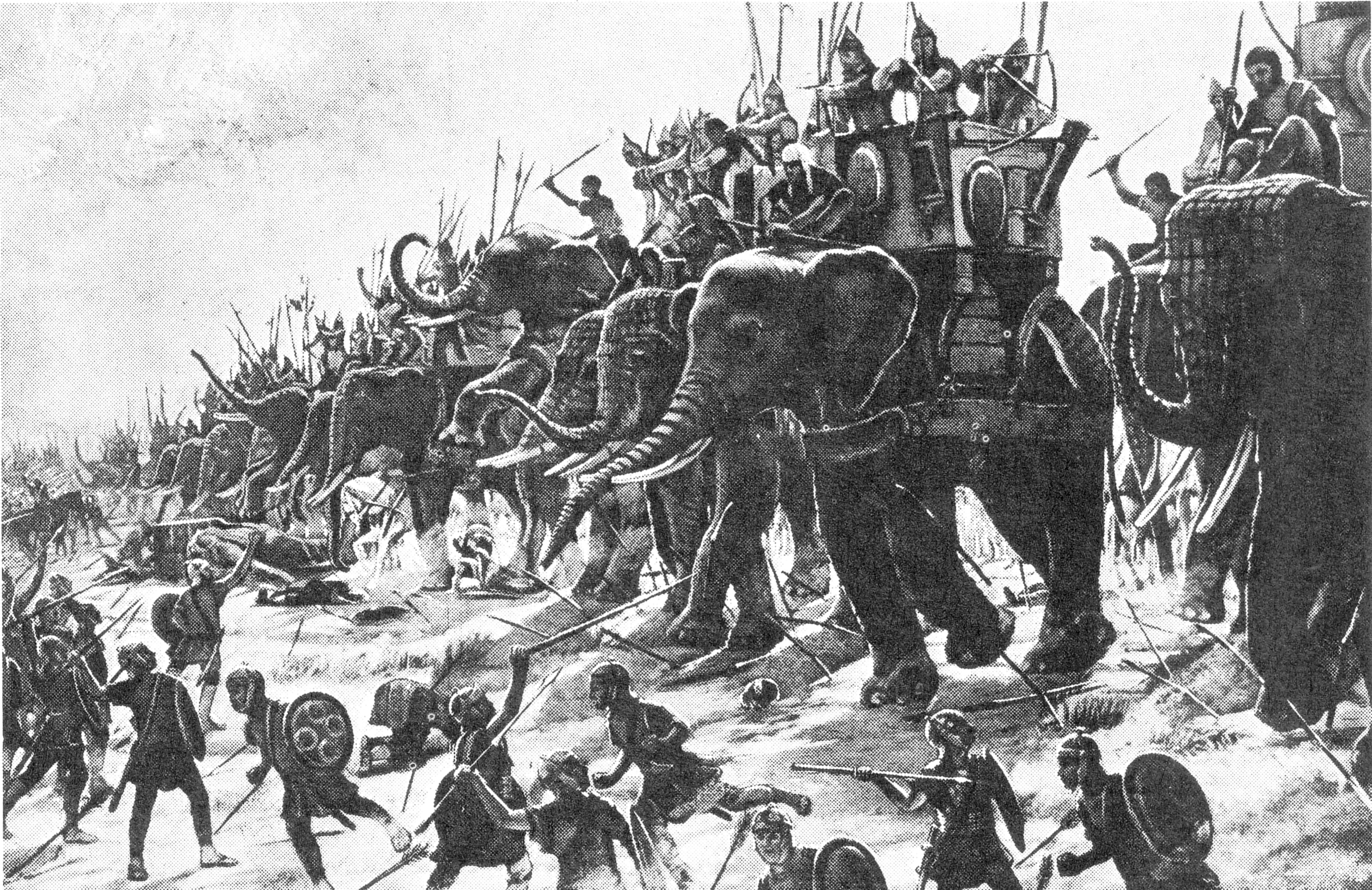
In any case, those beasts scared the bejeezus out of the Romans. War elephants were the tanks of antiquity. If things went according to plan (a big if), they plowed into the enemy ranks and broke up the formation. All the time, the archers and javelin-throwers were firing from their little fortress mounted on the elephant. Check out this fearsome rendition of the battle of Zama:

I’d rather be one of the guys on top in that one. Except……

Except that this was one of those many cases where things went wrong for the side with the elephants. Modern tanks go kaputt but not berserk. Ancient tanks went berserk. If they panicked, they were as likely to turn around and plow into their own ranks (the elephants didn’t care, after all). That happened here at Zama. For that reason, the elephants usually had mahouts with lances (you can see them in the picture), whose job was to kill the elephant as soon as he or she (both males and females were used) threatened the home side.

Long story short. Probably a sub-species of Indian. And soooo much fun to imagine. More, much more, in future posts.


Bookmark and Share

Hannibal in Colombia, Catalonia, Missouri

Alright, Hannibal did not actually go to South America and Missouri, in large part because he didn’t know that they existed. 😉

But have you ever wondered why more than a million Colombians on the steamy Caribbean coast live in a city called Cartagena? Because Colombia was Spanish, of course, and there is a city in Spain (Murcia) that is called Cartagena. But why is that city called Cartagena? Because it was founded by Hannibal’s brother-in-law, Hasdrubal (not to be confused with his biological brother, also named Hasdrubal), who made it Carthage’s regional capital. He called it Little Carthage, or Little New City, since Carthage is Punic for New City, as mentioned already.

When the great Scipio, another of my heroes and Hannibal’s eventual nemesis, conquered Spain, he renamed it New Carthage (Carthago Nova), thus inadvertently calling it New New City. Oh well, nobody’s perfect.

Now, how about that fantastic party town with all that great Gaudi architecture, Barcelona? Hannibal’s clan or family name, you recall, was Barca. Sounds suspiciously similar, doesn’t it? Barcelona probably started as the “camp of the Barcas”, when Hamilcar, with his young son Hannibal in tow, showed up in Spain to conquer it. Hannibal later would have passed nearby on his way to the Alps and Italy.

And what about that town in Missouri on the Mississippi, where Mark Twain grew up and had his Tom Sawyer and Huck Finn get into all sorts of trouble? It’s called Hannibal. I must assume that it’s named after my hero/antihero, but I’ve not actually been able to verify that. If anybody knows, please drop me a line below.


Bookmark and Share

Semitic Hannibal

The previous post was about Hannibal’s ethnicity, this one is about his language.

For the record, I love language–whether that means being wantonly pedantic or tracing words to their etymological origins. Let me do the latter now, to show that Hannibal was a Semite. Just to be clear: The word semitic, properly used, has a linguistic, not an ethnic, context (just as, say, Germanic or Anglo-Saxon are terms about language, not ethnicity.)

Hannibal’s clan name was Barca. Barca means ‘lightning’ (quite fitting, don’t you think?). Barca also tells us about the Punic language.

For explanation, I asked Rutie Adler, a scholar and the coordinator of the Hebrew Language Program in the Department of Near Eastern Studies at UC Berkeley.

Punic (the Roman world for Phoenician), she said, is a Northwest-Semitic language, and thus closely related to Hebrew and somewhat more distantly related to Arabic. A good family tree is here.

Thus the Punic word for lightning, Barca, is essentially the Hebrew word Barak (as in Ehud Barak, former prime minister of Israel, but not as in Barack Obama).

It is also the Arab word Buraq, which happens to be the name of the winged horse that carried Muhammad from Mecca to Jerusalem and back during his night journey.

Cool, isn’t it?


Bookmark and Share