My bibliography

Before I start, a snapshot of the overall structure of my bibliography: It’s the same as the structure of the book. That is to say, there is one overarching story–that of Hannibal and Scipio–and then each chapter introduces other lives from other times that fit what was happening in Hannibal’s life in this chapter.

This means that I have in effect two bibliographies: One, a classic library on ancient history–specifically, the Punic Wars. The other, an eclectic and perhaps unfathomable collection of biographies, psychology and philosophy to illustrate certain themes.

Stay tuned.

Why Andrew blogs

Andrew Sullivan

Andrew Sullivan

Andrew Sullivan, celebrity blogger and acerbic teller of truth, writes a long treatise on why he blogs in The Atlantic. He’s been at it far, far longer than I have, but his reasons are the same as mine. Some excerpts:

On finding a telos and a voice as a blogging virgin:

I remember first grappling with what to put on my blog. It was the spring of 2000 and, like many a freelance writer at the time, I had some vague notion that I needed to have a presence “online.” I had no clear idea of what to do…

I realized that the online form rewarded a colloquial, unfinished tone. … So I wrote as I’d write an e-mail—with only a mite more circumspection. This is hazardous, of course, as anyone who has ever clicked Send in a fit of anger or hurt will testify. But blogging requires an embrace of such hazards, a willingness to fall off the trapeze rather than fail to make the leap….

On the sense of liberation from the evil editor:

It was obvious from the start that it was revolutionary. Every writer since the printing press has longed for a means to publish himself and reach—instantly—any reader on Earth. Every professional writer has paid some dues waiting for an editor’s nod, or enduring a publisher’s incompetence, or being ground to literary dust by a legion of fact-checkers and copy editors. If you added up the time a writer once had to spend finding an outlet, impressing editors, sucking up to proprietors, and proofreading edits, you’d find another lifetime buried in the interstices. But with one click of the Publish Now button, all these troubles evaporated….

On the intimacy and authenticity of blogging:

That atmosphere will inevitably be formed by the blogger’s personality. The blogosphere may, in fact, be the least veiled of any forum in which a writer dares to express himself. Even the most careful and self-aware blogger will reveal more about himself than he wants to in a few unguarded sentences and publish them before he has the sense to hit Delete. The wise panic that can paralyze a writer—the fear that he will be exposed, undone, humiliated—is not available to a blogger. You can’t have blogger’s block. You have to express yourself now, while your emotions roil, while your temper flares, while your humor lasts. You can try to hide yourself from real scrutiny, and the exposure it demands, but it’s hard. And that’s what makes blogging as a form stand out: it is rich in personality. …

On how the new medium of blogging is likely to reinvigorate the older text media:

A blogger will air a variety of thoughts or facts on any subject in no particular order other than that dictated by the passing of time. A writer will instead use time, synthesizing these thoughts, ordering them, weighing which points count more than others, seeing how his views evolved in the writing process itself, and responding to an editor’s perusal of a draft or two. The result is almost always more measured, more satisfying, and more enduring than a blizzard of posts. The triumphalist notion that blogging should somehow replace traditional writing is as foolish as it is pernicious. In some ways, blogging’s gifts to our discourse make the skills of a good traditional writer much more valuable, not less. The torrent of blogospheric insights, ideas, and arguments places a greater premium on the person who can finally make sense of it all, turning it into something more solid, and lasting, and rewarding….

In fact, for all the intense gloom surrounding the news-paper and magazine business, this is actually a golden era for journalism. The blogosphere has added a whole new idiom to the act of writing and has introduced an entirely new generation to nonfiction. It has enabled writers to write out loud in ways never seen or understood before. And yet it has exposed a hunger and need for traditional writing that, in the age of television’s dominance, had seemed on the wane.


Bookmark and Share

Sarah Palin: Monty Python could have written this

So says no less an authority than John Cleese. Palin (Sarah, not Michael), he says, is “a nice-looking parrot” that has been trained to utter a few phrases beautifully, without understanding what they mean…


Bookmark and Share

The headbanger swim teacher

David White, my daughters swim teacher

David White, my daughter's swim teacher

You’ll need a healthy sense of irony and the surreal and quirky to enjoy this one. It’s a brief multimedia rumination on 1) fatherhood, 2) authorship and 3) the clash of the two.

Background information:

1) I took this past week off, ostensibly for vacation, but really to work on the book, because I feel so close to finishing it. Yeah, right.

2) I had agreed, for the entire week, to drop off and pick up my daughter from pre-school, while my wife stays with the baby, and then to drive my daughter to a sweltering suburban valley where a fantastic swim school is giving her a crash course. After all, I’m on vacation, right? And I can still blog and write my book, right?

Well, here is a “day in the life” of the aspiring young author:

  • Wake up by being kicked out of bed by daughter, who was not supposed to be in this particular bed to begin with, then discovering that she peed on the bed just out of spite.
  • Gulp down coffee while discovering that there is no muesli or other acceptable breakfast, because nobody in the family has had time to go shopping for weeks.
  • Kiss wife and baby goodbye while wrestling rebellious daughter into car and turning on, for first of many times on this day, the CD of Die Maus.
  • Drop off daughter, hurry back to “write book”, but only after clearing out email inbox of 634 new messages and RSS reader full of 131 new posts, checking 8 new voice mails…
  • Give up after 23 emails, without having written a sentence of the book, to pick up daughter and drive to swim school
  • Sit by eerily placid poolside in suburban California watching David White play with daughter in the pool, succeeding skillfully at getting her to dip her cheeks and nose in the water.
  • Discover that David White, gifted swim teacher and cool guy, is actually lead singer of heavy-metal band Heathen.
  • Drive back, listening to CD of Die Maus again, having memorized all two hours of it by now.
  • Arrive back to discover that dishes need to be done, and that the day is over
  • Repeat five times, until “vacation” is over…


Bookmark and Share

Uncle Lulu

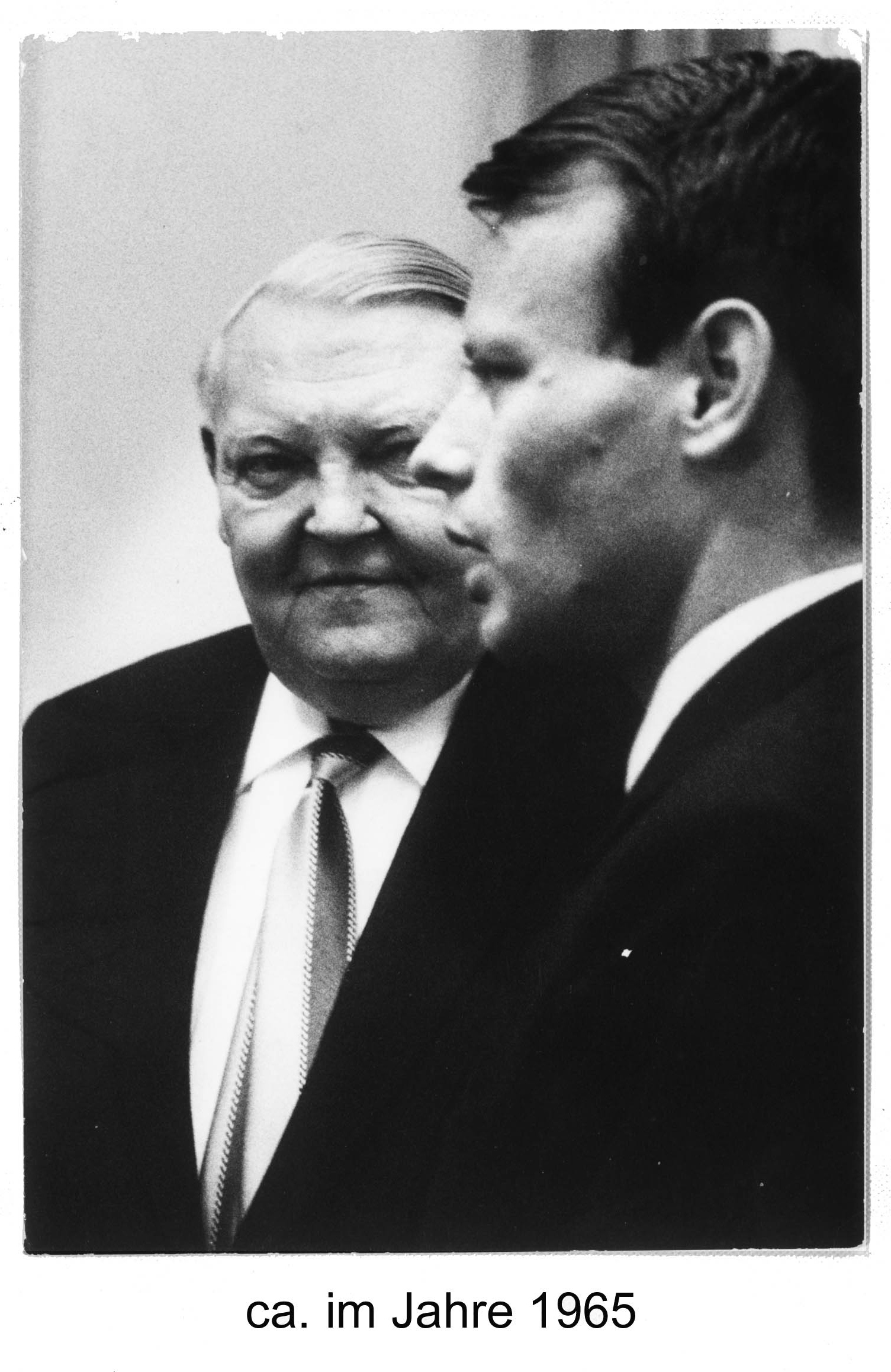
That guy with the cigar on this West German stamp from 1987 is my great-uncle, Ludwig Erhard, or “Onkel Lulu” in our family.

Why is he on this blog?

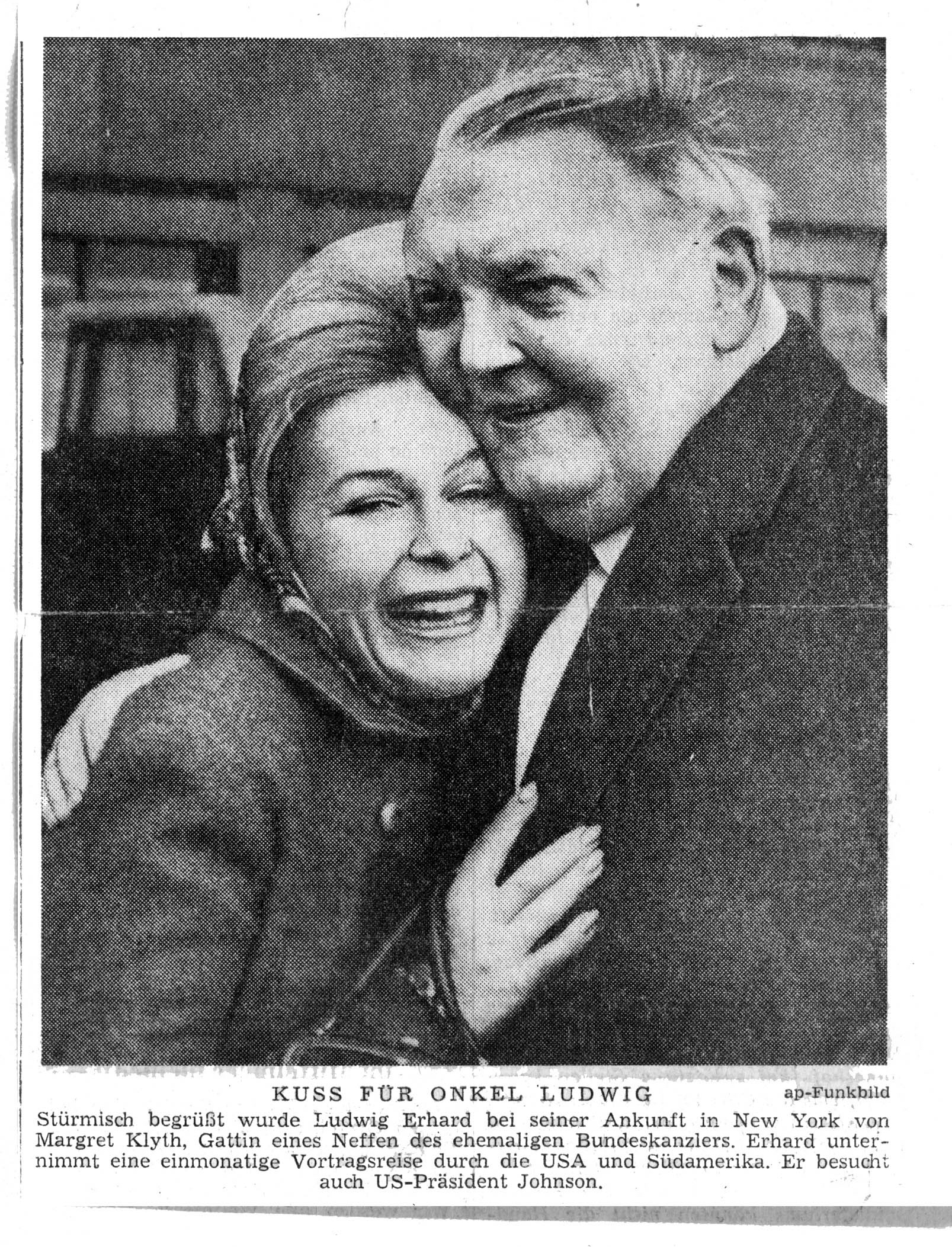
Newspaper cutting of my dad and his uncle

Newspaper cutting of my dad and his uncle

Because is life is one of those I trace in my book, to show that that what happened to Hannibal and Scipio happens to all of us, one way or another.

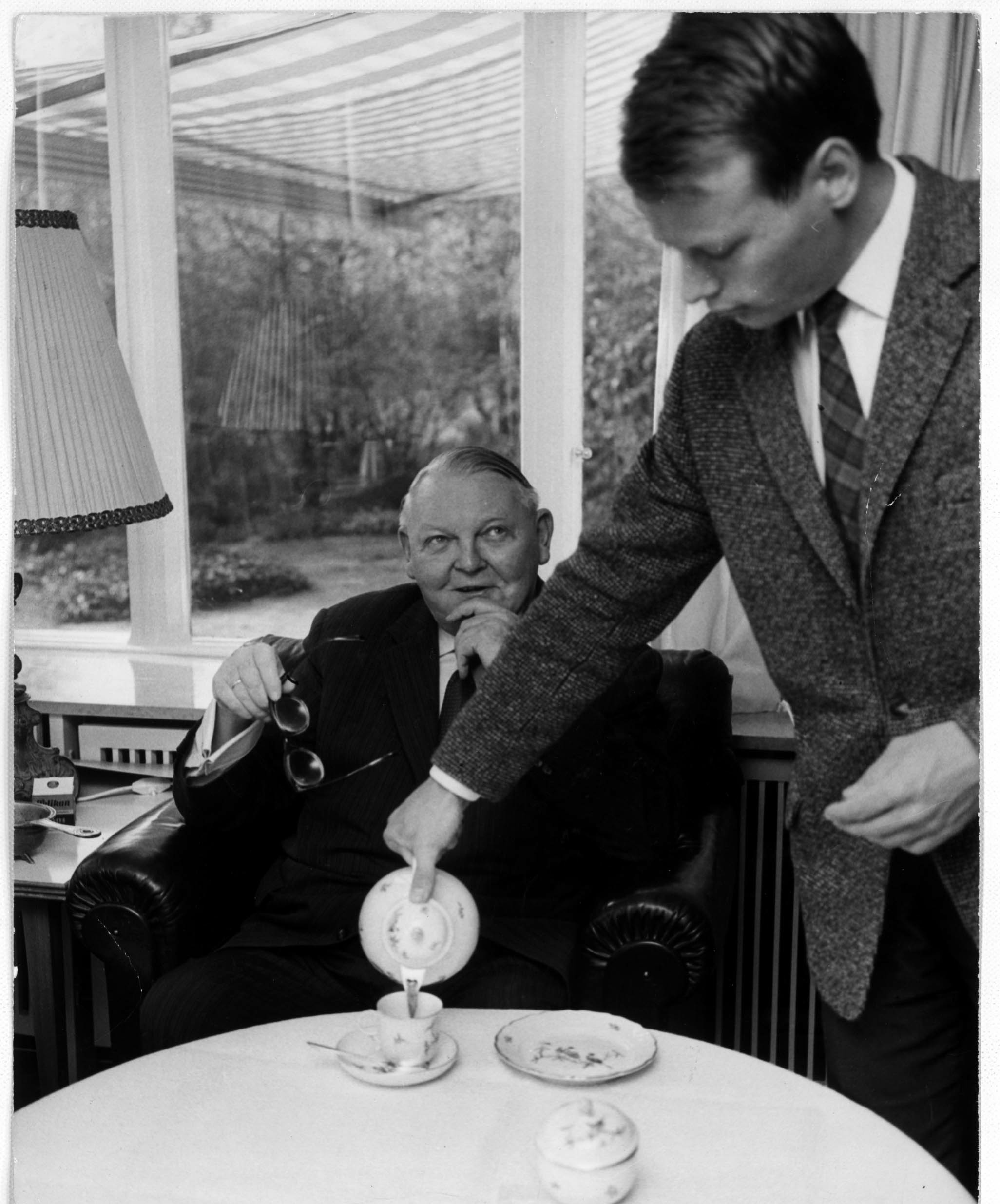
My dad pouring tea for his uncle, the chancellor, in the 60s

My dad pouring tea for his uncle, the chancellor, in the 60s

In Germany and continental Europe, Ludwig Erhard is a household name. In America, he is not, but should be. He is famous for being a founding father of post-war (West) Germany, its first economics minister, the father of its currency (the Deutsche Mark), and then its second chancellor (ie, prime minister). He is credited with causing the stunning economic growth of the 1950s, sometimes called (but not by him) an “economic miracle”. And he is probably the most steadfast proponent of freedom, tolerance and open and fair markets in German history.

Dad and Lulu again

As my father’s uncle and godfather, he practically raised my father after my grandfather died. I only met Lulu when I was very small (he died in 1977). He liked to hide Easter eggs for me in his steep hillside garden by the Tegernsee, an Alpine lake south of Munich. His influence lives on, in Germany, in our family, and now in my book.

My mom with Lulu in New York, where I was born

My mom with Lulu in New York, where I was born

Word-loving as science

I still remember my high-school English teacher telling me that good writers minimize the use of the, of, a and so forth. Those are fill words–in effect, noise. Turn nouns into verbs and get rid of them, so that the signal-to-noise ratio of your writing goes up. Don’t say: “A restructuring of our financial system and a recapitalization of our banks is an imperative for the avoidance of a depression.” Say: “We have to change our financial system and put capital into our banks to avoid a depression.”

I’ve also warned in a previous post about the treacherous first-person voice, which writers overuse, in my opinion, especially in America.

James Pennebaker

James Pennebaker

Well, James Pennebaker is now forcing me to think much more deeply about all this. He’s a psychology professor at the University of Texas at Austin, and he counts words. All sorts of words, especially the fill words that I thought existed only to be eliminated, and all those Is, mines and mes.

Why? Because how people use words, even and especially the ones we think don’t matter, says so much about them.

For instance, in analyzing the difference between Obama and McCain, Professor Pennebaker has this to say in on his blog:

Categorical versus fluid thinking.  Some people naturally approach problems by assigning them to categories.  Categorical thinking involves the use of articles (a, an, the) and concrete nouns.  Men, for example, use articles at much higher rates than women.  Fluid thinking involves describing actions and changes, often in more abstract ways. A crude measure of fluid thinking is the use of verbs.  Women use verbs more than men.

McCain and Obama could not be more different in their use of articles and verbs.  McCain uses verbs at an extremely low rate and articles at a fairly high rate. Obama, on the other hand, is remarkably high in his use of verbs and low in his use of articles.  These patterns suggest that McCain’s natural way of understanding the world is to first label the problem and find a way to put it into a pre-existing category.  Obama is more likely to define the world as ongoing actions or processes.

In this post, Pennebaker actually counts how often the candidates use various categories of words.

It’s all about probabilities, of course. But I love how Pennebaker reminds me–not that I’m somebody who was likely to forget it–just how much words matter!


Bookmark and Share

Window into the mind of a writer….

… brought to you by this week’s New Yorker:

1) Assumption about the target audience of readers:

2) Default state of writer:

2) Advanced state of writer, in human interaction:

3) Premonition serving as motivator to continue in 1, 2 & 3:

Bookmark and Share

Just one more on metaphors, really

Well, after exhausting all of you with my recent trilogy on metaphor-mixing, I thought I was done. But I also felt guilty that I didn’t quite live up to my promise of juicy and sufficiently current examples from The Economist. Let me atone herewith.

It must be this financial “meltdown”. It’s impoverishing all of us, and to add insult to injury (is that a metaphor?) it is making metaphor mixers out of hitherto presentable magazines. I will venture a theory about this below, but let’s have fun with–oh, let’s pick a random piece from our Finance section–the first two paragraphs, including title, rubric and chart caption, of this article: (As always, different metaphors in different colors)

Domino or dynamo?

Oct 9th 2008 | HONG KONG
From The Economist print edition

China is pretty well placed to cushion a global downturn

CHINA has become the main engine of the world economy, accounting for one-third of global GDP growth in the first half of this year. Will it keep humming? Compared with many other emerging economies, notably Brazil and Russia, which have recently suffered big capital outflows, China has so far largely shrugged off the global credit crunch. But there are signs that China’s economy is sputtering. Export volumes have slowed markedly; the growth of industrial production dropped to a six-year low in the 12 months to August; car sales fell by 6% in the same period; and China’s property boom seems to be turning to bust.

Some of the recent slowdown reflects the temporary closure of factories around Beijing during the Olympic games, which cleared the air but made China’s statistics even hazier than usual. …

Now, you notice that I couldn’t color the caption of the chart, but “Sweet and sour” is another metaphor.

So we have: Dominos, dynamos, cushions, a lot of engine stuff (with humming and sputtering, which is fine because it belongs to the same metaphor), as well as some shrugging and crunching and flowing and the obligatory dropping, falling, sliding and so forth.

Why does this happen?

I haven’t taken the time to test this hypothesis, but I will venture to guess that newspapers were mixing fewer metaphors after 9/11. After all planes flying into skyscrapers setting off blazing infernos over the skyline, human beings jumping off of buildings and avalanches of dust shrouding an entire city don’t need metaphors. Such images are what metaphors are made of. They are not abstract but primal.

This financial crisis is the opposite. Who has seen the enemy? What does a credit-default swap look, smell, sound, taste and feel like? Has anybody ever kicked a money-market fund in the shin? Have you ever seen a mortgage-backed security go up in flames? Have “toxic” assets ever actually made you puke?

No, no, and no. This stuff is so hard to write about because it’s so abstract. I once taught a class in which I started by asking “What is money?” One or two people tried the usual “I don’t care as long as I have enough of it”. But, as in the 1930s, people are discovering that money, banknotes and coins aside, is not actually there. That’s in the Gertrude Stein sense of “There’s no there there.” Go into a bank and ask politely to see and touch your money. That’s what I mean.

Ergo: We are in huge trouble, but we can barely even describe why and how. So we stretch for metaphors from primal experience. And we overdo it.

That doesn’t mean I condone it. For good writers, the advice stands: Just say No.


Bookmark and Share

The home stretch of writing

A big moment of sorts last week: I finished the first and rough draft of the book.

That doesn’t mean I’m done. But it does mean that I’ve started the second round.

What happened over the past year is roughly this: The basic idea proved better than I could have hoped. And the book almost wrote itself, much more easily and faster than I ever thought. But it took me a while to find my own, authentic, loose and easy voice (as opposed to my “The Economist” voice which I’ve become so accustomed to over the past decade). (Blogging helped, as you recall.)

And so I ended up with an unexpected trajectory: The early chapters are fine, but need improvement. Then the chapters get better and better, and the final ones absolutely rock.

So now, in the second draft, which I’m hoping will only take another month or so (all the raw material is already there), I need to bring the entire book, from the first sentence to the last, up to the quality of the later chapters.

Then I’ll mail them off to the editor at Riverhead, and see what happens next. I’m quite curious about the process….


Bookmark and Share