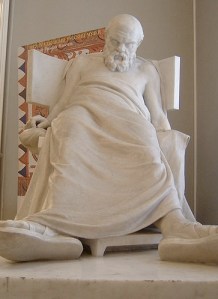
Spunky language in the search for truth

Yesterday I gave an example of bad–meaning squeamish, cowardly and therefore intentionally obtuse–writing. Today I came across an example of good–meaning courageous, irreverent and therefore clear and authentic–language.

It comes in the form of a spunky almost-ninety-year-old Welsh lady named Elaine Morgan. She took the stage at TED and clearly and humorously laid out her case that we descend not from apes that stood up because they left the trees and went onto the savannah (the mainstream paradigm) but rather from aquatic apes. The video is below.

A few things, before you watch:

  • Her theory is fascinating, but whether or not it convinces you is not my point. Most people are not convinced.
  • My point is the clarity of her language that comes from her courage, the corollary of my view that bad writing/expression comes from fear.
  • Worth noting: Morgan’s talk contains humor and sprezzatura, which often accompany courage but never cowardice.
  • She nods to Thomas Kuhn, whom I declared one of the runners-up for the title of greatest thinker ever. Kuhn, remember, was the guy who described how scientists will disregard any evidence (and messenger) that does not fit their paradigm until that paradigm collapses entirely. It is her way of saying to her audience: Snap out of it and open your minds!
  • Listen to her point about how to treat “priesthoods”!
  • Finally, think about how she would react if new evidence came to light that proved her theory wrong but advanced our understanding. Would she be upset? Or would she celebrate?


Bookmark and Share

Bad writing about white oral sex

A while ago, using George Orwell’s classic essay on language, I opined that:

Good writing = clear thinking + courage

with the implication that

Bad writing = confused thinking

or, more interestingly,

Bad writing = clear thinking + cowardice

Well, I was thinking about this today when reading a phenomenally badly written article in the Science section of the New York Times. It is a case study not only in writerly cowardice but its more petty form: squeamishness.

The article starts meekly enough with the headline that

Findings May Explain Gap in Cancer Survival

The background is a genuine conundrum, which is that

  1. cancers of the throat and neck have been increasing and
  2. whites survive more often than blacks.

The obvious question is: Why the difference? It could be late diagnosis for blacks, lack of access to health care by blacks, different treatment for blacks or something else.

Well, it’s something else! And this ought to be the big, screaming headline of the article, except that the article never says it! Since the article does not, I will write the simple, plain-English sentence that is missing:

Whites have more oral sex than blacks, and therefore get infected with a virus that causes more of them to have cancer, but of a less lethal sort.

There you have it: The two most explosive subjects in America, sex and race, both in the same sentence. Naturally, any editor of the New York Times will seek cover. I say: Cowardice! Squeamishness!

The result is some cryptic and off-putting verbiage that buries the central insight underneath impenetrable code. It is exactly the sort of intentionally obtuse language that George Orwell mocked.

Look at how the hints are buried in the text:

The virus can also be spread through oral sex, causing cancer of the throat and tonsils, or oropharyngeal cancer.

Or:

The new research builds on earlier work suggesting that throat cancer tumors caused by the virus behave very differently from other throat cancers, and actually respond better to treatment. And the new research suggests that whites are more likely than blacks to have tumors linked to the virus, which may explain the poor outcomes of African-Americans with HPV-negative tumors.

The research does actually establish the crucial link, but you would hardly know it from sentences such as this:

The results were striking: the TAX 324 patients whose tumors were caused by the virus responded much better to treatment with chemotherapy and radiation. And they were also overwhelmingly white. … While about one-half of the white patients’ throat tumors were HPV-positive, only one of the black patients had a tumor caused by the virus, Dr. Cullen said.

Towards the end, the writer dares venture the following hypothesis:

This suggests that the racial gap in survival for this particular cancer may trace back to social and cultural differences between blacks and whites, including different sexual practices, experts said.

Excuse me. “Social and cultural differences … including different sexual practices”?!

This would not happen at The Economist. If I wrote such claptrap, I would get laughed out of the room.


Bookmark and Share

Richard Meier’s modern Acropolis

IMG_6005IMG_6006

Did Richard Meier, the architect of the Getty Center in Los Angeles, explicitly intend to build a modern acropolis?

I’m almost sure that he did. This is the effect his superb architecture has. The museum’s contents–ie the art inside–is fine. But what makes the Getty Center a destination is that it is, well, what the acropolis of Athens would have been for Socrates: a space for civilized humanity. It has great Feng Shui.

Instead of sitting on a hill, the Getty Center, like the acropolis, seems to rise out of, or to be, the hilltop. It blends into its topography and simultaneously defines it. It signals itself to the people below as the obvious place to go up to. To the people already inside, it is a natural, light-filled place to dwell. It keeps you in, makes you reflective and social, encourages you to meander and talk.

It is simple and yet subtle, the equivalent of a Brancusi sculpture or of the kind of writing I like.

The easiest way to know that it is good architecture (= the way to know good writing) is that it does not make you tired. You can walk through the Louvre, for example, and feel all dutiful about being cultured, but within minutes you want to yawn, sit, sleep, escape, open a window. The Getty Center, and all good art in any medium, makes no such demand on you. It says “check your sense of duty at the door and come in: the culture will happen all by itself; you will feel refreshed after.”

Bookmark and Share

Alain de Botton on success and anxiety

Thinking more deeply, or at least differently, about success seems to have become a genre. Malcolm Gladwell has done it, I am doing it right now in the manuscript which I am rewriting, and now Alain de Botton, another young author, is doing it in this TED talk below.

His key points:

  • we live in an age of anxiety.
  • the problem is our egalitarianism. We no longer believe that people who are worse off are “unfortunates” (the old term). Instead, they are now “losers”. It is their fault.
  • So we fear failure more than ever, because it is our fault. This is the flip side of meritocracy, which we consider a good thing, but which is really a tyranny of expectations.
  • The dominant emotion in this age of equality/anxiety is envy. We envy everybody who does better.
  • With it comes fear: the fear of the judgment of others. If we have a boring job, others will look down on us and we will feel bad.

I think he underestimates the anxiety that previous generations had, but he does have a point.


Bookmark and Share

Letting go, in small ways and big

800px-Saimiri_sciureus-1_Luc_Viatour

One way to catch monkeys–or so I once saw in a documentary–is apparently to dig a hole in the ground just big enough for a relaxed monkey hand to go in and just small enough for a monkey fist not to come out.

Then you put some goodies in the hole and wait. The monkey then catches itself. It sticks its hand in, grabs the goodies, makes a fist and refuses to let go, even as it sees the hunters casually sauntering up to take it in.

Primates, in short, have a problem with letting go, and that’s how this relates to The Hannibal Blog‘s current thread on stuff. I rarely, these days, find anyone prepared to argue that clutter/stuff is a good thing. Nor, however, do I know a lot of people who have actually done anything about it. It may be that I hang out primarily with primates.

It’s our (ie, primates’) loss, because this not letting go is what makes us so miserable. That’s true in the context of physical stuff piling up, but also of mental clutter.

The Dalai Lama, at the end of this conversation, says that

True happiness doesn’t mean trying to acquire things, so much as
letting go of things.

Not coincidentally, therefore, a primary meditation technique consists of trying to let thoughts go. You sit still and observe dispassionately what pops into your mind. You don’t try to suppress bad, mean, nasty, stupid thoughts, because that would only make them come more–eg, you would feel guilty and angry about not ceasing to feel guilty and angry.

Instead, you “label” the thoughts (‘Aha, anger again.’) and then let them pass out, replaced by whatever comes next.

It’s quite surprising how much crap shows up this way. Even more surprising is that after a while of doing that, the parade of thoughts slows down. Eventually, it might even come to complete stillness, which is how Patanjali defines yoga (union). At that point, you have indeed let go.

So: stuff, clutter, things, illusions, attachments: it’s all there to be let go. Unfortunately we have evolved to hold on to it. Hence passion, literature, civilization, stories … and misery.

Bookmark and Share

The manuscript is in a pouch to me

Things are about to get really interesting: My editor at Riverhead just emailed to say that he has finished putting his comments into my book manuscript and will send me (the old-fashioned way, this being the book industry) the pages next week.

That’s when I begin my favorite part of writing: the re-writing. Research, whether for The Economist or my book, can be a hard slog, and filled with anxiety. The first draft is then a way of cleansing the anxiety by letting it out and giving it shape. But beauty happens in the re-writing, as Khaled Hosseini (also with Riverhead) said so well.

I sent off the manuscript a few months ago, and have since (deliberately) not even looked at it. In my mind and memory, the text has settled. Parts have receded, parts have become amplified. When I look at it fresh next week, things will jump out that I was blind to in February.

When I talked to my editor a couple of weeks ago, he sounded very happy with the book. My agent is happy too. That’s a good reaction, if it is half of the reaction. The other half must be the assumption that it can be made even better. That’s what I’m going to do in the coming weeks.

Then, after I send it back to Riverhead again, we will find the best title, and the date of publication.

Bookmark and Share

Stuff and clutter on web pages

Mostly, in this thread on stuff and clutter, I’m talking about actual, tangible stuff, stuff you can throw out or hit your toe against. But stuff can be non-material too, cluttering up our brains or … web pages. Mark Hurst is a usability thinker, and has this anecdote from a recent consulting trip to a company–let’s call it Acme–with a snazzy web site:

…Anyway. Acme had a problem: research showed that their website was completely, unforgivably, disastrously hard to use for their customers. And *ugly*, on top of that, as if it was spat from a template circa 1996. So I sat down with the executives, everyone with a stake in the online presence, to help them improve the business metrics by improving their website.

Here’s an excerpt of the meeting transcript, more or less.

Me: One thing customers complained about was the home page navigation. To quote one customer we talked to, “I can’t figure this thing out and I’m leaving right now.” I think it had something to do with the flaming chainsaw animation that follows the mouse pointer around the screen. Is it possible we could remove that?

VP Marketing: Oh right, the flaming chainsaw animation. I’d love to take that off the site, really I would, but I just think it’s so neat, and besides it aligns with our brand message of innovation here at Acme.

Me: But customers would shop more, and buy more, if it wasn’t there. Wouldn’t you like to reconsider that animation?

VP Marketing: Here in Marketing we have to adhere to our brand guidelines, and innovation is central to that, so I’m afraid the animation has to stay.

Me: OK – next up is the customer complaint about the 18-level-deep flying dynamic navigation sub-menus. Several customers said all the menus zipping around the screen made them dizzy.

VP Technology: I know what you’re referring to. That menu system took our technology team six months to code up, and I have to say it’s the most advanced implementation I’ve ever seen, really an awesome job.

Me: The technology is impressive, for sure… I mean, I’ve never seen 18 nested levels all flying in unison like that.

VP Technology: Thanks, man.

Me: Uhh – sure thing. But I’d just like to push back a little on this – the customers did say that the menus were confusing. How about a simpler menu, maybe just a few links to the top-level categories, and that’s it?

VP Technology: Listen, I’m all for simplicity and ease-of-use and all that, I hear you. I really get it. But I have to tell you, Web technology is moving fast, and if we don’t keep up, we’re going to look like Google or something. A bunch of blue links. Borrring.

Me: Allllright. Now we’ve covered the flaming chainsaw and the flying menus, let’s move on to the logo graphic. Some customers complained that they didn’t want to scroll down a full page just to get past the logo, the large stock photos, and the slogan.

VP Branding: What did they say about the color scheme? I’m just wondering, because the green and fuscia palette is really supposed to, you know, bring forth assocations of innovation and holistic thinking, all while blending in with the flames from the chainsaw.

Me: I think I have a plane to catch. (Exit conference door right)

Bookmark and Share

Stuff and sex: It’s a female thing

160px-Female.svg180px-Male.svg

The elephant in the room whenever you’re discussing stuff and clutter is sex.

(That’s sex as in gender, although our style guide at The Economist urges us to use gender only for words and sex for people. So the gender of ein Mädchen is neuter, whereas her sex is female.)

I believe we can stipulate that:

women need and keep and hoard, and cannot let go of, stuff much more than men do

Is this controversial? It shouldn’t be. It’s mostly women I’ve talked to who have said as much. If you go into a random house and count things, the odds are that “hers” outnumber “his” (although that need not apply to total weight or size, of course). It’s women who agonize over getting rid of things, not men.

(To pre-empt a Larry Summers situation, this is the time to remind everybody that I’m making a statement about averages and statistical dispersion. Of course, there are individual men who keep more stuff than individual women.)

So the question is: Why?

  1. One possibility is our hunter-gatherer past, which accounts for almost all of our time as a species. Whereas Neanderthal men and women hunted together, our ancestors sent the men to hunt and the women to gather, and benefited from this division of labor. A hunting party travels light. The less you carry the more fiercely you will wield what you do carry, and the more likely you will be to bring your prey back, which is the point. Stuff would only interfere. By contrast, gathering is about stuff, the collecting of it.
  2. Another possibility is that the nesting instinct shows up in females even outside of pregnancy, though perhaps to a lesser extent. Get a male (we’re not necessarily talking about our own species) to build a nest, then fill it up. All the way up. Don’t drop anything.
  3. The previous two points might just add up to a third possibility: That women have a stuff brain but men don’t. I read research somewhere (which applies eerily in my case) that men are usually better at, for example, such tasks as rotating an imaginary object in space, whereas women are better at remembering and locating objects in a crowded drawer that is briefly opened and shut. Men can’t find anything, women seem to find everything. (When I need something, I usually ask my four-year old daughter, and she always knows.)


Bookmark and Share

Socrates on trial

Death_of_Socrates

And here he is, the great man, dying of the hemlock coursing through his veins. Throughout this thread on Socrates, we’ve been pondering all the ways in which he–his life, his thoughts, his arrogance, his eccentricity, his genius and humor–speaks to us today, timeless in his relevance. But of course we always knew what happened next, the full stop that ended the sentence of his life. His trial and martyrdom is rivaled, in notoriety and historical importance, only by that of Jesus.

It is more than just another fact in the text books: It is one of the greatest mysteries in all of history, and an eternal challenge and reprimand to democracies and freedom lovers everywhere. The question is:

Why?

Why did the Athenians, the most ardent freedom lovers of all time, turn against their gadfly when he was 70 years old? For his whole life they had tolerated, mocked, enjoyed, hated and loved him. But then something changed. One of their 500-man juries, the sort that they were so proud of, found him guilty of two silly–laughable, stupid, banal!–charges and gave him death.

Let’s try to find out what was going on.

Bookmark and Share