Entropy in your home, life, body and mind

Like Fritjof Capra, I instinctively see Eastern philosophy and Western science as yin and yang. They rarely disagree and usually reinforce each other, the East using the vocabulary of metaphor, the West that of empiricism. So indulge me as I apply this instinct to my current thread on stuff.

The Feng Shui view is that stuff, ie clutter, blocks the flow of energy (qi) in your house and, since you are not ultimately separate from the space around you, in you.

The relevant Western analog is that clutter wants to increase all by itself. You have to expend energy to keep your stuff from spreading, multiplying, breaking, rotting.

This idea is called the Second Law of Thermodynamics. “Clutter”, in the argot, is entropy, the amount of disorder in a system. Disorder will increase as surely as water flows downhill (from a high-energy state to a low-energy state). The “system” in question can be:

  • your body, in which entropy manifests as aging and breaking,
  • a glass of warm water that cools (trading the “order” of warmth here and cold there for the “disorder” of lukewarmth everywhere)
  • your house or home office as it mysteriously gets submerged in stuff,
  • the entire universe (which is incredibly bad news for us, since there is no other system that we can decamp to), and
  • almost anything else.

Now, you might object that you can make water flow uphill, and you can warm a glass of water even in a cool room. Yes. But the key insight is that this takes energy, which must be added into the system. You have to pump, or boil, et cetera.

Hence the dilemma of stuff: First the clutter increases, thus (according to Feng Shui) blocking our energy, which is thus unavailable to reverse the cluttering, and so the shit–sorry, stuff–just happens.

Bookmark and Share

The changing nature of wealth: stuff is out

800px-Claude_Vignon_Croesus

Let’s return to Croesus for a moment. That’s the guy who gave us the phrase “rich as Croesus” and who learned the hard way about the ups and downs of life. Today I want to use him, the richest of the rich, to begin a brief meditation on wealth, as a way of understanding our modern problem with stuff. Because stuff is what we’re trying to figure out in this thread.

It used to be that wealth was a thingy thing, a state of having lots of stuff, especially stuff that others wanted and did not have. Let’s savor for a moment a brief passage from Herodotus, in which he dwells lovingly on the details of Croesus’ stuff/wealth. This was the porn of the fifth century BCE.

Croesus, in this passage, wants to impress the Delphic oracle, so he gives it lots of stuff:

three thousand of every kind of sacrificial beast, and besides made a huge pile, and placed upon it couches coated with silver and with gold, and golden goblets, and robes and vests of purple…. The king melted down a vast quantity of gold, and ran it into ingots, making them six palms long, three palms broad, and one palm in thickness. The number of ingots was a hundred and seventeen, four being of refined gold, in weight two talents and a half; the others of pale gold, and in weight two talents. He also caused a statue of a lion to be made in refined gold, the weight of which was ten talents…

On the completion of these works Croesus sent them away to Delphi, and with them two bowls of an enormous size, one of gold, the other of silver… Croesus sent also four silver casks, which are in the Corinthian treasury, and two lustral vases, a golden and a silver one… Besides these various offerings, Croesus sent to Delphi many others of less account, among the rest a number of round silver basins. Also he dedicated a female figure in gold, three cubits high, which is said by the Delphians to be the statue of his baking-woman; and further, he presented the necklace and the girdles of his wife.

Necklace and girdles? That sounds like the junk we just got rid off at the yard sale.

This, in other words, was the age of things, of stuff. Almost all people had extremely little of it, so to get any stuff at all was a stroke of fortune, and immediately imposed the need to hoard it and the anxiety of losing it. When you gave people gifts (and I’ll have more to say about gifts in another post), you gave things/stuff, because that’s how worth and sacrifice was defined.

All that is over, at least for the middle and upper classes of the rich countries today. (If you’re reading blogs, you belong to that set.) Our wealth is no longer thingy/stuffy. If anything, an excess of things is a mark of poverty. Any household today, even a trailer in Appalachia, is filled with gadgets that would have made Croesus green with envy.

What has taken the place of things? Two things:

  1. Time. We have so little of it, and so much stuff, that the exchange rate between the two has shifted hugely toward time. If you have money/things but no time, you are poor. Time is now one definition of worth and sacrifice, so when you really want to give a special gift, you give your time. You volunteer, or you spend a few hours of totally focused playtime with your children, or you take time to talk, really talk, with a friend/lover.
  2. Experiences. While the people in the Appalachian trailer haul in more TVs and fridges and toasters, the wealthy now buy themselves and their children experiences. Education is the big one, and that includes piano and tennis lessons, the trip to Europe and the Louvre. In my twenties, wealth was having hiked the Annapurna Circuit, say, or having sat in on a session of the House of Commons. Now, in my thirties, wealth is giving my children the experience of snow in the winter, seawater in the summer, and so forth.

So stuff is obsolete. Out of date. Unnecessary. Not worth anything. Which raises the question: Why do most of us hang on to it anyway, ruining their Feng Shui and making themselves miserable? I’ll try to tackle that anon, but I’m sure you’ve all got your ideas, so let’s have them.

Bookmark and Share

Stuff = Dead space: The Feng Shui view

335px-Feng1shui3

As a way of getting deeper into our new thread on stuff, here is a basic way of understanding why clutter is so bad for you: it “kills” space and blocks the flow of energy around your house and in your mind.

That’s how a Feng Shui guy explained it to me when I lived in Hong Kong.

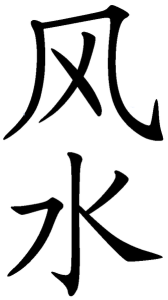
Feng Shui, if you’re new to it, means wind water (characters above), which is entirely unhelpful in understanding what it is. It’s the ancient Chinese version of geomancy–figuring out how to place buildings, furniture and other features of interior and exterior living in such a way that they make us feel healthier, more energetic and positive.

Feng Shui shares the fate of most things Eastern that are becoming fashionable in the West. That is: there are all sorts of quacks and weirdos eager to sell it to you as modern snake oil. If you know somebody who suddenly put mirrors, crystals and fish tanks all over his house, he probably became a Feng Shui victim.

800px-RepulseBay_holeOn the other hand, if you encounter buildings such as this (right behind a great beach I used to go to), you know you’re in Hong Kong. In this case, Feng Shui (ie, the hole that allows better energy flow) makes for idiosyncratic local architecture.
But if you’re lucky, you meet an expert who treats Feng Shui as the subtle application of common sense. I was lucky.

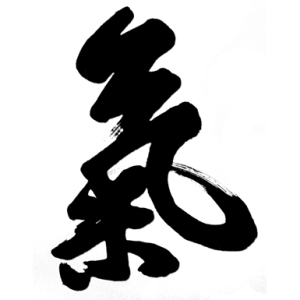
Ki-hanjaLike Chinese medicine (and indeed Indian Ayurveda), Feng Shui tries to optimize the flow of vital energy, or qi.

That qi is the ki in Aikido and the chi (different transliteration) in Tai Chi and the qi in Qigong. In Sanskrit it is called Prana. It behaves a little like electric energy, as it flows between a positive and a negative “pole”, Yang and Yin. When they stick needles into you in acupuncture, they are using the tiny conductors to amplify the flow of qi along certain conduits (called meridians in Chinese medicine, nadis in Ayurveda and Yoga).

What, you may be asking, does any of this have to do with stuff?

Stuff = dead energy

The way this Feng Shui master explained it to me, clutter in your home or office blocks the flow of qi in that space. The space becomes not just dusty but in effect dead.

Think of a corner of your house, or a drawer or a basement or a tabletop, that is hopelessly cluttered with stuff. (I’m using stuff to mean extraneous things here.) You don’t even want to look into that direction because it makes you feel bad. It reminds you that you should clean it up. Perhaps it reminds you of things on your to-do list that you never did because you didn’t want to, and now they’re piling up in that corner. Perhaps there are really important or useful or sentimental things hidden underneath that crap, but how would you ever know, without digging through it? Just thinking about all this makes you …. go somewhere else–anywhere else–and run away from the clutter once again.

And so your house becomes deader and deader with each cluttered corner. You walk through it as through a graveyard. The constricted space constricts your thoughts, perhaps your breathing (in Sanskrit, Prana means both breath and qi.)

So, to you hoarders: It’s not true that storing stuff costs nothing. It costs you more than any accountant could tally up.

Bookmark and Share

Socrates’ Athenian jury

Orestes and the Furies

Orestes and the Furies

Slowly, in this thread on Socrates and his surprising relevance to us today, we are leading up to his jury trial, the most famous in all of history. So a word is in order about Athenian juries.

I am skeptical of jury-systems, as I have hinted before and as I may eventually spell out more coherently. But that is neither here nor there today. Today I want to look at what juries meant to the Athenians, and how they worked.

Above, you see a strapping but unfortunate lad named Orestes being beset by the Furies. He is one of the main characters in the Oresteia, a famous trilogy of tragedies by Aeschylus, the oldest of the three great Greek playwrights (the others being Sophocles and Euripides). It is a heart-rending story about a truly haunted family that, generation after generation, goes from bad to worse until it ends …. in the world’s first jury trial!

Background

Very quickly: Several generations of disastering downstream, a king (Agamemnon) continues the pattern by sacrificing his own daughter (!) so that he can take an army to Troy to get his brother’s wife (Helen) back. More than a decade later, he comes back–victorious, as it were. But his wife is humping another man and hates her husband for killing her daughter and takes revenge: she stabs him in the bath tub.

Now the disastering moves on to the next generation: The remaining children of Agamemnon and his wife, Orestes and Electra, must avenge …. well, whom exactly? Their sister, whom their father had murdered? Or their father, whom their mother had murdered? They settle for the latter, and Orestes kills his mother. The Furies are beside themselves and go to work on Orestes.

What could possibly happen next? It would seem that everybody has to keep slaughtering everybody forever, were it not for…

The Athenian Jury

Aeschylus now did something very cheeky. The Trojan War took place, if indeed it did, around 1250 BCE. It was already ancient mythology for the Athenians of the fifth century BCE. But Aeschylus modernized the story. He added a patriotic Athenian twist: They do not keep slaughtering one another. Instead, they settle things in an Athenian jury trial!

The jury, as it happened, was split. Half thought Orestes was in the wrong, the other half thought he had had no choice. So Athena herself had to join in to break the tie. She voted to acquit, thus setting the precedent for all subsequent Athenian trials that a tied vote meant acquittal.

And so the days of blood feuding were over. The scary Furies turned into something else: the benevolent and beautiful Eumenides (“kind ones”), whom the Athenians would revere among their gods. Civilization had begun. Athens had begun! She stood for freedom and justice.

Practicalities

A few other things are worth mentioning:

  1. The juries were huge, numbering about 500. Sitting on juries and in the assembly was all that Athenian citizens did (slaves and women did what we would call work).
  2. Anybody could bring an indictment.
  3. There were two rounds of voting: First, to decide whether the defendant was guilty or innocent of the charges; second, if guilty, to decide between the punishments proposed by the prosecution and defense.

But the most important point is the one you’re supposed to infer from Aeschylus: the Athenians loved their jury courts, their assembly, their free speech, their democracy. The worst thing that could happen would be for something to call these institutions into doubt. And that’s what happened when an Athenian jury put Socrates to death.
Bookmark and Share

Discussing stuff while getting rid of it

IMG_5787

In preparation for this new thread on stuff, I spent much of the day talking and thinking about it at the perfect venue for this sort of thing: a yard sale.

Friends of ours were having one and invited us to piggyback on theirs, so we had a “multi-family” purge on a sun-baked California street corner. My daughter was scotch-taping the signs up around the neighborhood (which is why they are knee-level for a tall adult), and then I hauled our crap, I mean stuff, onto that lawn. And people bought it.

It was cleansing. The families hung out and talked about this odd tyranny of stuff. The other family was getting dirty looks from the mom/mother-in-law, who is a bit of a hoarder and couldn’t quite believe what we were giving away. My friend was walking out with something or other, allegedly a thing of beauty, and his mother-in-law interrupted her phone conversation to raise her eyebrows and say: “That was a wedding present from [so-and-so], you know.”

He chortled. It was his dang wedding, and a fun one, and it’s his dang marriage, and a good one, so where is the law that says he must forever junk up his house with crap, I mean stuff, that he never wanted in the first place?

The ladies did, however, share how hard it often has been for them to part with their stuff. The other mom had already tried dumping the baby things once, and said she was overcome by a sort of “nausea” and had to stop. This time, fortunately, she was ready.

The lads had no memories of any psychosomatic stuff-parting pains to report.

Bookmark and Share

New thread: A Theory of “stuff”

800px-EastNOAp06Carpile12

I have found myself, to my considerable surprise, doing some deep thinking about stuff. As in: Crap. Things. Knick knack. Papers. All that.

The occasion was a move–the before, during and after. My wife and I have been having to confront the cumulative load of stuff in our house and lives, stuff that has to be stored, then moved in order to be stored again. (Irony, anyone?)

If you are a regular reader and remember my feelings about, say, Diogenes or simplicity, or my utter loathing of clutter and complexity, you can pretty much figure out how I feel about stuff.

My wife does not disagree–and fortunately loves me for my eccentricities–but she is nonetheless

  1. female and
  2. not me.

This places her in a sufficiently different vantage point to produce some fascinating and highly entertaining discussions between us and ideas that I want to share with you in subsequent posts.

So I’m starting a new thread (ie tag) called stuff. Talking about things per se would be boring, so we are talking about things only in order to find out more about life and clutter, Feng Shui and simplicity, fear and serenity, and these sorts of things.

As regular readers know, this does not mean that any other ongoing threads–such as the ones on storytelling, the great thinkers, America, Socrates or, of course, Hannibal–will be interrupted, only that yet another one will be woven into them.

Prepare to get stuffed.

Bookmark and Share

Socrates, the cynics, idiots and me

Antisthenes

Antisthenes

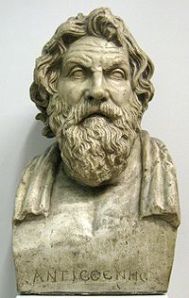
Socrates’ most famous disciple was of course Plato. But his oldest disciple was a man named Antisthenes (above), who became the first of the cynics and the teacher of that Diogenes whom I so admire and envy, because I would love the simplicity of living in a barrel.

I quite sympathize with Antisthenes, in several ways. Socrates was forever going around interrogating everybody in this intense–we would say anal-retentive–quest to come up with perfect definitions. What is virtue? What is justice? What is the good? Whatever answers others gave, Socrates dismantled them, but rarely came up with anything positive. Antisthenes eventually got rather bored and frustrated by all this.

So he concluded that these things that Socrates was obsessed with were really just names, or words. They mean what you want them to mean. 2,360 years later, French intellectuals like Derrida would say the same thing and get famous for it.

So to hell with words, said Antisthenes, and let’s get out of here. Screw society and its norms and conventions. Jury duty? Puhleeze. Vote? No way. That stuff was for those do-goody Athenians who were under the illusion that they were “free“. Antisthenes, who had a good sense of humor, regularly recommended that the Athenians should vote that asses are horses, as a way of celebrating democracy.

He, and all the Cynics, were thus what we would call apolitical: without politics, without a polis, without a city. Aristotle thought there was something pathetic about being apolitical, cityless–like being “a solitary piece in checkers”. But Socrates, Antisthenes, Diogenes and those types saw freedom in this withdrawal.

As Jag Bhalla, an expert on such matters, has already pointed out on the Hannibal Blog, the Greeks had a word for these people: keeping out of public affairs, they were private, or idiotes. In time we came to call people who cut loose from conventions idiosyncratic, but also tried to discourage that sort of thing and gave idiots a bad name.

I, for one, stick by my Diogenes dream: Being an idiot sounds great to me.

Bookmark and Share

More contemplation of the Bird in Space

IMG_0334

You may recall that, a while ago, I showed you Brancusi’s Bird in Space as my overture to a brief meditation on simplicity, beauty, honesty (and Einstein). Well, I couldn’t find a copyright-kosher image of the sculpture I had in mind, so I took a different version, one that was almost as good but not quite.

This, on the left, is the version I had in mind (even though the image is crap). Everything I said stands. When you strip away all extraneous detail, the underlying form of your sculpture (argument, story, living room, body, dish, …) must speak for itself. In this case it reveals its beauty. If the underlying form is ugly, well, let’s at least find out.

How did I come by this picture? Oh, I forget. Let’s just say that an elderly Filipina museum guard made herself known rather instantaneously….

Bookmark and Share

Socrates, individualism and conformity

Here is one way of seeing the timeless relevance of Socrates for us today: Think of him as the archetype of individualism fighting against oppressive social conformity.

In this thread on Socrates, I’ve already looked at some noble and less noble aspects of the man’s character. And every time I found him to be thoroughly modern and recognizable. So too in this way.

Watch the 2-minute video above of the famous Asch Experiments that began in 1956. They were devastating: We saw confirmed what we already suspected, that people will readily surrender truth to a group.

To me, still emerging from my old Ayn Rand phase, this was always the ultimate, the most disgusting, sin. To me, this is how the Nazis perverted an entire nation, how Mao’s Red Guards did it again, how all great evil throughout history spreads.

Hence the inherent appeal of a hero such as Socrates. He told the group (the Athenians) to bugger off. In return, they killed him for it. (This will get a lot more nuanced in future posts, but let’s leave it at that for now.)

If Socrates had sat in the Asch Experiments, he would never have changed his answer.

But should the group really bugger off?

If it were as simple as all that, The Hannibal Blog would not find this so interesting. But it is not so simple. It turns out that we have moved on from the Asch Experiments somewhat. Read, for instance, Bert Hodges and Anne Geyer, two psychologists who took a new approach.

The people who might change their answer to “lie” in unison with the group were in fact facing an exceedingly difficult situation that inherently required all sorts of complex trade-offs, they argue:

  • On one hand, there is the value of truth.
  • On the other hand, there is the value of social solidarity.

In practice, most people did not conform consistently (ie, “lie” with the group every time) but varied their response in what Hodges and Geyer call

patterns of dissent and agreement to communicate larger scale truths and cooperative intentions.

In short, they were being biological organisms that keep in mind 1) their own survival in a group and 2) the survival of the group as a whole.

Now this is exactly the sort of poppycock that I used to have no time for at all. But as I get older I see more complexities. In Socrates’ case, for instance, there actually was a specific threat to the group survival of the Athenians, and I will get to that.

So we can add another timeless conundrum to the issues that Socrates raised. We already said that truth often conflicts with gentleness and kindness, and that one cannot assume truth must always win this fight. What if Hodges and Geyer are right and truth must also occasionally take a backseat to those “larger truths”– and that Socrates, failing to understand that, paid a fair price?

Bookmark and Share

The arrogance of Socrates: Apollo made me!

None wiser, says Apollo

None wiser, says Apollo

So we opened this thread on Socrates and his relevance to us today by showing the heroically positive, then nuanced that with some more ambiguous observations. We must now add (before we eventually get to the heroic again) a few more. First: he was arrogant.

Yes, an arrogant S.O.B. I mean, let’s take his personal “creation myth”, ie the story that he would later use at his trial (to which we will get) as his raison d’être.

There are two versions of this story, one from each of the only two students whose writings we rely on to know anything at all about Socrates.

Xenophon, the less famous of the two, says that Socrates told the Athenian jury that he had sent a student/apprentice to Apollo’s oracle at Delphi, where the oracle opined that

no man was more free than I, or more just, or more prudent.

Ahem. Lest that sound a bit, you know, over-the-top, Socrates added that

Apollo did not compare me to a god [although he did] judge that I far excelled the rest of mankind.

So there, members of the jury. That’s why I have been going around humiliating and exposing you, disabusing you of your impression that you were free, undermining your self-confidence while tooting the horn of the Spartan enemy.

The more famous of the two students, Plato, wrote later and probably realized that it would be wise to tone this down a bit. Here Socrates ‘merely’ told the jury that the oracle told him that

there was no one wiser.

This is still rather cocky, but now with a twist. The twist is that Socrates is now on a divine mission. He must find out whether the oracle is right, whether anybody out there is wiser after all. So, you see, he had to make everybody look like a fool just to do justice to Apollo.

His ‘biographer’ I.F. Stone calls this one huge “ego-trip”, possibly the biggest in world history. It just so happens that I have a soft spot for huge egos, provided that they are intelligent and witty and not my editors. So on The Hannibal Blog, this is not an attack per se. It’s just, you know, ‘color’. We need to know who we’re dealing with.

Bookmark and Share