Brilliant and me

Larry Brilliant

You remember me mentioning the chat I had with Larry Brilliant, the man who helped to eradicate smallpox, at our (The Economist‘s) recent “innovation summit” in Berkeley?

The video of it is now on our site.

It’s about 14 minutes, and after a brief warm-up we talk about how to think about the worst threats facing the world.

As usual, there were some snafus: I had recorded an “intro” and “outro”, but we lost the recordings, so the voice you hear at the beginning and end is not mine. But then it’s me talking to Larry.

Larry is a bit of a Renaissance Man — interested in many things, like The Hannibal Blog — so it took us a bit to focus the conversation. Regrettably, some of the most interesting parts of our chat occurred after we turned off the camera. It turns out that Larry, like me, is fascinated by the Bhagavad Gita and Arjuna, so we discussed that for a long time.

Anyway, if you have 14 minutes and want to be scared, check it out.

Bookmark and Share

French & Anglo-Saxon ways of thinking

French thinking at Villandry

Having spent virtually all of my adult life within “Anglo-Saxon” cultures and institutions (not least in the hyper-English milieu of The Economist), I must have adopted Anglo-Saxon ways of thinking.

And what are those?

In this post, I’ll try to describe them, by contrasting the Anglo-Saxon mind with what I consider to be its foil or opposite.

Which is to say: French thinking.

And I’ll do that with just three little examples plucked from life:

  1. gardens
  2. cities
  3. laws

1) French and English gardens

In 1992, I spend my summer in Tours, France — allegedly learning the local language but mostly biking along the Loire and its tributaries with friends, visiting the various chateaux in that area.

I was twenty-two at the time, and gardening was not necessarily foremost in my thoughts. And yet, the gardens of those chateaux left an impression. That’s because I had an intuition that they explained a lot else I was observing in the country

Look at the garden of the Chateau of Villandry, above. Or look at the same castle from another view:

More French thinking

The principle that guides this and all “jardins à la française” is the expression of mastery over nature.

A landscaper imposes, through his reason, absolute and mathematically Cartesian symmetry and order onto what would otherwise be disorder.

It is a top-down notion of order. In fact, these gardens are best viewed from above, which is why almost all the chateaux are laid out so that there is a viewing platform above the jardins (as in the picture).

English landscaping developed largely in response to French landscaping and spread to many non-French parts of Europe.

The difference is striking. Here, for instance, is a view of the Englischer Garten, a huge park in the center of Munich, where I grew up:

Yup, those are sheep, in the middle of Munich.

Munich’s Englischer Garten was conceived during the Enlightenment by an Englishman, and the German landscapers to this day observe its “Anglo-Saxon” landscaping philosophy. Here, for instance, is a recent addition, a theater:

Let’s try to make the philosophy behind this landscaping style explicit:

If the French approach is to display top-down mastery of nature with an imposition of order, the English way is to integrate the human into nature, to adjust to the spontaneous or “bottom-up” order of nature itself.

The best way to enjoy such a garden is in fact “from below” — ie from the ground. You’re assumed to be in the garden, not looking down on it from above.

To give this the subtlety it deserves: English gardening does not deny the ability of man to create order (after all, there still is a landscaper). But the landscaper takes a much more humble approach to nature, choosing to see order in its disorder and incorporating its “accidents”.

Let me use a different phrase: The English landscaper “muddles through“.

2) Paris and London

Now think of the two cultures’ capitals as a “tale of two gardens,” writ large.

The “landscaper” of modern Paris was Baron Haussmann (Alsatian, hence the German name, but French). Between 1852 and 1870, he imposed order on the medieval street warren that Paris had been.

Here is the new Paris as he conceived it:

Haussmann's Paris

Boulevards (in red) as straight as swords now cut through the organically evolved webbing of streets, to clear vistas and let armies parade.

And that’s not enough. Along these straight boulevards, the houses must meet regulations as precise as Cartesian math. They stand in a row like soldiers being mustered:

Now London:

A century before Haussmann (and shortly after Descartes’ death), medieval London was burnt down in the The Great Fire of 1666. To the French, this would have been an opportunity to remake London in a rational and orderly way. There even was an equivalent of Baron Haussmann: It was Sir Christopher Wren, the great architect of many churches, including St Paul’s Cathedral.

What did Sir Christopher do? It was very English. He largely honored the network of streets as it had evolved over time. Using legal jargon, you might say that he respected stare decisis (“stand by things decided”).

Adhering to precedent, he then proceeded to … muddle through.

And that’s what London has been doing since. This is its street grid today:

In fact, that picture does not do its organic beauty/chaos (depending on your point of view) justice. London, unlike Paris, is not one city (even politically). It is many cities and towns that grew together. Each bit retains its own charms and problems, and the connections are haphazard and arbitrary.

London cabbies, in fact, spend years learning what they call “the knowledge” to navigate this maze. And London’s streetscapes are full of surprises, both positive and questionable:

3) Code Napoléon v Common Law

French law is a code. In some ways it goes back to Roman law, but its direct ancestor is the Code Napoléon of 1804.

Napoleon, being not only French (well, sort of) but a product of the Enlightenment, believed in the power of reason to impose order (here meaning justice) from above on the chaos of life, the infinite number of situations that can arise and must be adjudicated. The result was a document. Here is its famous first page:

Legal thinking in France and all other civil-law systems is therefore a process of deduction: You find the general principle in the code, then apply it to the instance in real life.

English law is not a code. In fact, England does not even have a written constitution (as its Anglo-Saxon nephew America does). Sure, there are statutes, laws written by legislators over time. But the core of the system in all Anglo-Saxon countries is the common law.

And what is it? In essence, it is the history of all former cases.

For about a millennium, the English have been considering each new case by comparing it with precedents, a bit as Sir Christopher Wren built St Paul’s on the site of the former church that had burnt down.

Which issues does this case raise? Aha, then it must be like X. But it is different, so it must also be like Y. And so on.

The process is inductive: The Anglo-Saxon mind starts with the particular, searches for a general principle, returns to the particular, adjusts the general principle, and so forth.

Put differently, the English mind muddles through.

Conclusion: Churchill vs Balladur

This post has been muddling through by inducing from particulars to generals. I will leave you with two quotes by former prime ministers that I think say it all:

Edouard Balladur of France:

What is the market? It is the law of the jungle. And what is civilization? It is the struggle against nature.

Winston Churchill:

The English know how to make the best of things. Their so-called muddling through is simply skill at dealing with the inevitable.

Bookmark and Share

How the French view my media habits

You might remember that I wrote a post last fall about my own, personal media habits and how they have been changing.

Based on observing only myself, I concluded that, contrary to what you might have read or heard in the media, there is no media crisis for citizens and consumers, who can inform themselves better than ever — and indeed that we may be at the beginning of a second Renaissance.

La Francophonie écoute

Well, somewhat to my surprise, that little post has had quite a career in the French-speaking world. It probably began when Francis Pisani, a respected French blogger in America, picked it up in Le Monde.

A while later, a French-Canadian newspaper, Le Devoir, ran a cover story (picture above) on it. 😯

And now Owni, a cutting-edge website, has not only translated my post but invited two experts to rebut my thesis. (As you know, intelligent rebuttals delight me, because they make me learn and refine my views, which is sort of the point of life, isn’t it?)

Divina Frau-Meigs

The first expert is Divina Frau-Meigs, a media sociologist and professor at the Sorbonne. In her rebuttal, she

  • concedes that access to news and information has become more “democratic” for those who are “intellectually and technologically equipped”, whom she calls the “info-riches”;
  • laments that this does not resolve the economic, social and cultural “divides” — in other words, she worries that people whom she calls “info-précaires” lose out;
  • dismisses the idea (which she believes I espouse) that we can just get rid of journalists, since most citizens don’t have the time to do the hard work of investigating and reporting on the world’s problems;
  • appeals for a wholesale reform of media education, both for the young and for poor adults;
  • sets out principles she believes should guide that reform.

Bruno Devauchelle

The second expert is Bruno Devauchelle, a researcher at a think tank in Lyon. In his rebuttal, he

  • redefines the crisis as one of overinformation;
  • argues that blogger-journalists like me feel good only because we have all the necessary skills to deal with this, whereas most young people today lack those skills;
  • also appeals for better education;
  • calls in particular for teachers to be trained in internet technology and internet culture;
  • calls for new pedagogic techniques.

De quoi s’agit-il?

I will respond to these rebuttals in a separate post. But first, I want to make sure that I do justice to Divina and Bruno. My own French went from passable (circa 1992) to laughable, so the translation was hard work for me. But among you, there may be more proficient speakers of French.

If you’re so inclined, read their rebuttals and put their main points, to the extent that I have not captured them above, in the comments.

And, of course, go ahead and give your own opinion.

Bookmark and Share

My 12-minute “book teaser”

If you’re taking a 12-minute cappuccino break, watch me give this “teaser” about my book at our (The Economist‘s) recent innovation conference in Berkeley.

(You’ll also find most of the other sessions on video now, including those with Arianna Huffington, Jared Diamond, Matt Mullenweg, et cetera.)

I’m not good at “teasers” or “elevator pitches”, especially since I tried to tell a story in my book that would keep you reading for 100,000 words. But I’m constantly being told that I now have to practice condensing that story into two seconds for some occasions (cocktail parties, elevators), two minutes for other occasions, 10 minutes for yet others, and so on.

So, er, I’m practicing. (Even while determined not to give too much away yet.)

Your feedback would be welcome. Do I snare your interest or do you say ‘so what’? Are there howling non sequiturs, or does it make sense? And so forth.

Bookmark and Share

The best tax for America

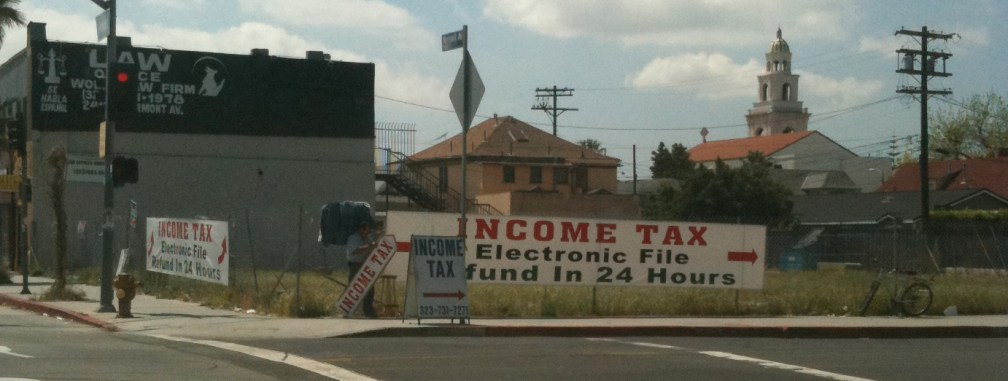
It is Tax Day again in America and some people left their returns to the last minute (as you can see on this photo, which I took in Los Angeles yesterday.) So I’ll take this occasion to muse about the relationship between America’s tax system and freedom.

One year ago today, I offered some “tax day thoughts on complexity in American life.” The gist of that post was that the complexity of America’s tax system, not the rate of taxation, is what harms freedom in this country. Contrary to what you might think if you go to Tea Party rallies, we are not overtaxed, we are badly taxed.

But I did not offer a better — meaning simpler — alternative system. In this post, which I expect to be controversial, I want to do that. (As always, keep in mind that the views expressed on The Hannibal Blog are mine alone, not necessarily those of The Economist.)

There are many proposals out there for a simpler and more efficient tax system: A flat tax, value-added tax, et cetera. I won’t review them all, but instead pick the proposal that I consider simplest, cleanest and boldest.

The Idea

It is the so-called FairTax Plan.

Part of its strength (ie, simplicity) is that I can describe the entirety of America’s proposed tax code in a few short lines:

  • America’s existing income and other taxes would be abolished. (Not cut, but eliminated!)
  • The IRS and America’s other organs of proto-authoritarian oppression would also be abolished.
  • Instead, all Americans would pay a national sales tax, as most Americans already pay state or local sales taxes.
  • In addition, all Americans would get a prebate — ie, at the beginning of each year, everybody gets a check.

And that’s it!

The drafters of the proposal think that the rate of this new national sales tax needs to be about 23% to provide the same revenues that we now get from the income tax. It might be 28% or 19%. I’m not the least bit interested in that.

The idea is that we raise as much money as we would otherwise raise through an income tax. As it happens, we would need to collect quite a bit less than we currently do, because we would no longer incur the enormous costs of the IRS bureaucracy, auditors and accountants!

Now for the discussion of the advantages and alleged disadvantages of this new tax system:

Advantages

I think the advantages are self-explanatory:

  • You would keep your whole pay check. Ie, your take-home pay would spike right away.
  • You would not have to file a tax return.
  • No more record-keeping! You no longer maintain mountains of paper for wages, the cost basis of your investments, mortgage deductions, childcare and nannies, et cetera et cetera.
  • IRAs, 401(k)s, Roth IRAs, Keoghs…..: You can throw them all into the trash, because all your investments are by definition untaxed.
  • Thanks to your annual prebate (which gives you a certain amount of subsequent sales tax “back”), a portion of your consumption is untaxed, too.
  • But beyond that, all your consumption is taxed, thus making you think twice about frivolous and unnecessary consumption, which reduces your carbon footprint and clutter.
  • Whenever you do consume (either goods or services), you can see the tax you pay on the receipt, in the clearest and simplest manner possible.
  • All this amounts to: transparency (replacing opacity) and freedom (replacing anxiety and bureaucracy).

Criticism

There is only one major criticism of this sales tax, but it is a big one, so I want to concentrate on it.

The disadvantage is that this sales tax, like any consumption tax, at first glance appears to be regressive.

In the current system, rich people pay not only absolutely but relatively more of their income than poor people. (There is a reason why I italicized that phrase. Keep reading.) In the new system, poor people (who might need to spend, rather than save, all their income) would seem to pay relatively more of their income than rich people.

And this seems unfair.

Rebuttal

I’ve pondered this for some time. As you may remember, I am a liberal, correctly defined (ie, libertarian but not loony). And I do worry about inequality, which is inevitable in a free society to some extent but in excess (ie, in America) harms freedom.

Part I

My first response to the above criticism is that our current income tax (ie, that which the FairTax proposes to replace) is not fair either!

Warren Buffett has famously explained how he, as a mega-rich investor who does no “tax planning”, pays a lower tax rate than his secretary, who lives off her meager pay check.

Fairness, it turns out, is not about progressive tax brackets. If you have progressive brackets but exceptions to everything (= “complexity”) you get not fair but unpredictable and arbitrary taxation.

So if you do care about fairness, first join me in stipulating that our current system must go.

Part II

My second response is to ask you to re-examine, as Socrates might, what wealth is.

Is it:

  1. to have vast stores of potential spending power (ie, paper statements of bank balances that produce income)?
  2. or to consume vast amounts of resources, human and natural, with your own or others’ (borrowed) wealth?

Our current conventional wisdom says 1. So if income is the definition of wealth, then a consumption tax is regressive.

I propose that the correct definition is 2. So if consumption is the definition of wealth (as it used to be for almost all of human history), then a consumption tax is fair.

Example: Croesus and Diogenes

Let me illustrate that point playfully by reviving two characters who have previously featured on The Hannibal Blog:

  • Croesus, the ancient king of Lydia who gave us the phrase “rich as Croesus”, and
  • Diogenes, the Greek cynic who chose to live in a barrel (and who is a hero of mine).

Let us assume that Croesus and Diogenes are equally rich in our Number 1) definition: Both get huge amounts of income from assets (Croesus from tribute, Diogenes from the equivalent of a trust fund set up by his benefactor, a wealthy Athenian).

Now let’s think about how the FairTax would treat these two rich guys:

Both Croesus and Diogenes would start every year by getting their prebate check. Their basic cost of living, their subsistence, is thereby pre-paid.

Diogenes can buy the few things he needs (dog food, loin cloth, etc) and his prebate covers the sales tax on these items. He pays no net tax at all, in other words.

(Meanwhile, he has millions in his bank account, sitting idle for him, but being lent out to other Athenians to grow the economy.)

Croesus is different. He sneers at his prebate check, which barely covers the sales tax on a single slave, and spends it in a day. Then he keeps spending: Gold, silver, jewels, women, palaces, feasts, galleys, ….

He consumes immoderately and to the detriment of his planet. But he is free to do so (freedom is one of our goals), and nobody even looks askance at him. However, each time he spends, he pays tax, and he knows exactly how much (transparency and simplicity are our other goals).

The years go by, and Diogenes donates his potential (= hypothetical) wealth to an anonymous Athenian. His wealth has been helping the economy all these years, because it was being lent to entrepreneurs. But now the Athenian recipient spends the wealth. And as he does so, he pays tax.

The taxes on Diogenes’ money were therefore only delayed, until such time as his wealth turned from potential into actual consumption. The taxes on Croesus’ money were immediate, because he chose to spend.

Every single dollar in the economy is therefore taxed, but only when it becomes consumption.

At a very fundamental level, this is how it ought to be. We should not calculate equality based on income but on consumption. If I have more than you but live more modestly than you, I should not pay more than you. This is the mental switch I ask you to attempt.

I believe it is fair that Croesus pays lots of taxes all along, but that Diogenes, who never consumes much, does not.

Effect on politics

A final thought about what the FairTax would do to our political discourse and climate.

Our current tax system is as complex as it is because it is the tote bag for our politicians: Any weird political give-away — to owners of gold mines or race horese, homeowners or Prius drivers…. — gets dressed up in Congress as a “tax break” and stuffed into the code. Each time that happens, society as a whole loses, but nobody notices because, well, the tote bag is too messy to see any individual item in it.

Complexity, in short, is the tool politicians and lobbies use to hide things from our attention.

If we switch to the FairTax, the tote bag is dumped and replaced by two and only two numbers:

  1. rate of sales tax, and
  2. the amount of the prebate check

Every American could understand this system and therefore participate in our debates about government, funding and fairness.

Should more people be exempt from all taxation? Fine, raise the prebate amount.

Is government too big? Fine, cut the sales-tax rate.

But what what if we still want to help particular groups of people? Earthquake victims or people whose homes are being foreclosed, for example.

Today, we would stuff more gibberish into our tote bag and nobody would notice the cost.

Under the FairTax, we could still help these people, but we would no longer do it through the tax code. We would pay these groups actual cash.

This, of course, would be transparent and easy to measure. Once again, we could all debate whether home owners in foreclosure actually deserve this cash (perhaps not) or whether earthquake victims do (probably).

We would understand what’s going on in our country as well as in our own finances, and understanding is the beginning of freedom.

A shocking thought, isn’t it?

Bookmark and Share

Ready for Round IV of the manuscript

Arriving back home from a reporting trip, I was delighted to find a FedEx package from Riverhead with my manuscript in it.

To extrapolate from the previous three drafts: I seem to turn around a new draft in one month, then to wait for three months to receive it back from my editor with comments.

This time, both processes might go faster: There are far fewer comments in the margins than in previous rounds.

But there will be one change:

I will finally bow to the pressure of the market (letting no side, neither the artistic nor the commercial, “win”, as Ed Catmull might say). I will drop my resistance and add a concluding chapter with …. lessons.

Bookmark and Share

Politicians & their fathers, continued

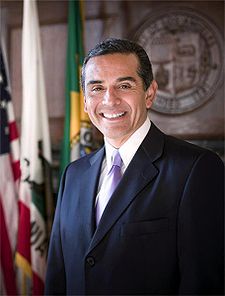
Antonio Villaraigosa

I met Los Angeles mayor Antonio Villaraigosa for the second time the other day, and he did something peculiar — also for the second time, thereby making it notable.

He brought up fathers.

You may recall that I’ve pondered the role of fathers in success when reflecting on Obama and McCain, or Bill Clinton and Gavin Newsom.

The theory, to remind, is that (male?) leaders often have absent fathers.

So here is what Villaraigosa did to make me think about that again:

First time

I first met him last summer, when he was still being talked about as a possible Democratic candidate for governor. He is the first Latino mayor of LA since the 19th century and a wily politician, so he was said to have a chance. On the other hand, he had a new sexy girlfriend who was not his wife and so forth, so perhaps not.

So I went into his office in City Hall. He looked tired, with bags under his eyes. I thought that his face was right out of The Godfather — in a good, soulful way — but his hands were small and soft.

He surprised me by insisting on first talking about me. I didn’t quite know how to handle that. But he wanted to know a whole lot about me — what schools, where from, etc. He said he liked the boots I was wearing. I realized that he was a people politician (in fact, I kept getting distracted by all the photos of him with famous and beautiful people), not an ideas politician.

So we started talking about what I talk about: ideas. I thought it was slow and plodding. Then I realized that he slowed down for me whenever he thought he was saying something sound-bitey, so that I might transcribe it more easily.

But then finally we found a topic that got him relaxed and enthusiastic. Ostensibly, it was his city, LA, which is so fantastic. But here’s the reason why it’s so fantastic:

People don’t care who your father is.

He said that several times. As in: In New York, you need to be from the right family, but here we only care about what you are today.

Or perhaps as in (I imagine his thought bubble): My father left my mom and me when I was young, so screw him.

He did, in fact, say that he had seen his father at most 25 times in his whole life, making it clear with a (perhaps exaggerated) gesture that he couldn’t care less about him.

Second time

I met him again a few weeks ago when my editor was visiting me and I took him around to see interesting people. This time, Villaraigosa looked much better. No bags under his eyes. He was no longer a candidate for governor, so now he was just enjoying himself as mayor (and in his private life).

Again, I got distracted by all the photos of him with famous and beautiful people — they were now on automatic slide show on a large electronic picture frame.

Again, the slow and deliberate sound bites about weighty topics. Again, name-dropping (he also knows some British politicians, and he wanted us to know that).

Then my editor and I said Thank You and left. We were already in the hallway, and Villaraigosa huddled with his handlers for the next meeting.

Suddenly, Villaraigosa ran out and after us, all but screaming:

You know what? Screw it. Let’s do a story on how great LA is. The greatest city in America.

He was beaming with excitement:

I mean, here nobody cares who your father is!

Bookmark and Share

PR people and internet etiquette

In September 2007, I received — as part of that never-ending, never-even-ebbing stream of emails from public-relations people that all journalists used to get — a message from one of the better known PR women in the San Francisco Bay Area.

At the time, I tried to reply to all emails for the simple reason that I was raised to be polite. If somebody sends you a message, it behooves you to answer.

That day’s email chain put an end to that gentilesse. I will reproduce it below, with all the names XXX-ed out to protect the individual.

It started on September 11, 2007. This PR woman emailed me (Subject: “Quick Q”) to ask whether I covered a certain industry segment in which she had a client she was hoping to introduce me to.

On September 12 at 10:58 PDT I replied:

Sure. But I’m not planning an article right this second

At 11:02 PDT — in other words, four minutes later — her reply showed up in my inbox, except that it was addressed to her client. She must have accidentally hit Reply instead of Forward.

In any case, I now saw my email (the one she thought she was forwarding), which she had edited:

[Client’s first name],

With your permission, I am going to set up a lunch with you and Andreas – in early October.

XXX

From: Andreas Kluth [mailto:andreaskluth @ economist.com]

Sent: Wednesday, September 12, 2007 10:58 AM

To: XXX

Subject: Re: Quick Q

Sure. But I’m not planning an article right this second. Let’s plan a lunch in October?

AK

This was strange, and I thought it appropriate to point it out. So I sent one more email to her:

Er, XXX, there is something highly bizarre going on. Today I replied to your email with the first and second sentence in the email trail that allegedly comes from me below. I did not write the third sentence and i don’t sign with AK.

I don’t recall asking for a lunch in October

A

And, not entirely to my surprise, I never got another peep from this lady (who had been firing off emails at a rapid clip).

***

What was I to make of this?

On one hand, I like to consider myself, whenever possible, a Cavalier, not a Roundhead. Basically, that means smirking at life, not frowning.

On the other hand, I was somewhat puzzled and miffed.

If the exchange had not been so utterly trivial and boring, one might have called this fraud. But it was simply too petty. Did this woman really think that her client would be impressed if he saw an email from me to her with (as opposed to without) my initials? Did she really think that she could somehow insinuate me into a lunch in October that I had never suggested?

***

So I took a look at my inbox as it was at that time. In 2007, I received more than 500 emails a day — 90% from PR people — on a weekday. This robbed me of a lot of time and thus made me less productive. PR people were interfering with my work and life.

Worse: they were also calling. My phone (at the time I had an actual — as opposed to virtual — phone) was constantly ringing, and it was usually an intern at a PR company, announcing that she was updating their database and asking me whether I was so-and-so at this-and-this address and so forth.

I realized, of course, that my habit of replying was part of the problem: Whenever I answered an email or phone call, I confirmed my presence to them, and they would put me on their automatic distribution lists of press releases. (These emails then as now did not necessarily have a one-click unsubscribe button).

Seriously: When was the last time anybody read a press release?

So I decided to interrupt the vicious cycle.

Genuine (meaning bespoke) emails and emails from people I personally knew, I still answered. The rest I ignored.

That did not restore my inbox to health, but it arrested its deterioration.

Then, a month later, Chris Anderson wrote a blog post that got quite a lot of attention. (Chris had been a colleague at The Economist — in fact, I replaced him as Hong Kong correspondent in 2000 — but by this time he was editor-in-chief of Wired)

Chris took a two-pronged approach:

  1. He whacked any unsolicited and inappropriate email into his Spam filter, and
  2. he published a blacklist of prime offenders.

I decided that the blacklisting was too harsh — the modern equivalent of a pillory — but that the spam-filtering was a great idea.

So I have been doing the same: If I get an automatically distributed press release, or even just a really inappropriate email, it goes straight into our corporate Postini. (And Postini, of course, “learns” this way which emails to consider spam, so that my click indirectly helps other journalists.)

***

Over time, this solved the problem. My inbox now often looks like this:

And I have become productive again.

Not only that, but I have learned to love email again! It has actually become useful to me.

Those people, including PR people, who ought to be able to reach me can now do so more easily than ever. The others no longer bother me as much.

And etiquette is making a comeback. Every new technology causes a change in social protocols. Our grandparents used to have to learn when and how to call people — and simultaneously how to be called — without being rude. Now PR people and the rest of us are figuring out how to be civil in the Internet era.

Breaking news

Bookmark and Share