This blog must be shrunk

I just did something for the first and, probably, last time: I deleted a post on The Hannibal Blog.

Why?

I’d like to make the answer general, not specific to the post in question. The post was badly written, and that tells me that I must shrink this blog — not in size but in scope.

I will explain in the next post.

Bookmark and Share

Done but still untitled

By the way, it turns out that the fourth draft of my manuscript, which I sent off to my editor at Riverhead in May, was indeed the last and final draft.

In other words, the manuscript (ie, book) is officially finished. It is written. Done.

I chatted with my editor the other day, and he loved it. Thinks it’s a winner. All that.

In particular, you may recall that the only major and noteworthy change in the final draft was a new final chapter. A chapter of “lessons”. My editor likes that chapter exactly as is, without any iteration.

So we now have an interesting timeline:

  • I got my book deal with Riverhead in December 2007, a bit over 2½ years ago.
  • About one year later, I delivered the first draft. So that was 1½ years ago.
  • Just over 2 years after the deal, I sent my final draft.

So I guess it took two years to write the book. But for much of the time between drafts, I was really just waiting for my editor to get back to me. So it actually only took about 1½ years of work. And always part time, (after the kids went to bed, on weekends etc.). No big deal. Consider that, if you’re thinking about writing a book.

That said…

The surprise, therefore, is not how long it took me (not long) or how hard it was (not hard) but how incredibly, mind-numbingly slow the publishing industry is.

The next step, I have been told, is now for the publishers of Riverhead (ie, the boss) to set a publication date. You might think, as I once thought, that they simply start printing and there we are. Oh no. Various mysterious processes now begin, and they take half a year or so.

Furthermore, the scheduling of a book release is apparently both science and art, so tactics come into it. You may not want to release in the fall, when celebrity authors come out; you may want to release just after Christmas when reviewers and connoisseurs apparently look for new talent; and so forth.

So now I am, as I have been, waiting. Just waiting.

Oh, and we haven’t chosen a title yet. They think it’s incredibly important, but are in no hurry. You’ll be the first to know.

Bookmark and Share

Competitive Christians on poles

Constantine

The Roman emperor Constantine (above) caused a counterintuitive problem for early Christians.

By converting to Christianity and making it the official religion of the Roman Empire in about 313 AD, Constantine made it impossible for early Christians to be either confessors or martyrs.

  1. To be a confessor meant to acknowledge openly to the Roman bureaucracy that you were a Christian. This carried the risk of martyrdom.
  2. To be a martyr then meant actually going through with the process and dying for your faith.

Why was this a problem?

Because these were the two main ways in which early Christians competed for religious kudos — and those Christians were (are?) a competitive bunch. Both confessing and martyrdom constituted a sort of second baptism and suggested spiritual excellence.

Being martyred, in particular, was surprisingly difficult, since the Romans (with rare exceptions, as under Diocletian) did not actually want to kill anybody because of religion. Historians have recovered trial transcripts that show how eager the Roman administrators were to accommodate Christians. The administrator might ask the confessor whether he might, please, consider a small sacrifice — not to any pagan gods but merely to the Emperor. No? OK, how about a pinch of incense just to acknowledge the Emperor? No? OK, how about….

But when the Roman Empire officially became Christian, this form of Christian achievement came to a complete and screeching halt.

Christians had to find some other way to excel….

(What follows is based on Lecture 5 of Philip Daileader’s excellent course on the Early Middle Ages.)

The first monk

In perhaps the strangest psychological twist in human history, the most competitive Christians in the fourth and fifth centuries AD responded by, in effect, martyring themselves (ie, attacking their own bodies).

Perhaps the most famous to do so was Anthony, who lived in Egypt. Early in his career, when it was still possible, he tried and failed to get himself martyred in Alexandria. When that didn’t work, he went far into the desert to live as a hermit.

He was, in Greek, a Monakhos, a lonely one (as in mono, one; and of course monk).

He ate nothing, slept little, did everything to punish the human senses. (No sex ever, it goes without saying.) When that made him delirious, he imagined that demons and Satan himself attacked him, but he despatched them heroically. Here is Michelangelo’s depiction of that cheerful anecdote:

Word of Anthony’s self-torture got out, and other Christians traveled to the desert to see him. Anthony, of course, wanted to be a Monakhos, so he moved further into the desert to lose his groupies. Eventually, he gave up and accepted that his followers were going to live together in the desert near him, in a sort of … monastery (not that lonely anymore, obviously).

Anthony’s fame soon spread west and throughout the Roman Empire. The reason was that a man named Athanasius, Bishop of Alexandria and a publisher with a sense of Zeitgeist, wrote a book called Life of Saint Anthony, describing what Anthony got up to in the desert.

From the book’s title, you notice that Anthony is now a “saint”. And thus a new genre is born: the hagiography. (Greek hagio = saint, as in Hagia Sophia; graphe = writing.)

To put this in contemporary perspective, Life of Saint Anthony was the Eat, Pray, Love of the late Roman Empire. Everybody suddenly wanted to try it out…

Grazers, fools and stylites

The result was a competitive free-for-all, as Christians tried to one-up each other in search of spiritual kudos.

  • The Grazers, for example, ate only grass and shoots and chained themselves up as barnyard animals.
  • The Holy Fools behaved as though they were insane, or tried to be insane. The most famous of them once paraded into the women’s bathhouse and disrobed, at which point the women, suspecting that he might be less foolish than he pretended, beat and ejected him.
  • The Stylites lived on top of pillars (Greek stylos) or poles.

The most famous Stylite, named Simeon (above) and also sainted before long, lived on top of his pole for some 40 years. (He reminds me of some tree sitters in Berkeley that I wrote about in The Economist once.) People sent food up to him via ladders and pulleys and presumably received and disposed of Simeon’s detritus by the same method.

Simeon became a tourist spectacle. Crowds watched from below as he performed painful exercises. He once touched his feet with his head 1,244 times in succession.

Exegesis

Let’s sit back for a moment, perhaps with a glass of sensual Cabernet Sauvignon and a cavalier mindset, and reflect.

Regular readers of The Hannibal Blog already know that I have a recurring Diogenes fantasy. Diogenes was the guy in classical Greece who lived in a barrel like a dog (the first “cynic”).

But Diogenes did that to be free, not to compete with other barrel-dwellers. He was an eccentric.

You may also recall that I admire Patanjali and his contemporary, the Buddha. Many yogis and Buddhists also (then as now) practice asceticism.

But, like Diogenes, they also do so in search of freedom. (The Sanskrit word for this kind of freedom is moksha, which is achieved at the highest stage of yoga, which is called kaivalya or detachment.)

For them, asceticism is a way to reclaim our peace of mind from the oppressive push and pull of our desires (appetite, lust, jealousy, et cetera). It is a path toward clarity, serenity and humility.

Somehow, this kind of freedom seems not to have factored as a motivation for the pole-sitting Christians.

A seconds difference:

Christianity soon turned lifelong asceticism and total chastity into a virtue.

By contrast, asceticism in antiquity and in Eastern philosophy was a temporary effort, practiced at a certain stage of life.

Vestal Virgin

The Vestal Virgins in ancient Rome, for example, were expected to remain chaste while serving the goddess of the hearth (Roman Vesta or Greek Hestia). But only until they were 30! Then they were expected to do the natural and healthy thing, which was to get married and start a family.

Hindus and yogis first make a living, marry and have sex, start a family, and then, at the end of life, withdraw into asceticism to contemplate the absurdity of it all. (This is called sannyasa, and it is the last of the life stages, or asrama.)

So, asceticism has a place in many spiritual traditions.

But what were these early Christians up to? Were their stunts not huge ego trips?

Worse, did they not begin what Nietzsche would later consider the ultimate perversion of nature — by slandering every one of nature’s instincts to be evil? Were they not fundamentally … sick?

Bookmark and Share

The beauty of Ashtanga Vinyasa

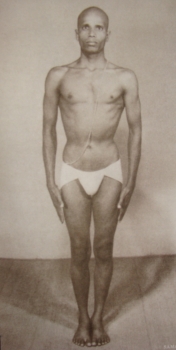
Pattabhi Jois

Pattabhi Jois

It should be obvious, but just to make it explicit: I love Ashtanga Yoga and still practice it as often as fatherhood and a day job allow. That’s about three times a week now.

My obituary in The Economist of Pattabhi Jois, the founder of this yoga style, actually reflected that, even though a lot of people have chosen to interpret it as critical.

(Good writing is about coloring in characters in all their rich complexity, not about churning out hagiographies, as I hope I made clear when I wrote about the creation of this piece.)

Anyway, I came across these old videos of Jois teaching some of his students. And I was struck by the sheer aesthetic beauty of the flowing postures.

Here are excerpts from the first (or “primary”) series. There are nowadays six never-changing series of postures (one for each day of the week, with Saturday being a rest day).

And here are excerpts from the “intermediate” series. I find that this usually gets a laugh out of people: If this is intermediate, then what is advanced?

The students in the video, by the way, have since aged and become yoga celebrities in their own right. They are:

(Here are other posts in my thread on Yoga.)

Bookmark and Share

Contemplating America’s desert civilization

ONE late November night in 1980 I was flying over the state of Utah on my way back to California.

Thus Marc Reisner began his 1986 book Cadillac Desert, quoted to this day in the West’s perennial water wars.

I remembered his lines this week as I myself was flying back from Utah to California, and also looking out of my window at the desert below, baked dead by the July sun.

[This note is cross-posted from my note on The Economist‘s Democracy in America blog.]

As Mr Reisner did then, I looked down and contemplated the barren mountains, mesas and buttes and the endless empty expanses of salt and sand, one of the most inhospitable wastelands in the world.

This is where Brigham Young and his Mormons had decided to make “a Mesopotamia in America”, as Mr Reisner put it. Then, in the early 20th century, the federal Bureau of Reclamation took over their work and dammed the West’s rivers to impose the will of America upon this desert.

There, on the horizon, I espied the result: Lake Mead, America’s largest reservoir, formed as the pathetically small, snaking trickle of the Colorado River runs into the Hoover Dam and backs up.

As Mr Reisner put it:

Thanks to the Bureau—an agency few people know—states such as California, Arizona, and Idaho became populous and wealthy; millions settled in regions where nature, left alone, would have countenanced thousands at best; great valleys and hemispherical basins metamorphosed from desert blond to semitropic green.

The people in the states below my aeroplane are today among the most conservative in America. The tea-party movement thrives here. Big government is the enemy.

How ironic that the people are only on that land because big government first subdued it.

Then again, “subdue” may be a word from another time and worldview. The water wars have never really stopped (Californians will vote on another water bond in November, in the never-ending effort to bring water from where it rains to where the people live). And in the long run, as Mr Reisner might say, the desert may yet subdue the people.

Bookmark and Share

In praise of sublime Greek violence

Nietzsche turned 26 as the Franco-Prussian war was raging (above). He saw this bloodshed as a failure of culture. So he started thinking more deeply about culture and its most fundamental mandate: dealing with human violence. And he arrived at some very interesting insights.

He did this by weaving together two strands of his thinking:

  1. the nature of violence in humans, and
  2. the nature of ancient Greek civilization

This is a great example of the benefits of cross-fertilization between areas of expertise. That’s because Nietzsche was not yet what we would call a philosopher. Instead he was, by training and profession, a philologist, which at that time in Europe basically meant a classicist — somebody who studies antiquity, which in turn mainly meant studying the Greeks.

Nietzsche absolutely adored the Greeks of the classical era (as we do here on The Hannibal Blog). He believed that they were the first to elevate humanity by transcending violence. Here is how.

(This is based on pages 139-141 of Julian Young’s excellent philosophical biography of Nietzsche, which I am currently reading.)

I) Violence

First, according to Nietzsche, the Greeks were honest about the human instinct to violence, and that’s a great start.

The Greeks knew that they were just as capable of violence as the barbarians. (Just read Homer’s account of Achilles’ wrath, or Thucydides’s account of the rape of Melos.) So they accepted that violence was simply part of human nature. The question was what to do about that knowledge.

Pause here for a moment:

a) 19th-century context

In Nietzsche’s own time, this was already a radical interpretation. First, European academe (of which he was part) basically viewed the Greeks as serene and enlightened über-thinkers, as beyond violence. And second, European society (of which he was also part, at least at the outset) had adopted a Christian morality (which Nietzsche would later in his life set out to debunk) that considered violence sinful and tried to eliminate or even deny it. So Nietzsche was already being politically incorrect.

b) Our contemporary context

While no longer politically incorrect, this view is still controversial today.  Which is to say that we are still arguing about whether we are at heart peaceful, like our cousins the bonobos, or violent, like our other cousins the chimps. (Video via Dan.)

In any case, the Greeks recognized the chimps in us humans, but then went a crucial step further.

II) Agon

That step was to redirect and sublimate whatever violent energy there is in humans.

Rather than denying or suppressing human aggression (what Nietzsche would later call the “will to power”), the Greeks purified it through the filter of culture.

The result was agon — strife or, better, competition. That’s agon as in agonize, agony, protagonist and antagonist, et cetera.

Classical Greece was perhaps the most agonistic — meaning competitive — civilization in world history, surpassing even modern America. Everything was a competition:

  • poets such as Homer and Hesiod competed with words,
  • playwrights such as Aeschylus, Sophocles and Euripides competed with their tragedies — literally for an award given out during the Dionysian festivals at which their plays were performed,
  • Socrates and Plato competed with the Sophists, and the Sophists with one another,
  • orators like Demosthenes and Aeschines competed with their rhetoric, and
  • athletes competed at the Olympic Games.

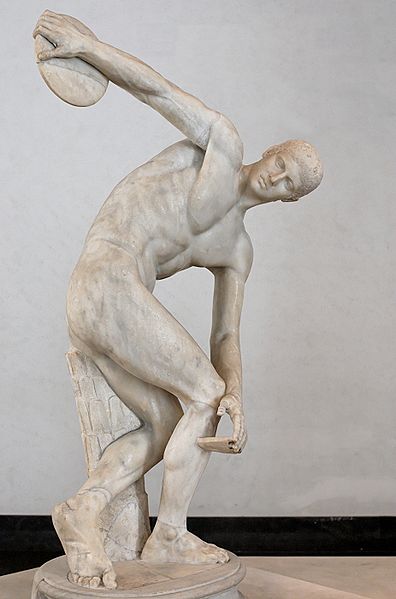
The result was beauty such as this discus thrower, sculpted by a competitive artist of a competitive athlete:

Agon pervaded every single aspect of Greek culture. It was the nasty goddess of strife, Eris, reincarnated as “good Eris”. Bad Eris had started the Trojan War. But Good Eris, according to Hesiod,

drives even the unskilled man to work: and if someone who lacks property sees someone else who is rich, he likewise hurries off to sow and plant… Even potters harbor grudges against potters, carpenters against carpenters, beggars envy beggars and minstrels envy minstrels.

You can choose to see infinite parallels in our own time and lives. For example, culture succeeds when Good Eris enters a courtroom in an adversarial justice system such as America’s. Culture fails when Bad Eris takes her place.

In the name of peace, may humanity study the Greeks and learn to ‘agonize.’

Bookmark and Share

High on freedom and honest debate

I find that a great test of whether your instincts are liberal (as classically and correctly defined to mean freedom-loving) is how you approach the question of legalising marijuana.

In the current issue of The Economist I try to summarize the debate in California about Proposition 19 in November, a ballot measure that would legalize cannabis for those 21 or older.

And in an accompanying podcast, I interview an opponent and a proponent of legalization, both carefully chosen, in an attempt to get beyond mere gut instincts to clarify the arguments for and against. I wonder how you guys would interpret that conversation.

Bookmark and Share

They can’t stop writing about Hannibal

It has been 2,200 years, and yet we can’t stop thinking about, and writing about, that man.

My book — about our own lives as seen through Hannibal’s — is essentially ready (but still awaiting a publication date from Riverhead, which is killing me). Meanwhile, others are coming out with their books.

The latest is historian Robert L. O’Connell, whose new book is called The Ghosts of Cannae: Hannibal and the Darkest Hour of the Roman Republic.

Here he is on NPR, talking about it.

Separately, geomorphologists (people who study the features of the earth) and archeologists are still debating which route Hannibal took with his army and elephants over the snowy Alps in October 218BC.

(Thank you to Peter Practice for the link!)

William Mahaney, a Canadian researcher, and his team now think that the likeliest pass is the Col de la Traversette in France. They believe they have located geographical features — such as a gorge where Hannibal was attacked by Gauls, or a rock fall that blocked his way — that either Polybius or Livy described.

Their main “rival” is Patrick Hunt at Stanford, who thinks that the Col de Clapier is the likeliest route.

What all these boffins of course hope to find is … evidence. Coins, swords, poop, bones, sandals, elephant tusks, … anything. Whoever finds any dropping of the Punic army is sure to become our era’s Heinrich Schliemann.

Bookmark and Share

The Laffer curve of writing quality

You’ve probably heard of the Laffer Curve. Economist Arthur Laffer allegedly sketched it on a napkin during a 1974 meeting in Washington that included Dick Cheney and Donald Rumsfeld.

It is a thought experiment intended to show that if you raise the tax rate beyond a certain point you actually end up collecting less tax revenue. (At a tax rate of 100%, for instance, nobody would bother earning income at all anymore.)

Well, the curve just popped into my head as I was contemplating something completely different: The quality of my writing — or of anybody’s writing.

Look at Laffer’s curve above and replace Government Revenue on the Y axis with Writing Quality, and Tax Rate on the X axis with Words Written.

Up to the peak

In general, I have noticed that my writing in the past always improved when I wrote more.

So, at The Economist for example, I noticed ‘being on a roll’ every time I finished a Special Report (those 12,000-word inserts). Then, when I wrote my book in my spare time, I again noticed that all my writing seemed to improve. When I added this blog, my writing seemed to get better again. And so forth.

Why might this be the case?

Perhaps because when you write too little (which applies to most people), you are too timid with your words, too diffident that you actually have something to say. As you write, you discover that you do have something to say, and the words come more easily and fluidly.

Or perhaps you feel less less uptight about your words as you write more of them, and you become looser as a result. Who knows?

So far, the advice for most writers and bloggers would therefore seem to be:

Write more.

Down from the peak

But of late, I’ve also been wondering whether one can write too much.

At The Economist, for example, we’ve been adding all these blogs, not to mention the “multimedia” content. So now we’re expected to “feed” those as well.

Internally, we’ve resolved that readers come to blogs with different expectations of polishedness (as opposed to quality, which should stay high). It’s OK to shoot from the hip.

Still, I wonder about the Laffer Curve. When do I start writing so much and so often that my writing gets worse?

Writing = Vita interrupta

That’s my silly word play on Coitus Interruptus. What I’m trying to say that writing is always and necessarily the second step in a process.

The first step must be:

  • thinking,
  • reporting,
  • experiencing
  • living

Then you interrupt that first step and write about it. But if you write too much, you cannibalize the thinking, reporting, experiencing and living, do you not?

Perhaps then it’s time to

write less.

Bookmark and Share

Justice: by truth or victory?

Credit: Javitomad

Which sort of judicial system, generally speaking, is more likely to lead to justice? One that:

  • looks for the truth, or
  • lets two sides fight it out to see who wins?

You might think that I’m setting up another facile thought experiment, but I am not. Most of the world has, through the fascinating and mysterious quirks of history, chosen one or the other of these underlying approaches to justice.

The first philosophy — justice as a search for truth — we call the inquisitorial system (because a judge sets out to inquire after the facts of a case, ie the truth).

The second philosophy — justice by duking it out until one side is left standing — we call the adversarial system (because two adversaries and their lawyers meet in court, and a judge merely makes sure that the rules are observed).

We generally find the inquisitorial philosophy undergirding the civil law systems of continental Europe and its former colonies and the countries that have adopted it voluntarily. That turns out to be most of the world — all the countries in blue on the map above.

And we find the adversarial philosophy mainly in the common law systems of England and all the lands it ruled at one point or another — ie, the countries in red or brown on the map. (Let’s leave the countries with Islamic Law, in yellow, and Mongolia, in green, out of this post.)

Because justice, and therefore law, is so fundamental to freedom (which is one of my favorite topics) I have for some time been pondering the question I opened with. So I challenged Richard, a frequent commenter on The Hannibal Blog and a veteran English lawyer, to compare the two systems. Somewhat to my surprise, he did.

In this rigorous series of posts, Richard introduces the systems in turn, proceeding methodically and cautiously to unveil — somewhat coquettishly, I might add 😉 — his preference. (I won’t spoil the fun: Go and find out for yourself.)

Here now is my modest contribution.

A brief history of the systems

Historically, the adversarial system descends from the brute medieval practice of trial by combat.

You did me wrong! → Let’s fight.

It is, in short, the law of the stronger.

Click for credits

Right from the start, especially whenever ladies were involved, the adversaries were allowed to appoint champions to fight on their behalf.

Like its gruesome medieval judicial cousin, trial by ordeal, trial by combat made no pretense to truth. Somebody prevailed, that was all. So it was efficient. But we would not call that justice.
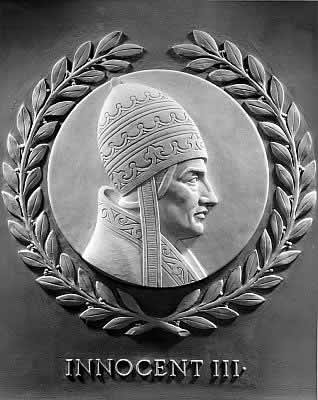
In 1215, Pope Innocent III wanted to change that. So he reformed the court system administered by the Catholic Church across Europe (ie, the ecclesiastical courts, from Greek ekklesia, assembly or church).

The idea was that an ecclesiastical court could take the initiative and summon and interrogate witnesses even without an accusation by one adversary against another.

Trial by combat was now forbidden in the ecclesiastical system. On the continent, this ecclesiastical tradition then became the basis for the subsequent evolution of secular courts.

But in England, Henry II had, during the 1160s, established parallel secular courts. When the church-administered courts in England switched to the inquisitorial system, the secular courts remained adversarial, and those in time became the courts of England. Hence the split.

Henry II

Critique

I) The adversarial system

The adversarial system makes me — intrinsically, philosophically, emotionally — uncomfortable because it was not originally designed to ascertain truth, merely the supremacy of one side.

That said, it has evolved in such as way that truth is now the implicit and desired by-product of the adversarial struggle. If the rules (of evidence, testimony, presumption of innocence et cetera) are sophisticated, it is hoped, the truth is revealed in the process and the “right” side wins, so that the outcome is indeed just.

Nonetheless, there are troubling remnants of the system’s combat origins:

1) The undue role of the “champions”

Today, we call those champions lawyers (attorneys, solicitors….). In the adversarial system, they are the stars. What do you tell a friend in trouble in an adversarial country? “Get a good lawyer.”

Some people try to get a good lawyer, but end up with a bad one, or at least one less good than the adversary’s. Other people cannot afford a good one. Others can afford entire armies of lawyers, and usually win. So money plays an unsavory role.

If the truth really wanted to be revealed, why should it matter so much which lawyer you have? But we all know that it does matter.

2) The undue emphasis on winning

An inquisitor wants to find the truth. But a prosecutor wants to win. To him, that means to convict.

A couple of days ago, I was chatting with Steve Cooley, the district attorney of Los Angeles County and a candidate for attorney general of California. How does he compare himself to his rival, Kamala Harris, the district attorney of San Francisco? Through the conviction rate, of course. Whether or not the convictions were just does not even come up for discussion. (How would you even discuss it?)

In practice, said Cooley, about 95% of convictions come through plea bargains, an inherent part of the adversarial system. (Ie, the two sides come to an agreement even before an independent judge or jury evaluates the truth of their arguments.)

Well, I recently mentioned Harvey Silverglate’s book detailing the various excesses to which prosecutors can go in the pursuit of victory. You can make anybody break down by piling more charges on him until he pleads. That does not make it just.

II) The inquisitorial system

The inquisitorial system makes me uncomfortable in a different way.

In theory, it is splendid to task somebody with inquiring after the truth. Take the example of plea bargains cited above: In the inquisitorial system, a guilty plea does not automatically lead to conviction. It is merely one more piece of evidence. (The inquisitor might decide to ignore the plea if he suspects, for instance, that the pleader is trying to protect somebody else, or is insane, et cetera.)

In practice, however, you have to choose an actual human being to find out the truth, and how is that likely to go?

There is a reason why we (or at least I) hear bad connotations in the word inquisition. It reminds us of the Spanish Inquisition, a time when the system went awfully wrong. The inquisitors, as it happened, were altogether more concerned with pleasing Ferdinand and Isabella than with ascertaining the truth. And they subscribed to the notion that you can get any truth that suits you; it’s just a matter of how you ask.

So an inquisition into truth can become corrupt. Notice, however, that this is a problem common to both the inquisitorial and the adversarial systems: The judiciary must be absolutely independent from political pressure. That includes not only the executive branch of government but also the mob. Ask black people in the Jim Crow South how well the adversarial system worked for them.

The subtler but more profound critique of the inquisitorial system has to do with what Richard calls “over-confidence in the expert”:

If you have a trained magistracy, ostensibly expert in discerning and charged with discovering the truth, there is the risk of over-valuing their work.

And why would that be a problem? Because experts are experts precisely because they have seen lots and lots of cases. And so they are likely to slip into a thought process that says “Hmm, this case X reminds of Y, and I should be consistent so I will…”. No. The facts (truth) of case X must be considered on its own merits alone.

Perhaps experts are less able to do that. As Richard says,

Justice is the art of espying the exception.

Which leaves us, unfortunately, where we started: with questions.

Who, expert or lay, is more likely to espy the exception?  Who is most likely to be free and fair? Which process — a search for truth or a struggle that reveals it — is more just?


Bookmark and Share