The Economist’s new home page

I’ve mentioned here and there how The Economist has been — really, really, honestly, totally, prove me wrong! — entering the internet era. 😉

Well, you should finally start to see some changes.

Our new home page will go live at the beginning of July. You can see a mock-up here, and you can take tell the web designers what you think about it here.

Bookmark and Share

The importance of the first reader

Eliza Hamilton

Every writer has, or ought to have, a more or less special first reader. For me it is my wife.

My wife is the first person to see every article I write for The Economist and every draft of my book manuscript. (I don’t show her my blog posts or emails, obviously, which may explain why those are so much worse.)

This is a very important and intimate relationship. The first reader is, in effect, the first editor, and also the sanity test, the acoustics check, the aesthetic focus group and the umpire of taste.

The first reader must be so confident of the underlying relationship as to be above flattery and fear of (lasting) repercussions.

Both writer and first reader must protect their credibility. My wife is probably most impressed with me when she gives a brutal but vague critique of something I have written … and I come back to her shortly after, having done even more brutal violence to my own words. This is known as “crucifying your darlings,” and it is what gives me credibility.

So it is fun to learn how the great writers of the past viewed that relationship.

Molière apparently tested his writings on his nurse to get her reaction. And Alexander Hamilton, my favorite Founding Father as well as by far the most prolific writer among them, had his wife, Eliza Hamilton. (Get ready for a new thread on Hamilton soon!)

On page 508 of this fantastic biography of Hamilton (recommended by Thomas Stazyk), Eliza recollects, 40 years after the fact, how her husband wrote George Washington’s famous farewell address. (Yes, most of “Washington’s” writings are in fact Hamilton’s.)

He was in the habit of calling me to sit with him that he might read to me as he wrote, in order, as he said, to discover how it sounded upon the ear and making the remark, “My dear Eliza, you must be to me what Moliere’s old nurse was to him.” The whole or nearly all the “Address” was read to me by him as he wrote it and a greater part, if not all, was written by him in my presence.

I probably appreciate more than most people how important Eliza Hamilton therefore was for American and world history.

Bookmark and Share

The wrong heroine: Joan of Arc

What does Joan of Arc — Jeanne d’Arc in French — say about our notions of heroism?

I’ve been pondering this for a while. So far in this thread on heroism, all the heroes have been male (and mythological). So the question of feminine heroism, raised but not satisfactorily addressed, has become more urgent.
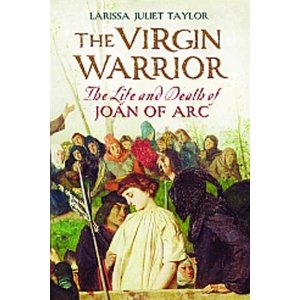
So I read Larissa Juliet Taylor’s biography of Joan: The Virgin Warrior: The Life and Death of Joan of Arc.

Taylor takes the dry — quite dry! — historian’s approach to Joan, and that was the approach I wanted for my purpose. Who was the actual woman, rather than the “saint” and statue that we have made of her. (Yes, in 1920 she officially became a saint.)

So here is I) the background, II) her story, and then III) my interpretation:

I) Historical background
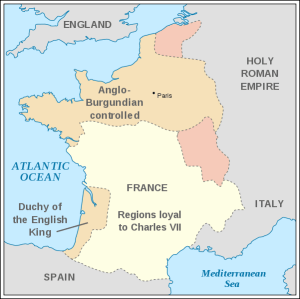
Click for attribution

Joan lived her short life — she was executed at 19 — in the 15th century, during what we retroactively call the Hundred Years’ War between England and France.

The most important thing to understand about this time is that nations or countries as we understand them did not yet exist. Instead, there were kingdoms and dynasties, shifting constantly depending on which royal married and procreated with which other royal.

“England” was ruled by French-speaking Norman royalty which, to complicate matters, frequently married royals from “France”, which were in turn more or less descended from Frankish (Germanic) royalty. (I venture to say that the common people neither understood nor cared who ruled them.)

As Joan was growing up, the English king claimed also to be King of France and held most of northern France, including Paris. He was allied with Burgundy, another originally Germanic kingdom that we today consider “French”.

Another contender to the throne, Charles Valois, considered himself dauphin but was considered wimpy and weak. The map above shows the lands under his control as “France”. This portrait of him, I believe, says it all:

Charles VII

II) Joan

Joan was born into a family neither poor nor rich — we would say “middle class” — in the Anglo-Burgundian part.

She was different from the other girls. She didn’t go dancing with them, and seems to have been a bit of a killjoy. She was constantly praying, and obsessed with the Virgin.

Starting at the age of 13, as she later claimed, she began hearing “voices.” The voices told her to go “to France.” She decided that the voices belonged to angels or saints.

Also around this age, she vowed to remain a virgin for the rest of her life. No reason given. She just did. This later became part of her mystique: She became La Pucelle (The Maid), which implied not only virginity but nobility and purity and innocence.

She became what we could call deranged. If she were alive today, she might be a suicide bomber. Guided by her voices, she wrote a famous “letter to the English”. In it, this teenage girl informed them that she would have mercy on them (!) if they did exactly as told, but that

you will not hold the realm of France from God, the King of Heaven, son of Holy Mary, for it will be held by King Charles, the true heir, because God, the King of Heaven wants it to be so, and this has been revealed by the Maid.

So there.

In 1429, aged 17, she set out to meet the dauphin Charles — ie, she left the “English” part of France and traveled to the “French” part, specifically a chateau on the Loire where Charles was staying. Already, she had short hair and wore only male clothing, as she would from then on.

When she arrived at the chateau, Charles’ advisers reacted as we might: They thought she was loony. They questioned her for a while. Joan told them that she was on a mission

  1. to lift the English siege of Orléans, an important town at the time, and
  2. to lead Charles to Reims (in English-controlled territory) to be crowned king of all France.

So the counsellors admitted her to see Charles. Charles also thought she was mad, or at least suspicious. But she was offering to make him king, and he had no other plan.

So Charles sent Joan to another town for a month for a thorough “theological validation.” This was their equivalent of psychoanalysis — the churchmen being the shrinks. Joan conducted herself well. Even her claims to virginity survived, ahem, examination.

So Charles saw her off to Orléans and put her in charge of some troops. Joan put on shining armor and set off. In the picture above, she is entering Orléans.

She sent another letter to the English:

… King of England, … if [the English forces] do not obey, I will have them all killed. If they obey, I will show mercy. I am sent here by God, the King of Heaven, to kick you out of all of France….

She perplexed but also fascinated every man there, both “French” and “English”.

She had one mode only: Charge!

She did not know doubt.

So she told the defenders to charge, and charge they did. In confused fighting, with Joan even getting wounded by an arrow, the tide turned and the English retreated from Orléans.

Suddenly, everybody either feared (if “English”) or adored (if “French”) the Maid.

Joan now led a laddish camp life. She was one of the guys. She got most angry whenever female “camp followers” came near her boys. She personally attacked the ladies with her sword to keep her soldiers pure.

Apparently feeling invincible, Joan led Charles’ forces to several more victories. Then it was time to bring Charles to Reims for his coronation. And thus the dauphin became Charles XII, King of France.

Charles, however, distrusted Joan more than ever. She seemed just plain deranged to him. Furthermore, Charles now had to begin the adult and mature business of negotiating with Burgundy and England to settle this mess in a civilized way. Joan, however, was constantly going on about her voices from the angels. She appeared not to understand the geopolitical context she was in. Which would be understandable: she was a teenager.

Joan, knowing only her one mode (Charge!), kept charging until she fell off her horse and was captured. In 1430 she was brought to Rouen, English-held Normandy, and put on “trial”.

The English did not prosecute or judge Joan. Instead, it was the French and Burgundian churchmen. Yes, they were aware that the power of the land, England, considered Joan a political problem. But their main bugbear seems to have been more Freudian-patriarchal. Joan threatened … something.

The obvious problem was to find something to accuse her of. What had she actually done?

The trial notes show the church, if not all religion, as silly, petty, ridiculous, irrational, vindictive and dumb. The inquisitors asked questions that were stupid, and Joan made fools of them.

The charges, when read, compensated for vagueness with length. Joan was to be tried

as a witch, enchantress, false prophet, a caller-up of evil spirits, as superstitious, implicated in and given to magic arts … [She was] scandalous, seditious, perturbing and obstructing the peace … [and she] indecently put on the ill-fitting dress and state of men-at-arms…

Sounds like everything I like to do in my spare time. 😉

Up on the scaffold she went, and onto the stake. They burned her. She died of smoke inhalation before she burned, but it was a cruel spectacle nonetheless, and nobody enjoyed it.

Her legend was born in the decades and centuries after her death.

She became, to different people at different times:

  • a martyr
  • a saint
  • a patriot and symbol of France.

Indeed, her retroactive importance is largely that she helped to bring about this concept of “France”.

So, was she a heroine?

III) Interpretation

Hua Mulan

Joan seems to belong to a small category of heroines who choose to remain virgins, dress up as boys and then fight with the boys.

China’s Joan, for example, might be Hua Mulan (pictured). Greece’s Joan might be Atalanta; Rome’s might be Camilla (who fought and died in the Italian wars against Aeneas).

But there is an obvious problem with such hermaphroditic or asexual heroines: Their heroism seems in large part to require denial of their femininity. That would suggest that heroism really is a male thing and the girls can play with the boys only if they pretend to be boys. I don’t like that at all.

Contrast that with a variation on her theme: the hyper-sexual warrior woman.

Here, for instance, is Brunhilde of Norse myth, with considerable Va Va Voom:
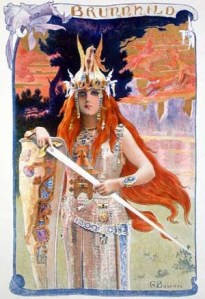
Then, of course, there are the Amazons, who not only fought but slept with male heroes, including Theseus and Hercules.

These women are seductive and fertile as well as brave and strong, and thus the direct primal equivalent of their male counterparts. As heroines they celebrate their sex rather than hide it. In fact, the Amazon queen, Hippolyta, seems to have been the model for Wonder Woman:

So Joan does not do it. She was a clueless teenager fired by inappropriate certitude (which describes pretty much every teenager) who never had the chance to grow into a whole person and become a genuine heroine.

But there are plenty of those out there, and The Hannibal Blog intends to find them

Bookmark and Share

Man v nature: Simplicity misunderstood

Here’s an important nuance in our evolving debate about complexity/simplicity: We have to distinguish between organic or natural complexity and manmade complexity.

Manmade complexity is usually bad. There is nothing good to be said about a convoluted and incomprehensible system of health-care administration, tax collection, customer support, software navigation, and so forth.

By contrast, organic complexity seems to be not only inevitable but good.

Here is how natural complexity seems to work: As Lao Tzu said in the Tao Te Ching 2,500 years ago:

The Tao gives birth to One.

One gives birth to Two.

Two gives birth to Three.

Three gives birth to all things.

He was describing what we now call the Big Bang: how energy split into two (yin & yang, electron & positron, matter & antimatter), thence into three and then into the whole bewildering world we see around us.

So the physical (Physis = Greek for nature) world is inexorably becoming more complex, as stars cook up new elements and explode to form new solar systems.

Then, as nature becomes biological (natura = Latin for birth), the pace at which it becomes more complex even seems to accelerate.

Evolution means a) that living organisms constantly reproduce with variations, b) that some of those variations will be more adapted to their environment than others and therefore reproduce more, leading c) to new species, which in turn split into yet more species, until d) entire ecosystems come about, constantly in flux and consisting of uncountably many organisms, all feeding off one another.

We could call this complexity but usually we call it diversity. And we consider this diversity good in the sense not only of colorful but also stable.

We do not say, for example, that a given ecosystem has too many “points of failure”, as a computer system might. The opposite is the case: If any link among the ecosystem’s uncountable permutations fails, another connection replaces it. There are redundancies. The ecosystem is self-correcting.

From the point of view of an individual in this ecosystem — an ant, say — the ecosystem might look Hobbesian in that life is probably poor, solitary, nasty, brutish and short. Well, not solitary, perhaps. (But the ecosystem did not evolve for the ant anyway. It didn’t evolve for anything. It evolved because it could not not evolve.)

Man, to the extent that he arrogates to himself a special place in such an ecosystem, tends to cause trouble. Like the ant, he would like to put himself first. Unlike the ant, he can. So he …. simplifies what should remain complex. For example, he goes from ….

…. horticulture to ….

… to agriculture, to ….

… to monoculture:

We’ve had good reason for this progressive simplification: Simplicity, after all, is more efficient.

But there are costs to organic oversimplification: Monocultures, for example, are the opposite of human societies, in that simplicity can lead to collapse.

Bookmark and Share

The Alexandrian Solution

A lot of people have a very famous story … wrong.

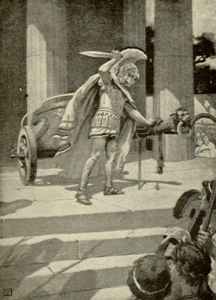
The story is that of the Gordian Knot and precisely how Alexander the Great loosened it. Most people imagine Alexander slashing the knot with his sword, as pictured above. But he did not.

In the nuance of how he really untied the knot lies hidden a worldview: the supremacy of simplicity and elegance over brute force and complexity. The true “Alexandrian Solution” was, for example, what Albert Einstein was looking for in his search for a Grand Unified Theory — a formula that was simple enough (!) to explain all of physics.

I’ll give you the background and the nuance of the story in a moment, but first another fist bump to Thomas for reminding us to make the association.

We are, remember, talking about complexity. The Gordian Knot is the archetypal metaphor for mind-numbing, reason-defying complexity; Alexander’s triumph over the knot is the archetypal metaphor for triumphing over complexity. Now read on…

I) Background

a) Phrygia

The Gordian Knot was, as the name implies, a knot in a city called Gordium. It was in Phrygia, an ancient kingdom in Anatolia (today’s Turkey).

The Phrygians lived near (and may have been related to) those other Anatolians of antiquity: the Trojans and the Hittites. They were Indo-European but not quite “Greek”. Their mythical kings were named either Gorgias or Midas (and one of the later Midases is the one who had “the touch” that turned everything into gold). Later, they became part of Lydia, the kingdom of Croesus. And then part of the Persian Empire. And then Alexander showed up.

b) The knot

Legend had it that the very first king, named Gorgias, was a farmer who was minding his own business and riding his ox cart. The Phrygians had no leader at that time and consulted an oracle. The oracle told them that a man riding an ox cart would become their king. Moments later, Gorgias parked his cart in the town square. In the right place at the right time. 😉

So fortuitous was this event and Gorgias’ reign that his son, named Midas, dedicated the ox cart. He did so by tying the cart — presumably by the yoke sticking out from it — to a post.

And he made the knot special. How, we do not know. But Plutarch in his Life of Alexander tells us that it was tied

with cords made of the rind of the cornel-tree … the ends of which were secretly twisted round and folded up within it.

It was a very complicated knot, in other words, and seemed to have no ends by which to untie it.

Lots of people did try to untie it, because the oracle made a second prophesy. As Plutarch said,

Whosoever should untie [the knot], for him was reserved the empire of the world.

II) Alexander, 333 BCE

Alexander, aged 23 and rather ahead of me at that age, arrived in (Persian) Phrygia in 333 BCE. The knot was still there, un-untied.

Alexander had already subdued or co-opted the Greeks, and had already crossed the Hellespont. But he had not yet become divine or conquered Egypt and Persia. All that was to come in the ten remaining years of his short life. And it began with the knot, since he knew the oracle’s prophesy.

Here he his, his sword drawn, approaching the knot:

Did he slash?

No, says Plutarch (ibid,. Vol. II, p. 152, Dryden translation):

Most authors tell the story that Alexander finding himself unable to untie the knot, … cut it asunder with his sword. But … it was easy for him to undo it, by only pulling the pin out of the pole, to which the yoke was tied, and afterwards drawing off the yoke itself from below.

III) Interpretation

I leave it to the engineering wizards among you to re-create the knot as it might have been. But what we seem to have here is a complex pattern that was nonetheless held together by only one thing: the beam.

It was, Einstein might say, like quantum physics and gravity: intimidatingly complex and yet almost certainly reducible to one simple reality.

Alexander, being Great, understood this. He saw through the complexity to the simple elegance of its solution, and pulled the peg.

This is how I understand “the Alexandrian Solution.” I intend to look for it in all of my pursuits. 😉

Bookmark and Share

Complexity and collapse

Joseph Tainter

As you know, The Hannibal Blog is fascinated by the issue of complexity in modern society.

That is, “fascinated” as you might be in a horror movie: simultaneously freaked out and intrigued.

If I had to give a working hypothesis in my evolving thinking, it would sound a bit like the answer by that character in The Sun Also Rises:

How does complexity enslave us? First gradually, then suddenly.

In other words, complexity can increase slowly for a while but then suddenly becomes catastrophic. This view seems to be in the Zeitgeist. Here, for instance, is just a tiny sample of intellectuals I’ve recently come across who seem to be exploring versions of it:

I

Clay Shirky

Clay Shirky, a new-media visionary whom you’ve met here before, takes another look at the fascinating work of Joseph Tainter (above), an anthropologist at Utah State University. (Somewhat surprisingly, he then tries to apply that to … business models in the television industry!)

Tainter’s 1988 book The Collapse of Complex Societies looked at the abrupt implosions of ancient Rome, the Mayas et cetera.

As Shirky summarizes it, Tainter’s thesis is that societies become more complex because

early on, the marginal value of this complexity is positive—each additional bit of complexity more than pays for itself in improved output—but over time, the law of diminishing returns reduces the marginal value, until it disappears completely. At this point, any additional complexity is pure cost.

Tainter’s thesis is that when society’s elite members add one layer of bureaucracy or demand one tribute too many, they end up extracting all the value from their environment it is possible to extract and then some.

… Why didn’t these societies just re-tool in less complex ways? The answer Tainter gives is the simplest one: When societies fail to respond to reduced circumstances through orderly downsizing, it isn’t because they don’t want to, it’s because they can’t.

In such systems, there is no way to make things a little bit simpler – the whole edifice becomes a huge, interlocking system not readily amenable to change. …

When the value of complexity turns negative, a society plagued by an inability to react remains as complex as ever, right up to the moment where it becomes suddenly and dramatically simpler, which is to say right up to the moment of collapse. Collapse is simply the last remaining method of simplification.

II

Niall Ferguson

Niall Ferguson, a history professor at Harvard, argues in a piece called “C0mplexity and Collapse” in Foreign Affairs that the great powers don’t rise and fall gradually (as everybody from Herodotus to Paul Kennedy has assumed) but disintegrate abruptly:

Empires do not in fact appear, rise, reign, decline, and fall according to some recurrent and predictable life cycle. It is historians who retrospectively portray the process of imperial dissolution as slow-acting, with multiple overdetermining causes. Rather, empires behave like all complex adaptive systems. They function in apparent equilibrium for some unknowable period. And then, quite abruptly, they collapse.

(I was somewhat surprised not to see a reference to Tainter’s work in Ferguson’s article, but there you go.)

III

David Segal in the New York Times takes that impetus and applies it to our strategy in Afghanistan, the financial crisis and much else.

***

It seems to me that there is an opportunity in this topic of complexity to find something original (and simple) to say, a new “theory of complexity”, as it were. I’m going to start looking for it.

Bookmark and Share

Nisht geshtoygn un nisht gefloygn

Climbing, flying ...

For the time being, I have a new favorite phrase:

Nisht geshtoygn un nisht gefloygn

It’s Yiddish and means “didn’t climb up and didn’t fly.” (The German spelling would be nicht gestiegen und nicht geflogen.)

OK, but so what?

Well, it’s a very witty and slyly subversive way of saying

Bullshit,

and I feel that we all could use new and innovative ways to express this necessary reaction to so much in life.

You can read about the historical and linguistic context of the phrase here. Basically, it’s what Jews, living in an overwhelmingly Christian society, said to each other to mean Bullshit. It was implicitly understood among them that the individual who neither climbed nor flew was, well, you know…

Let everybody make a fuss, the phrase seems to imply, but we don’t necessarily have to buy into it.

And yet, the phrase is also obscure enough to give its user deniability should he need it. The mainstream Christians were not likely to be offended about somebody saying that something neither climbed nor flew. It’s really an inside joke, nudge nudge.

PS: This post is not about you, or him

Usually, when the subject of religion comes up, I get a spike in traffic and everybody blows a fuse. This post is not even tagged religion. Instead, it is once again about intellectual conformity.

As you know, I value non-conformity but simultaneously appreciate how difficult it is to be non-conformist constructively, as Socrates illustrated.

So this great phrase might suggest the solution: to be non-conformist and simultaneously non-confrontational, and to have a bit of fun all the while.

Next time you hear that talking head on cable TV going on about, oh, death panels and what not, next time you feel overwhelmed by the truthiness and non sequiturs all around us, join me in a cavalier smirk and mutter

nisht geshtoygn un nisht gefloygn.

Bookmark and Share

What Polybius said about the Tea Party

I’ve been spending the weekend talking to various visitors from Europe, and they are, shall we say, fascinated by the American mood this year.

The country, a superpower that is hard for foreigners to ignore even when they try, seems to have gone loony-potty. A movement is afoot that wraps itself in a historic-sounding name, the Tea Party, then feeds on undistilled anger to rebel against… well, it’s not clear against exactly what.

The Hannibal Blog embraces intellectual contradictions as though they were steps in a Jacob’s ladder toward more humble and refined views. The Tea Party, on the other hand, won’t even acknowledge its contradictions. That’s the wrong way to go on a ladder.

And so we return once again to Polybius (Histories, VI, 57), who so influenced our Founding Fathers (those of the real Tea Party), and who seemed, about 2,150 years ago, to have something to say about America in 2010:

When a state, after warding off many great perils, achieves supremacy and uncontested sovereignty, it is evident that under the influence of long-established prosperity life will become more luxurious, and among the citizens themselves rivalry for office and in other spheres of activity will become fiercer than it should. As these symptoms become more marked, the cravings for office and the sense of humiliation which obscurity imposes, together with the spread of ostentation and extravagance, will usher in a period of general deterioration. The principal authors of this change will be the masses, who at some moments will believe that they have a grievance against the greed of other members of society, and at others are made conceited by the flattery of those who aspire to office. By this stage they will have been roused to fury and their deliberations will constantly be swayed by passion, so that they will no longer consent to obey or even to be the equals of their leaders, but will demand everything of by far the greatest share for themselves. When this happens the constitution will change its name to the one which sounds the most imposing of all, that of freedom and democracy, but its nature to that which is the worst of all, that is the rule of the mob.

Bookmark and Share

Hannibal, Fabius & Scipio in Missouri

Don Antonio Soulard, the Spanish surveyor general of what much later became Missouri, seems to be my kind of man.

I would never have heard of him but for Jim Markovitch, a reader of The Hannibal Blog who gets this week’s fist bump for some ad hoc investigative work while driving around Missouri.

As Jim discovered here and here, Don Antonio journeyed up the Mississippi some time around 1800 and, like so many classically educated types in those days, admired the people who also happen to be the main characters in my book:

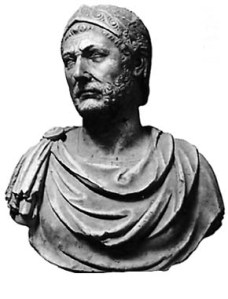
Hannibal (above left),
Fabius (above right) and
Scipio (left).

So Don Antonio named bodies of water after his heroes:

– the Hannibal Creek (now called Bear Creek), site of the eponymous future hometown of Mark Twain;

– the Scipio River (Bay de Charles); and

– the Fabius River (still named that).

And there is of course Carthage, MO, reachable in 5 hours, 34 minutes from Hannibal, according to Jim’s iPhone screen directions. Had Hannibal only had an iPhone when he crossed the Alps!


Bookmark and Share

Draft IV of the manuscript is off…

I seem, magically, to be keeping the same exact rhythm, turning over each new draft of my manuscript in one month.

My publisher, Riverhead, sent me the last round of comments one month ago, and I just now emailed the new draft.

The actual re-write this time took me only a few days.

And the main objective was accomplished, I think: To come up, in the last chapter, with “lessons” from the lives in the book that are catchy, not at all corny and actually meaningful.

We’ll see what my editor says.

Bookmark and Share