Uniting the two kinds of enlightenment

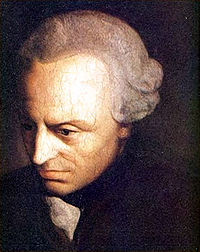
Kant clarified

Kant clarified

The English word enlightenment can have two quite different contexts:

  1. The (Western) Enlightenment of the 18th century. You know: Kant, Voltaire, Hume, reason, the American and French Revolutions and all that.
  2. The (Eastern) Enlightenment that the Buddha, Patanjali, and various Zen masters and bodhisattvas have achieved through meditation and Yoga. Samadhi, nirvana, satori and all that.
Buddha illuminated

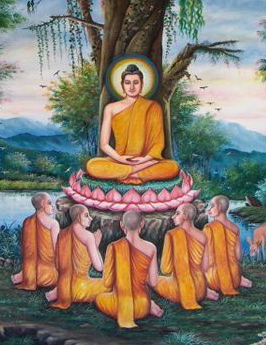
Buddha illuminated

The two are completely different, of course. The former is largely a collective phenomenon, one in which ideas elevated all of society. The latter is largely an individual phenomenon in which one person, through sudden insight (Zen) or hard and prolonged work (Ashtanga Yoga), achieves inner peace and freedom.

In fact, the same exact difference came up when I talked about freedom: There is:

  1. the (Western) Enlightenment view of freedom: Latin liberLiberalism, Liberty, and
  2. the Existentialist and Eastern views of freedom (moksha in Sanskrit).

Anyway, what this means is mainly that the limitation lies in the English word Enlightenment. German, for instance, has two separate words:

  1. The Western Enlightenment is called Aufklärung. The term was coined by Kant and means literally clarification (Auf-klär-ung = Up-clear-ing, for you fellow linguists. Incidentally, it can also refer to a young person learning about the birds and bees).
  2. The Eastern Enlightenment is called Erleuchtung, which means illumination, often symbolized with the halo (ie, ring of light) on the crown chakra of the Buddha or Jesus.

Why I bring this up

That difference between Aufklärung and Erleuchtung came up in 2007 when I was talking with Michael Murphy, one of the two founders of the New Age retreat Esalen. I was interviewing him for a profile of Esalen in the Christmas Issue of The Economist that year. Murphy is now in his seventies and lives in Sausalito, so I went there to see him. We sat by the waterfront and talked about absolutely everything except what we were supposed to talk about. For instance, he was the first person other than my agent, parents or wife whom I told about my book idea, and that really got him going. It was the best kind of conversation.

Anyway, so Murphy and I talked about the two kinds of Enlightenment, and to my surprise this Irish-American aging Hippie delves into German etymology. But it was appropriate. An oversimplified summary of his life work–at Esalen and in his books–is that he tried to unite Aufklärung and Erleuchtung, West and East, in an effort to liberate our full “human potential”. Hence the Human Potential Movement, which he helped to found at Esalen in the 60s, when folks like Abe Maslow were teaching there.

Instinctively, that is what I also aspire to: Uniting the two kinds of Enlightenment in my life. You see it when I call Diogenes a “Greek Buddha” or Abe Maslow a “Jewish Buddha,” or when I draw parallels between the Second Law of Thermodynamics and Feng Shui.

Somewhere between East and West (though perhaps not in the “middle East”)–somewhere between reflection and science, eternity and progress, mythos and logos–there must be something worth finding. I’m sure of it.

Bookmark and Share

Through the eye of Hannibal

hannibal barca

I’ve mentioned that Hannibal lost one eye to some sort of infection as he crossed an Etruscan (= Tuscan) swamp in 217 BCE. For four days and nights his army waded through the fetid sewage, men and beasts excreting into it as they progressed, unable to sleep for lack of a dry spot to lie on except when the mules died and they could pile the carcasses into a mound and climb on top for a brief nap.

In any case, Hannibal must therefore be pictured one-eyed. Which means that my tagline for this blog has been wrong. Until today it read:

A blog about a book: Thoughts deep and shallow about triumph and disaster in life, through the eyes of Hannibal the Carthaginian

Fortunately, Paul H. pointed out the flaw, an inexcusable one for somebody like me who fancies himself a wordsmith.

Paul H., you get today’s fistbump.

Look up and see the tagline changed. 😉

Bookmark and Share

The danger of the single story

Adichie

Adichie

A big theme in my thread on storytelling, and a premise of my forthcoming book, is that certain stories are universal and timeless–or, as Carl Jung might say, archetypal.

But as with everything, there is a way to misunderstand that insight. Yes, there are elements that are common to Homer’s Odyssey and Iliad, to the Grimm stories and to Heidi–elements such as a hero who goes on a quest and meets a wise old man and so forth….

But that does not mean that one single story can summarize a life, a person, a place or a country. The opposite is the case. There must be an infinite number of stories, even if they all have something in common.

The attractive Nigerian novelist Chimamanda Ngozi Adichie gave a great TED talk (below) about exactly this. As a girl in Nigeria she read and loved British and American books and stories and began to write stories herself at the age of 7. But her stories were about … white, blue-eyed girls who played in the snow and ate apples and talked about the weather and whether it might turn nice. Even though she had never left Nigeria!

She eventually realized

how impressionable and vulnerable we are in the face of a story.

Stories had overpowered her own perception of the world. She assumed that stories could not be about brown people eating mangoes in the sun but had to be about white people eating apples in the rain.

Emancipation occurred when she realized that

people like me … could also exist in literature

But that was only the beginning. She understood that many people have only one single story about Africa (= catastrophe), and that she did not fit into that story. She realized that she herself had only one story about Mexico (= illegal immigrants) which proved woefully inadequate. She realized that some people, such as her American college roommate, had only a single story about her, Adichie from Nigeria (= exotic tribal woman), and that she herself simultaneously had only one single story about her own family servant (= pitiful poor boy), which also proved incomplete. She understood that

power is the ability not just to tell the story of another person but to make it the definitive story of that person,

and that

the single story creates stereotypes, and the problem with stereotypes is not that they are untrue but that they are incomplete… It robs people of their dignity.

So consider this a refinement of my views on storytelling. We must be open to many, many, many stories even as we see the common, universal humanity that runs through all of them. Now take 18 minutes and watch:


Bookmark and Share

Einstein’s unfinished thought experiment

Mark Anderson

Mark Anderson

As you know, I am fascinated by many aspects of Albert Einstein, and one of them is his habit of doing thought experiments. We don’t do those enough!

In Einstein’s case, he mused (picture him day dreaming) about things such as elevators falling through space and painters inside of them, about two-dimensional beetles crawling around three-dimensional wires, and so on.

But his most famous thought experiment has always bothered me. So I was delighted that Mark Anderson, a physicist who writes the Strategic News Service, which offers trend-spotting analysis, echoes my frustration in a recent newsletter. Here he goes:

The most famous scientific anecdote of all time remains half-done, unfinished, although countless authors have told the story of Albert Einstein as though it makes sense. Here is how the “thought experiment” goes: when he was 16 or so, Einstein decided that he needed to travel alongside light to understand its nature. (Drum roll.) In this way, he came to understand Special Relativity, a bit later in life. Wow.

There’s only one problem with this apocryphal story: Special (and General) Relativity talk about time and space. They don’t say a word about light, except as it responds to gravitational force.

So, none of us knows what Einstein saw (or did not see) of the light itself, as he (illegally) screamed along at the speed of light, looking sideways…

Well, I have been doing this thought experiment for a while now, without success. (That is not surprising since I opted out of physics as soon as I could in high school.) Here, by the way, is a cool illustration of it.

It always seemed to me that if I were looking sideways at a wave-like quantum of light going at the same speed, it should not even “exist”. Mark seems to think the same thing:

Waves, at their deepest origins, are relative. If you stand at the shore, in they come. But if you fly along with one, like a seagull – say, at the crest of a traveling wave – there is no motion at all; there is no wave.

Having said that, I remind myself, through the haze of my confusion about such matters, that Einstein’s Relativity ended up being about time as much as space.

So perhaps what happens to a light-beam rider is that time … stops. Which is, ironically, exactly what happened when I opened my email inbox this morning.

Bookmark and Share

Book writers’ advice: book writing sucks

It’s amazing how many book authors are volunteering advice and/or satire about how bad it was for them, or is likely to be for you, to write a book.

Ellis Weiner in the New Yorker lampoons the “marketing department” at publishing houses which are so notorious among writers for not existing per se.

Mark Hurst claims to divulge “secrets of book publishing I wish I had known,” sounding just a tad bitter imho. Publishers hate/don’t get originality, and so forth.

Seth Godin, in a slightly older post, gives “advice to authors” which amounts to “lower your expectations” and somehow ends, in a non sequitur, with: “You should write one.”

Well, I am writing one. Once it’s published, will I post, right here, some advice and/or satire about how bad it was to write a book?

Bookmark and Share

Becoming a Mensch: “Self-actualization”

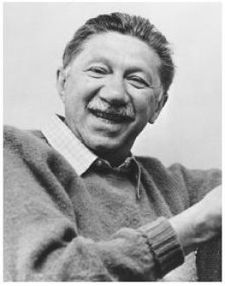
Abraham_maslow

Abe Maslow

The other day, I compared Abraham Maslow’s Hierarchy of Needs to the chakras in Indian philosophy, and I promised to expound a bit on the highest need/chakra, which we might call, to use Maslow’s word, self-actualization.

It’s an ugly term, born out of Esalen in the late sixties, when hyphens, Latin roots and the noun form of verbs were considered good things because they bestowed credibility in between naked massages in the Esalen hot tubs which I myself once had to endure as part of my journalistic research.

So let’s just call it something else. To self-actualize is–to use the technical Jewish-Buddhist term ;)–to be a Mensch. I consider it perhaps the highest form of success, and it thus becomes relevant in the penultimate chapter of my book. According to Maslow, only about 2% of the human population self-actualizes!

In the rest of this post, I want to flesh out what self-actualization might entail, with help from an excellent summary by Dr. C. George Boeree.

Needs you fill and forget & needs that grow as you fill them

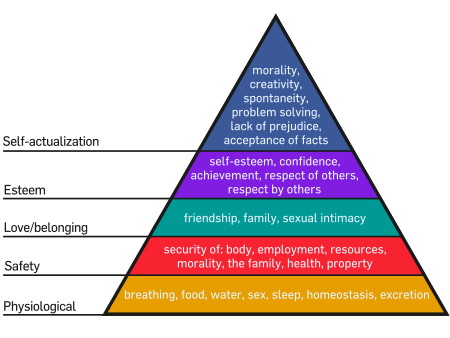
Take another look at Maslow’s famous pyramid, which I showed you in the previous post on the subject. There is one difference between the top of the pyramid and all the lower rungs. At the bottom (breathing, eating, feeling safe etc), we feel needs only when we lack something. We cease to feel them as soon as we have what we crave. So, if I am suffocating, all I care about is air. But once I have air again and can breathe, the obsession is gone. Maslow called these cravings deficit needs.

450px-Maslow's_Hierarchy_of_Needs.svg

Self-actualization is different. When we feel that we are fulfilling our potential–by being creative, for example–the need to self-actualize does not go away but grows. Fulfilling our potential makes us feel alive and satisfies us. So Maslow called these motivations being needs to distinguish them from the deficit needs.

Character sketch of a Mensch

So what kind of person reaches the highest stage and becomes a Mensch?

Maslow studied biographies.  (That happens also to be my approach in my forthcoming book; among the people Maslow studied are even some that are characters in my book.) From his studies Maslow concluded (we can debate whether he was right) that the Menschen shared certain traits that are actually quite rare. In this group of self-actualizers were:

  • Abraham Lincoln,
  • Thomas Jefferson,
  • Albert Einstein, (in my book)
  • Eleanor Roosevelt, (in my book)
  • Jane Adams,
  • William James,
  • Albert Schweitzer,
  • Benedict Spinoza,
  • Alduous Huxley, and
  • 12 unnamed people.

The traits they shared, according to Maslow, were the following. They:

  • were able to discriminate between what is fake and what is genuine,
  • were able to treat life’s challenges as problems demanding solutions rather than personal affronts to be angry or depressed about,
  • felt that the ends don’t necessarily justify the means, that the means could be ends themselves (this is the opposite of strategic thinking),
  • enjoyed solitude,
  • had deep and intimate bonds with a few people rather than shallow relationships with many people,
  • felt “autonomous” from society (I think this means that they were non-conformist),
  • had an unhostile sense of humor–preferring to joke at their own expense, or at the human condition, and never directing their humor at others (which comes close to my definition of irony),
  • accepted themselves and others, enjoying harmless flaws as personal quirks,
  • were spontaneous and simple,
  • respected other people and treasured ethnic and individual diversity,
  • were ethical and spiritual but not usually “religious”,
  • were able to feel wonderment,
  • were original, inventive and creative, and
  • tended to have “peak experiences“, which we might call episodes of rapture or ecstasy–mystical feelings of merging into an infinitely large and eternal whole.

Normally I don’t like lists (as opposed to one single and large insight), but in this case a sort of composite personality emerges, which becomes stronger when Maslow adds to these positive qualities a few flaws that he found common among self-actualizers. They:

  • often suffered from anxiety,
  • were often absent-minded,
  • were occasionally ruthless and cold.

In short, they were, as Walt Whitman might say, “large”: they contradicted themselves and were fine with that.

And so…

Frankly, Maslow is a lot of work, and I have been pondering whether it has been worth it. I can’t decide whether the character sketch, and even his hierarcy of needs, is too obvious and thus banal, or whether it is helpful. For now I lean toward the latter.

Since I began this meditation by comparing his thoughts to ancient Indian philosophy, let me also conclude that way. It does strike me that self-actualization is strikingly similar to some visions of what “enlightenment” might be like.

First, I happen to believe that the yoga taught by Patanjali and his contemporary, the Buddha, leads to fleeting instances of samadhi (enlightenment, ecstasy), rather as it overcame St Teresa, instead of lasting bliss. “Peak experiences,” in other words.

Second, the “method” is similar: The simplicity, love of solitude, humor (think of Zen monks), non-conformism, withdrawal and even the occasional coldness of the self-actualizers resembles that of the Eastern yogis and Zen masters. They are really Einsteins in the Lotus position.

In short, I think that Maslow’s contribution is to humanize “enlightenment” for us Westerners.

Bookmark and Share

PS: After reading these two posts on Abe Maslow, do you think he belongs into my pantheon of the world’s greatest thinkers?

The fun theory of life

As a dad, I have learned that the only (or at least best) way to get my children to do anything at all–to brush their teeth, eat their greens, jump into bed–is to turn the loathsome activity in question into … fun.

Perhaps the greens must become attacking naughties with shrill voices that want to fly into the mouth but keep missing and splattering. Suddenly, the little mouths are wide open, practically lunging for those mischievous little greens.

And as a former and frequently relapsing kid myself, I have learned that the only (or at least the best) way to get myself into a creative and productive mode is also to turn the loathsome activity in question (setting up interviews, doing research….) into … fun.

So I am delighted to see, and fully endorse, this research project that tries to elevate fun to a design principle. It appears to be a Volkswagen-funded undertaking in Sweden

dedicated to the idea that something as simple as happiness is the absolute easiest way to get people to change.

Video 1: How to get people to use the stairs

Video 2: How to get people to throw their trash into the bin

Thought experiment: Extensions

So now I am thinking: What else could be made fun with proper, more humane design?

  • doing taxes?
  • doing jury duty?
  • going to the doctor?
  • being at the airport?
  • Recycling?
  • Conserving (water, energy …)?

I refuse to exclude anything. It’s all a matter of how much one is willing to imagine. My kids are teaching me to raise the bar.

Bookmark and Share

Clinton, Newsom and their fathers

Newsom-lede

On Monday I found myself standing on a chair, peering over the baying pack of television crews to see Bill Clinton endorse Gavin Newsom for governor of California. For some odd reason (the PR handlers explained it to me, but it was too stupid to reproduce here) they chose the space between shelves in the library of a community college in Los Angeles for the occasion. My cheek was pressed into the sign 808.8, which seems to be children’s literature in the Dewey Decimal system. Go figure.

I have met Newsom several times before, and have experienced Clinton twice at conferences (TED and Google’s Zeitgeist). As I was observing these two men, I could not help but think of their fathers, as I will explain in a minute.

First, though, the reason my thoughts went that way: their (arguably endearing) vanity.

Bill Clinton, who was allegedly there to endorse (ie, make look good) Newsom, spoke for 22 minutes, mainly about green technology and so forth, before letting Newsom get in about 11 minutes of thanking and campaigning. This is par for the course. I remember somebody asking Clinton a purely rhetorical question at Zeitgeist, and Clinton dissecting the question into three parts, then delivering an exegesis worthy of a State of the Union on each. The man, God bless him, cannot help himself. He must hold forth.

So does Newsom. He admires Clinton and spent a good part of my first conversation with him, three years ago, talking about the political and rhetorical lessons he has drawn from Clinton.

Here is how that meeting, with my editor and myself and Newsom at a San Francisco cafe, went: Newsom came in and started talking about baseball. Realizing that neither my editor nor I seemed to have a clue about that sport, he switched effortlessly to … cricket. (The EconomistBrits…) Seeing that we knew nothing about that sport either and were geeky, wonky boffins, Newsom made another seamless transition and settled into … geeky, wonky politics arcana. He seemed liberated, as were we.

His eyes, I remember noticing, had bright circles of brown, yellow and green. He blushes very easily (as Clinton does). When there are women in the room, as there were when I met Newsom again a few months ago at the offices of Twitter, he preens very self-consciously, as if we were all at a high-school prom. The women notice this and like it.

In any case, both are very gifted and intelligent. Newsom, like many dyslexic people, has learned to overcompensate for his reading difficulties with other mental disciplines and is quick on his proverbial feet. He oozes Clintonian charm.

Their fathers made them

On to their fathers. Some of you may recall that, as part of my book research, I have been pondering the role of parents in the early stages of a young man’s (or woman’s) personality development. Obama and McCain both defined themselves against the (mostly abstract) idea of their fathers. Doug Wead, a presidential historian, has even put forth various theses that absenteeism by fathers somehow makes their sons more presidential.

Well, that’s what I was pondering as the 808.8 was jabbing into my cheek.

Clinton never knew his father, who died before Clinton was born. Clinton instead took the name of his stepfather, whom he recalls as an abusive drunk.

Newsom’s father separated from, and then divorced, Gavin’s mother when Gavin was a boy. His father was around, but the roles were apparently strained.

The quack psychologist in me would hypothesize that these father gaps left both men chronically insecure, permanently eager to win over and impress other people and to stay in their favor. In short, their fathers made them politicians.

Bookmark and Share

From sex to enlightenment in six small steps

ChakraDiagYou’ve heard of the seven chakras mentioned in the Yogic texts. They are energy centers along the spine often depicted as wheels.

I hesitate to bring them up because, well, the topic gets a bit touchy-feely and new-agey. Suffice it to say that one does, during pranayama (breath control) and the higher four of the eight stages of Patanjali’s Ashtanga yoga concentrate intensely on these chakras, perhaps visualizing them in their rainbow colors.

In this post I will not try to prove or disprove that the chakras exist. Instead, I would simply like to point out that Western culture seems to have the same concepts, especially if one views them more metaphorically than literally, as more mythos than logos.

Compare the hierarchy of chakras in the human body to the left to the hierarchy of needs as described so famously by the American psychologist Abraham Maslow to the right. Remarkably similar, aren’t they?

450px-Maslow's_Hierarchy_of_Needs.svg

I believe the idea is the same.

In the yogic vocabulary, the root chakra above the anus (essentially in the male prostrate) and the sacral chakra just above it (near the female ovaries) govern our most basic drives: individual survival (eating, excreting etc) and genetic survival (sex).

Maslow lumped these together in his ‘physiological’ needs at the bottom of his pyramid. He believed that if somebody is choking you and you are not getting oxygen, breathing is the only need you care about. Once you can breathe again, you may notice that you are thirsty. Once you have drunk, you may notice that you are hungry. Once you have eaten, you may notice that you desire. And so on.

The next chakra (going upwards) is the yellow solar plexus just below the navel. In the yogic conceit, this governs our will to power. (So I sometimes think of the sacral chakra as Freud and the solar plexus as Nietzsche.) Maslow calls these “security” needs, but you notice that they involve what we consider the trappings of power: money, property, status, and so on.

Now we get into the higher or ‘nobler’ chakras.

In the yogic vocabulary, the first of these is the green heart chakra, which governs deep, selfless, non-sexual love (not Aphrodite but Hestia, if you will). Maslow calls these the ‘love and belonging’ needs for friendship, family and intimacy. Even the color corresponds. (Which is interesting: Green = envy in the West but love in the East.)

The blue throat chakra in Yoga governs intellectual clarity, the ability to communicate, creativity and so forth. This is where artists, scientists, writers and orators draw their inspiration. Maslow calls these ‘esteem’ needs, which is the reward of such things.

Yoga then distinguishes between two more chakras: the third eye behind the brow which is indigo and the source of inner peace and meditative calm; and the crown (depicted in the Western tradition as a halo) just above the head which is the area that is energized during enlightenment (ie, very rarely for most of us).

Maslow lumps them together under “self-actualization”, which is arguably the goal of life and the definition of success. Maslow studied biographies (as I did for my book), and developed a theory about what sort of qualities people have who self-actualize. Perhaps that’s why they called his approach “Jewish Buddhism” at Esalen. 😉

More about self-actualization anon.

Bookmark and Share

Mini powwow

Boardingpass

Well, I’m off to another powwow of The Economist. This time it’s not a biggie, as last year’s was, but a little gathering of the US-based correspondents (politics+business+finance).

In case you’re wondering: that’s 17 of us, plus the US editor, plus the editor-in-chief. (I only say that because I have found that our readers tend to be surprised when hearing how few of us there are.) So 19 of us will decide the current direction, and thus future course, of America. That should take us only a short working day or so, so I hope to be back here blogging anon. 😉

Bookmark and Share