Discussing stuff while getting rid of it

IMG_5787

In preparation for this new thread on stuff, I spent much of the day talking and thinking about it at the perfect venue for this sort of thing: a yard sale.

Friends of ours were having one and invited us to piggyback on theirs, so we had a “multi-family” purge on a sun-baked California street corner. My daughter was scotch-taping the signs up around the neighborhood (which is why they are knee-level for a tall adult), and then I hauled our crap, I mean stuff, onto that lawn. And people bought it.

It was cleansing. The families hung out and talked about this odd tyranny of stuff. The other family was getting dirty looks from the mom/mother-in-law, who is a bit of a hoarder and couldn’t quite believe what we were giving away. My friend was walking out with something or other, allegedly a thing of beauty, and his mother-in-law interrupted her phone conversation to raise her eyebrows and say: “That was a wedding present from [so-and-so], you know.”

He chortled. It was his dang wedding, and a fun one, and it’s his dang marriage, and a good one, so where is the law that says he must forever junk up his house with crap, I mean stuff, that he never wanted in the first place?

The ladies did, however, share how hard it often has been for them to part with their stuff. The other mom had already tried dumping the baby things once, and said she was overcome by a sort of “nausea” and had to stop. This time, fortunately, she was ready.

The lads had no memories of any psychosomatic stuff-parting pains to report.

Bookmark and Share

New thread: A Theory of “stuff”

800px-EastNOAp06Carpile12

I have found myself, to my considerable surprise, doing some deep thinking about stuff. As in: Crap. Things. Knick knack. Papers. All that.

The occasion was a move–the before, during and after. My wife and I have been having to confront the cumulative load of stuff in our house and lives, stuff that has to be stored, then moved in order to be stored again. (Irony, anyone?)

If you are a regular reader and remember my feelings about, say, Diogenes or simplicity, or my utter loathing of clutter and complexity, you can pretty much figure out how I feel about stuff.

My wife does not disagree–and fortunately loves me for my eccentricities–but she is nonetheless

  1. female and
  2. not me.

This places her in a sufficiently different vantage point to produce some fascinating and highly entertaining discussions between us and ideas that I want to share with you in subsequent posts.

So I’m starting a new thread (ie tag) called stuff. Talking about things per se would be boring, so we are talking about things only in order to find out more about life and clutter, Feng Shui and simplicity, fear and serenity, and these sorts of things.

As regular readers know, this does not mean that any other ongoing threads–such as the ones on storytelling, the great thinkers, America, Socrates or, of course, Hannibal–will be interrupted, only that yet another one will be woven into them.

Prepare to get stuffed.

Bookmark and Share

Socrates, the cynics, idiots and me

Antisthenes

Antisthenes

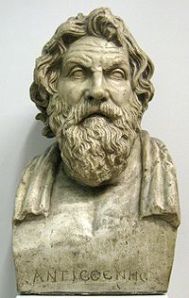
Socrates’ most famous disciple was of course Plato. But his oldest disciple was a man named Antisthenes (above), who became the first of the cynics and the teacher of that Diogenes whom I so admire and envy, because I would love the simplicity of living in a barrel.

I quite sympathize with Antisthenes, in several ways. Socrates was forever going around interrogating everybody in this intense–we would say anal-retentive–quest to come up with perfect definitions. What is virtue? What is justice? What is the good? Whatever answers others gave, Socrates dismantled them, but rarely came up with anything positive. Antisthenes eventually got rather bored and frustrated by all this.

So he concluded that these things that Socrates was obsessed with were really just names, or words. They mean what you want them to mean. 2,360 years later, French intellectuals like Derrida would say the same thing and get famous for it.

So to hell with words, said Antisthenes, and let’s get out of here. Screw society and its norms and conventions. Jury duty? Puhleeze. Vote? No way. That stuff was for those do-goody Athenians who were under the illusion that they were “free“. Antisthenes, who had a good sense of humor, regularly recommended that the Athenians should vote that asses are horses, as a way of celebrating democracy.

He, and all the Cynics, were thus what we would call apolitical: without politics, without a polis, without a city. Aristotle thought there was something pathetic about being apolitical, cityless–like being “a solitary piece in checkers”. But Socrates, Antisthenes, Diogenes and those types saw freedom in this withdrawal.

As Jag Bhalla, an expert on such matters, has already pointed out on the Hannibal Blog, the Greeks had a word for these people: keeping out of public affairs, they were private, or idiotes. In time we came to call people who cut loose from conventions idiosyncratic, but also tried to discourage that sort of thing and gave idiots a bad name.

I, for one, stick by my Diogenes dream: Being an idiot sounds great to me.

Bookmark and Share

More contemplation of the Bird in Space

IMG_0334

You may recall that, a while ago, I showed you Brancusi’s Bird in Space as my overture to a brief meditation on simplicity, beauty, honesty (and Einstein). Well, I couldn’t find a copyright-kosher image of the sculpture I had in mind, so I took a different version, one that was almost as good but not quite.

This, on the left, is the version I had in mind (even though the image is crap). Everything I said stands. When you strip away all extraneous detail, the underlying form of your sculpture (argument, story, living room, body, dish, …) must speak for itself. In this case it reveals its beauty. If the underlying form is ugly, well, let’s at least find out.

How did I come by this picture? Oh, I forget. Let’s just say that an elderly Filipina museum guard made herself known rather instantaneously….

Bookmark and Share

Socrates, individualism and conformity

Here is one way of seeing the timeless relevance of Socrates for us today: Think of him as the archetype of individualism fighting against oppressive social conformity.

In this thread on Socrates, I’ve already looked at some noble and less noble aspects of the man’s character. And every time I found him to be thoroughly modern and recognizable. So too in this way.

Watch the 2-minute video above of the famous Asch Experiments that began in 1956. They were devastating: We saw confirmed what we already suspected, that people will readily surrender truth to a group.

To me, still emerging from my old Ayn Rand phase, this was always the ultimate, the most disgusting, sin. To me, this is how the Nazis perverted an entire nation, how Mao’s Red Guards did it again, how all great evil throughout history spreads.

Hence the inherent appeal of a hero such as Socrates. He told the group (the Athenians) to bugger off. In return, they killed him for it. (This will get a lot more nuanced in future posts, but let’s leave it at that for now.)

If Socrates had sat in the Asch Experiments, he would never have changed his answer.

But should the group really bugger off?

If it were as simple as all that, The Hannibal Blog would not find this so interesting. But it is not so simple. It turns out that we have moved on from the Asch Experiments somewhat. Read, for instance, Bert Hodges and Anne Geyer, two psychologists who took a new approach.

The people who might change their answer to “lie” in unison with the group were in fact facing an exceedingly difficult situation that inherently required all sorts of complex trade-offs, they argue:

  • On one hand, there is the value of truth.
  • On the other hand, there is the value of social solidarity.

In practice, most people did not conform consistently (ie, “lie” with the group every time) but varied their response in what Hodges and Geyer call

patterns of dissent and agreement to communicate larger scale truths and cooperative intentions.

In short, they were being biological organisms that keep in mind 1) their own survival in a group and 2) the survival of the group as a whole.

Now this is exactly the sort of poppycock that I used to have no time for at all. But as I get older I see more complexities. In Socrates’ case, for instance, there actually was a specific threat to the group survival of the Athenians, and I will get to that.

So we can add another timeless conundrum to the issues that Socrates raised. We already said that truth often conflicts with gentleness and kindness, and that one cannot assume truth must always win this fight. What if Hodges and Geyer are right and truth must also occasionally take a backseat to those “larger truths”– and that Socrates, failing to understand that, paid a fair price?

Bookmark and Share

The arrogance of Socrates: Apollo made me!

None wiser, says Apollo

None wiser, says Apollo

So we opened this thread on Socrates and his relevance to us today by showing the heroically positive, then nuanced that with some more ambiguous observations. We must now add (before we eventually get to the heroic again) a few more. First: he was arrogant.

Yes, an arrogant S.O.B. I mean, let’s take his personal “creation myth”, ie the story that he would later use at his trial (to which we will get) as his raison d’être.

There are two versions of this story, one from each of the only two students whose writings we rely on to know anything at all about Socrates.

Xenophon, the less famous of the two, says that Socrates told the Athenian jury that he had sent a student/apprentice to Apollo’s oracle at Delphi, where the oracle opined that

no man was more free than I, or more just, or more prudent.

Ahem. Lest that sound a bit, you know, over-the-top, Socrates added that

Apollo did not compare me to a god [although he did] judge that I far excelled the rest of mankind.

So there, members of the jury. That’s why I have been going around humiliating and exposing you, disabusing you of your impression that you were free, undermining your self-confidence while tooting the horn of the Spartan enemy.

The more famous of the two students, Plato, wrote later and probably realized that it would be wise to tone this down a bit. Here Socrates ‘merely’ told the jury that the oracle told him that

there was no one wiser.

This is still rather cocky, but now with a twist. The twist is that Socrates is now on a divine mission. He must find out whether the oracle is right, whether anybody out there is wiser after all. So, you see, he had to make everybody look like a fool just to do justice to Apollo.

His ‘biographer’ I.F. Stone calls this one huge “ego-trip”, possibly the biggest in world history. It just so happens that I have a soft spot for huge egos, provided that they are intelligent and witty and not my editors. So on The Hannibal Blog, this is not an attack per se. It’s just, you know, ‘color’. We need to know who we’re dealing with.

Bookmark and Share

Gladwell reviews a book: what happens to it?

My wife and I were talking about Malcolm Gladwell’s review of Chris Anderson’s new book, Free: The Future of a Radical Price. We were trying to decide whether the review was merely lukewarm or devastating. Here is Gladwell’s last sentence:

The only iron law here is the one too obvious to write a book about, which is that the digital age has so transformed the ways in which things are made and sold that there are no iron laws.

Ouch. That seems to be Gladwell’s way of saying that the book should not have been written, because to be correct it would have had to be too obvious, and to be non-obvious it ended up being non-correct.

(And this in an industry with a preponderance of  inappropriately positive reviews.)

This is of interest to me for two reasons:

  1. My own book will soon come out (no, I don’t yet know exactly when), and I hope to have reviews, and above all good reviews, and simultaneously wonder how I would deal with bad reviews.
  2. Chris is a former colleague of mine at The Economist (he is now editor of Wired), and we are friends. Gladwell, on the other hand, is as close as you get in the writing world to a celebrity.

Chris has already responded to the review, in a remarkably measured tone. I couldn’t help but notice the parenthetical phrase

… Gladwell (who, by the way, I both like and admire, so let’s call this an intellectual debate between corporate cousins)…

The “corporate cousins” reference is to the relationship between the New Yorker and Wired, both of which are owned by Condé Nast. But I couldn’t help but wonder whether the “both like and admire” bit, which is indubitably true, was put there with the subtext “please don’t hurt me even more”.

Bookmark and Share

Elitism: Socrates’ Athens to Palin’s America

Snob

Snob

Socrates was a snob, an unabashed elitist. How I love him.

Now, I know it’s not fashionable to be an elitist in today’s America–every four years, a Palinesque figure emerges to tell you that you don’t belong to “real America”. Elites, in some vague and unspecified way, then become those people out there who conspire to keep the honest folks down.

Socrates had none of it, and he too eventually ran into the Palin faction of his time. So this is yet another way in which Socrates, with his life and thought and personality, speaks to us across the ages, as we are discovering in this thread.

The mob and the experts

As ever, we must see Athens as his analog of America. So how did the Athenians see themselves? Above all, as free. Their word for their city was polis, a free and self-governing state. That’s where we get our word politics.

So the non-slave, male Athenians of a certain class lounged around the Acropolis and Agora, debating in their assemblies and deliberating in their huge juries–participating in this and that and every way.

To Socrates they were a dumb herd of sheep. It’s not that he was against democracy per se. It’s just that, as I.F. Stone puts it in his work of investigative journalism about the trial of Socrates (about which more in later posts), Socrates believed in

rule neither by the few nor the many but by the one who knows.

In short, he was neither oligarch nor democrat, but elitist! An Athenian, he always loved and admired Sparta, the elitist enemy of Athens.

(The orginal Greek meaning of aristocrat was “rule of the best”, similar to our meritocrat. How strange that we need to mix Latin and Greek roots together to understand a word properly. See: television.)

So Socrates thought it was just as ridiculous for the Athenians to expect masons and smiths to “govern” and “judge” in the assembly and jury-courts as it would be for them to hire a mason to build a ship. Obviously, they’d get a shipwright. So too they should get a properly qualified statesman for the ship of state.

Better, therefore, to look for the best, then train them, then pick the best again, then train them even more. What you are doing is eligere in Latin, to elect in English, élire in French, and that last variant is where elite comes from.

Americans in particular love this kind of market selection. When they step onto plane and hear from the pilot, when they send in the Marines overseas, when they appoint and compensate CEOs, they are proudly rooting for members of the respective elite.

Just don’t tell Americans that they love elites. When it comes to politics, nothing has changed since, well, the polis. Some sort of Nietzschean slave morality, a ressentiment against anybody who might think of himself as uppity, seizes Americans. This is when you get, say, billionaires posing for the cameras chowing hot dogs and slurping beers, to prove that they are ordinary enough to be president.

The downside of Socrates’ elitism, if we had ever tried to put his ideas into practice, may have been that we would have got a totalitarian society. Indeed, that’s not good.

The downside for Socrates personally was that they gave him hemlock. We’ll get to that.

Bookmark and Share

A theory of failure

IMG_0327

As you may have noticed, The Hannibal Blog has been unusually quiet for a couple of days. That’s because I had to move the family to a new city, as part of my new beat at The Economist. Well, I’ve moved a good dozen times in my life, as has my wife, so we have more than a score of moves between us. We’re pros. Except not.

This was our first move with children. (If you don’t have any, you don’t know why I would bother to point this out.)

Now, as regular readers know, The Hannibal Blog can be relied upon to put forth profound analysis of important things; or, depending on availability, profound analysis of things; or, barring that, analysis of things.

So let me put forth a tentative theory of failure:

  1. The probability of failure increases with the number of permutations (see: complexity).
  2. Once the number of permutations rises above eight or nine, failure is assured.
  3. Thereafter, the devastation of the failure increases with the number of permutations.
  4. Eventually (this is the only good news) it doesn’t matter anymore, or seems not to.

PS: You obviously got me on that kind of day. For a more illuminating theory of failure (and success), wait for the book. 😉
Bookmark and Share

More trouble with “truth”: Religion

In opening this thread on Socrates and his relevance to our modern lives, I mentioned “an oddly serendipitous string of events”: Several of you had, independently, emailed me with links and thoughts that, directly or indirectly, touched on issues that Socrates raised.

Here is one example, which segues from the previous post on Socrates’ negativity, his apparent sacrifice of gentleness at the altar of unvarnished truth. A few weeks ago, Joel Rotem, a reader of The Hannibal Blog, emailed me this TED talk of theologist Karen Armstrong, in which she puts forth a theory of “good” religiosity. Joel was sceptical and asked philosophically:

Is it OK to misinform your listeners in order to get to a noble target? Do the ends justify the means?


As you see, Armstrong wants to persuade us that religion is not really about “believing” this or that, but about behaving in a certain way: with compassion. All religions, she argues, have at their core a version of the Golden Rule (“Do unto others as you would have them do unto you”). Hatred, she infers, is alien to true religiosity and a form of “hijacking” religion.

Now, this is of course a Rorschach test of sorts. Those who would like to exonerate religion will tend to confabulate ways to agree with Armstrong, those who would like to indict religion will do the opposite. Joel is in the later camp, as I tend to be. But that is not the point.

The point, as Joel said in our impromptu debate (because Socratic dialectic seems to come naturally and effortlessly to readers of The Hannibal Blog ;)) is this same tension between true and good that got Socrates into so much trouble. Joel’s words:

In western thought, we often equate truth with good (both very subjective terms). Telling the truth is good. Lying is bad. We must always strive to reveal the truth. We have book and movies dedicated to heroes struggling to reveal the truth. Some of our (my) heroes fighting to reveal the truth include: Woodward and Bernstein, Galileo and hey, how about that Superman guy fighting for truth, justice and the American way. Seems pretty open and shut until you listen to a Karen Armstrong. Is it better to paint Islam as the religion of humility and peace or to [point to] Islam’s bloody roots and doctrines?

Joel did not single out Islam but implicated all religions. He then listed other topics, beyond religion, where “truth” will get you into a world of hurt. For instance, race: What if we were to discover a truth that we would find just too apalling to entertain? We seem to need lies to maintain civilization. The problem, as Joel said,

is of course the slippery slope. Who says what lies we should believe for the common good?


Bookmark and Share