Voltaire and Frederick the Great were friends and conversed in French, as all European aristocrats did at the time. And they were witty.
One day, Frederick invited Voltaire to come join him at his castle, Sanssouci, in Potsdam, by writing the following note:
_p__ à _ci__
venez sans
Voltaire did not miss a beat and replied with his own note:
G a
And they both began to look forward to their next meeting!
Solution:
Voltaire immediately understood Frederick’s note to mean “venez souper à Sanssouci“–ie, come dine at Sanssouci. The word venez is “sous” (under) the letter p. The word sans is “sous” the word ci.
So he replied by saying J’ai grand appétit: Capital G = “Gé grand”; lower-case a = “a petit”.
What a bizarre article in the New York Times about an alleged crisis of irony, to be blamed in large part on Obama.
As you may recall from my previous thoughts on irony, I’ve never been tempted to consider irony thriving in American life to begin with. But now to mourn its decline because of an outbreak of naive and gushing earnestness about the prospects of imminent world-saving by the new savior?
I briefly suspected that the article was being retro-ironic when it proposed to prove the irony crisis by counting the appearances of the word irony in newspapers, before, several laborious paragraphs later, conceding that this was just plain silly.
Now I suspect that it comes back to that widespread American confusion over what irony is (not). Towards the end of the article, somebody finally attempts to define irony as “the incongruity between what’s expected and what occurs” which “makes us smile at the distance.” How could that be in decline?
Last time, I defined irony as “the non-aggressive savoring of contradictions in life and people (others and yourself) and of turns of phrase that are slightly and adroitly off-key and thus meaningfully surprising. Irony is not merely saying the opposite of what you mean.”
So irony is worlds apart from:
Sarcasm: This really is simply saying the opposite of what you mean. Hence: the lowest form of humor.
Wit: quick, sharp and probably biting associations between dissimilar things.
Humor: an ability find things funny.
Satire: the art of ridiculing somebody in power (possibly using irony, sarcasm, wit or humor as weapons).
My hunch: Irony is alive and well, inherently in situations and naturally in Britons. The rest of us can keep practicing. 😉
The biggest mistake in psychology is to think that the mind at birth is a blank slate. Instead, “the first draft” has already been written, and will now get revised by experience.
In particular, whether you’re liberal or conservative probably comes down to five aspects of your first draft, he says: How much you worry about/value:
Harm/care
Fairness/reciprocity
the Ingroup/loyalty
Authority/respect
Purity/sanctity
In all cultures, liberals tend to value care and fairness most, but largely reject the ingroup, authority and purity as values. Conservatives tend to value them all. Thought-provoking.
This question comes up in nearly every conversation about The Economist. Why don’t we have bylines? And will we ever change? It is one of those quaint eccentricities about us that people either love or hate, or love to hate, but at least they know about it.
(At the bottom of this post you get to vote whether we should have bylines. But just to be clear: this is meant as a bit of good fun. Nobody, as far as I know, is actually considering changing the policy.)
First, just a few examples of the way that this topic comes up. A couple of years ago, I introduced our editor-in-chief, John Micklethwait, and Orville Schell, then dean of Berkeley’s journalism school (where I was lecturing) for this conversation. (You can see Berkeley’s chancellor introducing me, then me introducing John and Orville, and then John and Orville chatting.)
At about minute 24 Orville gets the inevitable question from the audience. Why no bylines? And, Orville teases John, “I understand that there is a good bit of grousing” about it among the journalists. “They feel they don’t exist in a certain sense.”
John gives what I think is the best answer: “We haven’t done anything. We’ve kept the same, and everyone else has changed.” In other words, The Economist is 160+ years old, and back then anonymity was the norm. Then the industry went on a slightly disturbing path toward writer celebrity, and we simply chose not to participate.
But, John goes on, it is more than mere inertia: “Why do we keep it? Firstly, because it’s, I suppose, a brand. But it’s more than a marketing gimmick.” It also, he says, fits our method of collaborative writing. (This, I must say, strikes me as the weaker part of the answer, because most of my writing in the past eleven years has in fact been very individual, very “authorial”, and barely edited. And journalists at other magazines and newspapers also occasionally collaborate in their writing, despite having bylines.)
Orville and John then kid around, using, ahem, me as the guinea pig for their humor.
Another view is this one by Brad DeLong, an economist also at Berkeley. Greg Ip, a blogger and writer for the Wall Street Journal, had just quit both his blog and the Journal (and thus his personal brand) to join us at The Economist in chaste anonymity: “How could Greg Ip leave the WSJ for The Economist? I mean, he’s a brand – and the Economist doesn’t do brands, except its own. (And that it does exceedingly well.)” His commenters then vent on what they think about our policy.
Bill Emmott
Yet another instance: HereBill Emmott, John’s predecessor as editor (and the man who hired me), tells an interviewer that
Journalists are egomaniacs and protective about their own territory and their own work, and not having bylines mitigates against that somewhat. With bylines, you worry more about your own story. With no bylines, you worry more about the whole paper because your reputation depends on the reputation of the whole paper.
So I thought I might chip in.
What our policy is (and is not)
First, our vaunted anonymity has never been absolute. Yes, the vast majority of articles in The Economist have no byline. But there are exceptions.
1) Special Reports
These are huge essays of about 13,000 words around a specific topic, such as a country or an industry. In effect, they are small books. Whereas most other newspapers and magazines throw a team of reporters on these kinds of special sections, The Economist gives each report to one author. This is a great idea. That way, you get coherent, well-structured and individualistic reporting in great depth.
One thing that annoys me is that most readers don’t realize this. They think that the chapters in a Special Report are written by different people. And we don’t really help them with our layout. But we do hide a byline in each Special Report. Not doing so would simply be too cruel. A Special Report is its author’s baby.
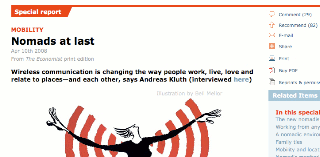
So the author’s name shows up in what we call the “rubric” of the opening chapter. It looks like this:
2) The World in 200x.
Another exception concerns our sister publication, The World In [Year]. It’s an annual magazine, and the new one, The World in 2009, just came out. Here is my piece in it. As you see, it has my name at the top and at the bottom.
3) Podcasts and video
This is an interesting category of exceptions, because it is new. We have had audio interviews with the authors of Special Reports for a while, but in 2006, when I wrote this Special Report about the new media, we fittingly experimented with podcasts. Somewhat to our surprise, they became hugely popular, hitting the iTunes charts with almost no effort on our part.
The thing about audio and video, of course, is that these media are extremely intimate and extremely personal. There is absolutely nothing anonymous about them. You hear the author’s “voice,” literally. This did not go unnoted at the time. The door of anonymity was opened ajar by another inch.
4) Reader letters
When you send a letter to the editor, it gets forwarded to the author of the article in question. And I have, I believe, answered every single letter by email for the past eleven years. Like many of my colleagues, I sign my replies, so anybody who wishes to know who wrote a particular piece can simply write a letter and wait.
Ironically, the new-media revolution has had a contrary effect on these exchanges. A while ago we started allowing people to comment on our web site directly underneath our stories. There are still a lot of letters to the editor, but a lot of this traffic now seems to get diverted to the comments sections. And I do not bother to answer those.
5) Extracurricular activities
As correspondents, we have always moderated panels at conferences and such. Each time we do, we are introduced by name and affiliation, and then the audience hears us talk. So they meet us.
Nowadays, several of us have also started personal blogs. Mine is the most recent example. Edward Lucas has for years had his blog about Eastern Europe and his book. Gideon Lichfield wrote a blog about Israel and Palestine while he was posted in the Middle East. Tom Standage has his site, as do all of us who write books.
My views
I won’t tell you. But I will say this: When I joined The Economist in 1997, I loved the anonymity. I had no name, no personal brand, and I felt that from my first day my articles had the same chance of being on the cover as anybody else’s. I expend as much effort on a tiny “box” as on a huge Special Report.
Admittedly, during the past eleven years, there have been moments when I wished that my cumulative work might have given me a personal brand. Writers at the New Yorker eventually become known as writers. We don’t. Writing a book is one way out of that dilemma. That is not why I’m writing a book. Nonetheless, it is quite remarkable how many of us do.
The view that counts
Ultimately, what the writers think ought not to be the decisive criterion. Duh. It is the readers who matter. But this is where it gets really interesting. Anecdotally, I have found that most readers tell me that they would prefer to know the writer’s name. But I wonder whether they actually do. It is also possible that something might get lost along the way. Something je-ne-sais-quoi. There is only one way of finding out, but the problem is that this experiment would be hard to reverse. So, what do readers actually want?
Thanks to Abhishek for pointing out a life story that fits the theme of my book, which is that success and failure can be impostors, as Kipling would say. Abhishek emailed that
The other day, I downloaded a documentary on Syd Barret [the co-founder of the band Pink Floyd] from You tube. This is a classic story of Hannibal of the 1970’s. A 22 year old Barret was at his peak as the lead singer of Pink Floyd and then he lost it all to LSD. During concerts, he stood on the stage stoned and out of sorts strumming his guitar playing all the wrong notes. His colleagues would somehow cover it up, but one fine day they had to pick up their bags and leave him behind…
Now, this actually not a “story of Hannibal,” because Hannibal’s life trajectory had more twists and turns and was more perplexing. But I do have a chapter where I explore this–ie, Barret’s–sort of life trajectory, which we might call “premature success.”
Contemplating his success
Contemplating Barret, I think of people like Diego Maradona, who soar to fame, success or some other kind of triumph in their field, but apparently too early in life to be able to cope with it. Then they fall apart. Drugs, alcohol, or less obvious but equally insidious lapses of personal discipline. They become wrecks.
Meriwether Lewis, you recall, is the first half of the Lewis & Clark expedition that explored the North American continent west of the Mississippi and to the Pacific after Thomas Jefferson bought those lands from Napoleon. Lewis is, in many ways, an American Hannibal: a young, dashing hero who did what many thought was impossible.
Meriwether Lewis
But what came next? Whereas his friend William Clark, upon their return, married and lived happily, Lewis fell apart. He couldn’t handle the fame. No luck with women. Booze, later even morphine. He did not publish his famous Journals. Jefferson made him governor of the territory he had explored, but he failed in every respect, defaulting on his debts and drinking himself into oblivion. In his mere thirties, only a few years after his breathtaking success, he killed himself in a dingy Tennessee tavern (although the event remains a bit of a mystery).
Impostor triumph indeed. To me, this sort of tale is not the end of a story but the beginning of one. What happens to these people?
Joe Queenan in the New York Times has an amusing but stirring piece on ridiculously over-the-top book reviews–in short, most reviews:
The least-discussed subject in the world of belles-lettres: book reviews that any author worth his salt knows are unjustifiably enthusiastic. …
the vast majority of book reviews are favorable, even though the vast majority of books deserve little praise. Authors know that even if one reviewer hates a book, the next 10 will roll over like pooches and insist it’s not only incandescent but luminous, too. Reviewers tend to err on the side of caution, fearing reprisals down the road. …
such reviews are unfair to the reader, who may be hornswoggled into thinking that Philip Marlowe really would tip his hat at the author, or that the author has gone toe-to-toe with Joseph Conrad and given the ornery old cuss a thrashing. Books are described as being “compulsively readable,” when they are merely “O.K.”; “jaw-droppingly good,” when they are actually “not bad”; “impossible to put down,” when they are really “no worse than the last three.”
I found myself smirking and cringing all the way through his essay, depending on which of my various “book” hats I was wearing in a given sentence.
The first thing to remember about a book review is that there is not only an author somewhere hoping for a good review but also a reviewer hoping to be told by his editor that he has written a good piece (ie, the review). And how boring is a review full of (to take examples from Queenan’s paragraph above) “O.K.” and “not bad” and “no worse than the last three.” Realistically, the editor would spike the entire piece.
So, the reviewer reverts to standard journalistic methodology: “Simplify and exaggerate.” (Before you foam with anger at all journalists, consider the alternative: “Complicate and obfuscate.” Right. Thought so.)
So now the review being written becomes “stronger”. The book is really good or really bad. Next question: If I make it really bad, can the author or anybody allied to him take revenge, now or later? Maybe? Well, perhaps I’m better off making it really good. But not all the time, because then I would lose credibility. Maybe make it really bad (to use Queenan’s ratio) 1 out of 11 times?
At The Economist we try to get around this in two ways:
1) We don’t have bylines, which protects the writer to a large extent. (Authors could in theory find out who trashed their book, but in practice are too awkward and self-conscious to inquire.)
2) We don’t allow conflicts of interest, and stopped reviewing books written by staff a few years ago. (I’m amazed that not all newspapers do this!) In those situations, the reviewer can only lose, and the author usually too.
I leave it up to you to decide whether this addresses all the subtleties of human nature.
Hat Nr. 2: Aspiring author
As you have noticed, I’m writing a book. And when the time comes, I am hoping that it will get fair and tough glowing and drooling reviews.
Seriously, I already dread the entire process that apparently comes next. Prostituting myself for blurbs (the moratorium I support is unlikely to come soon enough to be helpful), then again for reviews, then again on Jon Stewart (if I’m lucky).
Hat Nr. 3: Reader
God. It’s really annoying when the review does not, quickly and easily, tell me if this book is worth two weeks of my night time or not. I mean, really.
So everybody is wondering whether Obama will choose Hillary to be his Secretary of State.
I’ve been thinking that he might do that ever since I heard Obama speak, during the primaries, about Abraham Lincoln. Lincoln shrewdly, wisely, disarmingly followed the advice to “keep your friends close and your enemies closer”. He brought his harshest political rivals into his cabinet, where he could watch them and where their interests were aligned with his. “Do I not destroy my enemies when I make them my friends?”, he once said.
Naturally, Obama’s way of thinking immediately resonates with mine in at least one way: He instinctively looks to history for lessons and guidance in the here and now. I instinctively do the same. It is the premise of my book.
Taizu, the first emperor of the Song dynasty
So here is another story from history that Obama might like. The first emperor of China’s Song dynasty was fighting against a rival, King Liu, to consolidate his rule. Song won and brought Liu to his court, where he offered him a glass of wine. Liu assumed that Song was about to kill him, with poisoned wine, and begged for mercy. Instead, Song laughed, took the glass and drank it himself. Then he made Liu a high-ranking adviser at his court. Liu would be one of the most loyal servants in Song’s retinue.
A while later, Song defeated another king. Song’s ministers lobbied to have this king killed or locked up, presenting reams of documentary proof that he was plotting to kill the Song emperor. The emperor had him brought before him. Then he promoted the man, appointed him to high rank, and sent him home with a package to be opened later. When the man did open it, he found all the documents proving his plot to have the emperor killed. He also became one of the emperor’s most loyal servants.
The benefits of this sort of thing are clear: If your enemies are at large (as Hillary would be in the Senate), they can cause mischief and plot revenge. Their success is your failure, your success their failure. But by bringing them close and aligning their success and failure with yours, you disarm them. Bonus: Because everybody knows that they are former enemies, they must forever work harder than the others to earn their trust.
Wild cards: None of Lincoln’s or the Song emperor’s enemies had a spouse such as Bill. And Bill would still be at large. Oh boy.
I’m reading The Story of My Life by Giacomo Casanova and arrive at the following event, which took place when the boy was eleven years old.
(And yes, this is part of the bibliography for my book. If you’re trying to figure out why, I leave, for the time being, the subtlest of hints here.)
Casanova was in his home town of Venice, with a group of people having supper. An Englishman, who was communicating with the Italians in Latin, which the educated were able to do in the Enlightenment era, wrote down a couplet for young Casanova to read:
Discite grammatici cur mascula nomina cunnus/Et cur femineum mentula nomen habet.
In English: “Tell us, grammarians, why cunnus (vulva) is masculine and mentula (penis) is feminine.”
Casanova announced that, rather than just translating the phrase, he would prefer to answer the question. So he wrote, in pentameter:
Disce quod a domino nomina servus habet.
In English: “It’s because the slave always bears the name of his master.”
“It was,” he says, “my first literary exploit, and I can say that it was from this moment that my love of the glory conferred upon literature began to germinate, for the applause brought me to the pinnacle of happiness.”
Later that evening, the priest charged with looking after him told him it was a pity that he could not publish the couplet or Casanova’s response.
“Why?”, Casanova asked.
“Because it’s smut. Still, it’s sublime. Let’s go to bed now and speak no more of it. Your response is extraordinary because you know neither the subject nor how to write verse.”
Technically, the rendering shows the city as it was in 390AD, during the reign of Constantine. The main characters in my book–Hannibal, Fabius and Scipio–lived 600 years earlier. But who cares. Just wallow in your imagination and picture Fabius and Scipio arguing here, Scipio Triumphing here, …..
I just came across this quote from Yeats in Robert Greene‘s The 48 Laws of Power. More specifically, in Law Number 30, which says (page 245):
Make your accomplishments seem effortless. Your actions must seem natural and executed with ease. All the toil and practice that go into them, and also all the clever tricks, must be concealed. When you act, act effortlessly, as if you could do much more. Avoid the temptation of revealing how hard you work–it only raises questions. Teach no one your tricks or they will be used against you.
Greene takes us through a Japanese tea ceremony, through Houdini’s vanishing acts and other artistic/aesthetic feats that would be ruined if the effort were visible.
The best word to describe the ideal is sprezzatura. Italians are better at it than most. It is “the capacity to make the difficult seem easy” and “a certain nonchalance which conceals all artistry and makes whatever one says or does seem uncontrived and effortless.”
It’s why Michelangelo, master of sprezzatura, kept his work-in-progress under wraps and would not allow even the pope to sneak a peek. Would have killed the magic.
Ease = Beauty = Power.
Writers strive for it. I do.
Here, by the way, is a sixteen-minute TED talk on “glamor,” where we discover that they key is…. sprezzatura!





 Hannibal and Me: life lessons from history