Livy

I left off my series on the bibliography for my book with a long post on Polybius. Polybius, as I said, was one of the greatest historians ever, but most of his books were lost. This means that for the history of Hannibal’s war against Rome we have to rely heavily on another ancient source. And that is Titus Livius, or Livy in English.

There are big problems with Livy. He lived a century and a half after Hannibal’s war. Polybius had interviewed eye witnesses and traveled Hannibal’s route, but Livy did not even attempt any such research. Instead, he merrily plagiarized Polybius (and mentions him only once, by my count). At least we can take comfort from knowing that he had all of Polybius available to him, as well as other sources lost to us, such as Roman documents.

The next problem is that Livy had an agenda other than telling the best and purest history. Like his contemporary Virgil, Livy was writing under the reign of the emperor Augustus, who “restored” Rome’s republic after the long civil wars by replacing it with a monarchy in all but name.

Virgil responded by writing an epic poem, the Aeneid, placing Augustus in the context of a noble unfolding of destiny. A literary masterwork, but somewhat close to brown-nosing the great emperor. Livy sort of did the same, only in prose. So he starts his “history” with Aeneas’ flight from Troy, his journey to Italy, Romulus and Remus and so forth.

Aeneas flees burning Troy

Aeneas flees burning Troy

In general, Livy always makes the Romans look good and their enemies look bad. So the Gauls are unreliable and lazy brutes. The Greeks are savvy but slimy know-it-alls. The Carthaginians are either cruel or cunning or miserly or deceitful. Much of Livy is propaganda. Awfully entertaining propaganda, as it happens.

So if Polybius clearly emulated his fellow Greek Thucydides in trying to stay close to facts and analysis, Livy takes Herodotus as his example and embellishes and invents freely for the sake of a cracking good read. At that, he succeeds.

When the Europeans woke up at the end of the Middle Ages and rediscovered the classics, Livy became one of their favorites.

Personally, I couldn’t care less about Livy’s shortcomings. I’m in it for the stories, the characters, the scenes that I need to tell the story that I want to tell, which involves so many other people. More to come soon.


Bookmark and Share

Meaningless quotes by non-entities

Good things happen whenever I clean out my old emails. Here is one from our editor at The Economist, John Micklethwait, regarding the use and misuse of quotations in writing:

At our meeting on Friday I read out part of a letter … by Alan Parker, who used to work for us in the 1970s, and its main point was to explain – in a touchingly matter-of-fact way – that he had just discovered that he was about to die (which he did indeed do two weeks after he sent the letter). … I still think one part of it is worth passing on:

“I shall continue to read The Econ for the rest of my life, as my sub will outlast me. I shall enjoy it of course, but I should enjoy it even more if my death-wish could be granted: viz, that the editor decrees that henceforth all meaningless and trivial quotes should be excised before the copy gets anywhere near him. I cannot abide the constant oscillation between (a) serious reporting, and (b) meaningless quotes by non-entities. All I want is the story, clear and concise and preferably with a bit of style. As soon as I get to “Joe Bloggs, an accountant, says ‘these are big numbers'”, I turn over the page….”

I think he had a point. One of our hallmarks has always been avoiding the gratuitous quotes that slow down our rivals. Obviously, we should quote people when they are saying something new and refreshing – just as we should credit other news organisations. And I also accept that good sources occasionally need some form of payback; but, if you want to bring them into the story, make sure they are saying something that is original, which does not slow down the piece.

In general, our rule with quotes should be that either the singer or the song should be interesting. Thus “America is in trouble in Iraq” is worth using only if, say, the speaker is George Bush. But I would add three particular bugbears of mine. The first is beginning a paragraph with a general quote from an uninteresting source (“America is in trouble in Iraq” says Dwight Smith of the Foreign Policy Institute), when we are really just introducing a new part of our argument – and very little of what follows could be seen as Mr Smith’s unique insight. Quote Mr Smith later by all means if he has uncovered a new fact about National Guard numbers, or use him as an example of one side of a debate; but don’t hand over the paragraph to him – unless he deserves it. Second, where we do quote, we should whenever possible simplify intrusively long titles (so “Professor Dr John Smith, head of special research projects at the Joe. A. Doe  Global New Media Centre at Massachessetts Institute of Technology” becomes John Smith of MIT). And, lastly, one word is often preferable to a full quote: “This research strikes me, on the basis of available evidence, as dubious,” said Professor John Smith etc can happily become, “The research is “dubious”, reckons John Smith of MIT”.

The alternative is more people turning over the page.


Bookmark and Share

America as the new Rome: Polybius and us

Anybody seen Polybius?

Anybody seen Polybius?

In my previous post on Polybius, I promised to tell you why he is so important to us Americans in particular. Here is why:

His ultimate explanation for Rome’s greatness was that Rome had a constitution that was uniquely and perfectly balanced between the three types of government: monarchy, aristocracy, and democracy.

An excess of any of the three, Polybius thought, was bad. Monarchy led to tyranny, aristocracy to oligarchy, and democracy to mob rule. (Worth pondering, you anti-elitist Palinistas out there.)

But Rome achieved balance: the consuls were the monarchical element, the senate the aristocratic, and the popular assemblies the democratic.

Our founding fathers agreed with Polybius completely. And so they set out to create that same, perfectly-balanced constitution. Arguably, they succeeded. So we are the modern Rome of Polybius!

(I can tell you what the American analogs to the consuls, senate and assemblies are, but I’ll let you guess first.)


Bookmark and Share

Polybius

First off in this series of posts about the bibliography for my book–in the category of ancient sources–is, of course, Polybius. His life is one of the most fascinating ever lived, and his importance to us–especially to us Americans, as I will explain in the follow-up post–is enormous.

Let me lead up to Polybius in three short steps:

Herodotus

Herodotus

1) The first “historian” in history was a Greek writer named Herodotus. He lived during the fifth century BCE, the golden age of classical Greece, and wrote what he called “enquiries”, or histories in Greek. So that’s where we got the word! The main matter he was “enquiring” into was the glorious victory of the Greeks over the Persians, which forever changed world history.

In style, Herodotus was a genius story-teller, and I love him for that. But he was, shall we say, liberal with the facts and the truth. He tells us that Ethiopians have black semen, and so forth. He did not lie, but he embellished. But what the heck! He was the first.

Thucydides

Thucydides

2) Next up, one generation after Herodotus, was another Greek (it’s pretty much all Greeks from here on for a few centuries), named Thucydides. He was critical of Herodotus’ methods and wanted to bring a more factual, rigorous and scholarly style to history-writing. And I love him for that just as much as I love Herodotus! Together, Herodotus and Thucydides gave us history, my passion, just as Plato and Aristotle, another pair of Greeks one generation apart, gave us philosophy.

Thucydides had another war as his subject, as important to world history as the Greco-Persian wars. He wrote about the Peloponnesian war between Athens and her allies and Sparta and her allies. As the the Greek victories over the Persians had made the Greeks (even though there was no country called Greece) preeminent in the known world, the fratricidal war among the Greeks prepared their political decline. It was a tragedy.

In the process of describing this tragedy, Thucydides brought an analysis to bear that is also considered the foundation of all International Relations, and in particular of Realism in world politics (think Kissinger). That was my subject in graduate school, in case you care.

3) Next up were several other Greeks, including Xenophon, who would be giants in their own right were they not wedged between Thucydides and our guy, Polybius. So, because this is along post already, we will skip over them.

4) And now: Polybius.

He was a Greek. No surprise. In style he took clearly after Thucydides rather than Herodotus, which is to say that he believed in facts, research, cross-examination of eye witnesses, and above all in travel. Polybius  personally traced the route of Hannibal in order to write about his war.

Polybius was born about two centuries after Thucydides died, so the Mediterranean had changed completely. The Greek city states had declined in power after the tragedy that Thucydides described and then been swallowed up by Macedonia and Alexander the Great. Then Alexander died and his generals carved up the eastern Mediterranean into huge monarchies. In the western Mediterranean, Carthage was still the superpower.

But–and this is the phenomenon that Polybius tried to explain in his Histories–all that changed during his life time. Rome survived its war against Hannibal and Carthage by a hair. Then it turned east toward the Greek world until it dominated the whole Mediterranean. Polybius wanted to explain how and why Rome was able to do all that.

The circumstances in which he did his research would make a thriller all by themselves. He was a Greek aristocrat and when the Romans got around to his part of Greece they decided to send 1,000 hostages back to Rome just to keep the Greeks well-behaved. Polybius was one of them. He went to Rome as a prisoner for sixteen years!

But the Romans had a very nuanced and complex relationship towards Greeks. They dominated them politically and militarily but they admired and envied them culturally. A big historical thesis is that Rome was both captor (militarily) and captive (culturally).

Polybius’ fate shows that. He wasn’t thrown into a dungeon in Rome but became the guest and teacher in the household of the great Scipiones. Yes, that’s the family of great Scipio, Hannibal’s nemesis. So he had access to all the family archives. He and the younger Scipiones became very close, and some scholars say that this may have biased him towards their role in the Hannibalic war. Personally, I don’t care.

Polybius also stood next to a Scipio (the adopted grandson of Scipio the Great) when the Romans finally burnt and razed Carthage to the ground.

As a practical matter, Polybius then had to tell the story of all three wars between Rome and Carthage leading up to this moment. And for that, he talked to people who had known Hannibal, to veterans on both sides, crossed the Alps and so forth. This is why he is my, and everybody’s, first and best source.

Now, there is only one huge problem with Polybius. It is this: Most of his writing was lost. You may have other things to worry about in life, but I actually cringe when I think of what that means.

In practical terms, it means that we need a few other sources. Next, After the follow-up: Livy.


Bookmark and Share

My bibliography

Before I start, a snapshot of the overall structure of my bibliography: It’s the same as the structure of the book. That is to say, there is one overarching story–that of Hannibal and Scipio–and then each chapter introduces other lives from other times that fit what was happening in Hannibal’s life in this chapter.

This means that I have in effect two bibliographies: One, a classic library on ancient history–specifically, the Punic Wars. The other, an eclectic and perhaps unfathomable collection of biographies, psychology and philosophy to illustrate certain themes.

Stay tuned.

Why Andrew blogs

Andrew Sullivan

Andrew Sullivan

Andrew Sullivan, celebrity blogger and acerbic teller of truth, writes a long treatise on why he blogs in The Atlantic. He’s been at it far, far longer than I have, but his reasons are the same as mine. Some excerpts:

On finding a telos and a voice as a blogging virgin:

I remember first grappling with what to put on my blog. It was the spring of 2000 and, like many a freelance writer at the time, I had some vague notion that I needed to have a presence “online.” I had no clear idea of what to do…

I realized that the online form rewarded a colloquial, unfinished tone. … So I wrote as I’d write an e-mail—with only a mite more circumspection. This is hazardous, of course, as anyone who has ever clicked Send in a fit of anger or hurt will testify. But blogging requires an embrace of such hazards, a willingness to fall off the trapeze rather than fail to make the leap….

On the sense of liberation from the evil editor:

It was obvious from the start that it was revolutionary. Every writer since the printing press has longed for a means to publish himself and reach—instantly—any reader on Earth. Every professional writer has paid some dues waiting for an editor’s nod, or enduring a publisher’s incompetence, or being ground to literary dust by a legion of fact-checkers and copy editors. If you added up the time a writer once had to spend finding an outlet, impressing editors, sucking up to proprietors, and proofreading edits, you’d find another lifetime buried in the interstices. But with one click of the Publish Now button, all these troubles evaporated….

On the intimacy and authenticity of blogging:

That atmosphere will inevitably be formed by the blogger’s personality. The blogosphere may, in fact, be the least veiled of any forum in which a writer dares to express himself. Even the most careful and self-aware blogger will reveal more about himself than he wants to in a few unguarded sentences and publish them before he has the sense to hit Delete. The wise panic that can paralyze a writer—the fear that he will be exposed, undone, humiliated—is not available to a blogger. You can’t have blogger’s block. You have to express yourself now, while your emotions roil, while your temper flares, while your humor lasts. You can try to hide yourself from real scrutiny, and the exposure it demands, but it’s hard. And that’s what makes blogging as a form stand out: it is rich in personality. …

On how the new medium of blogging is likely to reinvigorate the older text media:

A blogger will air a variety of thoughts or facts on any subject in no particular order other than that dictated by the passing of time. A writer will instead use time, synthesizing these thoughts, ordering them, weighing which points count more than others, seeing how his views evolved in the writing process itself, and responding to an editor’s perusal of a draft or two. The result is almost always more measured, more satisfying, and more enduring than a blizzard of posts. The triumphalist notion that blogging should somehow replace traditional writing is as foolish as it is pernicious. In some ways, blogging’s gifts to our discourse make the skills of a good traditional writer much more valuable, not less. The torrent of blogospheric insights, ideas, and arguments places a greater premium on the person who can finally make sense of it all, turning it into something more solid, and lasting, and rewarding….

In fact, for all the intense gloom surrounding the news-paper and magazine business, this is actually a golden era for journalism. The blogosphere has added a whole new idiom to the act of writing and has introduced an entirely new generation to nonfiction. It has enabled writers to write out loud in ways never seen or understood before. And yet it has exposed a hunger and need for traditional writing that, in the age of television’s dominance, had seemed on the wane.


Bookmark and Share

Sarah Palin: Monty Python could have written this

So says no less an authority than John Cleese. Palin (Sarah, not Michael), he says, is “a nice-looking parrot” that has been trained to utter a few phrases beautifully, without understanding what they mean…


Bookmark and Share

The headbanger swim teacher

David White, my daughters swim teacher

David White, my daughter's swim teacher

You’ll need a healthy sense of irony and the surreal and quirky to enjoy this one. It’s a brief multimedia rumination on 1) fatherhood, 2) authorship and 3) the clash of the two.

Background information:

1) I took this past week off, ostensibly for vacation, but really to work on the book, because I feel so close to finishing it. Yeah, right.

2) I had agreed, for the entire week, to drop off and pick up my daughter from pre-school, while my wife stays with the baby, and then to drive my daughter to a sweltering suburban valley where a fantastic swim school is giving her a crash course. After all, I’m on vacation, right? And I can still blog and write my book, right?

Well, here is a “day in the life” of the aspiring young author:

  • Wake up by being kicked out of bed by daughter, who was not supposed to be in this particular bed to begin with, then discovering that she peed on the bed just out of spite.
  • Gulp down coffee while discovering that there is no muesli or other acceptable breakfast, because nobody in the family has had time to go shopping for weeks.
  • Kiss wife and baby goodbye while wrestling rebellious daughter into car and turning on, for first of many times on this day, the CD of Die Maus.
  • Drop off daughter, hurry back to “write book”, but only after clearing out email inbox of 634 new messages and RSS reader full of 131 new posts, checking 8 new voice mails…
  • Give up after 23 emails, without having written a sentence of the book, to pick up daughter and drive to swim school
  • Sit by eerily placid poolside in suburban California watching David White play with daughter in the pool, succeeding skillfully at getting her to dip her cheeks and nose in the water.
  • Discover that David White, gifted swim teacher and cool guy, is actually lead singer of heavy-metal band Heathen.
  • Drive back, listening to CD of Die Maus again, having memorized all two hours of it by now.
  • Arrive back to discover that dishes need to be done, and that the day is over
  • Repeat five times, until “vacation” is over…


Bookmark and Share

Uncle Lulu

That guy with the cigar on this West German stamp from 1987 is my great-uncle, Ludwig Erhard, or “Onkel Lulu” in our family.

Why is he on this blog?

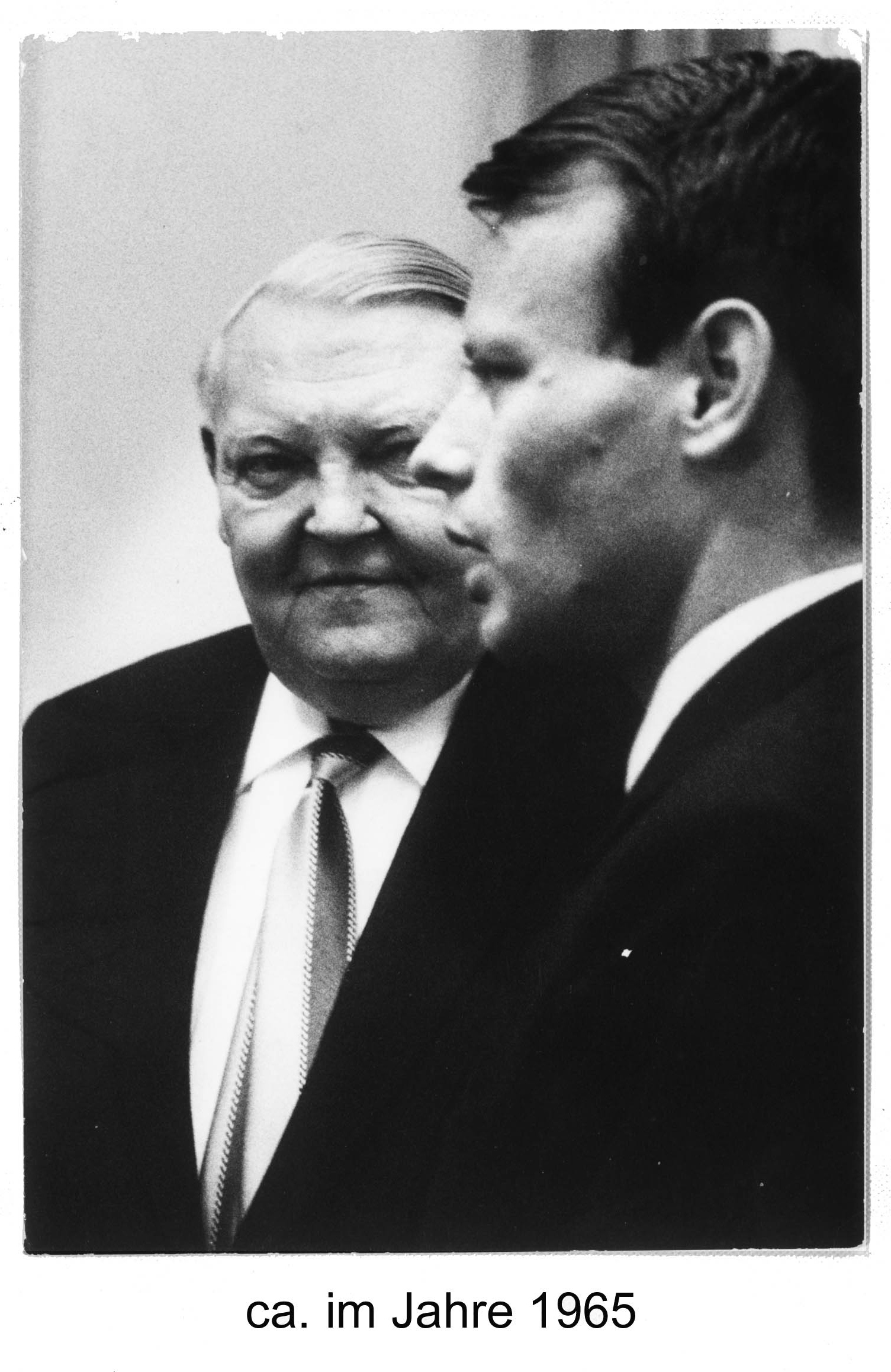
Newspaper cutting of my dad and his uncle

Newspaper cutting of my dad and his uncle

Because is life is one of those I trace in my book, to show that that what happened to Hannibal and Scipio happens to all of us, one way or another.

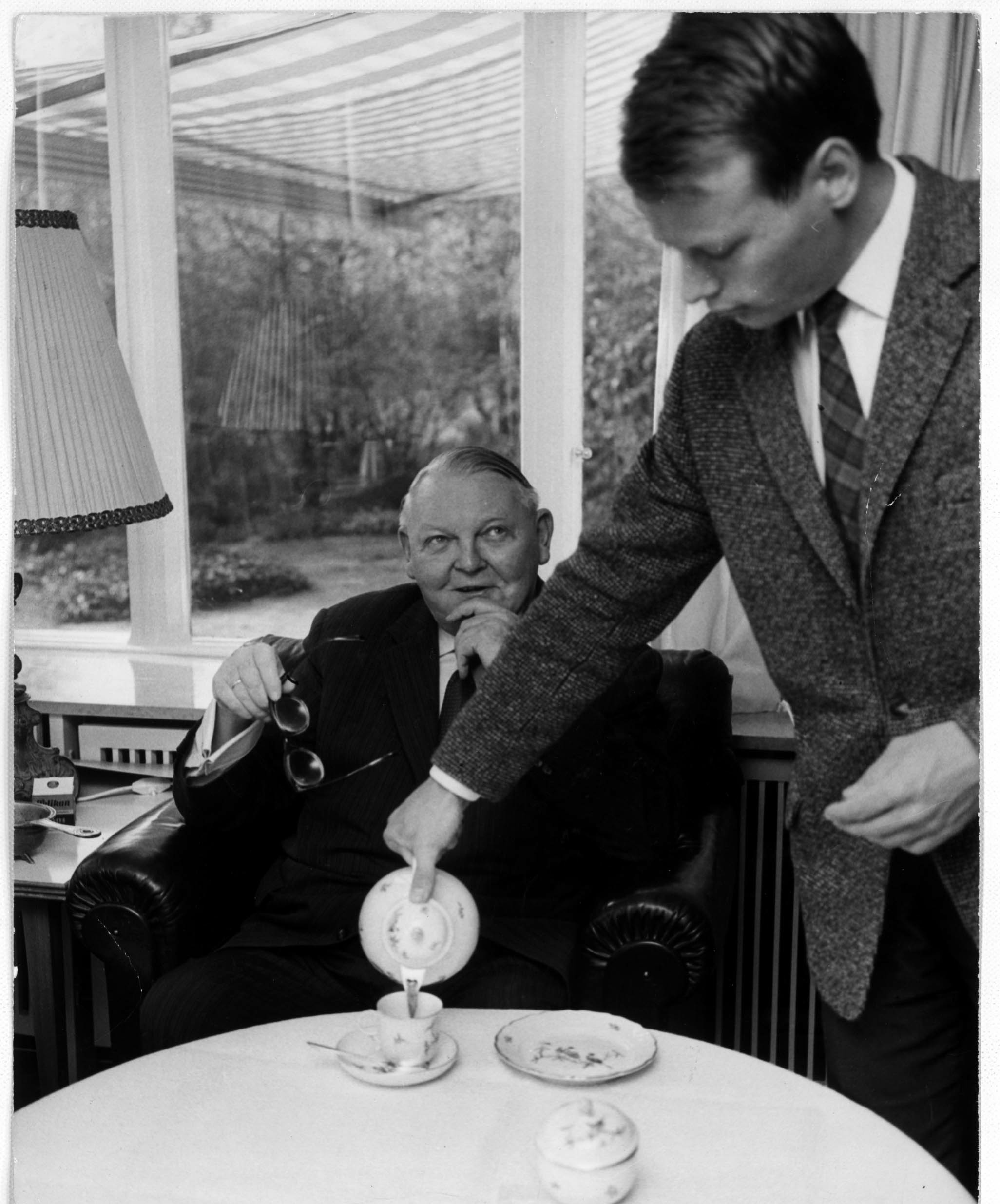
My dad pouring tea for his uncle, the chancellor, in the 60s

My dad pouring tea for his uncle, the chancellor, in the 60s

In Germany and continental Europe, Ludwig Erhard is a household name. In America, he is not, but should be. He is famous for being a founding father of post-war (West) Germany, its first economics minister, the father of its currency (the Deutsche Mark), and then its second chancellor (ie, prime minister). He is credited with causing the stunning economic growth of the 1950s, sometimes called (but not by him) an “economic miracle”. And he is probably the most steadfast proponent of freedom, tolerance and open and fair markets in German history.

Dad and Lulu again

As my father’s uncle and godfather, he practically raised my father after my grandfather died. I only met Lulu when I was very small (he died in 1977). He liked to hide Easter eggs for me in his steep hillside garden by the Tegernsee, an Alpine lake south of Munich. His influence lives on, in Germany, in our family, and now in my book.

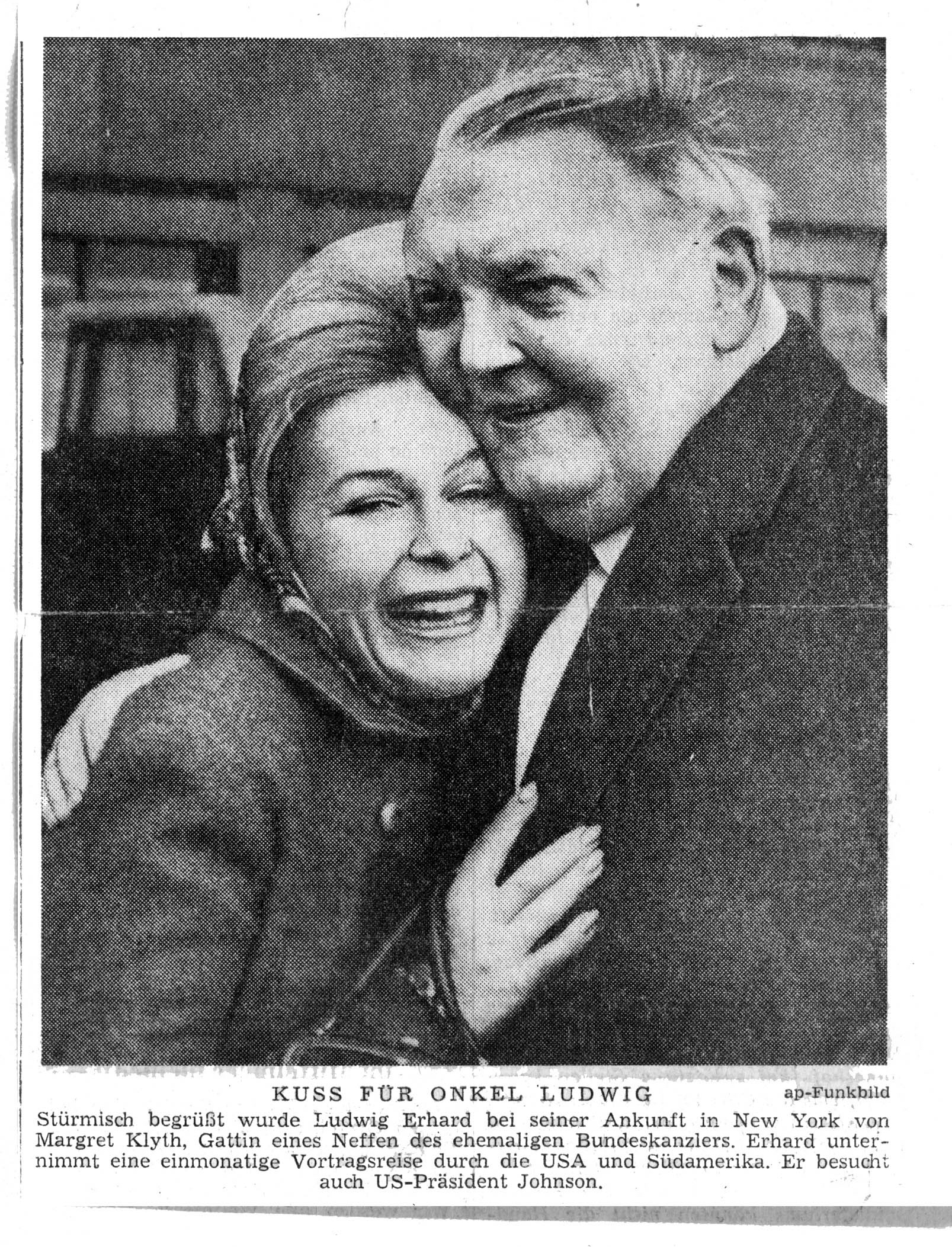
My mom with Lulu in New York, where I was born

My mom with Lulu in New York, where I was born