The spoken and the written word

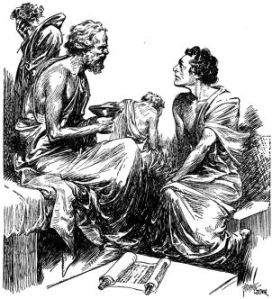
Socrates_teaching

So Socrates loved good conversations, which he called dialectic, and disdained bad conversations, which he called eristic, as I described in the previous post of this series on Socrates. But that actually opens up lots and lots of fascinating and difficult issues.

For instance: the relative value of the spoken and the written word.

Since I happen to write words for a living, I spend quite a bit of time pondering this, as you might imagine.

Socrates never wrote a single word. He did not believe in it. Why waste your time killing words (since to write them down was, to him, to kill them) when you could send them back and forth in intimate conversation such as the scene (with him on the left) above?

His student Plato was more schizophrenic on the point. He agreed with Socrates but also, obviously, felt that he should write things down to make them immortal, to reach more people, to make Socrates’ wisdom ‘scalable’ in our lingo. So he compromised, you see: He “wrote” by transcribing … conversations!

One generation on, and we get to Aristotle, who clearly did not agree at all, and wrote what we would consider genuine philosophical treatises. No qualms about the written word at all!

Why did Socrates disdain the written word?

He sort of tells us in one of his (ie, Plato’s) dialogues, the Phaedrus. He takes several shots:

  • He tells a legend from Egypt, in which a god gives a king the gift of writing as an aid to memory. The king, however, observes that writing things down is likely to be a remedy for reminding, at the expense of remembering, and thus will lead to less wisdom, not more.
  • He then compares writing to paintings, which “remain most solemnly silent” whenever you question them, and just say the same thing over and over, stupidly and dumbly. People wise and ignorant alike will look at them and understand and misunderstand them. And they (the words/pictures) cannot talk back, defend themselves, explain themselves.

So text has several problems, in Socrates’ opinion:

  1. It is not a conversation, not dialectic, because it cannot go back and forth and climb toward something higher, such as a truth.
  2. An author has no control over what idiots or assholes might read his text, whereas somebody in oral conversation does control with whom he speaks.
  3. Words outside of their original context (ie the intention of the person using them, and the way a listener might hear them) can mean anything, and thus nothing at all.

Ultimately, Socrates disdained writing for a subtler reason that unifies all these points: It’s just not what life is about!

Instead, life is about communing with others and discovering yourself and truths in conversation. Not about recording this or that, or propagating this or that. Socrates believed that you can’t find yourself when you write, only when you converse.

Where does that leave us writers?

In a tight spot, it would seem.

Then again, we have moved on 2,400 years, and few things are becoming clearer. Here is how I would converse with Socrates on the matter if he were to visit us today:

The need for conversation…

First, I would tell him that he is mostly right, even and especially for writers. Only a tiny part of “writing” consists of typing words–5%, if I had to guess. The other 95% consists of living, experiencing, interviewing, discussing, talking, reading what others have written, and so on. The ideas and stories that end up on pages don’t come out of nowhere. They still come out of conversations.

… but also for order

But writing, which should never replace conversation, has something to contribute: order. Real conversations–and Socrates’ own dialogue with Phaedrus is a great example–run all over the place, like foals on a meadow. That’s the fun. But it can also be frustrating when you want structure and discipline about one particular issue. Writing can simply be a way of forcing yourself to structure the thoughts that came up in conversations.

Why not written conversation?

This is one bit that Socrates overlooked. You can converse in written form.

Some of the greatest conversations in history have been exchanges of letters. Just think of Voltaire and Frederick the Great.

Today there is a fascinating technological twist. In 400 BCE, it was impossible to imagine ‘place-shifting’ (via tele-phony, far-hearing) or time-shifting conversations. But time-shifting is exactly what we do when we …. blog!. I write words, and those then turn into conversations in the comments below, or on other blogs that link to them. So the words are not dead at all. They can talk back. Writing can be conversation.

Indeed, by time-shifting the back-and-forth of a real conversation, the dialectic can become better. All of the people who talked to Socrates must have felt, a few hours later: “Doh! If only I had said…..” Well, now it’s possible to take a moment to think–without the distractions of, say, a famously ugly face such as Socrates’, or body odor, or wind, or sun–and then to come back with a clearer thought.

The inevitability of context

But Socrates was right on at least one point: The written word without context, as provided by conversation, is treacherous. Just take this notorious example, which we call the 2nd Amendment:

A well regulated Militia, being necessary to the security of a free State, the right of the people to keep and bear Arms, shall not be infringed.

Does that mean that a people has the right to keep an armed militia, or that every shmuck in the people individually has a right to bear everything from a pocket knife to nukes, whether there is a militia anywhere to be seen or not?

Socrates would find the author and … converse!

Bookmark and Share

Good & bad conversations: Recognize Eris

Eris_(Discordia)

I ended the previous post, the first in this series on Socrates, by suggesting that we “count all the other ways in which Socrates, like Hannibal, is relevant to us, today.” So let’s start with perhaps the most important (if not the most famous) insight that Socrates gave us: the incredible importance of knowing good from bad conversations. And for that, I need to introduce you to that strange lady above, whose named is Eris.

We spend much of our lives, and indeed many of our happiest moments, conversing with others. I love that word, which means turning toward each other. Good conversations make us human and whole, make us feel connected to others and bring us closer to the truth of something (or at least further from a fallacy).

Unfortunately, we also spend at least as much time in bad conversations. You know them:

  • bickering between husbands and wives
  • political “debates” on Fox, or indeed almost anywhere else.
  • Cross-examinations in courtrooms,
  • and on and on and on

Those “conversations”, which are really a turning away from one another, do the opposite of what good conversations do: They leave us depleted, down, disconnected, alienated, sleazy, yucky.

What is the difference between the good and the bad conversations? Socrates told us, by giving us two new words:

  • dialectic (=good), and
  • eristic (=bad)

Meet Eris, the Ur-Bitch

So now it’s time for a story. It’s the most famous of the many stories about Eris, whose Roman name was Discordia.

Eris was the goddess of strife. Nobody liked her, so when the future parents of Achilles had their wedding, everybody was invited except Eris. Eris fumed.

She knew what she was good at, and did it: She left a golden apple lying around the wedding party. It said “To the most beautiful”. How cunning, how feminine.

Three extremely beautiful goddesses, Hera, Athena and Aphrodite, immediately started bickering about who had rights to the apple. It was decided to appoint a judge, somebody sufficiently hapless, naive and male to be easily manipulated. They settled on Paris, a prince of Troy.

“Paris,” whispered Athena, “don’t you think I’m the most beautiful? I’m the goddess of wisdom, as you know, and I could be persuaded to make you the wisest man alive.”

“Choose me,” said Hera, “I’m the wife of Zeus and can make you the most powerful man in the whole world.”

“Oh, Paris,” cooed Aphrodite with a tiny bat of her languorous eyelids. “You know who I am, don’t you? We all know that the apple is mine. Say so, and I will give you the most beautiful woman in the world.”

Paris, with the priorities of the average teenager, chose Aphrodite. Athena and Hera were fuming. Hatred descended on the wedding party. And everybody knew that Paris was now to get Helen, the most beautiful of the mortal women.

The only problem: Helen was already married, to a Spartan who was the brother of the great king Agamemnon. Agamemnon and his Greeks would have to come after Paris and his Trojans to get Helen back. Ten years of bloody war followed. Eris had outdone herself.

Eristic conversation

So Socrates chooses to call bad conversations eristic. They are full of strife, because–and this is the key–they are conversations in which each side wants above all to win. Where there is a winner, there is usually a loser, so these conversations separate us.

The opposite was dialectic, whence our word dialogue, the Greek form of the Latin conversation (ie, turning toward). When you turn toward another, you are not trying to win, you are trying to find the truth. That is your motivation, and it is one you share with your conversation partner (as opposed to opponent). Everybody wins, as long as you climb higher through your conversing, toward more understanding or more communion.

We today

I mentioned in the previous post a series of serendipitous events recently. The first was an email from Cheri Block Sabraw, a writing teacher and reader of The Hannibal Blog, that pointed me to this essay, “Notes on Dialogue”, by a great intellect named Stringfellow Barr.

Written in 1968, it might as well have been penned today, as Barr describes eristic and dialectic conversation in our own world:

There is a pathos in television dialogue: the rapid exchange of monologues that fail to find the issue, like ships passing in the night; the reiterated preface, “I think that . . .,” as if it mattered who held which opinion rather than which opinion is worth holding; the impressive personal vanity that prevents each “discussant” from really listening to another speaker and that compels him to use this God-given pause to compose his own next monologue…

Expressing the Socratic ideal, Barr says that

We yearn, not always consciously, to commune with other persons, to learn with them by joint search,

and that

the most relevant sort of dialogue, though perhaps the most difficult, for twentieth century men to achieve and especially for Americans to achieve is the Socratic….

What makes good (Socratic) conversations good? They have a completely different dynamic than bad conversations. They tend to be

  • poor in long-winded declarations and rich in short, pithy back-and-forth,
  • egalitarian in that it does not matter who says what but what is said (even though this does not mean “equal time” for any nonsense)
  • spontaneous, in that they follow wherever the argument leads, even and especially to surprising destinations,
  • playful, and indeed humorous, for that is what makes “serious” investigation possible and sublime.

In short, this sort of conversation is what The Hannibal Blog is about, with the amazing input by all of you in the comments that make each topic come alive. If The Hannibal Blog is against anything, it is Eris and her spawn.

And so I leave you with just one famous instance when two fakers were called to account and told  just what sort of “conversation” they dealt in:


Bookmark and Share

New thread: Socrates

800px-UWASocrates_gobeirne

The Hannibal Blog is kicking off yet another series, this one on Socrates.

You’ve encountered Socrates before on this blog, as when he represented the “left leg” in this body metaphor of the Western tradition, or when discussing irony. He came up only indirectly, via Plato, in my series on the world’s greatest thinkers, of which he is of course one.

So why now an entire series? Because he deserves it. And because of an oddly serendipitous string of events:

  1. I have been thinking for a while about writing my second book about a theme illustrated by Socrates, rather as the theme of success/failure is illustrated by Hannibal in my first book–even though it’s not even out yet.
  2. Even though I haven’t told anybody about this, several people, indeed several readers of The Hannibal Blog, have been sending me ideas and links and recommendations that have to do with Socrates. (More about those soon.)

Hannibal embodies more than one theme in our lives, although any good story needs one theme for focus, with the others appearing along the way.

For Socrates, too, I have one theme in our lives in mind. But it’s way, way too early to get into that. For the rest of this blog thread, let’s just start counting all the other ways in which Socrates, like Hannibal, is relevant to us, today. There are so many.

Bookmark and Share

Tactics vs Strategy: MacArthur vs Truman

Tactician

Tactician

  • Knowing means from ends
  • Knowing tactics from strategy
  • Understanding why the first must always be subordinate to the second

These, as I argued in the previous post, are the greatest and most enduring lessons of Carl von Clausewitz, and the reason why I include him in my pantheon of great minds.

Where I have most fun in my forthcoming book is in fleshing out his ideas in contexts other than war, to show that strategy applies to all areas of life. But today I want to make his ideas a bit more concrete in the obvious context: war.

So allow me to introduce the two archetypes:

  1. Douglas MacArthur and
  2. Harry Truman
Strategist

Strategist

Here is their story (from one of the best biographies ever written):

Nuke to win, nuke to lose

In June of 1950, Communist forces from North Korea poured south across the 38th parallel in an all-out attack on South Korea. Harry Truman, having come to power late in life, was the American commander-in-chief and had already made history by dropping the first and only two atomic bombs on Asian cities just five years earlier. He knew immediately and instinctively that this Communist attack had to be reversed or contained. And there to execute this purpose, in theory, was Douglas MacArthur, the commander of the United Nations forces in the region, as well as a certified American Hero from World War II and a notorious prima donna.

MacArthur began true to form, with a swashbuckling landing at Inchon in South Korea. He took the enemy by surprise, liberated Seoul in eleven days and, by October 1st of 1950, brought UN forces—primarily composed of Americans—back to the 38th parallel that the North Koreans had crossed. MacArthur now wanted a “hot pursuit” , and Truman authorized him to cross the 38th parallel.

Truman, however, added a crucial strategic condition: Do not to provoke the Chinese to enter the war, lest that should spark World War III and possible nuclear Armageddon!

Right around then, things began going wrong, not only in the war effort but also in the relationship between MacArthur and Truman.

When the two men met–for the only physical meeting of their lives–on  a tiny coral islet in the Pacific, MacArthur tellingly greeted his commander-in-chief but failed to salute. The two men then met alone, before inviting others to join them. Truman made clear his overarching concern, one that Clausewitz would have approved of: to keep this a “limited” war,  meaning a war to meet one single objective—rebuffing Communist aggression in Korea—without risking an escalation into what Clausewitz would have called an “absolute” war.

But the following month, Truman’s fears came true and the Communist Chinese attacked with huge force. Suddenly, MacArthur, who had been dreaming of another glorious military victory, was trying to avoid a humiliating defeat. He demanded:

  • huge reinforcements,
  • a wholesale naval blockade of all of China and
  • immediate bombing of the Chinese mainland.

MacArthur wanted to broaden the war and to burst any remaining “limits” on it. For MacArthur, there was only one objective: victory. At all costs!

Truman thought the exact opposite. His first fear had already come true, and he now worried that the Chinese were the advance guard of a Soviet Russian intervention, what he called “a gigantic booby trap”  that could lead to the explosion of World War III.

Truman and MacArthur started issuing competing press releases. MacArthur began publicly blaming Washington for everything that was going wrong. He disobeyed specific orders. He called on Truman

  • to drop thirty to fifty atomic bombs on the cities of China (!) and
  • to “sever” Korea from China by laying down a field of radioactive waste all along the Yalu River.

MacArthur appeared to have lost his mind. He even issued his own ultimatum to the Chinese government, as if he were president.

Big Man vs Little Man

At last, Truman took the inevitable measure and fired MacArthur. This was an obvious step, but not an easy one. MacArthur, to ordinary Americans, was still a war hero, whereas Truman’s approval was at an all-time low of 26%. (Hard to remember today, but true.) Time Magazine wrote that “Douglas MacArthur was the personification of the big man” whereas “Harry Truman was almost a professional little man.”  In a poll, 69% of the country backed MacArthur. There were calls to impeach Truman. (Never underestimate the capacity of a democracy, whether Athenian or American, to run amok!)

In time, minds cleared. Truman settled for a stalemate in Korea that continues to this day and is as tense and unsatisfactory this week as ever. He chose a “defeat” of sorts that has brought lasting peace. Communism would be contained for another four decades and then crumble, leaving American as the only superpower. Parts of East Asia, like Western Europe, would prosper in relative safety.

Had MacArthur prevailed, America might well have achieved “victory”, at the cost of another world war, nuclear annihilation of millions, and perhaps nuclear counterstrikes on America from the Soviets, who were fast catching up to the Americans in the technology. It would have been the ultimate impostor of a triumph, with nobody left to march in the victory parade through the radioactive planet.

Bookmark and Share

Clausewitz and you: Life strategy

Clausewitz

Clausewitz

It’s time to talk about tactics as opposed to strategy in life, because knowing the difference is crucial to achieving success, and avoiding disaster. And that, of course, is the topic of my book.

The person to know about in this matter (besides Hannibal and Scipio, of course) is Carl von Clausewitz, a Prussian (and later Russian) officer on the losing side against Napoleon. He also witnessed Napoleon’s disastrous retreat from Russia, which made a deep impression on him. Think of him as the equivalent of an adviser to Scipio or Fabius, the Romans on the losing side against my main character, Hannibal.

Clausewitz is without any doubt one of the great thinkers in world history, even though he is enigmatic and still confuses people to this day. The main reason for that is that he spent his career taking notes–hundreds and hundreds of pages worth–which he meant to consolidate into a coherent whole. But then he died of cholera, at the age of fifty-one. So his great treatise, Vom Kriege, “On War”, was not coherent. Even so, it is now considered the most profound work on strategy ever, thanks to the thoughtful analysis of people such as Kenneth Payne, Patrick Porter and David Betz at King’s College in London.

Let’s look at his most famous and controversial quote:

War is nothing but the continuation of politics (or policy) with other means.

Lots of mediocre minds have, over the years, worked themselves into a fury over the alleged cynicism of this quote, entirely missing its point and getting the meaning backward. Clausewitz was not saying that all politics is potentially like war, but that all war must remain subservient to political/policy objectives. This is subtle.

Elsewhere he had set up the basic tension in war: War can in theory be:

  1. absolute, or
  2. limited

In practice, all wars must be limited but simultaneously “want to” escalate. And here we get into Clausewitz’s wisdom:

Means vs ends

A tactical mind always and only wants to win the battle–whatever battle is being waged. (Remember Pyrrhus?) This is the mind that wants to escalate any war toward its absolute extreme. In future posts I will give some devastating examples of what this can lead to.

A strategic mind wants to win “the war” or, better yet, “the peace”! Battles are simply a means to an end. So it makes perfect sense to adjust your battle tactics not to the goal of victory but to the goal of achieving the kind of peace you ultimately want. This almost always introduces moderation and limitation into your tactics.

As with so many bits of profound wisdom, this is deceptively easy to shrug off. But consider how earth-shattering it was in its time. There was, for instance, a pompous strategist named Heinrich von Bülow, who defined tactics as “the science of military movement in the presence of the enemy,” whereas strategy was “the science of military movements beyond the range of cannon-shot of either side.” What banal and trivial drivel!

Now consider how earth-shattering Clausewitz’s insight can be for your own life: “The object of war,” he said, and I will add emphasis in bold:

as of all creative activity, is the employment of the available means for the predetermined end.

And here you see why I include Clausewitz in my pantheon of great thinkers: Simple, profound and specific, and yet expandable to other areas of life.

Have you ever “won” a fight with your lover only to feel that you’ve lost something far greater? “Won” a promotion only to feel that you’ve lost something? “Won” in a bout of office politics only to feel that you should not have entered battle to begin with?

Are you, in your life, confusing tactics with strategy, means with ends? You need some Clausewitz.

Bookmark and Share

Postcard from (yet another) Mount Olymp

This is where I am at the moment.

In Rome, you ask? The home of Scipio, one of the two heroes in my coming book? The place that Hannibal almost took, almost destroyed, but not quite, and which, as a direct result, took over the world–our modern world–instead?

No, actually. I’m in a sleepy little state capital called Olympia. That’s Olympia, as in the abode of the Greco-Roman gods, the place my four-year-old could tell you all about.

Some of the people that I’ve been talking to in these buildings are very aware indeed of the heritage that their architects intended to remind them of, each and every time they walk in and out of their offices. Sam Reed, Washington’s erudite secretary of state (and apparently a direct descendant of Charles Sumner) could go toe to toe with me on Polybius.

Others here look at me blankly when I opine that it must have been quite a controversy to decide between … Doric, Ionic and Corinthian. (But even then they inform me proudly, as three people have now done, that Olympia’s Capitol has the fourth largest masonry dome in the world.)

In any case, I quite savor these improbable links–visual, symbolic, cultural–to our common Western heritage, and to the world of my imagination, peopled as it is with the likes of Fabius, Scipio, Hannibal, Polybius and all the others who are in my book and in our world.

Bookmark and Share

Croesus learns about success and happiness

800px-Claude_Vignon_Croesus

I mentioned that A.E. Housman might have got the idea for his poem, To An Athlete Dying Young, from his study of the classics, in particular Herodotus. I had one particular story from Herodotus in mind when I said that. It is the story of King Croesus.

(The story almost made it into my coming book about success and failure in life, but then it got a bit crowded and I cut it out.)

1) Croesus the happy

In the sixth century BCE there was a king named Croesus in Lydia (today’s Turkey). He was so rich that we still today say “rich as Croesus”. But he always wanted confirmation from others that he was indeed the richest, the most successful, the happiest man alive. Why would he need confirmation? One wonders. But people always do.

As it happened, Solon, the man who had given the Athenians their laws and who was the wisest man in Greece at the time, came for a visit. This was exactly the sort of man Croesus wanted to impress.

I paraphrase (the text is here):

Croesus: ‘Welcome Solon. You’re the wisest man in Greece. I’ve heard so much about you. Please take a tour of my palace and look at all the gold and silver, the women and slaves and fruit, and all my splendor. Isn’t it wonderful? Tell me: who is the happiest man in the world?’

Solon: ‘Tellus of Athens, sire.”

Croesus: [Blank look. Silence.] ‘Sorry, but… Who?’

Solon: ‘Tellus, sire. He was this guy who lived when his country was prosperous, and he had two sons and some grandchildren.’

Croesus [still uncomprehending]: ‘Right. So what? What does that have to do with anything?’

Solon: ‘Well, you see, he died on the battlefield, and the Athenians gave him a proper funeral. So he died knowing that everything was good in his life.’

Croesus [rather miffed, irritable]: ‘Well never mind. Who is the second happiest man in the world?’ [smiles and nods, leans forward]

Solon: ‘Cleobis and Bito.’

Croesus [jumpy, shocked]: ‘Who the hell are Cleovice and Vico?’

Solon: ‘Cleobis and Bito, sire. They were these two young lads in Argos. Their mom wanted to go to a festival but couldn’t find any oxen to pull her cart. So the two sons put the yoke on their own necks and pulled the cart to give their mother a ride. The whole town was watching and everybody loved them for it. Their mom was really proud. Later that night, both her sons fell asleep and never woke up. What a wonderful way to die.’

Croesus: ‘You’re supposed to be a wise man, Solon! What is this gibberish you’re talking? I asked you who the happiest man in the world is. Look around, for god’s sake. Look at me! What about me?’

Solon: ‘You? How would I know? You’re doing well right now. But wealth and success don’t last. And what comes next, nobody knows. I will know whether you were successful and happy after you die.’

Croesus thought Solon was a senile idiot and sent him home. Then he went back to enjoying his life.

2) Croesus the miserable

He fell from happiness in stages.

It started with a bad dream. In it, one of his two sons, his favorite, was killed by an iron weapon. Croesus immediately banned all iron weapons and tools from his palace. But his son soon got bored and went with his friends into the woods for a boar hunt. They cornered the boar and one man hurled a spear. It missed the boar and killed the prince. Croesus was devastated.

But he still had his kingdom, his wealth and another son, even though that son was mute. Even so, that was a lot to be happy about.

At this time, Persia was a rising empire in the east, and Croesus wanted to know his future. So he asked the oracle of Apollo some questions:

  • Will my surviving son ever speak? Answer: ‘You will rue the day when he speaks.’
  • Should I launch a preemptive war against the Persians? Answer: ‘If you march, a great kingdom will be destroyed.’
  • How long will I rule? Answer: ‘Until a mule rules over Persia.’

Apollo, you see, always said enough to be interesting and not enough to be helpful. (Ask Oedipus.) Croesus couldn’t figure out the bit about his son at all. He loved the second answer, since he was apparently fated to destroy the Persian kingdom. And he liked the third answer, since the Persians, as far as he knew, did not obey mules.

Off he went to war. The Persians won and stormed Croesus’ city, Sardis. A great kingdom was destroyed.

As the Persian soldiers were running through the streets to slaughter, Croesus took his son by the hand and ran for his life. One Persian grabbed Croesus and flashed his blade. Suddenly the mute boy screamed: “Do not kill him, for this is Croesus, king of the Lydians.” You will rue the day when he speaks.

So Cyrus, the Persian ruler, had Croesus, his defeated enemy, brought before him. Cyrus was half Mede, half Persian–a mutt. A mule.

A pyre was built, and Cyrus took his throne to watch the spectacle. Croesus was about to be burnt alive. The flames were already licking his feet.

Croesus on the pyre

Croesus on the pyre

3) Croesus the wise

Death was near, and Croesus suddenly thought of Solon. He started moaning:

“Solon, Solon, Solon!” “Solon, Solon, Solon!”

Cyrus sat up. What was this man muttering? This was not the name of a god. Just then it started raining. Cyrus looked up. Whatever Croesus was muttering seemed to be effective.

“Stop the fire. Bring him down. I want to ask him a question!”

Croesus was brought before Cyrus.

Cyrus: “Tell me what you were moaning.”

Croesus: “Solon, sire. He was a man who offered me wisdom and I spurned it.”

Cyrus: “What wisdom is that?”

Croesus: “He said to count nobody happy until the end is known.

Cyrus [thoughtful, empathetic, reflective]: “You may have spurned Solon then, but you seem to be a wise man now. I would be foolish to be the one spurning the wisdom now. I will let you live. I want you to be my adviser.”

Bookmark and Share

Free as Diogenes: a fantasy

800px-gerome_-_diogenes

One of my idols–and everybody has many and mutually contradictory idols–is Diogenes, the ancient Greek sage famous for living with no material possessions in a barrel.

I have to be careful about saying that because it might be misunderstood. Diogenes lived, quite deliberately, like a dog. Above, you see him with dogs. The Greek word for doglike, kynikos (as in, via Latin, the English canine) is the root of our word cynical. Diogenes was a cynic in the original and pristine sense.

So, yes, Diogenes defecated in public, masturbated in the marketplace and generally displayed the same unapologetic honesty towards others as, well, dogs do. I don’t intend to do any of those things, you’ll be reassured to know. So….

What’s the point?

My point, and the point of original cynicism, is to live a life that is:

  • simple
  • virtuous
  • honest
  • free

And there you have them, my favorite themes, especially simplicity and freedom.

Put differently, Diogenes and his crowd reacted against the complexity and dross of human society, something that I have been criticizing especially in American life.

The goal, you might say, is no entanglements; no bullshit; no striving for success as defined by the consumer society or power politics, because all of that only causes … suffering.

And with that last word, you see the connection that I make between Diogenes and the Buddha, Patanjali and Laozi (all of whom lived very roughly during the same ‘axial age’). They all believed in radical uncluttering and simplification as a way out of human suffering and into a higher form of freedom.

And so I hereby include Diogenes in my list of the world’s greatest thinkers. He was really a …

Greek Buddha

Calling Diogenes a Greek Buddhist is funny, of course. The three Asians I am comparing him to above (and others have made the same connection) communicated their insight in an Asian way: They retreated to some banyan tree or rode off on some water buffalo, kept themselves very clean, remained resolutely gentle towards others and wore that perennial smile that we Westerners eventually find somewhat annoying. (We do, don’t we?)

The ancient Greeks, by contrast, were confrontational, in-your-face, bring-it-on types. That was as much part of their Hellenism as their great art and culture. And in that way, they are recognizably Western–ie, like us.

But I believe the message of the cynics was the same as that of the Buddhists, Yogis and Taoists. And Diogenes delivered that message without ever preaching it, by simply living the example.

Diogenes looked past the vain and venal veneer of ‘civilized’ people around him and sought honesty instead–he carried a lamp around (in the picture above) to symbolize his search.

To stay simple and free, he volunteered for blissful poverty because he only wanted what he needed and we humans, as it turns out, need almost nothing. He had a wooden bowl to drink but then saw a boy drinking with his cupped hands and realized that he did not even need his bowl; so he threw it away and was happier for it. When Alexander the Great came to him (Diogenes being something of a celebrity by this time) and granted him any favor, Diogenes replied: ‘Yes, please, step out of my sunlight.’ (Alexander, being great indeed, was not offended but impressed. The two great men would die in the same year.)

387px-alexander_visits_diogenes_at_corinth_by_w_matthews_1914

Sounding like Einstein, Diogenes once said that

Humans have complicated every simple gift of the gods.

When asked where he was from, Diogenes was also the first person ever to say

I am a citizen of the world (cosmopolites)

Cosmopolitan, eccentric, cynical (in the good way) and free: That was Diogenes. Wouldst that I had the same courage to bid all this crap in life adieu to live merrily in a barrel somewhere. Perhaps someday I will.

Bookmark and Share

The violence of myth, the myth of violence

I am thinking about Cheri’s question: If children accept as natural the violence in the Greek myths and other old stories (Bible!), why do we adults reject it?

Part of the answer, I think, is in Steven Pinker’s talk, below. (It doesn’t show up in RSS readers.) It has to do with the stunning drop in violence in our human history. The ancients had violence all around them, so it entered their stories naturally. Even our great-grandparents still saw a lot more violence than we do, so they accepted it in their stories naturally. And we, as Pinker says, now have standards that have run ahead of actual behavior, so when we are being all grown-up and modern, we can’t deal with it anymore.

But the child within us ‘remembers’ the world of raw experience, before these standards. And, as Cheri has said, different people are childish to different degrees. The ‘child’ in my own personality is rather outsized, so perhaps that is why I connect to the old stories rather easily. (Emphatically not, however, to the vulgar and gratuitous violence in Hollywood).

Bookmark and Share

Cleo and the chasm between promiscuity and virility

Good essay on Cleopatra by Stacy Schiff, who is working on an entire book about her.

(By contrast, Cleopatra is one of three people–the others being Hannibal and Morihei Ueshiba–who feature in one chapter, Nr 6, of my forthcoming book.)

The news, apparently, is that they are hoping to find her tomb in Egypt. But aside from that, says Schiff,

What good can be said of a woman who sleeps with two of the most powerful men of her age… Cleopatra has gone down in history as a wanton seductress. She is the original bad girl, the Monica Lewinsky of the ancient world. And all because she turns up at one of the most dangerous intersections in history, that of women and power. She presides eternally over the chasm between promiscuity and virility, the forest of connotations that separate “adventuress” from “adventurer.”

My previous musings on Cleo are here.

Bookmark and Share