Dealing with disaster

Shackleton

Chapter 7 in Hannibal and Me is titled “Dealing with disaster”. So, how does the Hannibalic story tell us to deal with it?

First, a reminder about the premise of my book: I use stories of real people to make universal points. Put differently, I use the people in the stories to personify lessons (but you, the reader, ultimately have to adapt the lessons to your own life.).

The first personification of responding to disaster in life is named Quintus Fabius Maximus. (From the picture above, you may have guessed that by the end of the chapter he will have a “twin” in Ernest Shackleton, as I explain below).

As I introduce Fabius on page 144 ff., he

came from one of the oldest and noblest families of Rome, the Fabii, who claimed they could trace their ancestry back to Hercules. But Hercules was not exactly the first image that came to mind when looking at Fabius himself. When he was a boy, one of his nicknames was Verrucosus — “Warty” — because he had a big wart on his lip. Another nickname in his youth was Ocivula, “Lamb,” because he had an unusually mild temper for an aristocratic Roman boy. He did everything slowly. He spoke slowly, walked slowly, learned slowly. He was bad at sports in a society that was all about athletic, virile, and martial games. Young Fabius was in almost every way the exact opposite of young Hannibal. …

And yet the Romans gradually changed their minds about the warty, lamblike Fabius. As the boy grew into a man, that same slowness began to look like steadiness and prudence…

He was already in his forties when [the Romans] first elected him consul. As senator or elder statesman, five times as consul and twice as elected “dictator,” Fabius remained one of the republic’s leaders for the rest of his life.

By the time the young and dashing Hannibal crossed the Alps into Italy, Fabius was already in his sixties. … Fabius had never encountered such an enemy. What, Fabius reflected in his slow and methodical way, should he, and Rome, make of Hannibal?

And then, of course, the disasters began. Battle after battle in which Hannibal routed Roman armies that outnumbered him. Rout is the wrong word. Hannibal exterminated Roman armies, he depleted the Roman population of men, of senators, of sons, of fathers. From the Roman point of view, Hannibal represented the extinction of Rome.

How Hannibal did that — how he won those battles — I deal with in the preceding two chapters. But in Chapter 7, I’m looking at these events purely from Fabius’s side, so that we can understand how to deal with disaster.

And Fabius offers us a psychologically layered answer. Page 146:

… The younger Roman leaders found this hard to admit, but Fabius simply accepted that Hannibal was superior on the battlefield. That premise led Fabius to a simple but shocking conclusion: if going to battle against Hannibal meant losing, it was clearly not a good policy to go to battle against him at all. …

In these extreme circumstances, Fabius decided, the strategic definition of success was no longer victory but stalemate. In his slow and methodical way, Fabius thus determined that Hannibal’s stunning triumphs on the battlefield might yet lead to nothing. They might be impostors.

So what were the elements of his response, of “the Fabian response” in the language of my archetypes?

Page 153:

There are two aspects to a Fabian character that make it resilient and that you might remember if ever disaster should strike you. The first is the ability to accept reality for what it is. The second is the ability to stop resisting reality and instead to flow with it until circumstances begin to change.

1) Acceptance

From page 154:

Shock, denial, anger, bargaining, depression, and finally acceptance: these are the stages that make up the human “grief cycle” described by Elisabeth Kübler-Ross, a twentieth-century Swiss doctor who spent her time caring for dying people…

Losing your job, losing your house to foreclosure, being diagnosed with cancer, getting divorced — any bereavement, failure, or other disaster triggers the psychological responses of the grief cycle. But people move through the grief cycle in different ways. Some progress swiftly, others get stuck at one stage, and yet others cycle back and forth through them. …

Page 157:

Eventually, however, some grief-stricken individuals will arrive at a state of acceptance. As Kübler-Ross puts it, “Acceptance should not be mistaken for a happy stage. It is almost devoid of feelings.” But it is the stage where the person is ready to move on…

I illustrate this wrenching process in this chapter by looking at Eleanor Roosevelt, who suffered through the grief-cycle after discovering the love letters between her husband and their secretary, Lucy Mercer. Roosevelt literally cried and raged it out, while sitting for hours and days and weeks in a park, gazing at the female face of a statue called … Grief.

2) Flowing (or “non-doing”)

As Fabius himself said (to a consul who would soon be killed because his co-commander refused to heed this advice): “Can you then doubt that inactivity is the way to defeat an enemy?”

Page 158:

One translation of Minucius’s [a Roman rival to Fabius] taunt about Fabius’s do-nothing tactics into Chinese is wu wei, which means “nondoing” or “doing by not doing.” Wu wei happens to be a central concept of “the way,” the Tao, in Chinese philosophy. This Taoist notion of wu wei, nondoing, is often mistaken for passivity, which it is not. Instead, nondoing is really a very active way of letting inevitable things happen without wasting energy resisting them, instead bringing one’s own position into harmony with this flow of nature. The principle of wu wei might say, for instance, that is is better to use a rushing stream to spin a wheel and transfer its energy than to block the stream and try to make it stop flowing. Or it might say that a skipper is better off tacking through the wind than trying to go against it, which would be futile. Indeed the best skippers often look, as Fabius did, as though they were “doing nothing”….

I then illustrate this point by looking at Ernest Shackleton, who (page 161),

decided to cross the entire Antarctic continent on foot. It was as daring in 1914 as it had been in 218 BCE for Hannibal to Cross the Alps…

But, as you all know, Shackleton failed at his quest, when his ship, the Endurance, got stuck in the ice.

Page 162:

Shackleton’s first reaction was to order his crew to do what heroes normally do: fight. The men climbed onto the ice and hacked away at it with picks, trying to open a sea-lane. But it was useless…

They now spent the Antarctic winter on their ship, which was frozen into its ice pack. No light, eternal darkness. All the stages of Kübler-Ross’s Grief Cycle.

Then the ice crushed the Endurance, and the men watched as their ship sank. Page 164:

Suddenly, the men were all alone, floating on ice somewhere near the South Pole.

Shackleton announced new plans of daring and heroic resistance: they would march, while dragging their own life boats, across the ice toward an islet, covering roughly the distance from San Francisco to Loas Angeles. Page 164-165:

After three hours of hard toil, they had moved one mile. It began to snow. The next day they tried again, but the snow was like glue. … The next morning they tried again. Shackleton went ahead and scanned the ice. He saw pressure ridges where colliding ice floes had formed mountains that looked as forbidding as the Alps.

Shackleton turned around and walked back to the group. He took deep breaths of the icy air and prepared to announce his decision, which he knew was probably the weightiest of his entire life. At first, he had thought that attacking the enemy was the best thing to do, both for morale and for their chances of survival. But he now thought that he might have been in denial. During the night, he had accepted reality, and seeing the endless ice mountains around them had confirmed it. Instead of attacking and wasting caloric energy to make at most a mile  a day toward who knew where, they would instead … do nothing.

And to understand why this saved him, why this turned his disaster into one of the greatest triumphs in human history, you have to know something about the ice. For that, you’ll have to read the book.

The ice … the Tao.

Fabius, Roosevelt, Shackleton … you. 

To be continued.

A sort-of memoir

Los Angeles Magazine, a sophisticated West-Coast glossy, has just put Hannibal and Me on its “reading list” for January.

I’m in the non-fiction category, obviously. More interesting is perhaps the one-line description they’ve given me. I still struggle to say in one breath what my book is; so I’m endlessly curious how other people do it in one breath.

The editors at LA Mag went with:

Hannibal—remember the guy who invaded Rome on elephants two thousand-plus years ago?—is the starting point for this sort-of memoir from the West Coast correspondent of The Economist.

A sort-of-memoir. Hmmm. Why not?

Let’s see what the next one kicks up. 😉

Silver in the mine, jade unpolished

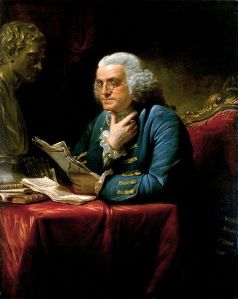
For the holidays, I’ll leave you with one of my favorite quotes, which is by Benjamin Franklin:

Genius without education is like silver in the mine.

And because all grand thoughts are timeless, they must re-appear in an eternal return.

So this quote, too, must have antecedents. Let’s work backwards in time, to savor even more of the same wisdom:

First stop: Song Dynasty

From my daughter, who is currently reciting the 13th-century Sanzi Jing (the Three-character Classic, a Confucian poem-treatise), I hear the beautifully rhythmic:

Which means (Number 7 here):

Jade that has not been polished

cannot be used.

[a] Person who has not studied

cannot know righteousness.

Second stop: Rome

By Rome I mean Latin. Let’s see: to educate = ex-ducere = to lead out

Lead out? As in: get out what is already there, as in silver or jade? Where might that idea have come from?

Third stop: Socrates

We haven’t talked about Socrates for a while here on The Hannibal Blog. (Here are all my old posts about him. He is not in my book, by the way).

The old man had his own silver/jade/education theory: He called it (in the Meno and Phaedo) “anamnesis”. And he demonstrated it by … helping a slave to remember (= “teaching”) that the blue square below has twice the area of the yellow square:

The lesson

And now for Kluthian axiom number whatchammacallit:

It’s in there. Get it out.

Happy holidays.

Life reversals: the case of the White Moustache

And now: something completely different, and much more important — indeed, rather uplifting, in the spirit of the season.

We are, obviously, talking about … yogurt.

Way back in May, I wrote a story in The Economist called Red Tape in California: Beware of the yogurt. The title says it all, really. But if you need additional context, my favorite line from the article is:

The tale thus went from Kafka to Catch-22.

In a nutshell, it is the tale of a Zoroastrian father-daughter team (pictured above) in Orange County who make fantastically good “artisinal” yoghurt — or would make it, if it weren’t for California’s bureaucrats. Go read the rest.

Why do I bring this up now? Because there has been an epilogue, which is unfolding still.

A few weeks after the article appeared, Homa (the daughter) emailed me that

… we were requested by two news sources a Chilean newspaper “Las Ultimas Noticias” (a conservative daily based in Santiago), and Fox Business News “America’s Nightly Scoreboard” to give an interview…. We were written up in HaAretz, an Israeli paper, which was basically a translation of your article, except with the headline: “U.S. against Iran– now the scene of yogurt”… A film-maker has asked us for the movie rights, he wants to call the documentary: “The Curdled Crusaders” — Catchy. Tons of people have commented on our FB page and send individual e-mails of support. A few consultants who want to help us more to other states (Tennessee, Texas, Mexico). Some wanting to know where to buy the yogurt (clearly, they didn’t pay attention to the article).

Pretty good, don’t you think?

And now, just the other day, Homa emailed again:

Dear Andreas,

I hope this letter finds you well. There have been quite a few developments for us (specifically in the last three weeks) which most definitely relate back to the piece you wrote on us. Most pleasantly, Secretary of State for Oregon Kate Brown read The Economist piece in November and thought “This shouldn’t happen. Let’s get her to make it up in Oregon.” And so she invited me up, introduced me to regulators and business recruiters and even though their regulations are similar to California, their attitude has been: How can we make this happen for you?” It has been such a nice change.

Also, nine months of begging for an audience, Karen Ross of The CDFA has finally agreed to meet with us (today!) and tell us what exactly the public risk is of using already pasteurized milk.

Ironically, I’ve only made yogurt twice in this whole time. An ideal time, I figured, to experiment with the paleo diet.

Best,

Homa

Hannibal & Me: The excerpt in Salon.com

What a very, very strange experience it is to see an excerpt of my own book on a famous website.

Salon.com has just posted exactly that.

Thank you, Salon!

And so I discover my designer

Do you remember our little debate seven months ago (that long!), about the design on my book’s jacket cover?

As usual, you didn’t hold back. (And may that never change!) Thus dafna, for example:

… it has the right parts, but they are not in the right place nor in the right proportions for the reasons listed. a few tweaks and you might have had a more memorable cover…

And then, in a follow-up comment:

as a first time author, you were probably assigned to a designer, perhaps “junior designer” who was over-worked and under paid.

Well, as a connoisseur of irony, I can’t help but delight in the one I’ve just discovered. The first hardcover copies of Hannibal and Me are out now, and my agent and I were holding them in our hands for our first look at the real thing (a feeling you e-bookers will never know. 😦 )

And there, on the back flap, we saw it:

Jacket design by Devin Washburn/Rodrigo Corral design

Wow, said my agent, Rodrigo Corral is huge.

I wouldn’t know anything about this, but in the world of book design, that agency might be the Apple, or the Ferrari, or the Le Corbusier, or whatever might be the appropriate analogy. And I actually do see a certain visual DNA inheritance in my cover, compared to some of the others you see here, wouldn’t you say?

So Riverhead actually had shelled out for the best. I wonder how that might have influenced my own reaction, and yours, if we had known. Do weigh in.

The only puzzle remains: why did Riverhead not simply tell us?

The books we (at The Economist) wrote this year

I’m not the only one at The Economist to launch a book “this” year.

(As you know, my launch is technically on January 5th, but Hannibal and Me is already available for pre-order, so that counts as 2011.)

Here is a list of the books my colleagues and I wrote this year. A pretty broad range of genres and topics, wouldn’t you say?

Bill of Rights for Friends of Authors

1) Thesis

I was talking to my boss the other day about my imminent book launch. After a few glasses of wine, and in the company of other writers, he, an accomplished serial author with a very British sense of humor, told me, claiming to speak from experience, that

the only thing you’ll ever regret is that you didn’t prostitute yourself more.

He meant, of course, that I (and all authors) should, at least this once, get over the discretion that is native to people of manners, and just … market (verb). Because if we authors don’t, nobody else will, and we authors will be angry with ourselves later.

2) Antithesis

On the other hand, I have been around some authors who, for a period lasting months, turn into book-marketing robots, to the point where I can no longer have a normal conversation with them.

And so I understand fully the humanitarian need for limits.

3) Synthesis

So, in the spirit of mutual empathy between Authors and Friends of Authors, I (pictured above, seated) hereby promulgate a Bill of Rights — nay, a Magna Carta — to protect … you.

(Whoever you might be. But especially if you happen to be somebody I know, like, owe, am married to, have fathered, have been friends with…..)

Rights:

  1. There shall continue to be, as there have been since time immemorial, topics of conversation that have nothing whatsoever to do with the Author’s Book, and the Author shall respect said topics as such — ie, as inviolable.
  2. If the Author happens to moderate a panel about an interesting (or even a boring) topic unrelated to his Book, the Author shall refrain from name-dropping his Book in introducing the Panelists or while moderating their debate. If the Author violates this rule, the Audience shall be within its rights to boo Him off the stage, with the physical assistance of the Panelists.
  3. If thou had, in thy previous dealings with the Author, the sort of relationship in which thou could call Him a wanker, or to cast other aspersion upon Him with impunity and to humorous effect, thou shalt retain said privileges in perpetuity, whether that friggin’ Book of His is a hit or a flop, because that’s really not thy problem.
  4. When meeting the Author socially, especially if the meeting involves a Honig Cabernet Sauvignon from Napa, thou mayest, with impunity, assert thy right to have a pleasant evening without being reminded of the darned Book at all.
  5. Thou shalt not blame, loathe or disdain the Author merely for marketing His Book to Others, being mindful that the Author is a prostitute only temporarily and on good advice, as wouldst thou be in His stead.
  6. Finally, thou hast the right, should thou find the Author’s presence insufferable nonetheless, physically to evade the Author for a period not exceeding the two months around the launch date, provided thou welcome the Author back into human society after the whole silly spectacle passeth into oblivion (which, remember, is a lot sooner than the Author thinks).

Hannibal and Me: the audiobook

I have a Google Alert set for “Hannibal and Me”, which is how I discovered that you can soon (5 days after publication of the hardcover version on January 5th) buy the audiobook. Here it is.

The company is called Tantor audio. Did you notice its logo, above? How utterly appropriate. Let us decide to call him (the pachyderm) Surus, in honor of Hannibal’s favorite.

FYI, I have not listened to the audiobook and have no idea how it will sound. (Indeed, I have not listened to any audiobook. I do like listening to lectures on my iPhone, but books? I never grokked that one. Why not read them?)

The narrator is one Sean Runnette. Has anybody heard him reading anything?

Sean Runnette

The third review (in Booklist)

The third review is now out, and also very good. The previous two (the one in Publishers Weekly  and the one in Kirkus Reviews) were perhaps a bit more gushy.

It appears in Booklist, which, as my publisher tells me, is a publication for the American Library Association — in other words, something that influences what librarians buy and stock. That makes it, like the other two, a “pre-pub” review. (I am learning a lot of jargon in this process. Pre-pub reviews when I lived in London meant checking your breath and hair before heading out to the … pub.)

Unfortunately, you need a subscription, and I don’t have one, to get the link. But I was sent a transcript, and here are excerpts (emphasis mine):

Here’s an intriguing premise: show, through the life and career of the Carthaginian military genius Hannibal (and other history-makers), how the line between success and failure can sometimes be blurry, not to mention how success can turn into failure when least expected, and vice versa. … Kluth’s main thesis seems to be that triumph and tragedy, success and failure, are merely points on a line, and that we make our way in life by cultivating the ability to turn failure into success and recognizing that success can breed failure, if we’re not careful. This isn’t the first book to tackle this subject, but its historical perspective, drawing on the life of a warrior who lived more than two millennia ago, gives it fresh appeal.

“Points on a line”. I don’t believe I used that metaphor anywhere in the book. I like it!

See? I’m already learning from my reviewers.