Skip to content

Posts from the ‘Life’ Category

A timeless story: Plutarch > Böll > us

Heinrich Böll (click for credits)

Let’s have a few minutes of fun tracing the genealogy of a story to illustrate the concept of archetypes — the Jungian idea that we tell each other the same timeless stories again and again, in infinitely many variations.

(My book is based on that idea: namely, that we see ourselves in the stories of others, whether they lived 2,000 years ago or 2 years ago, or whether they lived at all.)

On pages 140-142 of Hannibal and Me, I tell two versions of a short story. (This is the very end of the chapter called Tactics and Strategy in Life, which is about the fiendish difficulty of telling ends from means in life and the consequences of getting it wrong, as I hinted in this post for the Harvard Business Review.)

So I end the chapter with this:

A few years ago, one of those chain-letter emails landed in my inbox. It told the story of a fisherman who was lying in the warm afternoon sun on a beautiful beach, with his pole propped up and his line cast out into the water. An energetic businessman walked by.

“You aren’t going to catch many fish that way,” said the businessman to the fisherman. “You should work harder.”

The fisherman looked up and good-naturedly asked, “And what would I get for that?”

The businessman replied that he would catch more fish, sell them for more money, save the surplus, and invest in a boat and nets, which would let him catch even more fish.

Again the fisherman asked, “And what would I get for that?”

Somewhat impatiently, the businessman explained that he could then reinvest the even greater surplus and buy more boats and hire staff, becoming a small business and catching ever more fish.

Again the fisherman asked, “And what would I get for that?”

Now the businessman lost it. “Don’t you understand that you can become so rich that you never have to work for a living again? You could spend the rest of your days sitting on this beach, just enjoying this sunset!”

The fisherman’s eyes lit up. “And what do you think I’m doing right now?”

In the chapter, I then go on to tell another, and much, much older version of that story, which I’ll repeat in a minute. But here is what my cousin Bettina realized the other day as she was reading the above passage in my book: The story I was retelling from a chain email in fact derives from a short story by Heinrich Böll, the Nobel-Prize winning giant of postwar German literature.

Böll’s story, written in 1963, was titled:

Anekdote zur Senkung der Arbeitsmoral

I love that sardonic mock-bureaucratic tone. It translates into something like:

Anecdote for the Diminishment of the Work Ethic

Here is the German text, very simply and beautifully written. The Wikipedia page tells me that

The story, with its several adaptions, has been circulated widely on the Internet, and has been quoted in many books and scholarly papers. In one of the most popular versions, the tourist is an American (an MBA from Harvard in some versions), and the fisherman is Mexican.

Clearly, Böll’s story has a timeless kernel. So where might Böll himself have gotten the idea? (And by the way, he may not have realized where he got it, for we usually do not recall what influenced our ideas.)

Well, I think he got it from a story written about 2000 years ago about events more than 300 years before that. The author was Plutarch. The story was about Pyrrhus, the one who gave us “Pyrrhic Victories“.

You can compare it to the original here. But on page 141 of my book, I retell it this way (with anything in quotation marks directly sourced from Plutarch):

Pyrrhus was making preparations to invade Italy and attack Rome when Cineas struck up a conversation.

“The Romans, sir, are reported to be great warriors,” said Cineas. “If God permits us to overcome them, how should we use our victory?”

“But that’s obvious,” said Pyrrhus. “We will be ‘masters of all Italy’ with all its wealth.”

“And having subdued Italy, what shall we do next?” asked Cineas.

“Sicily,” replied Pyrrhus without missing a beat. “A wealthy and populous island, and easy to be gained.”

“But will the possession of Sicily put an end to the war?” asked Cineas.

“God grant us victory and success in that,” answered Pyrrhus, “and we will use these as forerunners of greater things; who could forbear from Libya and Carthage then within reach?” Once we have those, will anybody anywhere “dare to make further resistance?”

“None,” replied Cineas, which leaves us to “make an absolute conquest of Greece. And when all these are in our power, what shall we do then?”

Pyrrhus smiled and said, “We will live at our ease, my dear friend, and drink all day, and divert ourselves with pleasant conversation.”

“And what hinders us,” said Cineas, “from doing exactly that right now, without going through all these troubles?”

Pyrrhus suddenly looked “troubled” and had no answer. Then he went ahead and invaded Italy anyway — without success.

Hannibal/Hasdrubal/Mago > Danny/Ben/Sam

It sucks that I can’t watch the Beeb from here in the US. That’s because something fun is on the telly there.

Three brothers — Danny, Ben and Sam Wood — are tracing the route that Hannibal took, from Spain through France and over the Alps into Italy, and thence to Tunisia and perhaps onward. (Here is a map of Hannibal’s lifetime path.)

They’re doing it by bike, instead of elephant.

What does this show? That Hannibal maintains his eerie ability to inspire us modern types today, just as he inspired me to write my book.

“So we also feel a certain sense of ‘Hannibal and Me’,” as Danny, also a journalist, emailed me this week.

If you’re in Britain, follow them on the BBC. And good luck, lads!

Here’s a taste:

Hannibal and Me in Bogota, Colombia

I just received the following email from one Matt Aaron, and it’s the sort of spontaneous, casual and genuine feedback that makes authors happy:

I just finished the audio version of Hannibal and Me this morning, walking through a park in Bogota, Colombia.

I am in a transition period, now in my late 20′s. This book has helped me understand my current path and a general direction for the next 10-15 years.

Thanks for writing this!

-Matt

Thank you, Matt.

PS: I guess I should really get myself that audio version now, to hear what my book sounds like. ;)

Hannibal and Me … and Mr Crotchety

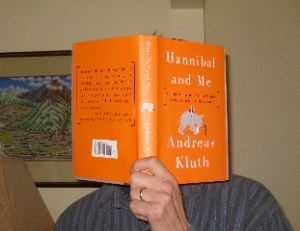
There are reviewers, and then there are reviewers. And then there is … Mr Crotchety.

Who is Mr Crotchety?, you ask.

He (and I am reasonably confident that he is indeed both human and male, as allegedly pictured above) first presented himself to me in 2008, when he wrote a reader letter to The Economist about a piece I had written (about “Slow Food”). Here is that letter:

Date: 16 September 2008

To: letters@economist.com

Subject: slow food

Regarding: (11 Sep 08) Revolutionaries by the Bay

Many years ago I sat down in a Slow Food restaurant in New England. It seems like only yesterday when I walked out. The food was not memorable, but the service was glacially slow and inattentive (this was before global warming). Does the service have to be European also?

Mr. Crotchety

That set the tone for all that was to follow. Mr Crotchety, possibly encouraged by me, poured himself into the blogosphere and, under his increasingly notorious nom de guerre, began spreading his wit more widely.

Here on The Hannibal Blog, for example, we were soon turning the epic tale of Hannibal the Carthaginian into its … limerick version. (Read through the comments in that post, too: We expanded the mission to Zen Senryus.) In retrospect, it is hard to believe that both Polybius and Livy overlooked such an obvious literary device.

But Mr Crotchety never over-indulged himself with his blog commentary. Sometimes he crotched, sometimes he didn’t. Over time, I became aware that an entire subculture of the blogosphere was secretly yearning for one of his ambushes. They bestowed the ultimate kudos.

All of which is a long-winded way of saying that this same Mr Crotchety has now, via Sprezzatura, written his own and inimitable review of Hannibal and Me. Follow the link, and may the kvetching and crotching continue over there….

Dylan Ratigan and I, the backstory

So here are my five minutes on MSNBC with Dylan Ratigan.

And here is the backstory:

I had made a beginner’s mistake: Yesterday, I got a bit of redness above my right eye, eczema or something, as I occasionally do. Normally, I ignore it, but today I remembered some cream that my mom had once sent me for exactly this purpose. I fished it out of the closet and rubbed it on. And apparently, I got some in my eye.

Just as I was arriving at the studio, my right eye started gushing tears. Great.

This is what wives are for. So I texted mine, and she texted back, while I was still in the parking lot:

think about Hannibal and his one conjunctivitis eye.

So that’s what I did. I was clutching a Kleenex during the clip, and kept wiping the tears away.

So, not that bad a performance, considering. ;)

Thoughts (not mine) over coffee before 7AM

My wife and I just got a heart-warming email from an old friend (who shall remain anonymous), with just the sort of thoughtful, soulful reaction to my book that I was aiming for when writing it:

Wow. Just read the Salon bit. Had me crying and laughing. (I was reading it over morning coffee before 7 am, when I am prone to be emotional.)

I have to admit, for these several years, I never quite “got” what Andreas was on about with this whole Hannibal thing. And now, in those Salon paragraphs, it has all become so damn clear. Through Andreas telling that individual, personal narrative, seeing it reflected in my own life, and then seeing up, with ever greater reverberations, expanding out to the great truths of all lives.

Been thinking a lot about the narratives of my own life these days. A lover of nature. A scientist. Successful conservationist. [...] Failed Buddhist. Living in the heart of a loving community of friends, even if it is a geographically dispersed community of friends. Me not maintaining that community of friends as much as I used to, as much as I should. Me craving romance, yet terrified of sex, terrified of intimacy. Neurotic, bordering on psychotic.

What are my successes? What are my failures? Has one come at the cost of the other?

Chogyam Trungpa once said something about how our brilliance, in that Buddhist, primal human sense, is the direct result of our neuroses. It is not despite our neuroses that our most beautiful and generous properties come, but because of them. In Kipling’s terms, “brilliance” and “neurosis” are two imposters, to be treated the same…

Dealing with disaster

Shackleton

Chapter 7 in Hannibal and Me is titled “Dealing with disaster”. So, how does the Hannibalic story tell us to deal with it?

First, a reminder about the premise of my book: I use stories of real people to make universal points. Put differently, I use the people in the stories to personify lessons (but you, the reader, ultimately have to adapt the lessons to your own life.).

The first personification of responding to disaster in life is named Quintus Fabius Maximus. (From the picture above, you may have guessed that by the end of the chapter he will have a “twin” in Ernest Shackleton, as I explain below).

As I introduce Fabius on page 144 ff., he

came from one of the oldest and noblest families of Rome, the Fabii, who claimed they could trace their ancestry back to Hercules. But Hercules was not exactly the first image that came to mind when looking at Fabius himself. When he was a boy, one of his nicknames was Verrucosus — “Warty” — because he had a big wart on his lip. Another nickname in his youth was Ocivula, “Lamb,” because he had an unusually mild temper for an aristocratic Roman boy. He did everything slowly. He spoke slowly, walked slowly, learned slowly. He was bad at sports in a society that was all about athletic, virile, and martial games. Young Fabius was in almost every way the exact opposite of young Hannibal. …

And yet the Romans gradually changed their minds about the warty, lamblike Fabius. As the boy grew into a man, that same slowness began to look like steadiness and prudence…

He was already in his forties when [the Romans] first elected him consul. As senator or elder statesman, five times as consul and twice as elected “dictator,” Fabius remained one of the republic’s leaders for the rest of his life.

By the time the young and dashing Hannibal crossed the Alps into Italy, Fabius was already in his sixties. … Fabius had never encountered such an enemy. What, Fabius reflected in his slow and methodical way, should he, and Rome, make of Hannibal?

And then, of course, the disasters began. Battle after battle in which Hannibal routed Roman armies that outnumbered him. Rout is the wrong word. Hannibal exterminated Roman armies, he depleted the Roman population of men, of senators, of sons, of fathers. From the Roman point of view, Hannibal represented the extinction of Rome.

How Hannibal did that — how he won those battles — I deal with in the preceding two chapters. But in Chapter 7, I’m looking at these events purely from Fabius’s side, so that we can understand how to deal with disaster.

And Fabius offers us a psychologically layered answer. Page 146:

… The younger Roman leaders found this hard to admit, but Fabius simply accepted that Hannibal was superior on the battlefield. That premise led Fabius to a simple but shocking conclusion: if going to battle against Hannibal meant losing, it was clearly not a good policy to go to battle against him at all. …

In these extreme circumstances, Fabius decided, the strategic definition of success was no longer victory but stalemate. In his slow and methodical way, Fabius thus determined that Hannibal’s stunning triumphs on the battlefield might yet lead to nothing. They might be impostors.

So what were the elements of his response, of “the Fabian response” in the language of my archetypes?

Page 153:

There are two aspects to a Fabian character that make it resilient and that you might remember if ever disaster should strike you. The first is the ability to accept reality for what it is. The second is the ability to stop resisting reality and instead to flow with it until circumstances begin to change.

1) Acceptance

From page 154:

Shock, denial, anger, bargaining, depression, and finally acceptance: these are the stages that make up the human “grief cycle” described by Elisabeth Kübler-Ross, a twentieth-century Swiss doctor who spent her time caring for dying people…

Losing your job, losing your house to foreclosure, being diagnosed with cancer, getting divorced — any bereavement, failure, or other disaster triggers the psychological responses of the grief cycle. But people move through the grief cycle in different ways. Some progress swiftly, others get stuck at one stage, and yet others cycle back and forth through them. …

Page 157:

Eventually, however, some grief-stricken individuals will arrive at a state of acceptance. As Kübler-Ross puts it, “Acceptance should not be mistaken for a happy stage. It is almost devoid of feelings.” But it is the stage where the person is ready to move on…

I illustrate this wrenching process in this chapter by looking at Eleanor Roosevelt, who suffered through the grief-cycle after discovering the love letters between her husband and their secretary, Lucy Mercer. Roosevelt literally cried and raged it out, while sitting for hours and days and weeks in a park, gazing at the female face of a statue called … Grief.

2) Flowing (or “non-doing”)

As Fabius himself said (to a consul who would soon be killed because his co-commander refused to heed this advice): “Can you then doubt that inactivity is the way to defeat an enemy?”

Page 158:

One translation of Minucius’s [a Roman rival to Fabius] taunt about Fabius’s do-nothing tactics into Chinese is wu wei, which means “nondoing” or “doing by not doing.” Wu wei happens to be a central concept of “the way,” the Tao, in Chinese philosophy. This Taoist notion of wu wei, nondoing, is often mistaken for passivity, which it is not. Instead, nondoing is really a very active way of letting inevitable things happen without wasting energy resisting them, instead bringing one’s own position into harmony with this flow of nature. The principle of wu wei might say, for instance, that is is better to use a rushing stream to spin a wheel and transfer its energy than to block the stream and try to make it stop flowing. Or it might say that a skipper is better off tacking through the wind than trying to go against it, which would be futile. Indeed the best skippers often look, as Fabius did, as though they were “doing nothing”….

I then illustrate this point by looking at Ernest Shackleton, who (page 161),

decided to cross the entire Antarctic continent on foot. It was as daring in 1914 as it had been in 218 BCE for Hannibal to Cross the Alps…

But, as you all know, Shackleton failed at his quest, when his ship, the Endurance, got stuck in the ice.

Page 162:

Shackleton’s first reaction was to order his crew to do what heroes normally do: fight. The men climbed onto the ice and hacked away at it with picks, trying to open a sea-lane. But it was useless…

They now spent the Antarctic winter on their ship, which was frozen into its ice pack. No light, eternal darkness. All the stages of Kübler-Ross’s Grief Cycle.

Then the ice crushed the Endurance, and the men watched as their ship sank. Page 164:

Suddenly, the men were all alone, floating on ice somewhere near the South Pole.

Shackleton announced new plans of daring and heroic resistance: they would march, while dragging their own life boats, across the ice toward an islet, covering roughly the distance from San Francisco to Loas Angeles. Page 164-165:

After three hours of hard toil, they had moved one mile. It began to snow. The next day they tried again, but the snow was like glue. … The next morning they tried again. Shackleton went ahead and scanned the ice. He saw pressure ridges where colliding ice floes had formed mountains that looked as forbidding as the Alps.

Shackleton turned around and walked back to the group. He took deep breaths of the icy air and prepared to announce his decision, which he knew was probably the weightiest of his entire life. At first, he had thought that attacking the enemy was the best thing to do, both for morale and for their chances of survival. But he now thought that he might have been in denial. During the night, he had accepted reality, and seeing the endless ice mountains around them had confirmed it. Instead of attacking and wasting caloric energy to make at most a mile  a day toward who knew where, they would instead … do nothing.

And to understand why this saved him, why this turned his disaster into one of the greatest triumphs in human history, you have to know something about the ice. For that, you’ll have to read the book.

The ice … the Tao.

Fabius, Roosevelt, Shackleton … you. 

To be continued.

Silver in the mine, jade unpolished

For the holidays, I’ll leave you with one of my favorite quotes, which is by Benjamin Franklin:

Genius without education is like silver in the mine.

And because all grand thoughts are timeless, they must re-appear in an eternal return.

So this quote, too, must have antecedents. Let’s work backwards in time, to savor even more of the same wisdom:

First stop: Song Dynasty

From my daughter, who is currently reciting the 13th-century Sanzi Jing (the Three-character Classic, a Confucian poem-treatise), I hear the beautifully rhythmic:

Which means (Number 7 here):

Jade that has not been polished

cannot be used.

[a] Person who has not studied

cannot know righteousness.

Second stop: Rome

By Rome I mean Latin. Let’s see: to educate = ex-ducere = to lead out

Lead out? As in: get out what is already there, as in silver or jade? Where might that idea have come from?

Third stop: Socrates

We haven’t talked about Socrates for a while here on The Hannibal Blog. (Here are all my old posts about him. He is not in my book, by the way).

The old man had his own silver/jade/education theory: He called it (in the Meno and Phaedo) “anamnesis”. And he demonstrated it by … helping a slave to remember (= “teaching”) that the blue square below has twice the area of the yellow square:

The lesson

And now for Kluthian axiom number whatchammacallit:

It’s in there. Get it out.

Happy holidays.

Life reversals: the case of the White Moustache

And now: something completely different, and much more important — indeed, rather uplifting, in the spirit of the season.

We are, obviously, talking about … yogurt.

Way back in May, I wrote a story in The Economist called Red Tape in California: Beware of the yogurt. The title says it all, really. But if you need additional context, my favorite line from the article is:

The tale thus went from Kafka to Catch-22.

In a nutshell, it is the tale of a Zoroastrian father-daughter team (pictured above) in Orange County who make fantastically good “artisinal” yoghurt — or would make it, if it weren’t for California’s bureaucrats. Go read the rest.

Why do I bring this up now? Because there has been an epilogue, which is unfolding still.

A few weeks after the article appeared, Homa (the daughter) emailed me that

… we were requested by two news sources a Chilean newspaper “Las Ultimas Noticias” (a conservative daily based in Santiago), and Fox Business News “America’s Nightly Scoreboard” to give an interview…. We were written up in HaAretz, an Israeli paper, which was basically a translation of your article, except with the headline: “U.S. against Iran– now the scene of yogurt”… A film-maker has asked us for the movie rights, he wants to call the documentary: “The Curdled Crusaders” — Catchy. Tons of people have commented on our FB page and send individual e-mails of support. A few consultants who want to help us more to other states (Tennessee, Texas, Mexico). Some wanting to know where to buy the yogurt (clearly, they didn’t pay attention to the article).

Pretty good, don’t you think?

And now, just the other day, Homa emailed again:

Dear Andreas,

I hope this letter finds you well. There have been quite a few developments for us (specifically in the last three weeks) which most definitely relate back to the piece you wrote on us. Most pleasantly, Secretary of State for Oregon Kate Brown read The Economist piece in November and thought “This shouldn’t happen. Let’s get her to make it up in Oregon.” And so she invited me up, introduced me to regulators and business recruiters and even though their regulations are similar to California, their attitude has been: How can we make this happen for you?” It has been such a nice change.

Also, nine months of begging for an audience, Karen Ross of The CDFA has finally agreed to meet with us (today!) and tell us what exactly the public risk is of using already pasteurized milk.

Ironically, I’ve only made yogurt twice in this whole time. An ideal time, I figured, to experiment with the paleo diet.

Best,

Homa

Hannibal & Me: The excerpt in Salon.com

What a very, very strange experience it is to see an excerpt of my own book on a famous website.

Salon.com has just posted exactly that.

Thank you, Salon!

Follow

Get every new post delivered to your Inbox.

Join 411 other followers