As a dad, I have learned that the only (or at least best) way to get my children to do anything at all–to brush their teeth, eat their greens, jump into bed–is to turn the loathsome activity in question into … fun.
Perhaps the greens must become attacking naughties with shrill voices that want to fly into the mouth but keep missing and splattering. Suddenly, the little mouths are wide open, practically lunging for those mischievous little greens.
And as a former and frequently relapsing kid myself, I have learned that the only (or at least the best) way to get myself into a creative and productive mode is also to turn the loathsome activity in question (setting up interviews, doing research….) into … fun.
So I am delighted to see, and fully endorse, this research project that tries to elevate fun to a design principle. It appears to be a Volkswagen-funded undertaking in Sweden
dedicated to the idea that something as simple as happiness is the absolute easiest way to get people to change.
Video 1: How to get people to use the stairs
Video 2: How to get people to throw their trash into the bin
Thought experiment: Extensions
So now I am thinking: What else could be made fun with proper, more humane design?
doing taxes?
doing jury duty?
going to the doctor?
being at the airport?
Recycling?
Conserving (water, energy …)?
I refuse to exclude anything. It’s all a matter of how much one is willing to imagine. My kids are teaching me to raise the bar.
On Monday I found myself standing on a chair, peering over the baying pack of television crews to see Bill Clinton endorse Gavin Newsom for governor of California. For some odd reason (the PR handlers explained it to me, but it was too stupid to reproduce here) they chose the space between shelves in the library of a community college in Los Angeles for the occasion. My cheek was pressed into the sign 808.8, which seems to be children’s literature in the Dewey Decimal system. Go figure.
I have met Newsom several times before, and have experienced Clinton twice at conferences (TED and Google’s Zeitgeist). As I was observing these two men, I could not help but think of their fathers, as I will explain in a minute.
First, though, the reason my thoughts went that way: their (arguably endearing) vanity.
Bill Clinton, who was allegedly there to endorse (ie, make look good) Newsom, spoke for 22 minutes, mainly about green technology and so forth, before letting Newsom get in about 11 minutes of thanking and campaigning. This is par for the course. I remember somebody asking Clinton a purely rhetorical question at Zeitgeist, and Clinton dissecting the question into three parts, then delivering an exegesis worthy of a State of the Union on each. The man, God bless him, cannot help himself. He must hold forth.
So does Newsom. He admires Clinton and spent a good part of my first conversation with him, three years ago, talking about the political and rhetorical lessons he has drawn from Clinton.
Here is how that meeting, with my editor and myself and Newsom at a San Francisco cafe, went: Newsom came in and started talking about baseball. Realizing that neither my editor nor I seemed to have a clue about that sport, he switched effortlessly to … cricket. (The Economist … Brits…) Seeing that we knew nothing about that sport either and were geeky, wonky boffins, Newsom made another seamless transition and settled into … geeky, wonky politics arcana. He seemed liberated, as were we.
His eyes, I remember noticing, had bright circles of brown, yellow and green. He blushes very easily (as Clinton does). When there are women in the room, as there were when I met Newsom again a few months ago at the offices of Twitter, he preens very self-consciously, as if we were all at a high-school prom. The women notice this and like it.
In any case, both are very gifted and intelligent. Newsom, like many dyslexic people, has learned to overcompensate for his reading difficulties with other mental disciplines and is quick on his proverbial feet. He oozes Clintonian charm.
Their fathers made them
On to their fathers. Some of you may recall that, as part of my book research, I have been pondering the role of parents in the early stages of a young man’s (or woman’s) personality development. Obama and McCain both defined themselves against the (mostly abstract) idea of their fathers. Doug Wead, a presidential historian, has even put forth various theses that absenteeism by fathers somehow makes their sons more presidential.
Well, that’s what I was pondering as the 808.8 was jabbing into my cheek.
Clinton never knew his father, who died before Clinton was born. Clinton instead took the name of his stepfather, whom he recalls as an abusive drunk.
Newsom’s father separated from, and then divorced, Gavin’s mother when Gavin was a boy. His father was around, but the roles were apparently strained.
The quack psychologist in me would hypothesize that these father gaps left both men chronically insecure, permanently eager to win over and impress other people and to stay in their favor. In short, their fathers made them politicians.
You’ve heard of the seven chakras mentioned in the Yogic texts. They are energy centers along the spine often depicted as wheels.
I hesitate to bring them up because, well, the topic gets a bit touchy-feely and new-agey. Suffice it to say that one does, during pranayama (breath control) and the higher four of the eight stages of Patanjali’s Ashtanga yoga concentrate intensely on these chakras, perhaps visualizing them in their rainbow colors.
In this post I will not try to prove or disprove that the chakras exist. Instead, I would simply like to point out that Western culture seems to have the same concepts, especially if one views them more metaphorically than literally, as more mythos than logos.
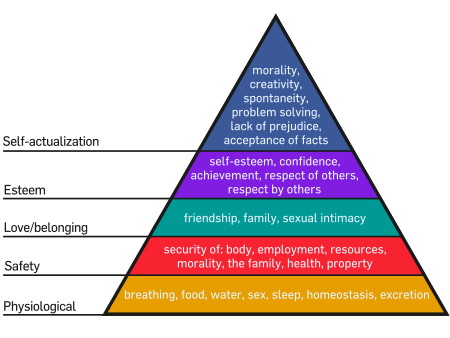
Compare the hierarchy of chakras in the human body to the left to the hierarchy of needs as described so famously by the American psychologist Abraham Maslow to the right. Remarkably similar, aren’t they?
I believe the idea is the same.
In the yogic vocabulary, the root chakra above the anus (essentially in the male prostrate) and the sacral chakra just above it (near the female ovaries) govern our most basic drives: individual survival (eating, excreting etc) and genetic survival (sex).
Maslow lumped these together in his ‘physiological’ needs at the bottom of his pyramid. He believed that if somebody is choking you and you are not getting oxygen, breathing is the only need you care about. Once you can breathe again, you may notice that you are thirsty. Once you have drunk, you may notice that you are hungry. Once you have eaten, you may notice that you desire. And so on.
The next chakra (going upwards) is the yellow solar plexus just below the navel. In the yogic conceit, this governs our will to power. (So I sometimes think of the sacral chakra as Freud and the solar plexus as Nietzsche.) Maslow calls these “security” needs, but you notice that they involve what we consider the trappings of power: money, property, status, and so on.
Now we get into the higher or ‘nobler’ chakras.
In the yogic vocabulary, the first of these is the green heart chakra, which governs deep, selfless, non-sexual love (not Aphrodite but Hestia, if you will). Maslow calls these the ‘love and belonging’ needs for friendship, family and intimacy. Even the color corresponds. (Which is interesting: Green = envy in the West but love in the East.)
The blue throat chakra in Yoga governs intellectual clarity, the ability to communicate, creativity and so forth. This is where artists, scientists, writers and orators draw their inspiration. Maslow calls these ‘esteem’ needs, which is the reward of such things.
Yoga then distinguishes between two more chakras: the third eye behind the brow which is indigo and the source of inner peace and meditative calm; and the crown (depicted in the Western tradition as a halo) just above the head which is the area that is energized during enlightenment (ie, very rarely for most of us).
Maslow lumps them together under “self-actualization”, which is arguably the goal of life and the definition of success. Maslow studied biographies (as I did for my book), and developed a theory about what sort of qualities people have who self-actualize. Perhaps that’s why they called his approach “Jewish Buddhism” at Esalen. 😉
Well, I’m off to another powwow of The Economist. This time it’s not a biggie, as last year’s was, but a little gathering of the US-based correspondents (politics+business+finance).
In case you’re wondering: that’s 17 of us, plus the US editor, plus the editor-in-chief. (I only say that because I have found that our readers tend to be surprised when hearing how few of us there are.) So 19 of us will decide the current direction, and thus future course, of America. That should take us only a short working day or so, so I hope to be back here blogging anon. 😉
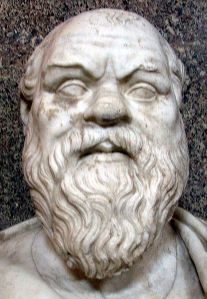
One of the most momentous conversations in history you’ve never heard about took place between Socrates and a man named Callicles, and is recorded in Plato’s Gorgias. It is a surprisingly moving portrayal of a man who tries to describe the world as it is but, upon prompting, reveals how much he yearns for the way it ought to be. Although it took place 2,400 years ago, the conversation is timeless and very modern. I think it describes many of us today.
The weak, the sheep, don’t like that, of course, so they get together and call what the strong do unjust. By implication, what they themselves do is just. Collectively as a herd, the sheep want to dominate the lions. So whereas nature is on the side of the strong and the lions, convention is on the side of the weak and the sheep.
Influence on Nietzsche
To many of you, this rings a bell. Yes, this is where Nietzsche got his ideas for his Genealogy of Morals. Nietzsche took his metaphors of lions, sheep, herds, slaves and so forth from Callicles, then spun his theory. It was that the sheep banded together to invert the natural concepts of good and bad, strong and weak, motivated by a festering rage for which Nietzsche used the French word ressentiment.
Relevance to Darwin
Socrates being Socrates, of course, he goes on to needle Callicles about the precise meaning of words in order to poke a hole in his argument. He asks Callicles to clarify the terms “better” and “stronger”. Are they the same?
Callicles has to admit that they are not. And off they go, debating what that means.
Today, of course, we know that Callicles was looking for a better word: not strong or good but fit. Not fit as in ‘toned from the gym’ but as in ‘survival of the fittest’. The fittest, according to Darwin, are not the strongest or the best but the most adapted.
The law of nature that Callicles refers to is therefore evolution. It is the tautological observation that those who are better adapted to the prevailing circumstances will leave more of themselves (ie, their genes) behind than those who are worse adapted.
Gibe at democracy
Callicles and Socrates go on to mock democracy (Athens was an even more direct democracy than America is today). Democracy to them is the inversion of nature, the herd of sheep ruling the lions, the weak dominating the strong, the inferior getting their revenge on the superior.
Yearning for what ought to be
But the dialogue between Callicles and Socrates becomes more moving than anything Nietzsche did with it. That’s because during the conversation it becomes clear that Callicles is a sophisticated and sensitive man who’s trying to describe how the world is while simultaneously being sad about it and yearning for how things ought to be.
He’s confused and bitter, about many things. He’s angry at Socrates for needling him, but also because he already foresees (correctly, of course) that the democratic herd of sheep will condemn the lion Socrates. And he hates himself for having to suck up to the herd, to the Athenians, to make his living.
He also hates seeing the fit succeed whether or not they are also good. In other words, he has the ideal of justice in his head as though it were an archetype. Like most of us, he’s frustrated. That’s all that Plato definitely establishes in this dialogue.
More than three years ago–it seems like three decades–I wrote an eight-chapter Special Report in The Economist in which I tried to envision the future of the media. (It starts here, for those of you with a subscription.)
In it I argued that we (society) were in the midst of a transformation equal in significance to that started by Gutenberg’s printing press during the Renaissance. One media era was ending, another starting:
Old: Media companies produce content & captive, passive audience consumes it.
New: Everybody produces content and shares, consumes, remixes it.
Old: Media companies lecture the audience (one to many).
New: The audience has conversations among itself (many to many).
To show you how long three years can be, consider:
As part of my Special Report, I did our (The Economist‘s) very first podcasts–a word that many of the editors in London had not even heard yet. Today our podcasts are among the most popular on iTunes.
During my research for the Report, I heard the word “YouTube” for the first time (the company had just been founded). When I sent the Report to the editor, it contained one single reference to YouTube. Four (!) weeks later, when the Report was published, YouTube had already become the biggest story of that year (2006).
I had never heard of Facebook (not to mention Twitter). And so on.
How I use the media today
All of this sounds quaint today, so I thought I might share with you how my personal media habits have changed since my Report, and then answer some questions:
Does my 2006 thesis hold up?
Would I refine it today?
Is there a media “crisis”?
1) More efficiency in my work life
Back in 2006, I still subscribed to a lot of paper newspapers and magazines, as all journalists used to do, in order to “keep up” with the competition and to be informed. Those things piled up on my floor and made me feel guilty.
Today I have no paper subscription at all! I have precisely two electronic subscriptions on my Kindle, one newspaper (The New York Times) and one magazine (The Atlantic).
I use my Kindle in the morning over my latte to catch up with the global headlines, the mass market “news”. It is almost relaxing. It takes maybe 15 minutes. Later in the day, if I am driving, I will listen to NPR in the car. That represents my entire consumption of “mainstream” media through their traditional distribution channels. I do not own a TV set.
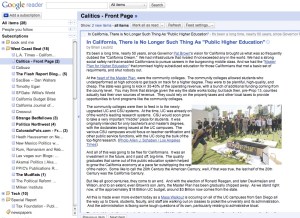
After I put down my Kindle, my work starts. This means that I open my own, personal “newspaper”, which is my RSS Reader. Here is what it looked like yesterday:
In my RSS reader I mix “feeds” from the “head” and the “long tail”, from the LA Times to small blogs on California politics and obscure research outfits such as the Public Policy Institute of California.
The important thing to note here is that I have
disassembled many disparate publications and information sources, including sources not traditionally considered “news”, and
reassembled them as only I can for my own productivity. I have thus replaced “editors” and will never, ever allow them back into this part of my life.
I probably spend an hour or so reading inside my RSS reader. This is not so relaxing. I consider it work. This is my deep dive into stuff I need to know to cover my beat (ie, the Western states). I don’t worry about printing or filing anything because I tag the items, knowing that I can search for them in future. (And yes, that means that my office is now paperless.) Sometimes I hit “share” and my editor can see what I’m reading.
Then I’m done for the day, and I move on a) to do research for my stories and b) to take occasional study breaks for fun with the other media….
2) My intellectual life: Social curation
In my “private” (ie, non-Economist) existence, I now essentially live the vision that I sketched in my Special Report. Which is to say that I am simultaneously the audience for other “amateur” producers of content and an amateur producer myself. This is simply a highfalutin way of saying:
I blog (right here) for motivations that are not remotely commercial, and
I read other blogs for intellectual stimulation, and
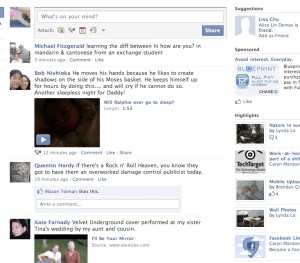
I occasionally post to my Facebook news feed, and
I glance into the Facebook updates of people I know.
Through the blog, Facebook and the old-fashioned medium of email, I now have a spontaneous and unplanned but remarkably efficient and bespoke system of social curation for my media content.
I can easily spend an hour or two a day just following the links that you guys, ie my blog readers, provide. Virtually all of you on this blog have never met me in person but you have a keen sense of my intellectual tastes by now, and you provide links that are, for the most part, stunningly relevant. Sometimes you bring to the surface specific research papers or articles in obscure journals that I would never have discovered in the previous media era.
On Facebook, I find that the connections are of the opposite nature: Most of my “friends” I really do know in offline life, but many understand my intellectual tastes less than my blog readers. But my Facebook friends nonetheless are in my social circle, so their links tend also to be obscure, risqué, ironic, or moving–in short, more interesting and enjoyable than any content the media companies used to dish up for me in the previous era. Ten years ago, for instance, I would probably never have seen this stunning Ukrainian artist perform the Nazi invasion of Ukraine with sand:
The things to note here are:
My social curators also disassemble and reassemble the sources of content. They mix Jon Stewart clips (mainstream media, commercial) with homemade music ensembles (amateur, non-commercial) into one bespoke media flow.
My online and offline friends have thus become what media editors used to be, and they are far better at it than their media-conglomerate predecessors ever were. I will never allow the old editors back into my life.
It goes without saying that I “time-shift” and “place-shift”, which is just a highfalutin way of saying that I “consume” this content wherever and whenever (laptop + iPhone) I happen to be.
3) My intimate media
The final layer is what Paul Saffo in my Special Report called the “personal” media. These are media produced by family members and very intimate friends for defined and tiny audiences.
Example: baby pictures and clips on my private family web site. The site is protected and only grandparents and dear friends have access. The motivation is thus the opposite of the traditional media:
The audience is deliberately kept small (whereas media companies want large audiences)
The intent is to share and preserve personal memories.
Because the capture and sharing of such intimate media is so much easier than it ever was, I spend much, much more of my media time immersed in them. Where do I find this time? Easy. As Clay Shirky has been saying for years: We have a surplus of time, once we get rid of the crap in our lives.
Conclusion
So, to answer my three questions:
Does my 2006 thesis hold up? Yes, I believe it does. We all have the equivalent of many Gutenberg printing presses in our pockets and on our laps, and we use them to tell stories to one another as never before.
Would I refine it today? I would pay more attention to video and audio as opposed to text in the mix.
Is there a media “crisis”? No!
It is that last point that may come as a surprise. I am in an unusual position in that am both a professional and an amateur writer. So I must be aware that the news industry is dying, right?
I am indeed aware that it is shrinking. But is that a problem? There are indeed two crises:
A money and profits crisis for owners of media capital.
An employment crisis for journalists.
But those are two constituencies that the rest of society need not care about. For society as a whole, I believe there is no crisis, once we stop being hysterical and examine our media habits.
What I have discovered in my own personal media behavior is that I am today better informed than I have ever been before. But much of the information I consume no longer comes from journalists.
Instead, much, much more of it now comes from universities and think tanks in my RSS reader and iTunes University, from scientists and thinkers and other experts at conferences such as TED, and from you, who are a self-selected and thus qualified bunch of editors.
Speaking purely as a consumer of the media and a citizen, I believe that there is no media crisis–indeed, that we are entering a second Renaissance.
One thread on The Hannibal Blog, as regular readers know, is strategy. That’s because strategy (as distinct from tactics, which is also important) is so important in achieving success. Genius tactics in service of the wrong strategy leads to disaster, as it did for the main character in my forthcoming book, Hannibal of Carthage.
Mark Hurst over at Good Experience has an amusing and insightful post on strategy as opposed to tactics. (Mark, by the way, also runs Gel, an ideas conference and a mini-TED, as it were.)
On one hand, Mark quotes Calvin Coolidge, our 30th (as well as 30th-most-impressive) president:
Nothing in this world can take the place of persistence. Talent will not; nothing is more common than unsuccessful people with talent. Genius will not; unrewarded genius is almost a proverb. Education will not; the world is full of educated derelicts. Persistence and determination alone are omnipotent.
If I may reflect on my guy, Hannibal: He had remarkable persistence: Leading an army of elephants over the Alps, defeating the Romans, staying undefeated in Italy for 16 years!!
The trouble with the Coolidge take on success is, as Mark points out, that the effectiveness of persistence
depends on having the right direction. Without that one little element, the entire effort is for naught.
So Mark wheels out the Cheshire Cat, a sort of feline Clausewitz. Alice asks which way she should go, and the Cheshire Cat answers:
“That depends a good deal on where you want to get to,” said the Cat.
“I don’t much care where,” said Alice.
“Then it doesn’t matter which way you go,” said the Cat.
To Mark that means that
you have to stop and take time to find the direction. You can’t run while you’re reading the map.
To me it means that Hannibal was a bit like Alice. Yes, he knew that he wanted to defeat Rome (which was like saying “I want to achieve success”–ie, vague). But he did not know where he wanted to go (ie, how to go about defeating Rome).
I admire people like Albert Einstein and Carl Jung (both characters in my book) who were able to feel awe. They retained their ability to be amazed by the world, and derived out of that amazement what Abraham Maslow called “peak experiences.”
I also admire people like Richard Dawkins (and of course Charles Darwin) who are able to use the precision-scalpels of their minds for clear thinking and shocking insight. Eg: Evolution. Eg: No God.
Like Einstein, I don’t really see combat between the one attitude and the other, between the left brain and the right, the yang and the yin. I especially like what happens when the two are well connected.
Dawkins, true to take-no-prisoners form, answered:
The kindest thing to say is that it leaves him with nothing to do, and no achievements that might attract our praise, our worship or our fear. Evolution is God’s redundancy notice, his pink slip.
Armstrong responded brilliantly too, by avoiding the embarrassing efforts of certain people to deny the evidence of evolution and instead going a level deeper, into topics dear to The Hannibal Blog: story telling, mythology, and archetypes:
First Armstrong concedes that
Richard Dawkins has been right all along, of course—at least in one important respect. Evolution has indeed dealt a blow to the idea of a benign creator, literally conceived…. No wonder so many fundamentalist Christians find their faith shaken to the core.
But then she expands the topic:
Most cultures believed that there were two recognized ways of arriving at truth. The Greeks called them mythos and logos. Both were essential and neither was superior to the other; they were not in conflict but complementary, each with its own sphere of competence. Logos (“reason”) was the pragmatic mode of thought that enabled us to function effectively in the world and had, therefore, to correspond accurately to external reality. But it could not assuage human grief or find ultimate meaning in life’s struggle. For that people turned to mythos, stories that made no pretensions to historical accuracy but should rather be seen as an early form of psychology; if translated into ritual or ethical action, a good myth showed you how to cope with mortality, discover an inner source of strength, and endure pain and sorrow with serenity…
(Note 1: Logos is one of those Greek words that can be translated in several different ways. Viktor Frankl, as you recall, translated it as meaning, and named his approach logotherapy after it.)
(Note 2: The complementarity of mythos and logos is the stylistic assumption behind the book I am writing. It is non-fiction (logos) but–or so I hope, and so the editor believes–reads like myth. That’s because I feel that ideas, even logical ones, require stories for their telling.)
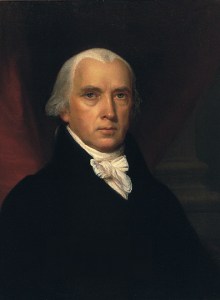
I have been researching James Madison for a little project that I am not yet entirely at liberty to disclose. And my research is reminding me to be extremely impressed–so impressed that he may just be my favorite founding father. He certainly belongs into my pantheon of the world’s greatest thinkers.
Madison, of course, was not only the fourth president but also, and more importantly, the “father” of the US Constitution. He was the one who took the official notes in the sweltering summer heat of Philadelphia in 1787, and the one whose “Virginia Plan” (which was delivered by the other Virginian delegate but conceived by Madison) formed the basis of the subsequent compromises that led to our constitution. He was 36 years old at the time, and as physically short as he was intellectually giant. Wouldst that America had a man of his ilk today.
I am about to sketch out his vision of freedom as succinctly as I can, but let me just say that if you have been reading the Hannibal Blog for a while, you won’t be at all surprised that I admire the man. Madison fits perfectly my tastes for:
the republican, as opposed to democratic, vision of liberal government, where both ‘republican’ and’democratic’ are properly defined.
Since it is that last point that is most likely to be misunderstood, let me drill into that part of Madison’s thinking. Here is how I understand his views on the matter:
Madison originally preferred to use the word republic to describe the new America they were building, as opposed to the word democracy.
“Republic”
Republic comes from the Latin res publica, which means ‘public thing’–in other words a country ‘owned’ by its people rather than by a monarch. Deriving from Latin, the word reminded educated men such as Madison of republican Rome (ie, Rome before its civil wars), which was so remarkably stable and moderate, and which so impressed Polybius.
Being a public thing, a republic implicitly contains the element that we would call democracy, but it is understood that this is a representative democracy, in which the people choose representatives who in turn decide the issues of the day in competition with other branches of the government. Governance, in other words, has a basis in the people but is removed from the mob.
Most importantly for Madison, minorities in this republic are protected from majorities. He recognized that the tyranny of majorities is perhaps the greatest threat to freedom (which liberal thinking is all about, after all).
Put differently and in modern lingo, Madison was the opposite of a ‘populist‘. If he were around today, certain ‘real-America’ Alaskans would attack him with demagogic effect for being elitist.
“Democracy”
Democracy, by contrast, comes from the Greek and means ‘rule of the people‘. The connotation to educated men such as Madison was therefore ancient Athens, during the Periclean era of the Peloponnesian War, which had a direct democracy as opposed to the balanced representative one.
As part of another project that I’m not totally at liberty to disclose yet, I am also looking into that Athenian democracy right now. And allow me to state clearly that it ended in chaos and failure, in pre-emptive wars (Sicily) that should never have happened and mob-mad injustices such as the trial of Socrates.
Direct democracy is of course alive and well today in western states including California. In a mindlessly populist culture, it is a popular idea. (Stuck in a debate? Just say “let the people decide!”) What that leads to I have described in The Economist.
I’m finding myself intrigued in the extreme by a figure from antiquity as colorful as Hannibal: Alcibiades. He is such a good character, he might be worth another book.
Why? Mostly because he was a (bad) student of Socrates‘, and indeed the perfect foil for the great old man:
Socrates: interested in justice. Alcibiades: interested in himself.
Socrates: tried to teach Alcibiades inner values. Alcibiades: tried (and failed) to sleep with Socrates
Let me give you an abbreviated and simplified biography of this man. (One reason why many people never learn to appreciate history is that many teachers get bogged down in boring detail. So let’s not make that mistake today.)
Alcibiades, his father having died young, was raised in the home of his uncle, Pericles, the greatest statesman of Athens, which was in turn the greatest power of Greece. Alcibiades was thus a rough equivalent of, say, a Kennedy heir in the 60s and 70s–a party boy in a powerful family.
On the eve of Alcibiades’ own entry into Athenian politics, Socrates took an interest and, using his customary Socratic irony (in which Socrates pretends to be less than he is), got Alcibiades to talk about what he wants Athens to do, in the process exposing him to be the confused young man that he was.
Alcibiades, being good-looking (and very much the ladies’ man, of which more in a minute) and charming, rose politically. He became a general in the Peloponnesian War, one of two to take a huge invasion army to Sicily in what was to be one of the dumbest pre-emptive strikes in history.
Just after they sailed, however, the Athenians discover that somebody had, apparently as a prank, broken off all the erect phalluses on the statues of Hermes, which was sacrilege. This was exactly the sort of thing that Alcibiades got up to when he was drunk, so he was presumed guilty. (Then again, he was such an obvious culprit that he may have been framed.) So the Athenians sent another ship after the invasion fleet to arrest their general and bring him home for trial.
Alcibiades did not like that idea and defected to … Sparta! The enemy. Because he was so charming, the Spartans accepted him, and Alcibiades helped them defeat the Athenians. But then it was found out that Alcibiades was sleeping with the wife of one of the Spartan kings, so he made a hasty exit.
Next he went to Persia, Athens’ other enemy. He charmed them, advised them …. (you get the pattern).
Such was his charm and charisma that, after having been a traitor to his native country so long, he then persuaded the Athenians to take him back! For a while, he became their general again. But then he fell out again and crossed back over the Hellespont to another kingdom.
He was sleeping with a girl there one day when his political enemies (he had amassed a few by then) surrounded the house. Alcibiades grabbed a dagger and, possibly naked, attacked. He died in a hail of arrows.





 One thread on The Hannibal Blog, as regular readers know, is


 Hannibal and Me: life lessons from history