The story of Cicero, told well

I just devoured Robert Harris’s Imperium, the first book in what will be a trilogy of historical fiction, or fictional biography, about Cicero. I read it in a couple of sittings, hardly able to put it down. It may be the best way to learn about that great man and that fascinating time, a turning point in world history. I’ve just ordered the second book in the trilogy, and I can’t wait for the third to come out.

In terms of themes that show up a lot here on this blog:

  1. Storytelling: Wow. Harris has Cicero’s slave and confidante Tiro tell the story from his point of view, which works well. All the details of Roman life and of the characters (Crassus, Pompey, Caesar etc etc) come to life.
  2. The “impostors triumph and disaster”: Cicero embodies them (though not quite as perfectly as Hannibal and Scipio do, which is why I myself chose them to tell my own story. ;))
  3. The tension between mobs and elites, republican and democratic power sharing, what ought to be and what is.

Among other things.

In any case, if you like The Hannibal Blog, you’re likely to like not only Hannibal and Me in January but also Imperium right now.

The brain: How body makes spirit

We Westerners have traditionally viewed mind as separate from matter, spirit as separate from body. This assumption started with Plato and culminated in Descartes, who drew the sketch above. And the notion trickled down from the various philosophers into what we consider “common sense”. In the Graeco-Roman “leg” of our heritage, spirit and body were seen as equal in stature (hence Juvenal: “mens sana in corpore sano“). In the Judeo-Christian leg, body was seen as inferior. But the essential dualism between the two was mostly taken for granted.

Eastern traditions such as Hinduism, by contrast, have traditionally viewed body as arising out of spirit. So pure energy or collective spirit, Brahman, might take the form of individual spirit, Atman, and become the body of something, through the magic process of Maya. (Recall that the Sanskrit word Maya is the root of magic.) That magic could work in both directions, but the essential monism of spirit and body were and are mostly taken for granted.

Modern neuroscience lets us correct and refine both of these views. And this is the first of my tentative conclusions after studying the brain for the past year. We now understand that something as simple as a thought or an emotion or as complex as “consciousness” is an emergent phenomenon from a pattern of physical events.

Those events are action potentials, electrochemical signals that propagate through one neuron and jump across synapses to other neurons. The mechanics of such propagation inside each individual neuron and of the “hop” (or the non-hop) across the synapses are fascinating. But the magic, the Maya, arises — or emerges — when those patterns of action potentials become self-aware. And not just self-aware but “happy”, “aroused”, “aggressive” and so forth.

Dualism, in other words, is wrong. Monism is right, but runs in the opposite direction. Not from spirit to matter and back, as in the Vedantic model, but from matter to spirit and back again to matter.

This insight, once one gets used to it, is merely the beginning of a cascade of radical questions. Such as:

  • What is “personality”? Why and how is your emergent magic different than mine?
  • Do we have “free will”? When, and how much?

Those have to wait for their own posts.

Lessons in meritocracy from Gadaffi’s son

At a very stimulating dinner the other day, somebody told me an anecdote that happened to him “at Davos a few years ago”, when he was chatting (as one does) with one of the sons of then-dictator Muammar Gaddafi.

(I should say that the topic of conversation at the table was “meritocracy”, and whether the Chinese Communist Party might, surprisingly, be better at fostering it in its internal ranks than America’s allegedly transparent and hyper-democratic electoral systems.)

In any case, Gaddafi junior (I don’t know which one), said something like:

Do you want to know why Israel wins all the wars against Arabs? Because the Israeli army is meritocratic: they pick the generals that will win wars. In our armies, we pick the generals that will be the smallest threat to the boss.

Explains a lot, doesn’t it? And is applicable to a lot else, isn’t it?

The mob in the White House: Jacksonian populism

Recall that I placed Andrew Jackson near the “populist” (as opposed to “elitist”) pole in the spectrum. Here, from Jon Meacham’s excellent biography of Jackson, is a little anecdote that shows how easily such populism veers into mob rule.

I) Background

The seventh president, six foot one but only 140 pounds — “gaunt but striking, with a formidable head of white hair, a nearly constant cough, a bullet lodged in his chest,” according to Meacham — was orphaned at 14 and never knew his father (rather, if not quite, like Hamilton,  Obama/McCainClinton/NewsomVillaraigosa and other presidents).

He also never had biological children of his own. In this respect, he was similar to George Washington. Both Jackson and Washington, in the popular mind, made good “fathers of the nation” because, childless, they regarded the people as their children.

But above all, Jackson was the first president to come from “the common people,” from what we would call the lower classes. The six presidents before him had all been members of an educated, classically trained elite. This contrast became Jackson’s salient feature. He would spend his two terms fighting against what he perceived as elites.

As Meacham puts it (emphasis mine):

Before Jackson, power tended toward the elites, whether political or financial. After Jackson, power was more diffuse, and government, for better and worse, was more attuned to the popular will….

The [debates among the Founders had] largely concerned how the new nation might most effectively check the popular will. Hence the Electoral College, the election of senators by state legislatures, and limited suffrage. The prevailing term for America’s governing philosophy was republicanism–an elegant Enlightenment-era system of balances and counterweights that tended to put decisive power in the hands of elites elected, at least in theory, by a country of landowning yeomen. The people, broadly defined, were not to be trusted with too much power. This creed, best articulated by James Madison and Alexander Hamilton, lay at the heart of presidential politics in the first decades of the nineteenth century, years in which a small establishment in the capital essentially decided on its own who would have the chance to live in the White House.

Jackson had reason to regard this elitism as his personal enemy. In the election of 1824 he won the popular vote but was tied in the electoral college and lost in the House of Representatives. In his mind, the people had chosen him, but the elites had robbed him of the office. So in the next two rounds, which he won, he took his fight directly to the people, even going on the first presidential campaign tour.

Meacham:

The force driving Jackson after 1824: a belief in the primacy of the will of the people over the whim of the powerful, with himself as the chief interpreter and enactor of that will…. “the republic is safe, and its main pillars — virtue, religion and morality — will be fostered by a majority of the people”… Democracy was in; elitism was out.

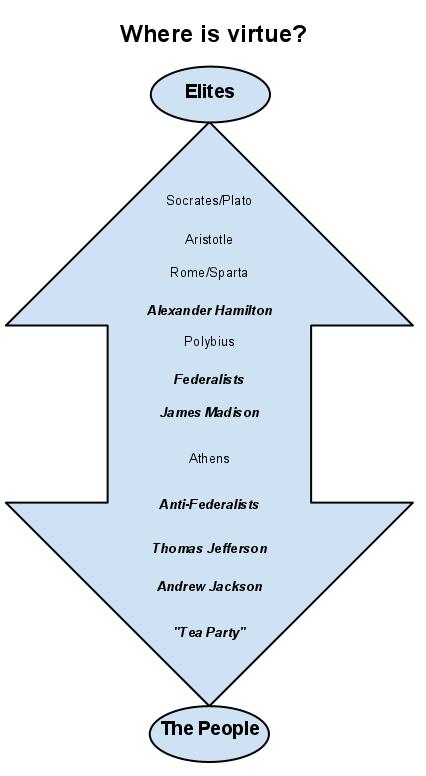
(Notice his explicit mention of virtue as residing in the common people — that, ie the putative location of virtue, was what I attempted to trace across time in that diagram post.)

II) Inauguration Day

On the day in 1829 he was sworn in, Jackson (apparently without prior planning) opened the White House to “the people”. They gladly obliged by piling in. As one contemporary lady of letters described it:

no police officers placed on duty and the whole house [was] inundated by the rabble mob…. The Majesty of the People had disappeared, and a rabble, a mob, of boys, negroes, women, children, scrambling, fighting, romping [replaced it] …. the carpets and furniture are ruined …. The armies of democracy were pitching their tents in Andrew Jackson’s White House. …

Supreme Court Justice Joseph Story, who was at the White House that day, declared the “the reign of King Mob.”

The brain: sources

For over a year now, I’ve been studying the brain. Why? Because neuroscience might be the single most exciting area of science — nay, of knowledge in general — today. Just the other day, I found myself in a conversation with an 18-year-old cousin and heard myself saying that, if I were to enter university again today, I would choose any discipline that might lead me to neuroscience. (One feels old when spouting such counterfactuals to the young.)

So, given that my own brain is now teeming with newly-acquired insights into the brain and — much more importantly — with newly acquired insights into what is not yet known about the brain, I might amuse myself with a few posts here on the subject.

Just to be clear: This has nothing whatsoever to do with my forthcoming book, nor with my day job at The Economist (where I cover very different things). It’s just one of my little intellectual hobbies.

In this post, I’d simply like to tell you about some of my main sources. The two big ones are:

Robert Sapolsky

1) Robert Sapolsky: Biology and Human Behavior: The Neurological Origins of Individuality

This is a great course in 24 lectures by a very entertaining character, whom you’ve already met on this blog here and here.

Sam Wang

2) Sam Wang: Neuroscience of Everyday Life

Another good course, in 36 lectures, organized totally differently from Sapolsky’s (as you can easily see by glancing at the lecture titles). The two are very complementary.

I also seem to be reading about specific aspects of neuroscience everywhere these days. The articles are too numerous to link to.

Here is one, by David Eagleman in The Atlantic, on how understanding the brain might or might not affect our notions about criminal justice.

Here is another, by John Tierney in the New York Times, on “decision fatigue”. Like Eagleman’s, it looks at one of many, many topics covered in the lectures by Sapolsky and Wang.

That should give you enough infrastructure to hold me to account as I pen my indubitably outrageous and provocative posts on the brain. Bye for now.

Cross-posting: My 9/11 etude

(Throughout the day today, The Economist’s Democracy in America blog will be sharing various impressionistic thoughts and recollections on 9/11 by us, the correspondents. Mine is here, and again below:)

ON SEPTEMBER 11th, 2001, I had already been a correspondent for The Economist for four years and, as we are wont, had moved around for the publication, just then finding myself living in Hong Kong and covering Asia. It was already evening in Hong Kong and I had just returned, somewhat tired from a long day, to my flat on the 25th floor of a skyscraper in “Mid-Levels”, with a view of Hong Kong, the harbour and Kowloon. Just then my assistant called and said simply: “Turn on the TV.” For the rest of my night, which for America was that endlessly long morning and day, I watched.

The next morning, I walked to my office and stopped by my usual coffee bar in Lan Kwai Fong, Hong Kong’s expat playground. All the regulars were there, and in each conversation, people of various nationalities were trying to make sense of what this world was now to become—now, as of September 12th, as of the day after. Anger, worry, confusion, fear—all these emotions were mixed together. I knew right away that the main significance of this dreadful event lay in what would happen next, not in what had already happened. How would America react? China? Muslims? Everybody?

There was a lot of nonsense said in those early days, as always when people must talk about something but have little new to say. I was suddenly getting lots of eager advice to cancel a trip to Indonesia. A Muslim country, you see. I went, and it was my favourite trip ever to that mystical place, easier for the lack of other travelers and just as welcoming as ever. The Schadenfreude of many mainland Chinese was harder to stomach. The unfocused jingoism of some Americans (“nuke’em back to the stone age”) even harder.

The first casualty of war is truth, it is often said. Instead, it is nuance. Every individual flees to his in-group and becomes susceptible to its caricatures of the respective out-group, to what the Germans call a Feindbild, a perception of The Other as enemy. This is already an act of de-humanisation. Bad laws, more oppressive bureaucracy (at borders, in courts, in daily life), distrust in interpersonal relations invariably follow, just as one apocalyptic horseman inevitably rides close behind the one before.

Did September 11th teach us about the risks of terrorism? It should not have. The existential threat of a suitcase bomb, a rogue nuclear event, already existed before and exists still. On the other hand, September 11th itself killed about as many Americans as die each year as a result of texting while driving. Homo sapiens are bad at understanding risks relative to one another, and worse at responding proportionately. The world became a worse place on that day. In part because the terrorists made it that way. In part, because the rest of us then did the same.

__

For the regulars here, some of these thoughts might strike you as “in-character”, such as those on

Interview tips for ships that pass in the night

Henry Wadsworth Longfellow

Ships that pass in the night, and speak each other in passing, only a signal shown, and a distant voice in the darkness; So on the ocean of life, we pass and speak one another, only a look and a voice, then darkness again and a silence.

These words by Henry Wadsworth Longfellow popped into my mind this week, as I read an internal email from The Economist‘s “brand communications manager” that landed in my inbox. It began:

As more and more of you are doing broadcast interviews now, I thought it might be useful to re-circulate these hints and tips…

I have indeed, over the past 14 years, been doing more and more broadcast interviews, and made more than my share of mistakes. So I began perusing these tips with an open mind. Many were about the mechanics (wear plain shirts on TV, no patterns, no black; don’t fiddle with your hands; etc). But the important ones were about content. And, as I kept reading, I grew somewhat pensive.

That’s because, as I see it, the tips were simultaneously

  1. good — ie, anybody doing media interviews is well advised to heed them — and
  2. awful — ie, heeding them is what makes our political, public and personal conversations increasingly pointless and frustrating.
I shall explain, in two parts:

1) The tips

I was slightly suspicious of the Powerpoint-style pseudo-acronyms (this email came from the “business side”, after all), but could not argue with the advice:

Prepare beforehand – decide what it is you really want to get across, having stats to hand will usually be useful. Know your:

  • Audience
  • Messages (focus on three key things to say)
  • Evidence (third party endorsement is good e.g. quotes or research)
  • Negatives (what’s the “worst” question they could ask?)

(AMEN, get it? Oh dear.)

Then:

Get in early with your messages/evidence – don’t wait for the perfect question, it may never come

Translation: Ignore the question, just say whatever the heck you want to say, which is probably whatever you said in your last article in The Economist.

More tips:

Avoid being question-led so the interviewer gets a neat segment that fits their preconceptions but you don’t get to say anything really interesting or useful.

Add value. Don’t feel forced to answer a question at length that you feel is unclear or irrelevant. You are the expert, talk about what you think is most significant.

If you are asked a difficult question:

1. Acknowledge it (“I understand that view…” / “we need to look at this issue in the light of..”)

2. Bridge back and communicate what you want to say.

3. Don’t repeat any negative language – if the audience is only half-listening, that’s all they will hear.

4. Don’t fake it if you don’t know, bring the conversation back to where you feel comfortable.

Translation: In case you didn’t get the first translation, ignore the question (but be suave about it) and say whatever the heck you want to say….

2) The consequences

I did say, right up front, that I had contradictory reactions to this advice. I know too well how utterly demoralizing it is to be on the radio or on TV, and to go off on that tangent that might become so very sophisticated in just a few minutes but dies suddenly and ignominiously when the interview is … over.

‘Wait, you mean, you don’t want to hear all my complex thoughts on this issue?’

No, they don’t.

If you don’t seize the conversation, they, or it, will seize you.

On the other hand, what kind of “conversations” are we talking about?

The worst kind: the eristic kind, as Socrates would say, the kind that obstructs communication and discovery of truth.

And so we all — journalists, politicians, consultants, pundits — become “media-trained”, talking right past one another, just like ships that pass in the night.

Minard’s map of Hannibal’s crossing

As you know, I love maps, especially historical maps, and I like to play with them to make points.

For instance, in this post, I turned a map of Hannibal’s invasion of Italy upside down to illustrate the arc of his and his enemy’s lives.

And in this post I paid my respects to Charles Minard, a Frenchman who, in the 19th century, launched the field of data visualization by producing a new kind of map — one that graphically as well as geographically shows Napoleon’s invasion of Russia.

Now I get an email from one Jonnie Lappen, a senior at Arizona State University who is studying geography and considering doing his honors thesis on a different map by Minard.

I didn’t even know about that map until Jonnie showed it to me. Which is shocking: On it, Minard depicts Hannibal’s crossing of the Alps.

If it’s not famous, that’s probably because it is not nearly as good as the Napoleonic map: Minard gives us an angle of the Riviera we’re not used to seeing, and the shrinking line of the Carthaginian army is not as striking as in the Napoleonic map. (Still, look at that Alpine crossing: suddenly the line shrinks by half. That’s a lot of human beings dropping into gorges, slipping off ice sheets, dying of dysentery…)

Anyway, Jonnie is now engrossed in Livy to improve upon this map and give it its proper drama. A great idea. Good luck, Jonnie!

The benefits of a blogging holiday

Without even having planned it, I have just taken a one-month blogging holiday. By which I mean: a holiday from blogging, not a holiday spent blogging. And what a healthy thing that turned out to be. I recommend it.

That the hiatus occurred during the dog days of August was pure coincidence. It was neither heat nor languor (in excess of the usual dose) that kept me from logging on. Instead, it was that larger category of reasons which we might call “life happens”. When life does happen offline, it’s sometimes best to stay there (ie, offline).

Only twice in the past month was I tempted to break this online fast by posting:

Once, when I read something that so outraged and offended and mystified me that I at once unsheathed my blogging sword to slice and stab and slay. This resulted in a long draft saved in my WordPress account that will probably never see the light of day. For I showed it to a family member or two, and these confidants — though agreeing with, and liking, my polemic — asked sensibly whether I needed to pick this particular battle just now, just so, or indeed at all. No, I didn’t, I realized. After all, picking one’s battles well is the secret to strategy as opposed to tactics (which, in a way, is the thesis of my book in one nugget.) So this particular battle will not be fought. (Except perhaps posthumously, as Twain might say.)

The second instance when I was tempted, I produced another draft, less controversial and quite entertaining. But I now felt that it was — in comparison to the polemic just left unpublished — banal. Why bother? Back to life.

So here I am again. The break allowed me to reflect where I want to take this blog in the coming months.

Recall: I started the blog rather prematurely three years ago, to write about my book. My editor subsequently urged me rather passionately not to divulge much from the book before publication. That left my blog without a purpose. So I began goofing off intellectually, with threads on:

and so forth. None of those had much to do with my book at all. I was just amusing myself.

So, in a couple of months, I’d like to return to this blog’s original purpose: as a journal in support of, and about, the stories in my book.

In the meantime, I might just tie up a few of the loose “threads” from the past three years. And I might just indulge myself with one new one.

(That’s because, for the past year or so, my new hobby has been to study the brain — human and animal, male and female, old and young, happy and depressed, criminal and healthy, et cetera. So the new thread would be about brain science and its implications for life, justice, love and everything else.)

But then, at the latest in December, it’s all book, all the time, for any of you who will still be around for the fun.

The virtue matrix: Elitism and Populism

American history moves in various cycles. For example:

  • isolationist ↔ interventionist (in foreign policy)
  • prudish/puritan ↔ permissive/liberal (sex)
  • progressive ↔ conservative (attitudes toward change)

But perhaps the most striking and consequential cycle is the one between elitism and populism.

The question here is about virtue. Who is most likely to be virtuous/corruptible? The common people, or the elites?

This question has an ancient pedigree. The answer a society gives at any given time in effect determines the kind of democracy it will practice and the kind of institutions it will build: It will shift power (or pretend to shift power) to the pole it considers more capable of virtue.

I’ll say more about all this in future posts (especially in response to a great biography of Andrew Jackson I just finished reading). But for now I just wanted to amuse myself with another little diagram. As ever, I’m not taking it too seriously, just trying to order my thoughts and invite yours.

Below, I’ve placed some of the figures that have appeared here on The Hannibal Blog over the past two years (each one has a Tag, or you can search for his name) along a spectrum.

Classical thinkers are in normal font, American ones in bold italics.

(Notice the centrality of James Madison, the primary architect of the Constitution. His answer was, in effect, to be agnostic on the question. Therein lies his genius and the strength of the constitution. So he represents the neutral value, 0)

So weigh in. You can also suggest where to place other thinkers, such as John Locke or Montesquieu, or modern pols such as presidential candidates, or foreign politicians.