I)
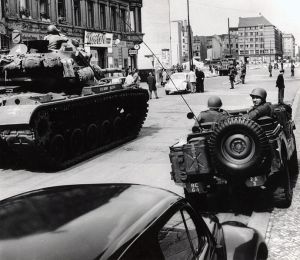
In the late 80s, when we still thought the Iron Curtain and the Berlin Wall were as good as eternal, my friend Matt Lieber and I, fairly fresh out of high school, traveled around Germany and got a visa for a few unforgettable hours in Communist East Berlin. We entered through Checkpoint Charlie (pictured above in 1961, during one of the many standoffs). Then we walked up the famous Friedrichstrasse toward the equally famous Unter den Linden.
I’ll never forget those first few blocks behind the Iron Curtain.
Crosstreets:
- Krausenstrasse
- Leipzigerstrasse
- Kronenstrasse
- Mohrenstrasse
- Taubenstrasse
II)
Just a few years later, in 1993, I was back on that same stretch of that same street: Friedrichstrasse, between Taubenstrasse and Mohrenstrasse.
Except this time I was an unpaid intern for CNN, that (then-) unbeatable American, Western, Capitalist media success story. By sheer luck, n-tv, a German start-up that wanted to be, and indeed became, the German CNN, had just opened in the same building and CNN owned a part of it. In the utter chaos of n-tv‘s first weeks, I did all sorts of jobs for both companies that I was entirely unqualified for and benefitted hugely from.
III)
Now, many years later again, I will be back once more at that same stretch of that same street. This time (as of mid-June, 2012) I am Berlin Bureau Chief of The Economist. Our office is right at a corner that Matt and I walked past all those years ago.
It’ll be my fifth beat in the 15 years I’ve worked for The Economist so far. (You may recall my meditation on being that kind of “generalist” when I last switched beats, three years ago.)
IV)
When I visited the office the other day, before the actual move from Los Angeles, I loitered a bit on those blocks, looking for something familiar from the past.
Wasn’t this where that East German cop stopped Matt and me for jaywalking?
And wasn’t that where, in 1993, that god-awful East-Germanesque sausage snack bar was?
I simply couldn’t tell. Yoga, Starbucks, Gucci, banks, BMWs. Physically, the street had become aggressively 2012, and nothing else.
I remembered how somebody once told me about visiting, in 1978, a tiny fishing village north of Hong Kong. It was called Shenzhen. Three decades later he went back to try to find the spot where he stood. Well, you know.
But even that did not capture the feelings I had while standing again at that particular corner of the world. In my imagination, I rewound and fast-forwarded through life on that spot. From its Slavic time through its Prussian time, to its Wilhelmine and Twenties time, its Nazi time, its Cold-War time, its Wende time. Then I opened my eyes again.
V)
Why do people become journalists? For different reasons. But many, I am guessing, want to feel that they lived history.
This year and in the coming years, Europe seems likely to be making history again, and Berlin seems likely to play a big role in that history. If I do my job right, and even if I just do it mediocrely, I’ll see a good bit of it up close.






 Hannibal and Me: life lessons from history