The original “gadfly”: Socrates’ negativity

783px-Horse_fly_Tabanus_2

Socrates saw himself as “a gadfly to a horse”, where the horse was Athens–a “sluggish horse” in need of a bit of “stinging”. This the origin of our clichΓ©. As we keep discovering in this thread on Socrates, the old man is still with us all the time, whether we are aware of it or not.

Socrates also liked to compare himself to a midwife. (Perhaps that metaphor came to him because his mother was a midwife.) What he meant by it was that, through his dialectical questioning and conversation, he “birthed” the thoughts that his conversation partners were already pregnant with. Put differently: He felt that he brought something out of people: he led (Latin ducare) something out (ex), ie educated.

But how did others see him?

Cicero, a few centuries later, said that Socrates practiced a “purely negative dialectic which refrains from pronouncing any positive judgment.”

Hippias, one of the sophists (teachers) Socrates interrogated, said that “You mock at others, questioning and examining everybody, and never willing to render an account yourself or to state an opinion about anything.”

Meno, another conversation “partner”, tells Socrates that “You are extremely like the flat torpedo sea-fish; for it benumbs anyone who approaches and touches it… For in truth I feel my soul and my tongue quite benumbed.”

In short, it is hard to avoid concluding that Socrates left everybody feeling bad. If you were lucky, he merely belittled or embarrassed you; if you were unlucky, he exposed and humiliated you. He never made anybody feel confident or good. In our lingo, he left everybody 😦 and nobody πŸ™‚ .

What if Socrates had talked to Patanjali?

This is quite worth thinking about.

You recall that Patanjali was my nomination for the title of “the world’s greatest thinker ever“. He was the original sage of Ashtanga Yoga. Which is to say: Whereas the Bhagavad Gita outlines Ashtanga Yoga (which it calls “Raja Yoga”: “regal union” or “kingly discipline”) in a narrative form, Patanjali was the first to analyze the “how to”, step by step.

As it happens, he had a lot to say about something that Socrates valued: truth, or Satya in Sanskrit. It is one of the Yamas, or ethical principles, that yogis must adhere to if they want to embark on the journey that leads to enlightenment. Don’t lie, in Commandment language, to others or yourself.

But Patanjali is more subtle than Socrates. Another of the Yamas is Ahimsa, non-violence: Don’t hurt people (others or yourself), physically or psychologically.

The subtlety lies in understanding that Satya and Ahimsa, truth and gentleness, often conflict. It may be true that you are ugly, but do I need to tell you that and hurt you? In Socrates’ case, it may have been true that his interlocutors were, if not ignorant, at least far less wise than they pretended. But did he need to humiliate them publicly?

There was widespread consensus that his negativity helped the cause of truth only insofar as it tore down certain falsehoods. That’s a step forward! But Socrates did not then build on the rubble with a positive truth.

Patanjali might ask Socrates: What, sir, were you trying to accomplish by humiliating your opponents in your dialectic? Did you not forget your own distinction between eristic dialogue, in which the parties try to win, and proper dialectic, which brings people closer together in the common search for truth?

Sometimes, in life and world history, one must be violent in the name of truth. Other times truth is not worth violence. There must be a higher purpose, a positive goal. Otherwise a gadfly is just another gnat that bites to feed on the blood of others.

Bookmark and Share

Socrates and the original think tank

Aristophanes

Aristophanes

And so we continue this thread on Socrates, and the profound ways that he is still with us today.

We’ve been looking at his ideas about conversations, good and bad, and his skepticism toward writing (as opposed to oral conversation). But what did this in fact lead to, in practical terms?

It led to a weird, perambulatory kind of school, as Socrates walked around with various people, mostly younger, engrossed in conversation. This would ultimately get him in trouble, of course. But before it got him killed, it merely raised eyebrows.

Aristophanes, the greatest comedian of ancient Greece and Socrates’ most cutting parodist, invented a word for this kind of purposeful and moderated conversation, in his play the Clouds: a thinkery (phrontisterion).

A think tank, in other words.

Indeed, think tanks are among Socrates’ legacies. His student Plato took over a grove dedicated to Athena, the goddess of wisdom, and founded his Academy, which lasted for three hundred years, throughout the entire Hellenistic era.

One of the people perambulating and thinking and conversing at that Academy was Aristotle, who eventually took over another grove, dedicated to Apollo, the god of wisdom (and other things), and also started a think tank, called the Lyceum.

In time, Academy and Lyceum became the roots for “school” in many languages, depending on whether the insitution leant toward Platonism or Aristotelianism. But the more direct descendants today might be the likes of Heritage, Cato and Tellus.

But we’re getting ahead of ourselves. We need to start looking at whether Socrates actually practiced what he preached in his peculiar style of conversation. Stay tuned.

Bookmark and Share

Was Jesus black, Jewish or female?

Willie Brown

Willie Brown

Willie Brown, the only black mayor San Francisco has every had, as well as a California state assemblyman for donkey’s years, many of them as speaker, tells a good joke in his latest column:

There are three good arguments that Jesus was black: He called everyone brother, he liked gospel, and he didn’t get a fair trial.

But then, there are three equally good arguments that Jesus was Jewish: He went into his father’s business, he lived at home until he was 33, and his mother was sure he was God.

But then, there are three equally good arguments that Jesus was Californian: He never cut his hair, he walked around barefoot, and he started a new religion.

But most compelling of all are the three arguments that Jesus was a woman:

He fed a crowd at a moment’s notice. He kept trying to get a message across to a bunch of men who just didn’t get it. And even when he was dead, he had to get up because there was work to do.


Bookmark and Share

The Atlantic on the success of The Economist

Michael Hirschorn

Michael Hirschorn

Our success at The Economist continues to baffle and intrigue an entire industry.

Where some postulate that it is our tone (analogous to coffee beans “shat out be a civet cat“), others are analyzing our position as simultaneously niche and global, which is no longer oxymoronic but suddenly Γ  la mode.

Michael Hirschorn in The Atlantic is the latest. As he puts it,

The Economist has become an arbiter of right-thinking opinion (free-market right-center, if you want to be technical about it; with a dose of left-center social progressivism) at a time when arbiters in general are in ill favor.

This is the American part of any article about us, which is always amusing, since there is a one-word synonym for the convoluted phrase “free-market right-center, if you want to be technical about it; with a dose of left-center social progressivism”: That word is liberal.

But Hirschorn is really interested in why we are doing well when Time and Newsweek, which are trying to copy us, are not.

The easy lesson might be that quality wins out. The Economist is truly a remarkable inventionβ€”a weekly newspaper, as it calls itself, that canvasses the globe with an assurance that no one else can match. Where else, really, can you actually keep up with Africa? But even as The Economist signals its gravitas with every strenuously reader-unfriendly page, it has never been quite as brilliant as its more devoted fans would have the rest of us believe. (Though, one must add, nor is it as shallow as its detractors would tell you it is.)

Here he is expressing what I’ve observed to be a persistent sour-grapes, cringing, squinting snobbishness toward The Economist from American journalists at the “good” publications: They always feel compelled to call us “smug”.

Indeed, he does:

At its worst, the writing can be shoddy, thin research supporting smug hypotheses.

I don’t actually disagree. But Hirschorn then comes around to what I’ve been saying internally at The Economist for a while now:

The Economist prides itself on cleverly distilling the world into a reasonably compact survey. Another word for this is blogging, or at least what blogging might be after it matures.

This of course leads to an irony that we at The Economist all savor:

For a magazine that effectively blogged avant la lettre, The Economist has never had much digital savvy…. most of the magazine’s readers seem to have no idea the site exists. While other publications whore themselves to Google, The Huffington Post, and the Drudge Report, almost no one links to The Economist. It sits primly apart from the orgy of link love elsewhere on the Web.

As it happens, this missing “link love” was the topic of my presentation at our internal powwow last fall in Danesfield. The title of my talk was “Google Juice”. I was offering thoughts on how to increase our link love, but Hirschorn thinks that our relative dearth of it

turns out to have been a lucky accident. Unlike practically all other media β€œbrands,” The Economist remains primarily a print product, and it is valued accordingly. …

By that he means that we are really friggin’ expensive. He then signs off with an interesting thought:

General-interest is out; niche is in. The irony, as restaurateurs and club-owners and sneaker companies and Facebook and Martha Stewart knowβ€”and as The Economist demonstrates, week in and week outβ€”is that niche is sometimes the smartest way to take over the world.

I like that. That’s exactly what I might try to do when my book comes out.

Bookmark and Share

The spoken and the written word

Socrates_teaching

So Socrates loved good conversations, which he called dialectic, and disdained bad conversations, which he called eristic, as I described in the previous post of this series on Socrates. But that actually opens up lots and lots of fascinating and difficult issues.

For instance: the relative value of the spoken and the written word.

Since I happen to write words for a living, I spend quite a bit of time pondering this, as you might imagine.

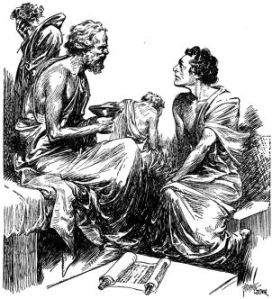
Socrates never wrote a single word. He did not believe in it. Why waste your time killing words (since to write them down was, to him, to kill them) when you could send them back and forth in intimate conversation such as the scene (with him on the left) above?

His student Plato was more schizophrenic on the point. He agreed with Socrates but also, obviously, felt that he should write things down to make them immortal, to reach more people, to make Socrates’ wisdom ‘scalable’ in our lingo. So he compromised, you see: He “wrote” by transcribing … conversations!

One generation on, and we get to Aristotle, who clearly did not agree at all, and wrote what we would consider genuine philosophical treatises. No qualms about the written word at all!

Why did Socrates disdain the written word?

He sort of tells us in one of his (ie, Plato’s) dialogues, the Phaedrus. He takes several shots:

  • He tells a legend from Egypt, in which a god gives a king the gift of writing as an aid to memory. The king, however, observes that writing things down is likely to be a remedy for reminding, at the expense of remembering, and thus will lead to less wisdom, not more.
  • He then compares writing to paintings, which “remain most solemnly silent” whenever you question them, and just say the same thing over and over, stupidly and dumbly. People wise and ignorant alike will look at them and understand and misunderstand them. And they (the words/pictures) cannot talk back, defend themselves, explain themselves.

So text has several problems, in Socrates’ opinion:

  1. It is not a conversation, not dialectic, because it cannot go back and forth and climb toward something higher, such as a truth.
  2. An author has no control over what idiots or assholes might read his text, whereas somebody in oral conversation does control with whom he speaks.
  3. Words outside of their original context (ie the intention of the person using them, and the way a listener might hear them) can mean anything, and thus nothing at all.

Ultimately, Socrates disdained writing for a subtler reason that unifies all these points: It’s just not what life is about!

Instead, life is about communing with others and discovering yourself and truths in conversation. Not about recording this or that, or propagating this or that. Socrates believed that you can’t find yourself when you write, only when you converse.

Where does that leave us writers?

In a tight spot, it would seem.

Then again, we have moved on 2,400 years, and few things are becoming clearer. Here is how I would converse with Socrates on the matter if he were to visit us today:

The need for conversation…

First, I would tell him that he is mostly right, even and especially for writers. Only a tiny part of “writing” consists of typing words–5%, if I had to guess. The other 95% consists of living, experiencing, interviewing, discussing, talking, reading what others have written, and so on. The ideas and stories that end up on pages don’t come out of nowhere. They still come out of conversations.

… but also for order

But writing, which should never replace conversation, has something to contribute: order. Real conversations–and Socrates’ own dialogue with Phaedrus is a great example–run all over the place, like foals on a meadow. That’s the fun. But it can also be frustrating when you want structure and discipline about one particular issue. Writing can simply be a way of forcing yourself to structure the thoughts that came up in conversations.

Why not written conversation?

This is one bit that Socrates overlooked. You can converse in written form.

Some of the greatest conversations in history have been exchanges of letters. Just think of Voltaire and Frederick the Great.

Today there is a fascinating technological twist. In 400 BCE, it was impossible to imagine ‘place-shifting’ (via tele-phony, far-hearing) or time-shifting conversations. But time-shifting is exactly what we do when we …. blog!. I write words, and those then turn into conversations in the comments below, or on other blogs that link to them. So the words are not dead at all. They can talk back. Writing can be conversation.

Indeed, by time-shifting the back-and-forth of a real conversation, the dialectic can become better. All of the people who talked to Socrates must have felt, a few hours later: “Doh! If only I had said…..” Well, now it’s possible to take a moment to think–without the distractions of, say, a famously ugly face such as Socrates’, or body odor, or wind, or sun–and then to come back with a clearer thought.

The inevitability of context

But Socrates was right on at least one point: The written word without context, as provided by conversation, is treacherous. Just take this notorious example, which we call the 2nd Amendment:

A well regulated Militia, being necessary to the security of a free State, the right of the people to keep and bear Arms, shall not be infringed.

Does that mean that a people has the right to keep an armed militia, or that every shmuck in the people individually has a right to bear everything from a pocket knife to nukes, whether there is a militia anywhere to be seen or not?

Socrates would find the author and … converse!

Bookmark and Share

Good & bad conversations: Recognize Eris

Eris_(Discordia)

I ended the previous post, the first in this series on Socrates, by suggesting that we “count all the other ways in which Socrates, like Hannibal, is relevant to us, today.” So let’s start with perhaps the most important (if not the most famous) insight that Socrates gave us: the incredible importance of knowing good from bad conversations. And for that, I need to introduce you to that strange lady above, whose named is Eris.

We spend much of our lives, and indeed many of our happiest moments, conversing with others. I love that word, which means turning toward each other. Good conversations make us human and whole, make us feel connected to others and bring us closer to the truth of something (or at least further from a fallacy).

Unfortunately, we also spend at least as much time in bad conversations. You know them:

  • bickering between husbands and wives
  • political “debates” on Fox, or indeed almost anywhere else.
  • Cross-examinations in courtrooms,
  • and on and on and on

Those “conversations”, which are really a turning away from one another, do the opposite of what good conversations do: They leave us depleted, down, disconnected, alienated, sleazy, yucky.

What is the difference between the good and the bad conversations? Socrates told us, by giving us two new words:

  • dialectic (=good), and
  • eristic (=bad)

Meet Eris, the Ur-Bitch

So now it’s time for a story. It’s the most famous of the many stories about Eris, whose Roman name was Discordia.

Eris was the goddess of strife. Nobody liked her, so when the future parents of Achilles had their wedding, everybody was invited except Eris. Eris fumed.

She knew what she was good at, and did it: She left a golden apple lying around the wedding party. It said “To the most beautiful”. How cunning, how feminine.

Three extremely beautiful goddesses, Hera, Athena and Aphrodite, immediately started bickering about who had rights to the apple. It was decided to appoint a judge, somebody sufficiently hapless, naive and male to be easily manipulated. They settled on Paris, a prince of Troy.

“Paris,” whispered Athena, “don’t you think I’m the most beautiful? I’m the goddess of wisdom, as you know, and I could be persuaded to make you the wisest man alive.”

“Choose me,” said Hera, “I’m the wife of Zeus and can make you the most powerful man in the whole world.”

“Oh, Paris,” cooed Aphrodite with a tiny bat of her languorous eyelids. “You know who I am, don’t you? We all know that the apple is mine. Say so, and I will give you the most beautiful woman in the world.”

Paris, with the priorities of the average teenager, chose Aphrodite. Athena and Hera were fuming. Hatred descended on the wedding party. And everybody knew that Paris was now to get Helen, the most beautiful of the mortal women.

The only problem: Helen was already married, to a Spartan who was the brother of the great king Agamemnon. Agamemnon and his Greeks would have to come after Paris and his Trojans to get Helen back. Ten years of bloody war followed. Eris had outdone herself.

Eristic conversation

So Socrates chooses to call bad conversations eristic. They are full of strife, because–and this is the key–they are conversations in which each side wants above all to win. Where there is a winner, there is usually a loser, so these conversations separate us.

The opposite was dialectic, whence our word dialogue, the Greek form of the Latin conversation (ie, turning toward). When you turn toward another, you are not trying to win, you are trying to find the truth. That is your motivation, and it is one you share with your conversation partner (as opposed to opponent). Everybody wins, as long as you climb higher through your conversing, toward more understanding or more communion.

We today

I mentioned in the previous post a series of serendipitous events recently. The first was an email from Cheri Block Sabraw, a writing teacher and reader of The Hannibal Blog, that pointed me to this essay, “Notes on Dialogue”, by a great intellect named Stringfellow Barr.

Written in 1968, it might as well have been penned today, as Barr describes eristic and dialectic conversation in our own world:

There is a pathos in television dialogue: the rapid exchange of monologues that fail to find the issue, like ships passing in the night; the reiterated preface, “I think that . . .,” as if it mattered who held which opinion rather than which opinion is worth holding; the impressive personal vanity that prevents each “discussant” from really listening to another speaker and that compels him to use this God-given pause to compose his own next monologue…

Expressing the Socratic ideal, Barr says that

We yearn, not always consciously, to commune with other persons, to learn with them by joint search,

and that

the most relevant sort of dialogue, though perhaps the most difficult, for twentieth century men to achieve and especially for Americans to achieve is the Socratic….

What makes good (Socratic) conversations good? They have a completely different dynamic than bad conversations. They tend to be

  • poor in long-winded declarations and rich in short, pithy back-and-forth,
  • egalitarian in that it does not matter who says what but what is said (even though this does not mean “equal time” for any nonsense)
  • spontaneous, in that they follow wherever the argument leads, even and especially to surprising destinations,
  • playful, and indeed humorous, for that is what makes “serious” investigation possible and sublime.

In short, this sort of conversation is what The Hannibal Blog is about, with the amazing input by all of you in the comments that make each topic come alive. If The Hannibal Blog is against anything, it is Eris and her spawn.

And so I leave you with just one famous instance when two fakers were called to account and toldΒ  just what sort of “conversation” they dealt in:


Bookmark and Share

New thread: Socrates

800px-UWASocrates_gobeirne

The Hannibal Blog is kicking off yet another series, this one on Socrates.

You’ve encountered Socrates before on this blog, as when he represented the “left leg” in this body metaphor of the Western tradition, or when discussing irony. He came up only indirectly, via Plato, in my series on the world’s greatest thinkers, of which he is of course one.

So why now an entire series? Because he deserves it. And because of an oddly serendipitous string of events:

  1. I have been thinking for a while about writing my second book about a theme illustrated by Socrates, rather as the theme of success/failure is illustrated by Hannibal in my first book–even though it’s not even out yet.
  2. Even though I haven’t told anybody about this, several people, indeed several readers of The Hannibal Blog, have been sending me ideas and links and recommendations that have to do with Socrates. (More about those soon.)

Hannibal embodies more than one theme in our lives, although any good story needs one theme for focus, with the others appearing along the way.

For Socrates, too, I have one theme in our lives in mind. But it’s way, way too early to get into that. For the rest of this blog thread, let’s just start counting all the other ways in which Socrates, like Hannibal, is relevant to us, today. There are so many.

Bookmark and Share

Idioms: The Book

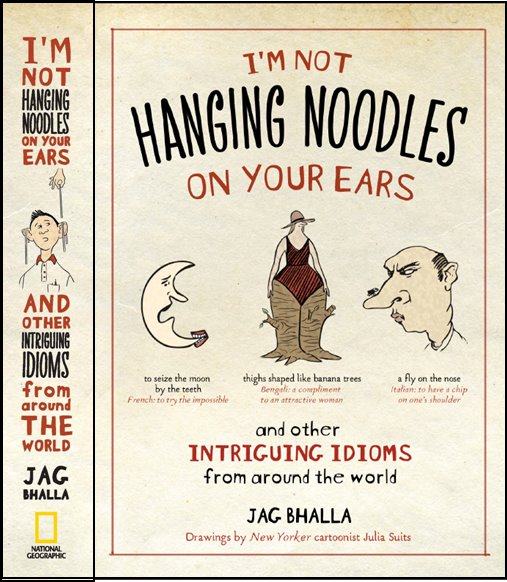
Congratulations to Jag Bhalla, whose witty wordsmithery adorns many comment threads on The Hannibal Blog, for publishing his new book today.

It’s called: “I’m not Hanging Noodles on your Ears” and is about idioms–their mystery, meaning, beauty. I’ve read it, and it’s witty and entertaining, humorous here and intellectual there. Get yourself to Amazon now.

Now if I could just set my own publisher’s butt on fire to get my own publication date.


Bookmark and Share

If you don’t know what it is, give it a name

  • What is sleep?
  • What is an electron/photon?
  • What is money?

I find it forever fascinating how utterly clueless we (Homo Sapiens) are, about almost anything. A different sort of person marvels at how much we know, but I marvel at how little we know.

Which sort of person you are, I find, depends on how curious you are–ie, how easily satisfied that you know enough about something, anything. To oversimplify for the sake of some easy labels, the first sort might be called intellectual, the second practical. Every joke you’ve ever heard about intellectuals applies to me.

The most boring branch of college philosophy, as I recall hazily, is epistemology, the logos of episteme, ie knowledge. You read and write endless stupid essays on whether we really know that the chair we’re sitting on is a chair, whether we can be sure that we are not brains in a vat, and so forth. Able-bodied twenty-year-olds tune out and go to the keg party, as I did.

But there are infinitely more interesting questions to ask, and they get more fascinating with age. Today I want to give you a sample of just three. They have two things in common: 1) the practical types are likely to roll their eyes because, you see, the answer is too obvious to merit the question, and 2) nobody who does ask the question, least of all the experts, has the foggiest notion of what the answer might be.

800px-Puma_Sleeping1) What is sleep?

The practical person says ‘Make sure you get enough of it.’ Thank you, and I do. I’m really good at it, or I was until I had children.

But what is it we’re getting ‘enough’ of? With food, it’s easy to tell. Chemical energy goes in, changes shape into bodily functions and waste. But with sleep, it’s a mystery.

Some animals do it standing up, others lying down, some for minutes a day, others for months on end. All of us go through different phases in our sleep and we should probably have different names for each phase. We can measure some brain waves and chart them. We can follow people who don’t sleep enough and observe their immune systems and reaction times and such. We can, in short, describe what sleep does to us.

But can we say what it is? I’ve been asking some neurologists lately, and the answer is No. You can answer with semantic layers (“rest”, eg), but each layer leaves you more frustrated. We just don’t know. If we find out, that might be one of the greatest breakthroughs in human consciousness ever.

2) What is an electron/photon?

The practical person says ‘If this light switch works, you see the electrons and photons in action, okay?’ Indeed, he might whip out all sorts of measuring devices for both. But we didn’t ask what electrons and photons can do. We asked what they are.

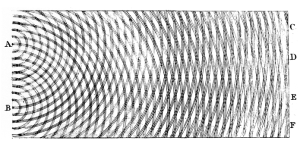
I love this example because it illustrates how we soothe our ignorance with labels. First we called “them” (we were/are not sure whether they are separate things or aspects of the same thing) waves. Waves, of course, are something we think we understand because we’ve skipped stones in ponds and all that. And somebody discovered that if you shoot electrons/photons through two slits, this happens:

Young_Diffraction

A wave pattern, in other words. Aha.

Then somebody else discovered that when you shoot electrons at a metal plate, photons are knocked out, like this:

132px-Photoelectric_effect.svg

Particles, in other words. Aha.

And so we have the answer: “wave-particle duality“. It is Orwellian in its beauty. Rather than admit that we don’t know what it is (a “bundle” of energy? A “quantum”?) we take two things we know and mix them together with a hyphen.

This example goes far beyond electrons and photons, by the way. We follow this approach with all subatomic particles–ie, we bash them together, see another flying off, and instantly … name it. Bosons, muons, leptons. My favorites are the quarks which can be (and I kid you not) up, down, top, bottom, charmed or strange. Those guys in the hadron colliders have a great sense of humor.

800px-BanknotesWhat is money?

I actually found myself in the amusing situation once of teaching (to a class of journalism students) a lecture on this question. What you do, in case it ever happens to you, is that you say you don’t know, but at a high intellectual level, for two hours.

Again, the practical person says ‘I know it when it’s in my bank account’, or describes things that money does.

It does three things, by the way: It acts as a

  1. medium of exchange (so we don’t have to barter)
  2. unit of account (so we can keep track of value)
  3. store of value (so we can save value over time, lest it rot as bananas do)

Great. We can describe other aspects of it. It has velocity. It has a multiplier effect. And so on.

But what is it? It is not cowry shells, although it once was. It is not gold or silver, although it once was (and still is in many names for money, such as Geld or argent). But even though the queen promises to pay me x pounds of sterling, she would not actually give me any metal if I showed up at Buckingham Palace. Other times money is cigarettes (post-war Germany) or sex (ditto). Often it is just paper (above). But almost all of the time, nowadays, it is just debits and credits on a computer screen. (!)

The key moment for me occurred when I was talking to an economist about this, and finally he said:

you have to understand that all this money isn’t actually … there.

He meant it can go pouff if people don’t believe it’s there (see: etymology of credit). It can reappear when people believe it might be there.

And that may be the appropriate note to leave this post on, in the second year of our Great Recession. Everything you lost was … faith-based to begin with.

Bookmark and Share