“Color” in writing

445px-der_mann_mit_dem_goldhelm

I think this is probably my favorite Rembrandt. More than that: it is a lesson! What makes this painting so good is the same thing that makes good writing good. It is the sparing use of color and light.

For two years, I taught at Berkeley’s journalism school (thanks to Orville Schell, the then-dean, who invited me). That was the first time that I had to think about (ie, analyze, intellectualize, verbalize) writing, as opposed to just doing it for a living. And one thing that struck me is that all my students, and quite a few of the teachers there, grotesquely overdid that thing writers call “color”.

Before I go any further, so that we are on the same page, let me give you a caricature of what I mean (this is made up! No real writers are being harmed or embarrassed!):

On a bright, sunny day, John Smith was striding into his corner office, with a view of the Hudson and pictures of his three sons (Jimmy, 12, Billy, 14, and Bobby, 18) on his desk, next to a pile of Wall Street Journals and a cup of Starbucks soy latte. “I love this view,” said Smith. The Fortune 500 executive then turned…..

How many New Yorker articles have you read that started with some variation of ‘On a recent Sunday afternoon…’ or “It was a dark, overcast day when John….”, only to discover on the third of the article’s fifteen pages that these details would almost certainly prove to be of no help whatsoever?

So there I was at the J-School, getting paid to read piece after piece by bright-eyed young journalism students who were so eager to prove that they had been there (wherever there happened to be), that they had actually interviewed some guy, that they had got the color, that they were ready for the New Yorker. It got extremely tedious.

Color and substance

Am I against colorful writing? You must be mad. Of course not. I love color. By the standards of The Economist, I am a “color” guy. No child has ever said to his parents, ‘mommy, I want to grow up and write really monochrome stories’. If you have ever felt the impulse to try your luck as a writer, it was because you loved color, whether or not you called it that yet.

The problem is that color without substance is just a paint bucket that tipped over. I’m not even talking about Rembrandt versus, say, Jackson Pollock. I’m talking about Pollock’s studio floor before he cleaned it up.

Color has to be in support of something. And that something has to be an idea, a thought, a story. The mistake many writers make is to list details. Lists are boring; we use them to go shopping. Details are boring, unless they illuminate some meaning. It does not have to be epic. It can be quirky, amusing, moving, insightful, whatever. But there has to be a there there.

So the trick is to find substance, and then to take away details so that only a few splashes of light and color remain, which then filter out the entire sensual world around the reader and deliver him to that one place that you, the writer, have in mind for him. In terms of thought process, it may be the opposite of what my students were doing, and what I used to do.

I can find no better illustration than Rembrandt, above. You are drawn deep into this man. If I asked you, you would say that there is so much color in this painting, so much light. Only then would you notice that most of the canvas is dark, that very little of it is … in color.

Bookmark and Share

Big night in London for The Economist

I just got an email from my colleague Ed Carr in London, who has been attending the gala dinner at an annual ceremony where they give out these swanky journalism awards. It appears that The Economist cleaned up tonight, with four awards. (The announcement is not up on the official site yet.)

Philip Coggan won, not one, but two! Fiammetta Rocco, our delightful books & arts editor, won another. (For a profile, as she just informed me in another email, of a subject “who caused me much amusement when I discovered that he uses a condom with 39 holes in it attached to the end of a Hoover to make his finest works of art.” Must investigate.) And the fourth award, I’m happy to say, appears to me mine.

Years ago, I won another one of those. For some reason, I never get to go to the dinner, though, so it is always Ed who accepts on my behalf. That means he gets his picture taken with the trophy. When I met my wife in Hong Kong and she googled me, she came upon that picture and, because he and I sort of look alike, forwarded it to her friends as a way of introducing her new boyfriend.

Bookmark and Share

Identity in the age of bureaucracy, continued

And apropos of our recent discussion about ‘bureaucracy and alienation in American life’, here is a footnote from China, just for perspective (my emphasis):

Chinese parents’ desire to give their children a spark of individuality is colliding head-on with the Chinese bureaucracy’s desire for order. Seeking to modernize its vast database on China’s 1.3 billion citizens, the government’s Public Security Bureau has been replacing the handwritten identity card that every Chinese must carry with a computer-readable one… The bureau’s computers, however, are programmed to read only 32,252 of the roughly 55,000 Chinese characters, according to a 2006 government report. The result is that Miss Ma and at least some of the 60 million other Chinese with obscure characters in their names cannot get new cards – unless they change their names to something more common.

What would Kafka say now?

Bookmark and Share

Cleo and the chasm between promiscuity and virility

Good essay on Cleopatra by Stacy Schiff, who is working on an entire book about her.

(By contrast, Cleopatra is one of three people–the others being Hannibal and Morihei Ueshiba–who feature in one chapter, Nr 6, of my forthcoming book.)

The news, apparently, is that they are hoping to find her tomb in Egypt. But aside from that, says Schiff,

What good can be said of a woman who sleeps with two of the most powerful men of her age… Cleopatra has gone down in history as a wanton seductress. She is the original bad girl, the Monica Lewinsky of the ancient world. And all because she turns up at one of the most dangerous intersections in history, that of women and power. She presides eternally over the chasm between promiscuity and virility, the forest of connotations that separate “adventuress” from “adventurer.”

My previous musings on Cleo are here.

Bookmark and Share

The closing-Tube-door method of writing

800px-london_underground_tube_stock_1992

About ten years ago, when I was still living in London and already writing for The Economist, I got in the habit of visualizing a specific scene whenever I was preparing to write something (ie, most of the time). And I still do it today.

In this mental scene, I am saying goodbye to somebody I know and like, somebody who would not bullshit me–my wife, for instance. She has boarded her train in the London Tube (“subway”, to you New Yorkers), and just as that famous Tube voice says Mind the Gap and I pull back on the platform, she says: ‘Oh, and what’s your next piece about?’

As the doors close, I shout one single mouthful of words into the train. A few words. That’s all there is time for. Then I watch the train pull away, and I imagine her facial expression as she looks through the pane.

  • Intrigued? Good.
  • Thoughtful? Good.
  • Outraged? Good, if that’s the kind of story it is.
  • Smirking? Good, if that’s the kind of story it is.

But what if the reaction on her face is:

  • Ho-hum. Not good.
  • Bored. No go.
  • Squinting. Ouch, I must have shouted out a cliché.
  • Disgusted.

Often, I iterate story ideas in real conversations, of course. But there isn’t enough time to do that with the thousands of half-formed story ideas that teem inside my head at any given moment. And conversation has a drawback: You have time. Time to explain… and explain… and explain. The writer needs the opposite: to be constrained into one short phrase only.

So the big surprise is that this mental exercise alone usually does the trick. That ‘trick’ being:

To find something in the everything around me that is worth telling, because somebody will react to it.

Our nomenclature

At The Economist, we have a ‘flytitle’, ‘title’, and ‘rubric’ above every piece, and sometimes a ‘dateline’. In this article, for instance, these are:

The Filipina sisterhood [flytitle]

An anthropology of happiness [title]

Dec 20th 2001 | HONG KONG [dateline]

Out of misery, some extraordinary lessons [rubric]

ONCE a week, on Sundays, Hong Kong becomes a different city. Thousands of Filipina women throng into… [text]

I chose this example because it’s one that worked. Spoken through closing Tube doors, this trio of flytitle, title and rubric would have done the trick. I would know that I’m ready to start writing the pice.

The rubric, Out of misery, some extraordinary lessons, actually came from the editor of that piece, Ann Wroe (usually our Obituary writer, and one of our best). She had taken whatever phrase I had put there, probably a grammatically complete sentence, and chopped it into this open-ended, verbless and … inescapable line. (Notice the alluringly modest some)

So that’s what I do, day in and day out, I think of rubrics and titles. The world is full of things and events and people and sensual inputs. Those are not yet stories. To become stories, they have to fall into place in a way that is interesting. And an essence has to emerge out of them. That becomes the rubric.

The rubric is not a summary (that’s where I used to get it wrong for a long time). It can, but need not be, a thesis, bluntly put. It can be a question, inviting the reader to go on a journey of discovery. Or anything else. The best ones are Haikus, full of attitude. I thought this one, for instance, worked okay, although it bordered on gimmicky:

Google

What a lot of wheatgrass

Jun 30th 2005 | SAN FRANCISCO

Psst, there is news about Google, but don’t tell

IT IS hard to know whether to be impressed, suspicious or amused…..

Really, all it does is to inform you that I’m about to ‘take the piss’, as the Brits would say, on the general subject of Google. If you expect serious analysis after this, it’s your own fault.

Anyway. I happen to believe that this rubric-shouting through closing Tube doors works for all writing at all length. Short blog posts, long essays, even entire books. If you don’t know what that center of gravity is toward which you want your readers to be pulled, you’re not ready yet.

Which makes me wonder, of course, whether I have found the title and rubric of my forthcoming book (which I happen to care about more than about any article I’ve ever written.) You may recall that I recently sent the manuscript to my editor at Riverhead, and that for all sorts of reasons, having to do with the American marketplace, I do not yet know the title and subtitle. It will be determined by the editor, “in consultation” with me. And so I wait.

Lots of Tube doors opening and closing in my mind. Mind the Gap.

Bookmark and Share

Frenemies: Freedom and equality

756px-eugene_delacroix_-_la_liberte_guidant_le_peuple

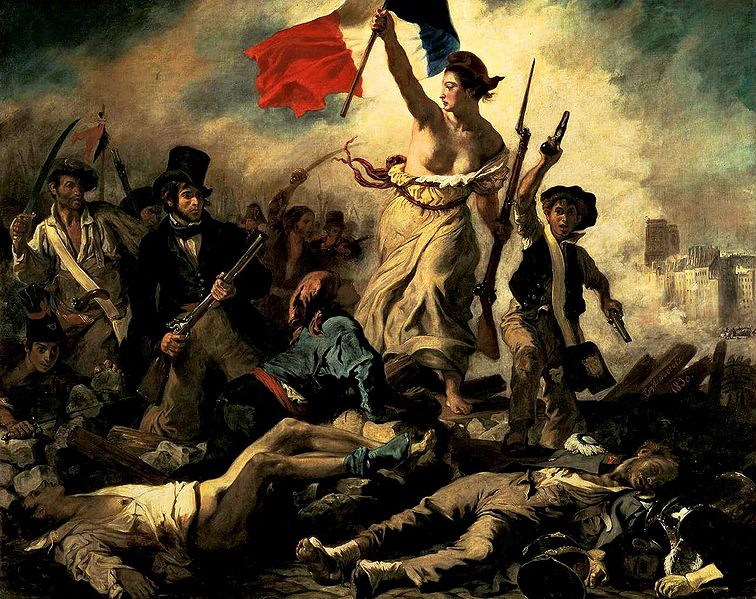
Marianne, above, did not flash her boobs to all those corpses for nothing. She did it for the trinity (as in the tricolore she carries) of liberté, égalité, fraternité. Let’s leave fraternity, which is a rather mushy notion, to one side. That leaves liberty and equality. Do those two belong together?

I knew I would have to address this issue sooner or later in my ongoing ‘freedom lover’s critique of America‘. But the fascinating debate in the comments below this post brought it to the fore. Fortunately, that comment thread neatly summarizes the entire spectrum, across the world and history, of views on the subject. As I see it, the three options are:

  • You can’t have freedom without equality.
  • You can’t have freedom with equality.
  • It’s complicated.

The Classical Liberal view

Broadly, classical liberals (as properly defined) are passionately in favor of equal opportunity and just as passionately against enforced equal outcomes, exactly as “Hizzoner” paraphrased Friedrich von Hayek here.

Which is to say: If you (ie, the government) predetermine that everybody will be the same (think the same, dress the same, drive the same car, live in the same house…) then nobody in your society can be free, if ‘free’ means being able to be yourself, ie different than others. Why create, why achieve, why risk, if the fruits of your effort and ingenuity will be confiscated (“redistributed”) in the name of equality?

I personally glimpsed the extreme form of just such a dystopia when I peaked into East Germany months before it crumbled (although I didn’t know that it would crumble, of course). They were all driving, or on the waiting list for, the same damn Trabi. And while I was ogling their Trabis, many East Germans were already flooding into the West German embassy in Hungary, trying to escape and eventually forcing their leaders to let the Berlin Wall crumble.

That same example, East Germany, also showed what Hayek correctly predicted would happen in reality in an ‘egalitarian’ society. As Orwell might put it: Some were more equal than others. The difference was that the ‘more equal’ ones didn’t use wealth to assert their supremacy but more nefarious means–party connections, or what the Chinese call guanxi. The resulting horror was captured intimately on screen here.

And so, to those of us, like me, who were devotees of Ayn Rand, the answer was clear. Equality is the enemy of individualism, and thus of freedom.

How it got complicated for Liberals

Even at the time, however, there were some contradictions that gnawed at me. Even in the ‘free world’, we were often invoking equality. For instance, democracy, which we (perhaps wrongly) associated with freedom seemed to be based on the equality of one citizen = one vote, even as capitalism seemed to be based on the opposite, ie unequal outcomes.

Then there was the bit about equal opportunity, which we were all supposed to be for. Well, this was messy, because, inconveniently, we were biological organisms and as such insisted on looking after our offspring. Anybody who ‘makes it’ devotes his entire life, and all his resources, to ensuring that his offspring get a head start. And who can blame him?

So if ‘we’ (the government) really wanted to preserve equal opportunity, we would have to get heavy-handed and stop ‘him’ from looking after his kids. We would have to stop him not just from sending his kids to better schools and doctors, but from reading his kids all those bedtime stories, paying for all those piano lessons and SAT prep courses, building all those Lego houses with them–ie, from doing all those things that give kids ‘unequal’ opportunity. In short, we would have to take his freedom away! Obviously, a non-starter.

The triumph of biology

And then I saw a documentary. I tuned in somewhere during the middle and never saw the title, so I can’t be sure it is this one, but it might be. It was based at least in part on Sir Michael Marmot’s Whitehall Study from Britain. Here is how I remember it:

Stress: It is not the same as pressure, which we all feel from time to time. Instead, it comes from ranking low in a hierarchy and lacking power over your own time, your own self (=not being free). You who are at the bottom are at the whim of others. You suffer. And not ‘just’ psychologically, but biologically. You tend to get fat in your mid-section, and your heart, blood vessels and brain change visibly, with entire neurological circuits shriveling up. Meanwhile, the brains and hearts of top dogs expand and thrive.

The most poignant moment came when they cut from our species, Homo sapiens, to monkeys. The researchers observed packs of primates, and sure enough: a monkey at the bottom of the hierarchy got fat in his mid section, had hardened arteries and heart walls and a a shriveled brain.

Equally poignant: One group of monkeys, led by particularly aggressive alpha males, played in a trash dump and was decimated by an epidemic. Another group, more female and egalitarian, moved in and absorbed the survivors of the first group. The egalitarian culture prevailed. And voilà, the health of the surviving monkeys from the first group recovered and improved! They were slim, their hearts and arteries pumped, their brains fired on all neurons.

Let’s take this one more step toward generalization: You recall that I criticized Ayn Rand for getting individualism wrong (which took me many years to figure out). Well, I now know how she got it wrong. She did not allow or understand how inviduals, when forming groups, pick up signals from one another that change who and what they are.

Watch this amazing TED talk by Bonnie Bassler as a mind-blowing illustration of what I mean. It is not about humans per se, but about bacteria. That’s right. Stupid, single-cellular strings of DNA and surrounding gunk. The trick to understanding bacteria (→all biological critters?) is to grasp how they chemically detect the presence of other bacteria, and then suddenly change their own chemistry. Upshot: No bacterium is an island.

The case of America

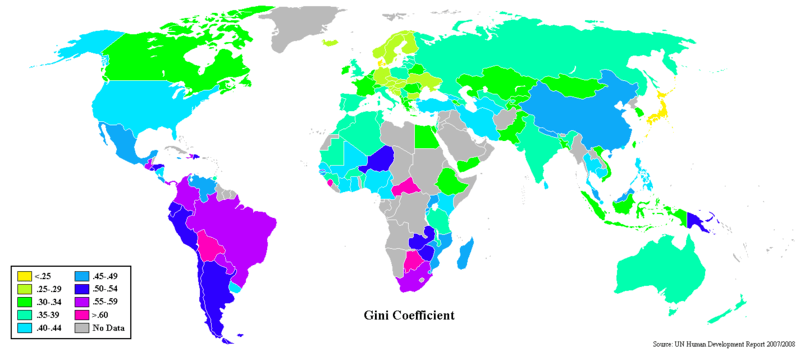
Let’s now look at America. Without getting into the academic weeds, there is a proxy for social equality called the Gini Coefficient. If the coefficient is 0, everybody has exactly the same; if it is 1, one person has everything, and everybody else has nothing. So countries fall somewhere in the middle between 0 and 1. Now look at this world map:
800px-gini_coefficient_world_human_development_report_2007-2008

The first thing you will notice is that the darkest blues and purples–ie, the greatest inequality–tend to be in poor countries, even in nominally “Communist” ones such as China. That’s because poor countries tend to be corrupt and feudal, with a few lords and many serfs. It is hard to consider these countries “free”.

But the second thing is more interesting. If you look at just the “developed” countries (let’s say those belonging to the OECD), you notice that one country stands out.

All the rich countries are in shades of yellow or green, meaning that they are fairly egalitarian societies. Only America is blue. America, in short, is the least egalitarian of all the developed countries.

And so? I’m not sure. The old Hayekian in me would chalk this up as a possible sign of more freedom in America than elsewhere. The new bacteriologist and epidemiologist in me wants to ring the alarm bell. This is not healthy! Sure, the Americans on top of the pecking order might show up at Party Conventions every four years and proclaim that ours is the freest country in the world. But many other Americans are simultaneously dying from their serfdom, whether they are aware of it or not.

For the time being, let’s consider freedom and equality neither friends nor enemies, but frenemies.

Bookmark and Share

Ancient scroll worms

As a writer, I am naturally interested in reading. That includes all the ways in which technology changes reading habits. How is reading different on a Kindle? Do you retain more if you “delete through a text“?

And: What if we were still reading scrolls?

That was the fun insight in this piece by Mary Beard, a professor of classics at the University of Cambridge. She takes us on a tour of reading and writing in ancient Rome. Some aspects of the trade were eerily familiar, but others quite different:

The ancient equivalent of the printing press was a battalion of slaves, whose job it was to transcribe one by one as many copies of Virgil, Horace or Ovid as the Roman market would buy. And it was a large market. Imperial Rome had a population of at least a million. Using a conservative estimate of literacy levels, there would have been more than 100,000 readers in the city. The books they read were not “books” in our sense but, at least up to the second century, “book rolls” – long strips of papyrus, rolled up on two wooden rods at either end. To read the work in question, you unrolled the papyrus from the left-hand rod, onto the right, leaving a “page” stretched between the two. It was considered the height of bad manners to leave the text on the right- hand rod when you had finished reading, so that the next reader had to rewind back to the beginning to find the title page.

Reading was a very different experience with this technology. You could not really skim, for example. You could not easily go back to check something you had forgotten. And you really had to concentrate, because often the Romans did not separate words with spaces but wrote in one continuous stream of letters.

Incidentally, in case you were wondering where papyrus came from: It came from Phoenicia, the mother country of Carthage and thus Hannibal. The Phoenician city that did the briskest export trade was Byblos. Hence: Bible, bibliography, bibliophile, etc.

Bookmark and Share

What’s in a word: Rostrum

When you speak in front of people, you “take the rostrum“. Literally, you are “taking the beak”. The what? Why would you do anything so odd when everybody is watching?

It turns out that, like so much else in our lives, our phrase for pulpit or lectern–ie, rostrum–has everything to do with the story that forms the historical backdrop for the main characters in my forthcoming book. Recall that we left off describing the foolish and tragicomic cock-up that led to two world wars and then a genocide. Well, the first of those wars “produced” quite a bit of flotsam, which the Romans called rostra.

We are talking now about the 23-year-long First Punic War between Rome and Carthage that started in 264 BCE. This war was about the island of Sicily. Both the Romans and the Carthaginians rather wanted it. There was a lot of fighting on the actual island, but the most dramatic and spectacular battles were sea battles. In fact, one of these may have been the single largest naval battle in all of history, involving 200,000 sailors and soldiers!

If you’ve been reading The Hannibal Blog for a while, this might strike you as odd. Yes, Carthage was a great naval power, so that makes sense. But Rome was not. In fact, Rome had no navy at all at the start of the war.

Well, the Romans changed that. At one point, they captured a Carthaginian ship, studied it, and copied it again and again, until they had an entire fleet. This was the ‘reverse-engineering’ part.

517px-corvussvgNext came a bit of innovation. They added an ingenious weapon to their ships. This was the “raven” (corvus), a large swivel bridge that the Romans brought crashing down onto an enemy ship when they pulled up alongside of it. The two ships were then tied together as a large floating platform, and the Roman soldiers stormed across. In effect, the Romans had thereby found a way to turn sea battles into land battles, and they tended to win land battles.

Now to those rostra, or beaks: It’s what the Romans called the prows of galleys. After their first big naval victory, the Carthaginian ships were sinking or floating in the water in pieces, so the Romans fished out the prows, brought them to Rome and stuck them onto the speaker’s pulpit in the Forum, as in the image at the very top of this post.

It was the equivalent, you might say, of an Indian hanging the scalps of his enemies above his tent.

And so, ever since, speakers in Rome and elsewhere have been taking the beak.

Bookmark and Share

Humor, education and creativity

You probably remember the old chestnut of Philosophy 101, Metaphysics: If a tree falls in a forest and nobody is there to hear it, did it make a sound?

Well, enjoy Ken Robinson’s twist on it, 14:40 minutes into the talk at the end of this post:

If a man speaks his mind in a forest, and no woman hears it, is he still wrong?

The talk is another great example of the British humor that I love and am often surrounded by at The Economist. But humor is best with substance, as a vehicle that delivers a serious point more memorably.

Does Robinson have such a point? Yes. It is:

Schools kill creativity.

As he says,

If you’re not prepared to be wrong, you’re never going to be original.

But we–first in our schools, then in our companies–stigmatize “mistakes”. We do, don’t we? Even on this blog, I am sometimes so worried about saying something stupid that I end up saying nothing at all. As Robinson says, we “educate people out of creativity.”

Well, let’s stop doing that, certainly here on The Hannibal Blog. Watch the whole thing:

Bookmark and Share

Tax day thoughts on complexity in American life

800px-boston_tea_party_currier_colored

April 15. Tax day. All over America today, people are amusing themselves with “tea parties“. And that is great fun, to be sure. Part of our creation myth is that the country started with a tax revolt, as we rugged individualists stood up to those imperial tyrants. So let’s put on our costumes and play.

But let’s then talk seriously about taxation as part of our ongoing ‘freedom lover’s critique of America‘. To do that intelligently, I feel I must remove one important distraction upfront:

I don’t believe we are overtaxed in America. I believe that some of us could pay even more. But the amount or rate of American taxation is not the problem.

What, then, is the problem? Make no mistake that there is a problem. America’s tax system is a scandal. It is incompatible with freedom.

The problem is complexity, and its effect, opacity.

Today I heard the IRS commissioner say on NPR that America’s tax code is four times as long as War and Peace. 5.5 million words, apparently. The wordcount, however, is a very abstract and bad way of grasping the complexity of the system. We don’t read the code.

The complexity begins hurting, and enslaving, us as we live–that is, as we participate in our society and economy, have children, work and save, and so forth. Young Americans probably don’t know what the fuss is about. That’s because they are not yet participating fully in society. Some adult Americans–probably the spouses of the one “doing the taxes” in any given household–might also feign surprise. That is because they have chosen not to inquire into this scandal. But they are fooling themselves.

The only legal American way to keep things simple in matters of tax paperwork and hassle is not to live. That’s the only way. Don’t work, save, have children, move, and so forth. (Above all, never ever contemplate hiring a nanny!) So I think we can agree that a country that torments its citizens just for trying to make their dreams come true (might I say, for “pursuing their happiness”?) is not … free!

Short meditation on complexity and simplicity

Regular readers of The Hannibal Blog already know how important simplicity is to me, in all things aesthetic, creative, or administrative. Simplicity to me accompanies freedom. I feel free when I am free of clutter.

But I also recognize that nature is full of complexity. and that complexity can be beautiful. However, it comes in three very different kinds:

  1. Natural. Our bodies, for example, are extremely complex. The two nervous systems, the immune system, each organ, each cell, each organelle within each cell–all these are beautifully and mysteriously complex. However, this complexity has evolved, and comes with a “user interface” that remains extremely simple. We do not compute how to attack a virus in our body or how to inhale, we just do it. The complexity is hidden.
  2. Manmade, but following the path of nature: Our cars, for example, are constantly getting more complex. I might have been able to fix a Model T, but I can’t begin to comprehend the 20-odd computers that together represent my Prius. However, just as our bodies hide their complexity from us with a simple user interface, my Prius hides its complexity, so that driving (and bluetoothing, GPSing, etc) is simpler than it was in a Model T. Such complexity is actually sophistication. It works for us, and thus is humane.
  3. Manmade, and going against the path of nature. This is the bad one. This is where our bureaucracies reside. They get inexorably more complex, as surely as entropy increases anywhere in nature, but away from sophistication and toward oppression. They are inhumane. Our tax system is the best (meaning worst) example.

Symptoms of denial

So they arrive, the W2s, W4s, W8s, the 10this and 10thats, the Schedules A, B, C, D, E, F, the worksheets and other papers, and above all, those truly weird, out-of-nowhere, can’t-even-indentify, forms of the sort that we just got and now have the pleasure of disputing and investigating.

People respond in one of three ways.

  1. Take deep breaths, fire up TurboTax and just do it. Those of us who are youngish tend to do it, because we are the do-it-yourself generation, or don’t trust that a tax preparer would do it as meticulously as we will, or actually want to understand (gasp) our affairs.
  2. Get an accountant, forward all that dreadful crap to him, sign whatever he produces, and push the whole thing out of our consciousness.
  3. Break down and give up completely, not filing at all.

In my opinion, 3 is the worst, 2 is the second-worst, and 1 is merely bad. Why? Because all those in Number 2 are fooling themselves. They are accepting that they cannot, and never will, understand their own relationship to government. They are acquiescing in a subtle form of serfdom.

Summary

We can say, speaking for adult Americans who participate fully in life, society and economy, that:

Nobody truly understands why they pay what they pay

The tax system, in short, has become a black box.

180px-blackboxsvg

Black boxes are profoundly and inherently illiberal. Propaganda about “lands of the free” is empty when you’re shouting it over black boxes. (And there are other black boxes in American life, to which I will get.)

Finally, recall my two comparisons to Hong Kong: 1) There, my tax return was two pages, counting the bilingual translation, and I understood exactly what it contained. 2) This despite Hong Kong not being a democracy. How intriguing. As it turns out, it is our peculiar American brand of democracy that has caused this mess.

Of that, and of the possible ways out of this mess, more in posts to come.

Bookmark and Share