Our election, Napoleon, and that map again

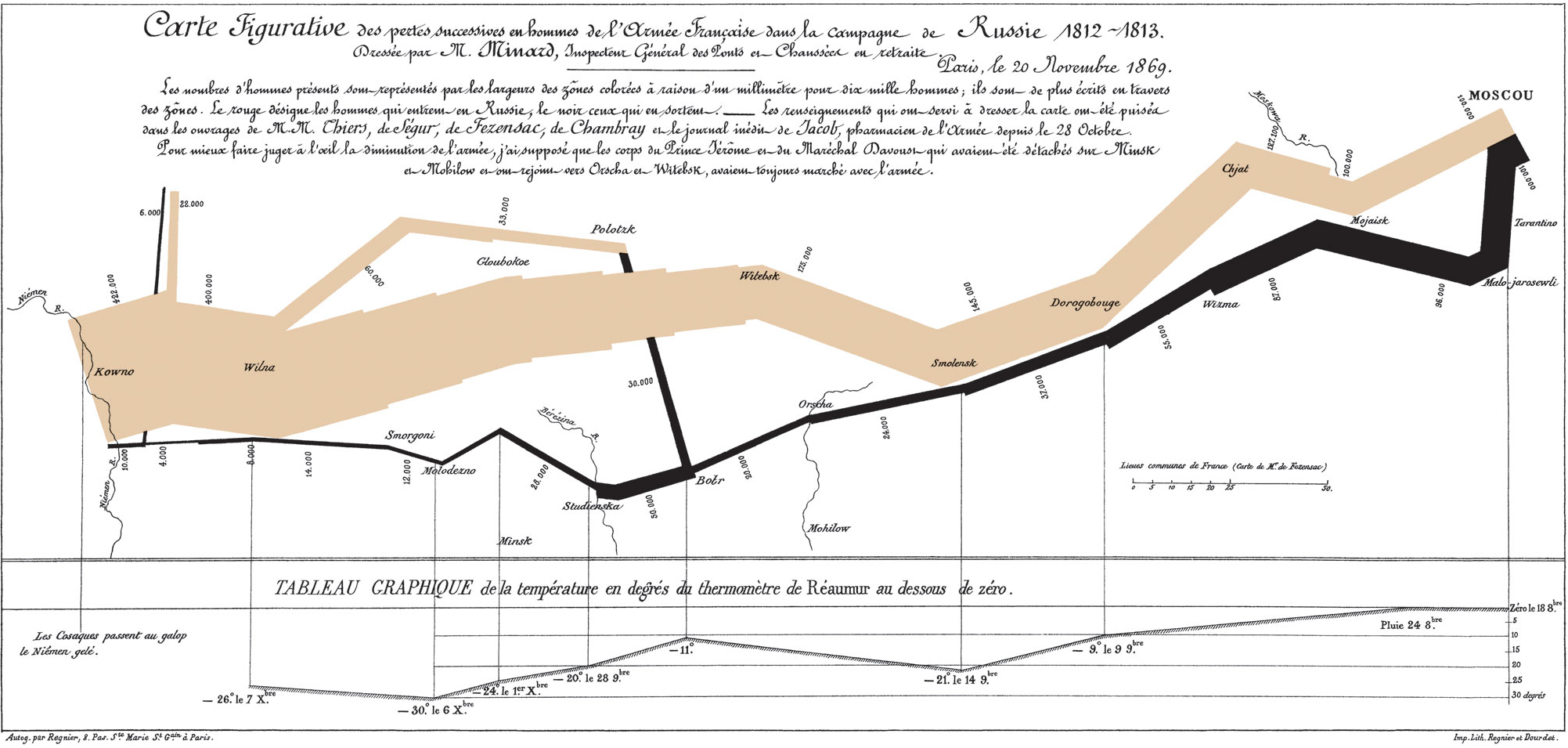
Remember that famous and superb map of the impostor success that I wrote about the other day? Well, it depicted Napoleon’s invasion of Russia, and how it went from triumph to disaster, which is one of the twin themes I explore in my book. There is a famous picture of Napoleon’s retreat. And now The New Yorker has updated it just in time for the remaining presidential debates:

The New Yorker

The New Yorker


Bookmark and Share

Metaphor metaphysics

And just to follow up with the final post in this trilogy on mixed metaphors (after this and this), here is the exegesis of what goes on when you commit this crime.

1) The writer

From the writer’s point of view, the reason for mixing metaphors is usually fear and laziness, a toxic cocktail.

The fear is that whatever he is writing is not interesting enough in and of itself. It is not a murder mystery, but a friggin’ merger of two banks, for instance. Or a wobble in the stockmarket. Or something else that Truman Capote never chose to write about. So, out of insecurity, he and his editor dramatize. They do that by aggrandizing the thing in question with words from more primal situations. Mergers become either “takeover battles” or “marriages.” Divestitures become “divorces”. Usually, war, love, sex, floods, fires, mountains and geology (“erosion,” “tectonic shifts,” “rifts”) find their way into the passage. And so on.

The laziness consists of not even noticing. They stuff these templates of primal experience into their paragraphs and don’t bother to think about what the words actually mean.

2) The reader

When the reader sees the outcome, he has one of two reactions. If sophisticated, he will notice the mixed metaphors and lose respect for the writer, usually in excess of what is justified, and probably stop reading the article, or at least taking it seriously.

If less sophisticated or hurried, he may not notice the mixed metaphor per se. But something more insidious now occurs. The different metaphors (floods, fires, quakes, wars) will cancel one another out in his mind. Instead of evoking strong and specific images, which is what metaphors are supposed to do, they produce a verbal goo. Its effect is tedium. The text loses energy and the reader gets tired and bored. The subject that the writer feared was not sufficiently interesting is now even less interesting. It’s excruciating.

3) The solution

In 99% of all cases, the solution is for the writer to address first the laziness (because that’s easier) and then the fear. To stop being lazy, just get in the habit of loving words and seeing their original meanings. To stop being afraid, get in the habit of forgetting about your audience entirely. You must find your subject interesting (otherwise, why not choose something else to write about?), and so it simply is interesting.

At this point, you’re ready to take all metaphors out of your text and see what’s left. Usually, it will be much better. The big secret about metaphors is that you don’t usually need them at all! Other details, from direct observation, take over.

Then, if you really feel something is missing, choose something evocative–but just one single image for the entire article–and stick with that. It doesn’t need to be “literary”. I heard a Congressman complain about the “bailout” package last week by saying that it was “a giant cow patty with a little marshmellow in the middle of it”. He didn’t even need to spell out that he was not going to swallow the marshmellow (by voting Yes), given what it was served in. Now that’s an effective metaphor, don’t you think?


Bookmark and Share

More metaphor mixing

I promised in the discussion underneath my declaration of war on the pox of wordsmithery–this pox being the mixed metaphor–to follow up with examples from…. The Economist, lest I sound smug.

Now, now. That was a joke. I was just seeing whether you were paying attention. War, pox and wordsmithery do not belong together, because that would be … mixing metaphors!

In any case, those mixed metaphors are everywhere. Well-known writers such Thomas Friedman practically bathe in them. (Does he not have editors?) So it was good to see that the New York Times Book Review finally took him to task for it today, choosing this example from his new book:

“The demise of the Soviet Union and its iron curtain was like the elimination of a huge physical and political roadblock on the global economic playing field.”

Oh, right, I was going to make us at The Economist look bad. Sorry.

Alright, here is a story that pains me to this day. It was supposed to be my first act of heroism for The Economist. It happened almost ten years ago, on a Thursday morning (London time). Thursday mornings are when we “close” the issue of the week. We sit in a room in a building we call the “tower” in St James’s Street (London’s drag of private clubs for toffs) and proof-read. No big changes are supposed to be made, because the pages are about to be sent off to the printing presses. Only if huge news happens, do we “open” up the book again and quickly insert something new.

I was still relatively new at The Economist and was not, on that morning, planning to call attention to my existence. But then a news item crossed the wires. A large Dutch insurance company had just announced that it would buy Transamerica, the large American finance firm that gave its name to San Francisco’s landmark skyscraper. As it happened, I had just met and interviewed the boss of that Dutch firm, and had really fun, colorful details about him in my notebook. I thought I might be able to hack out a piece quickly and … bask in glory.

I mentioned it to two editors, and they said ‘alright, write something really fast, and we’ll see if we can keep the paper open to use it.’ My adrenaline spiked, and I set to it. To my relief, the words came out in a torrent. And it was good. And the editor said it was good. And they took the piece into the still-open book.

There were only minutes or seconds to spare now. Two editors had to sit in front of the screen to give the piece a quick edit (because that’s what editors do). I stood behind them, watching the clock tick and biting my nails. They loved it and I was proud. And then…..

To my horror, he (who shall remain unnamed) fiddled here and there, and suddenly the last sentence–the very last and thus most prominent sentence!–read:

Surely Mr Storm hasn’t been seduced by the greatest merger wave in history?

Say what? Seduced? By a wave? You mean, not swept up by it, or deluged by it? I was horrified. But I was new and they were senior and this was my big moment and there were seconds left and I was not about to make this my final stand. I said nothing. They pushed ‘send’, and it went to the presses. I was that week’s hero.

But I walked through the streets of London in a state of shame comprehensible only to the loony fringe among pedants. Everyone–no, really, every Briton in this city, everyone in the Tube, and certainly my landlord–would within hours receive a copy of The Economist, and they would all turn straight away to the most important article, which was mine, and they would immediately spot this atrocity of a sentence! I was ruined!

And in truth, I have never gotten over it.

For those of you who want to read the silly thing in question, which is a decent sample of my style as of a decade ago, here it is.


Bookmark and Share

Congratulations, Matthew Bishop

My friend and colleague at The Economist, Matthew Bishop, just published his new book, Philanthrocapitalism, with his co-author, Michael Green. Congratulations, guys!

Matthew and I are lucky to share Dan Mandel as our agent. Congratulations, Dan!

(Doubly so for getting Bill Clinton to hold it up at the podium of the Clinton Global Initiative and recommending it to the audience: “This is about many of you.” Beats blurbs!)


Bookmark and Share

The second secret to good writing

In my previous post, I promised to follow up with the second secret to good writing. Here goes.

The first secret, to recapitulate, is not “worrying about what readers might want,” as my old boss and colleague, Clive Crook, put it in that piece I linked to. Thither lies authenticity.

But I ended by saying that every lesson needs a counter-lesson, just as yin and yang need each other, or as it takes two blades to make scissors. If you only say “to hell with the audience” and hold forth, you risk making a fool out of yourself. Thither lies pompous, self-important–and often incomprehensible–blather.

So what is that second blade? In a word, it is: empathy.

Empathy, properly used, means the ability to imagine what somebody else is feeling or thinking. The word comes from the Greek em (in) and pathos (feeling), so the direct English would be in-feeling. German actually has that direct translation, in the word Einfühlung.

I say that because some people confuse empathy with sympathy and compassion, which are very different things. Sympathy is  with-feeling in Greek, and compassion with-suffering in Latin. The first is taking somebody’s side. The second is feeling pity. Both can be good, but this is not what we are talking about.

A good writer needs empathy because he (or she) needs to imagine, beginning with the first word and ending in the last, how a reader might understand those same words. Jacques Derrida tried to pretend that words cannot communicate their intended meaning to readers because they have a life of their own and each reader will understand them differently. This is 1% insight and 99% nonsense.

The trick is to be so precise about choosing words, sentences, paragraphs–and through them details, scenes, characters, plots, sequences, and theses–that readers are able to follow along the thoughts inside the writer’s mind. For that the writer has to empathize with other minds. Those minds are probably anonymous and absent, perhaps of a different gender, age, nationality, and so forth. So this can be difficult. Hence: empathy.

In my writer’s brain, what goes on is a permanent interrogation: If I want to say this, what would somebody need to know first in order to understand it? Can I introduce this without first introducing that? On the other hand, I don’t want to “bury my lede”, so can I find a way of changing the order, so that something else entirely–something more interesting–comes first, grabs the reader, and then introduces the other thing. And so forth.

For instance, when I introduce Hannibal in my book, and assuming that the reader does not already know about him, which detail should come first? The objective is to create not only a picture but the right picture of him, which is that picture which leads naturally to the aspect of him that I want to bring out. Which precise moment in his life should I choose as the first? The time when he was nine years old and swore an oath to his father? The time he stood on the Alpine pass and saw Italy? The moment just after the battle of Cannae? (In which case, why not the moment during the battle of Trasimene?) The time he was planting olive trees? The moment when he committed suicide? Should I start with the eye he lost? Or with a memory of him that somebody else later had, which might put his life into perspective?

Whatever you start with determines what comes next and next and next. If you take a reader off in the wrong direction, even just be one degree, you can’t bring him back later.

Some might say that empathy is itself audience-specific. Take Sarah Palin and Joe Biden last night. She was empathetic (“Can I call you Joe?”, “doggone”, “soccer moms”) in thinking herself into the minds of a certain kind of person–one who likes folksiness and hates “elitism”. She didn’t give a hoot about the minds of another demographic, who saw a shrewd and manipulative, but inexpert and ignorant, mind on display. In her case, that was fine, because she had to survive politically, and for that she only needed one audience (the other being lost to her anyway).

The story-teller also needs to be prepared to let certain audiences go. That was the point of the first secret. But he needs to have a way of letting all of them come back, and then follow along.

So, yes, don’t worry about what readers might want, but do worry about what readers might need.


Bookmark and Share

The first secret to good writing

Clive Crook

Clive Crook

I’m just cleaning out some of my old stuff and came across this, which is now two-and-a-half years old but worth re-reading for a moment. In it the author, Clive Crook, writes about why, in his opinion, The Economist is such “a splendid, and partly inadvertent, success,” as he puts it. He gives a few reasons, but one is, I believe, relevant to all writers–of books, articles, blog posts–and even to all story-tellers, whether in video, audio or text.

First, though, the obvious disclaimers: I write for The Economist, and it was Clive who “discovered” and hired me, way back when. Clive was The Economist‘s deputy editor for many years, until he left to join the National Journal/Atlantic family. (He also blogs for the FT now.) At the time of the article from which I am about to quote, The Economist was looking for a new editor, and Clive threw his hat into the ring. (John Micklethwait became editor instead.) But that is neither here nor there.

Instead, here is the crux, buried in his last two paragraphs (my italics). Isn’t it odd, he says, that we are getting so many readers, when

it is not as though the paper’s writers and editors ever really sought those readers out. In my experience, the editorial side of the enterprise spends little time worrying about what readers might want. In this insecure age, the larger part of the media industry thinks about little else but what readers, viewers, and advertisers might want—the better to serve them, or condescend to them, or pander. The Economist has always been much more interested in the world, and in what it thinks about the world, than in the tastes of its readers or anybody else.

… I suspect that if The Economist ever starts to worry very much about the new readers it would like to reach, in print and on the Internet, and to think about how it should tailor its content more deliberately with them in mind, then that will be the moment when its business starts to conform to industry averages.

The lesson: don’t second-guess what others want, for that is the way to inauthenticity. Say what you want to say, and to hell with “the market”.

Now, every lesson, needs a counter-lesson, just as yin and yang need each other. Otherwise you make a fool out of yourself. I’ll give you the counter-lesson in the next post.


Bookmark and Share

Podcast about my book

Abhishek and I are talking for half an hour in this podcast about my book. The Indicast, if you don’t know it, is an up-and-coming podcast show in India.

We’re really having fun and getting side-tracked a bit, so it’s not until 16 minutes in that I actually summarize the book’s plot. The sound quality is a bit grainy, because I’m talking from California, and Abhishek from Mumbai.

Click play:


Bookmark and Share

Mixed metaphors

I’ve weighed in a number of times on various style crimes in the English language, starting with my rant on this grammar felony. Now Abhishek, India’s up-and-coming podcaster, tells me that he’d like more on style and language on this blog. Well, Abhishek, this one’s for you.

We’re in the middle of a financial meltdown, you may have noticed. Well, meltdown is a metaphor, from the nuclear industry. It’s fine to use metaphors from time to time. But let’s have a look at two articles published in the last hour by esteemed organizations, the New York Times and the Associated Press, about today’s market drop (another metaphor).

First, the two opening paragraphs of the NYT article:

Stocks fell by nearly 9 percent on Monday — the worst single-day drop in two decades — after the government’s bailout plan, touted by its supporters as a balm for the current market stress, failed to pass the House of Representatives, setting off a fresh wave of anxious selling.

In yet another day that has shaken the embattled canyons of Wall Street, the Dow Jones industrials fell 777.68 points after it became clear that the legislation could not muster the support it needed to pass the House.

You notice I had some fun here by giving colors to each kind of metaphor. This was actually quite hard, because I ran out of colors of sufficient contrast. And that’s exactly my point.

In a passage of 85 words, I counted nine different kinds of metaphors, and I was being conservative. That things should be falling and dropping and otherwise succumbing to gravity when prices are going down seems obvious. That bailout nowadays refers more to Wall Street than to ships in distress I can accept. But….

… do we really need–simultaneously!–to imagine ointments (balm) for wounds, in this case stress, as well as waves, even though these do not go on to deluge anything, but rather shake things? In fact, it turns out that the things being shaken are canyons, which makes us wait for some quaking or perhaps erosion. Instead, we discover that the canyons are embattled (although it is not clear by whom). Just as I settle in for more siege and war images, I am asked to go back to falling, and then to take a side trip to mustering, with an image of congressmen standing at attention.

Ouch. My head is spinning. If the writer just wants me to know that this is all really bad, well, I get it. But do I need word torture as well?

Surely, this one slipped through the editors. The Associate Press, in its opening paragraph, probably does it better. Let’s see:

Wall Street’s worst fears came to pass Monday, when the government’s financial bailout plan failed in Congress and stocks plunged precipitouslyhurtling the Dow Jones industrials down nearly 780 points in their largest one-day point drop ever. Credit markets, whose turmoil helped feed the stock market’s angst, froze up further amid the growing belief that the country is headed into a spreading credit and economic crisis.

Oh well. So we have the bailout, then a whole lot of plunging and dropping with some hurtling (not the same thing) thrown in. Fine. But now we also get turmoil and then, instead of waves and canyons, feeding! Of angst, no less, which I recall means fear in German. This fear is apparently what caused a temperature drop because the markets froze. And this in September. While this was going on various things were either growing or spreading.

Pulitzers to all involved.


Bookmark and Share

If the whole world were the electoral college….

I rarely digress from the two threads of this blog (the writing of my book, and book-publishing and book-writing in general), but this is just too fun.

We at The Economist are running a global election for US president. You vote as part of your country. Each country has a specific number of votes in the world’s electoral college, according to the same formula that America uses in its own electoral college.

So go check it out, and vote.


Bookmark and Share

A map of the impostor Success

Above is perhaps the most famous map and chart of all time (via the Wikimedia Commons). It is too small in my post, so please click through to the image. Its French caption begins:

Figurative Map of the successive losses in men of the French Army in the Russian campaign 1812-1813. Drawn up by M. Minard, Inspector General of Bridges and Roads in retirement. Paris, November 20, 1869.

The numbers of men present are represented by the widths of the colored zones at a rate of one millimeter for every ten-thousand men; they are further written across the zones. The red [now brown] designates the men who enter into Russia, the black those who leave it. …

What’s the big deal? 1) It is perhaps the first time in history that somebody thought about visualizing data. 2) Just look at the scale of this Impostor and Disaster!

You see the thick trunk of Napoleon’s Grande Armée as it invades Russia in 1812. Next you see Napoleon sweeping through Russia in apparent victory. His army is decreasing (the brown line is getting thinner), in part to casualties and in part because he has to leave troops behind to guard supply lines. But he is winning. And thus he takes Moscow.

Now the impostor drops his veil! Russia does not surrender. Napoleon does not win the war. Instead, he has to retreat. In the Russian winter. While the Cossacks attack. As Russian peasants pull away French stragglers and spear them with their pitchforks. The French starve, freeze and bleed to death. The black line shrinks.

And then, perhaps the most chilling pixels (you have to click through to see it well): As the French cross the freezing river Berezina, they discover that hell has indeed frozen over. You see a thick-ish black line on the eastern bank, a thin trickle on the western bank. The river became a mass grave. That’s why the French still today have a phrase to describe disaster: C’est la Berezina!

And if you’re new to this blog and wondering why I keep mentioning the word Impostor, here is why.
Bookmark and Share