About Hannibal’s elephants

(Note to readers: I have corrected and updated this post here.)

So the other day I get a text message from our dear friends, the Rammings, with an urgent plea to intervene in one of their heated controversies around the dinner table of their rustic farm house in hip and rural North Carolina. James Ramming, aged eleven and studying Latin (and contemplating adding Greek), was contesting whether Hannibal’s famous elephants were …. Indian or African. It’s the obvious first question to ask about his elephants, which must be why the adult experts never ask it.

I pick up the phone and report for duty. And as I talk I discover …. that I have no idea what the answer is. So I extricate myself from the conversation with James and go back to our trusted old friends, Polybius and Livy. Those two, it turns out, didn’t even know enough to ask the question. (How many elephants would a Greek and a Roman historian in those days have seen?)

The fact that Hannibal took war elephants with him in his attack on Rome–and crossed with them over the snowy Alps–is usually the first and only thing that people know about Hannibal. It’s entered our collective lore. Above, a snivelly-nosed Hannibal on a (vaguely Indian-looking?) elephant who seems to be going shopping. Below, a more dramatic rendition of the Alpine crossing, with (vaguely African-looking?) elephants tumbling into the gorges as the mountain Gauls attack from the heights. (Actually, Polybius says that all the elephants survived.)
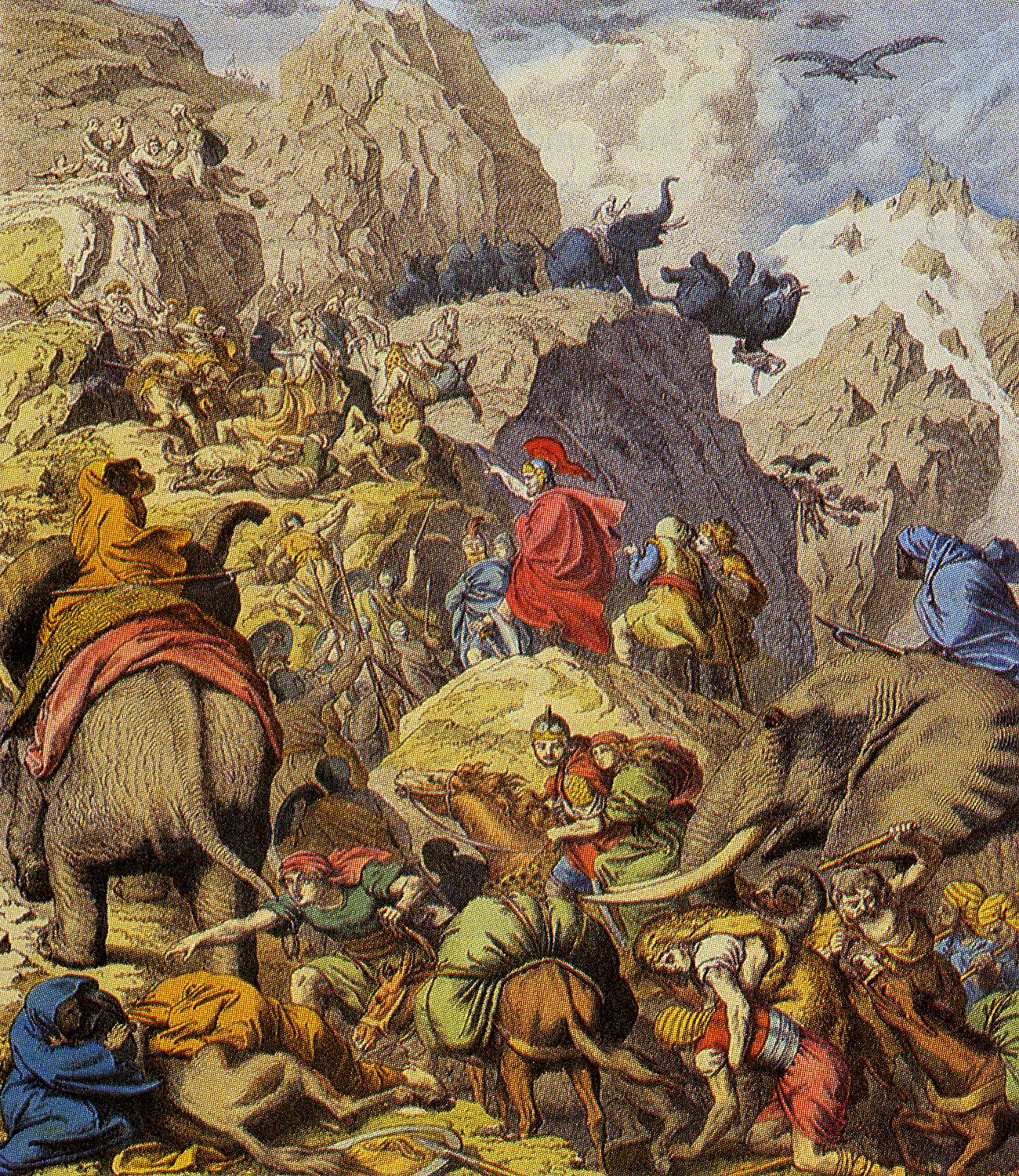
Well, which is it? One line in the middle of this Wikipedia entry claims that

he probably used a now-extinct third African (sub)species, the North African (Forest) elephant, smaller than its two southern cousins, and presumably easier to domesticate.

Makes sense. After all, Carthage was in Africa. Except that I don’t think so. I’ve already written about the trouble we get into when we confuse Carthage’s geography with modern notions of human race, what we might call the “Denzel trope”. I think the same applies to elephant race.

This Wikipedia article talks about the origins of war elephants in India. It is these that Alexander the Great would have encountered. Then he died and his generals, notably Seleucus and Ptolemy, carved up his empire to start their own kingdoms. They also seem to have taken over the tradition of fighting with war elephants. Carthage’s mother city, Tyre in modern Lebanon, was in the Seleucid empire, which included Syria. I think that Carthage, a naval empire oriented toward its mother city in the East more than toward the lands south across the Sahara, would have got its elephants from there. Hence, they would have been Indian.

That might explain why Hannibal’s favorite elephant–the one he was riding through the swamp when he caught the infection that blinded one of his eyes–was named Surus, “the Syrian”.

In any case, those beasts scared the bejeezus out of the Romans. War elephants were the tanks of antiquity. If things went according to plan (a big if), they plowed into the enemy ranks and broke up the formation. All the time, the archers and javelin-throwers were firing from their little fortress mounted on the elephant. Check out this fearsome rendition of the battle of Zama:
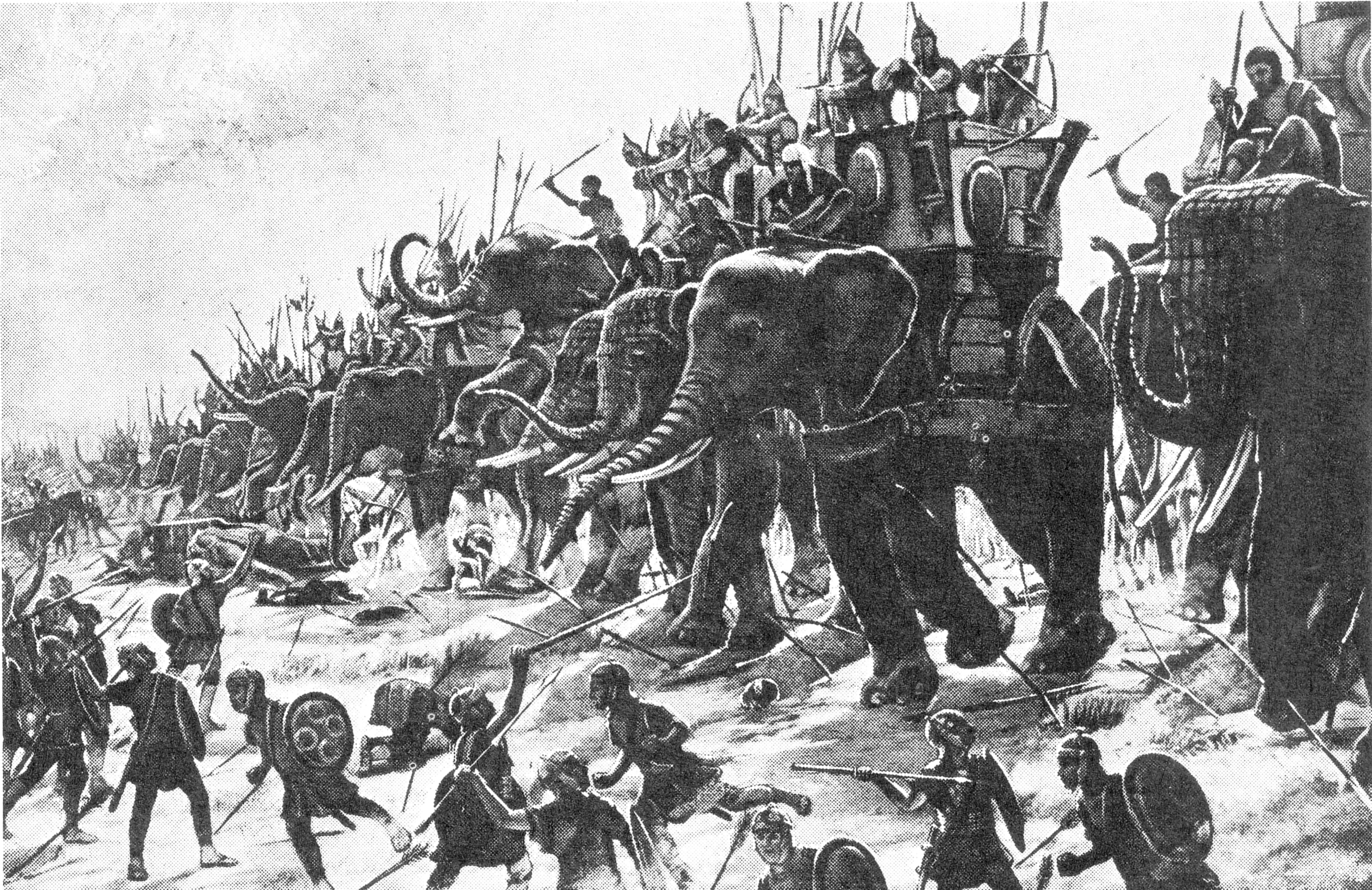
I’d rather be one of the guys on top in that one. Except……

Except that this was one of those many cases where things went wrong for the side with the elephants. Modern tanks go kaputt but not berserk. Ancient tanks went berserk. If they panicked, they were as likely to turn around and plow into their own ranks (the elephants didn’t care, after all). That happened here at Zama. For that reason, the elephants usually had mahouts with lances (you can see them in the picture), whose job was to kill the elephant as soon as he or she (both males and females were used) threatened the home side.

Long story short. Probably a sub-species of Indian. And soooo much fun to imagine. More, much more, in future posts.


Bookmark and Share

More Amy Tan, on creativity

Just following up on this weekend’s “writer’s Koan” by Amy Tan, best-selling author. For those of you who are interested, here is Amy speaking at the TED conference about the subject of creativity.

And for those of you who haven’t heard of the TED conference, it’s a sort of “cooler, hipper Davos,” traditionally held in Monterey, California, but now moving to L.A. I’ve gone once. Mind-blowing. A smorgasbord of intellectual stimuli from all fields of human endeavor–design, politics, philsophy, ideas, physics, environment, etc. And now it’s all online!

I digress. Here is Amy:


Bookmark and Share

The Narcissism of John Edwards: Impostor Success or Failure?

In my first preview of one of Kipling’s two impostors, triumph, I casually nodded to hubris as the most obvious mechanism that turns success into disaster, then went on to give another example that I thought was a bit subtler.

And now John Edwards forces me to come back to hubris. In case, you’ve been behind the moon, we now know that he cheated on his wife. More interestingly, we have now heard why he thinks he cheated. The key phrase in his mea culpa to ABC’s John Woodruff, was this: Becoming a “national public figure”, he said:

fed a self-focus, an egotism, a narcissism that leads you to believe you can do whatever you want, you’re invincible and there will be no consequences.

We always knew, of course, that Edwards had a narcissist in him, at least since we watched him preening here:

Narcissus, at least in Ovid’s version of the myth, was the handsome youth who fell in love with his own reflection as he bent down to drink from a stream, and then wouldn’t touch the water lest he ruffle the beautiful image in it, and so died of thirst. So it goes, as Vonnegut would say. Impostor beauty, as we might paraphrase.

So narcissism is slightly different from hubris, although Edwards conflates the two. Hubris is the classical Greek notion that power and success make people arrogant, and that this arrogance then invites disaster. Think Ken Lay, Eliot Spitzer, et cetera. And now, John Edwards?

Maybe, maybe not. I’ll give you one contra and one pro. The contra is Steven Berglas, a specialist in “narcissistic disorders” at Harvard Medical School for many years, who writes here that Edwards is kidding himself, and that it was in fact Edward’s failure to become Vice President in 2004 that is to blame:

I feel that Edwards had a need to re-assert his power and his masculinity (via an affair) because of his history of believing that his entire self-worth derived from success. Had Edwards not “proved his potency,” I feel he would have suffered ego-annihilation when he failed.

The pro comes from research by Cameron Anderson at Berkeley’s Haas School and Adam Galinsky at Northwestern, who found that perceived power does make people excessively optimistic and blind to risk. In one of their experiments, they discovered that those participants who were more powerful were less likely to use condoms. Who says academics never have fun?


Bookmark and Share

Writer’s Koan of the day

Amy Tan, best-selling author, in today’s New York Times Magazine, when asked whether writing is a kind of performance, thus giving her anxiety:

No. It’s a meditation. It does not have to do with personal humiliation until after it gets done.

(Incidentally, she will feature in two of my chapters. I’m intrigued in the effect her mother had on her success and perceived failings, and of course whether any of it has been a Kiplingesque impostor. Amy, if you’re googling yourself, will you give me an interview?)


Bookmark and Share

Hunky Hero Hannibal

What did Hannibal look like? I’ve suggested that the faces on this cover of National Geographic would be a good start. Then again, we could look at old coins, since those might have been circulating at the time of the person depicted. Here, thanks to the Wikimedia Commons, is one that appears to be of Hannibal.

What can I say? He was a stud.

Notice that the eye we see is healthy. That would be his left eye. Or are coins minted in mirror image? I don’t know.

I bring it up because this means either that Hannibal here was younger than thirty (quite possible if this coin was circulating in Spain before he invaded Italy) or that his other eye would have been shut or otherwise disfigured. That’s because, when he was thirty and already in Italy, Hannibal led his army on a surprising speed-march through a swamp in Etruria, today’s Tuscany. For days, the soldiers, mules, horses, and elephants were wading through water and bog. They couldn’t even lie down to sleep except for short catnaps on top of piles of dead pack-animals. Imagine tens of thousands of men and beasts urinating and defecating into a summer swamp and you get an idea of the nasty infections and diseases that must have been going around in the army.

Hannibal was riding on his favorite elephant, Surus (“the Syrian”), which may have been the only surviving one at this point. And he caught a really bad eye infection which festered and blinded one of his eyes. From that point onward, we must picture Hannibal’s face one-eyed. And all the more remarkable for it!

By the way, although I’m no numismatist, a very cursory search does suggest to me that the ancients were surprisingly honest in their depictions of the boss. Take, for instance, this coin of Cleopatra. That’s the same Cleopatra who seduced Julius Caesar and Mark Antony. Well, it would appear that she must have had lots and lots of ….. charm!

The treacherous First Person

I’ve been meaning to share a tidbit of a conversation I recently had with my colleague at The Economist, Tom Standage, while we were having lunch at Zuni in San Francisco. Both of us are writing books, both of which are not traditional “histories” but have a strong element of history, and indeed assume a reader intellectually curious about history and open to seeing its timeless legacies in the world around us today. Tom’s is about food throughout history and to our own day. Mine is about life, specifically success and failure, throughout history and to our own day.

The interesting tidbit for writers, however, was our spontaneous and passionate agreement on a matter of literary fashion: the First Person. We were not entirely against it, but extremely skeptical.

American publishers tend to push writers into “personalizing” their non-fiction stories. Journalists, especially columnists, are increasingly doing the same thing. Personalizing can indeed be a good thing, in the sense that good stories need characters, and writers need to present them colorfully. The problem is that “I” tends to be the wrong character to put into the story.

If you are writing a book about an earth-shattering event, conspiracy, cover-up, war, disease or what have you, and you were genuinely a protagonist in that story, by all means, personalize away. Tell us what happened to you. That is the story.

But if you’re just telling a good story, and then looking for ways to use the word I, please stop. Why do we have entire paragraphs in The Atlantic (otherwise one of my favorite magazines) whose sole purpose is to say that so-and-so “told me” such-and-such, which was probably utterly banal? Well, because the writer wants to prove to us that he was there, you see. At The Economist, we believe that readers already assume that we were there and, besides, don’t much care either way, because they just want a cracking good story or analysis. So by I-ing and me-ing, you’re really just getting in the way of the story. You’re turning sophisticated readers off.

Once you try writing without the First Person, you may find it surprisingly difficult. Which is why it is such excellent discipline! Without the I, you can’t fake it. You can’t give us the three-paragraph “color” opening about how “I was walking into his office on a sunny March day” and so forth. You actually have to deliver a detail or observation that is telling. Much harder to do!

So I kept telling my students at Berkeley’s Graduate School of Journalism to try leaving the First Person out. They kept ignoring me. Through blogs and email and all those columns, it has seeped into our writing culture. It’s just so much easier.

The result is reams and reams of writing that is narcissistic. I could highlight one or two high-profile books and articles, but I know better. (Also, I admit that some of them do become best-sellers, which may be why publishers push the First Person so hard.) But next time you’re reading an I piece, try stripping out the First Person and seeing what content or substance is left. If a lot, good article. If not a lot, it was a narcissist.

But I did say that neither Tom nor I was* completely against the First Person. I’m using it in this blog, obviously. (Then again, a blog is by definition an ultra-personal medium.) And I’ve also, after agonizing about it, decided to use it in my book, which I am–yes–“personalizing.”

The challenge I see is to do this without being narcissistic and interrupting a cracking good story for the heck of it. In short, it is about finding an authentic voice or tone. That, of course, is true whether you’re using the First Person or not.

(*Bonus: did the was surprise you? Did you think it should be were? Nope, was is correct. More to come in future posts.)
Bookmark and Share

Shakespeare’s “Like you like it”, part II

You may snicker at me, but I can’t help myself. eTrade just sent me one of those polished, glossy, over-produced marketing emails, informing me that:

you can diversify like never before with an E*TRADE Global Trading account.

Like never before? Do they speak English? Do they vet their junk mail? Is this supposed to be folksy (lest they sound “elitist”)?

If you don’t know what I’m talking about, here is my earlier post on the subject.


Bookmark and Share

Kudos to other Hannibal lovers and thinkers

I’ve always noticed that, although Hannibal is ever so slightly less of a household name than, say, Alexander or Caesar (or should that be because, rather than although?), he seems to have the more passionate, sophisticated and thoughtful following.

Read, for instance, 100falcons on the subjects of Hannibal’s most ingenious trick, his famous boyhood vow to his father, and some of the lessons that Hannibal has to teach us.

In my book and this blog, I’ll be offering my own lessons. But today I’ll just quote excerpts from 100falcons’:

1. Take the initiative, keep the initiative. […] His enemy had constantly to try to guess his intention and defend himself against several alternative attacks. The enemy Roman consul was forever on the defensive, waiting, wondering, guessing, bracing himself for the blow. […]

2. Be quick. Surprise. Hannibal decamped by night from Capua and got to Rome before the Romans in Capua ever realized he was gone. He crossed Etruria through a swamp because that was the way everyone assumed he wouldn’t go.

3. Be crafty, lay a trap. [see also: Hannibal’s most ingenious trap] ….

4. Be flexible. Have a plan but be able to alter it or even drop it as circumstances change. […]

5. […] Think two steps ahead, not just one.

6. Understand your enemy; learn his weaknesses. Hannibal always sent out spies to learn the enemy’s plans. He interviewed prisoners and guides to get information. As soon as new Roman consuls were given command, he sent informers to find out who they were. Was the new general a hothead? Had he ever led troops in battle? What was the result? Was he cocky or impatient, did he like to tip the bottle? […]

7. Be daring. Come down with your army across the Alps with elephants and attack Rome on Roman ground, far from your own country and without logistic support except what you can steal.

8. Keep your mouth shut. Hannibal never told anyone what he was doing.

9. Be all of the above except when you are faced with an enemy who is all of the above. In that case, be like Fabius, […]

My comment at this stage is that the above lessons fall into the how-to-win category. Some of my lessons will zoom out to contemplate how you can win and yet–mysteriously–lose. That, of course, is half of the point of my book, which is that success can be one of Kipling’s impostors.

Incidentally, Erikatakacs left a comment underneath 110falcons’ post which he/she then began to answer in another post. In essence: why on earth did Hannibal not take Rome itself? Isn’t that why he went to Italy in the first place? Well, there are good reasons why he did not. But this also presents us with his fascinating paradox. If he was so good at thinking several steps ahead (as in Lesson Nr 5 above), why didn’t he… think that one extra step ahead as well. Let’s remember, that this winner ended up …. losing! Kipling indeed.


Bookmark and Share

Hannibal in Colombia, Catalonia, Missouri

Alright, Hannibal did not actually go to South America and Missouri, in large part because he didn’t know that they existed. 😉

But have you ever wondered why more than a million Colombians on the steamy Caribbean coast live in a city called Cartagena? Because Colombia was Spanish, of course, and there is a city in Spain (Murcia) that is called Cartagena. But why is that city called Cartagena? Because it was founded by Hannibal’s brother-in-law, Hasdrubal (not to be confused with his biological brother, also named Hasdrubal), who made it Carthage’s regional capital. He called it Little Carthage, or Little New City, since Carthage is Punic for New City, as mentioned already.

When the great Scipio, another of my heroes and Hannibal’s eventual nemesis, conquered Spain, he renamed it New Carthage (Carthago Nova), thus inadvertently calling it New New City. Oh well, nobody’s perfect.

Now, how about that fantastic party town with all that great Gaudi architecture, Barcelona? Hannibal’s clan or family name, you recall, was Barca. Sounds suspiciously similar, doesn’t it? Barcelona probably started as the “camp of the Barcas”, when Hamilcar, with his young son Hannibal in tow, showed up in Spain to conquer it. Hannibal later would have passed nearby on his way to the Alps and Italy.

And what about that town in Missouri on the Mississippi, where Mark Twain grew up and had his Tom Sawyer and Huck Finn get into all sorts of trouble? It’s called Hannibal. I must assume that it’s named after my hero/antihero, but I’ve not actually been able to verify that. If anybody knows, please drop me a line below.


Bookmark and Share

China cliches: Hu knows Wen?

An amusing missive from Kaiser Kuo, at least for those of us who have lived in, or reported from, China.

It’s a sort of dirge from a weary soul who’s just seen too many bad articles/headlines/captions by foreigners about China. Just a few excerpts:

Welcome to Beijing, friends from the foreign press! I greet you on behalf of the many expatriates who’ve lived in Beijing for years. …

Please do not write “Beijing is a city of stark contrasts” and refrain from using any variation thereof — “a city of startling juxtapositions,” or (needless to say) “a city of yin and yang.” Not that it isn’t a city of, um, rather pronounced differences; it’s just too damned lazy an observation to make. A special enjoinder to photographers: please resist the temptation to position yourself in a hutong with a decrepit but charming tile-roofed courtyard home in the foreground and a shiny, hyper-modern steel-and-glass skyscraper rising behind. No using Blade Runner comparisons for Beijing. You’ll want to save those for Shanghai, believe me.

The bureaus of reputable western papers here in China have a rule against quoting taxi drivers. But since Beijing’s cabbies are so fabulously colorful, you will be permitted one exception. Make it a good one. Helpful hint: That story about efforts by our city’s cabbies to learn English phrases? That one’s been written several thousand times so please, anything but that one…

No writing “There is an ancient Chinese curse that says, “May you live in interesting times.’” There isn’t such a curse. No writing “the Chinese word for crisis includes the character for opportunity and the character for danger.” That it may be true doesn’t reduce my aggravation each time I see it in print. In fact, just to be safe, avoid anything involving “an ancient Chinese saying.” This will save you, anyhow, from having to Google for choice quotes from Sun Tzu or Confucius’s Analects.

Try your best to avoid phrases like “China’s rising middle class,” “the Little Emperors” and “ideological (or moral) vacuum.” Find a descriptive for security personnel other than “stone-faced.” And only use “Great Leap Forward” if you’re covering events like the triple jump or pole-vaulting….

While we’re on puns, some common ones to avoid include pander/panda and the always irksome Peking/peeking. And no using “your average Zhou” or “Zhou Sixpack.” There will be absolutely no punning on the interrogatives “who” or “when” and the family names of the Chinese president and premier, respectively. I know you’re thinking, “Hu knows Wen I’ll get another chance like this?” and I feel for you, but just resist it, okay?


Bookmark and Share