My employer, The Economist, is 170 years old. Another British publication, the Financial Times, turned 125 today.
It turns out that we are
loosely affiliated in some complicated corporate way and
very dearly affiliated in a personal way, because I, for instance, share an office space with them in Berlin.
By pure coincidence, their Berlin Bureau Chief, Quentin Peel, has exactly the same deep, sophisticated British voice and accent that one of our editors in London (Xan Smiley, if you must know) has, so I keep doing double takes whenever Quentin is on the phone, expecting Xan to come waltzing in. I digress.
The first of my points, if this post has any, is that the FT is a spring chicken by our standards. I mean, we were friggin’ middle-aged when they were born. But what’s a half-century or so among friends?
The second point is that it can be strangely revealing to go back in time to what journalism back then was like. And so I indulged myself during my coffee break today by reading their first front page, the one from February 13, 1888.
As was the custom at the time, the articles were listed (no pictures, it goes without saying) in unadorned columns. And so my eyes alit, after the headline on “Russia and Finance” and before the one on “Speculation in Copper,” on an article that began as follows:
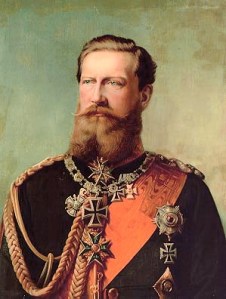
The Crown Prince
What is to be the result of the very serious operation which has been performed on the throat of the Crown Prince of Prussia? This is not a mere question of ordinary politics, but one which vitally affects the peace and prosperity of Europe. It is not merely that the Crown Prince is the son of our ally, the Emperor of Germany, and the husband of England’s eldest daughter, but he is a Prince of pacific tendencies, though not less a soldier than the rest of the Brandenburgers. The operation only took ten minutes to perform…..
For those among you who are, or are related to, hacks, let’s just savor such themes as:
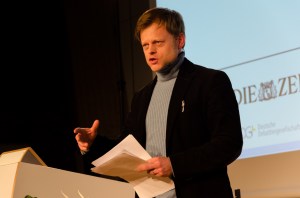
The World Universities Debating Championship (WUDC) is going on right now in Berlin, with more than a thousand very talented students from all over the world testing their arguments and wit — and having a rather good time after hours as well. (You can watch the live stream of their debates here.)
They asked me to give the opening speech on Friday, with some thoughts on debating. Nothing too heavy.
A grainy video is attached below. (I start after the, yes, Alpine horns, at about minute 9.) But here is a shortened and approximate transcript of what I said:
___
Patrick just told me that The Economist is considered “the debater’s bible”. Wow. I had no idea. When you catch me in the halls later, maybe you can explain to me why that is.
Right now, I want to make only 4 simple points:
Debating is fun
It helps to be British
Thou shalt remember Athens
Debating is not enough, and does not automatically lead to truth
1) Debating is great fun.
I spend my whole life debating. At The Economist, every conversation we have is really a debate. In my family every conversation I have is really a debate. Especially with my children.
Let me tell you about a particular kind of debate we have at The Economist that you can’t know about because it’s not public:
The Monday morning meeting.
This takes place every Monday morning, when the various section editors read out the list of planned stories. We sit very casually, often on the floor, around the desk of our editor in chief. After the lists are read, we discuss what the Leaders should be. “Leaders” is our name for opinion editorials. So we talk about what they should say. Basically, we debate.
When I joined The Economist in 1997, this was the event of the week, the institution, that most inspired me. Because it was such a joy to listen, and to participate:
The humor,
the reductio ad absurdum,
the overstatement
the understatement.
I’ve learned so much just from sitting in those Monday morning meetings. And I hope that you guys here also get to sit in rooms like that, perhaps even here in Berlin in the coming days.
And that leads me to my second point:
2) It helps to be British.
I mean that a bit tongue in cheek. But in my experience, it’s sort of true. The level of debate in those Monday morning meetings is probably the highest anywhere, and part of the reason must be that most of the people in the room are British.
Several politicians here in Germany have told me that they like to watch House of Commons debates on YouTube, because the debating there is at a much higher level than the debates in the Bundestag. And I’ve heard similar statements in Washington DC and Sacramento CA and other places.
Part of it is, I think, that the Brits have that tradition more than any other culture in world history.
For the British upper classes, part of growing up has always been to speak in front of people, and to use humor and charm, so that when those people later grew up they seemed to do public speaking naturally.
In other modern countries, I think you’d have to go back to the debates between Alexander Hamilton and James Madison to get anything of that quality. Then again, those two Americans were really ALSO Brits. 😉
Now, I’m NOT British. And most of you are NOT British. But that’s OK. Because we can learn from them. Fortunately, their language is now our common world language.
3) Athens
Before Britain, there was of course ancient Athens. And I think a quick look back at Athens is a great way to make my other two points about debating.
First, the Athenians demonstrated the inherent link between debating and democracy, or debating and freedom.
What is a democracy?
It is basically a society that makes its decisions after lots and lots of debate, one in which power and influence therefore come mostly from skill at debating. As opposed to brute force, for example.
In Athens during the time of Pericles they applied that idea very literally: the free men of the city met physically on one large rock to debate every topic.
They had no “government” and no “opposition” (as you do in your debate format here) because they had a pure democracy, ie a rule of the people. The people WERE the government. And they had no parties either. So leadership came down purely to skill at public speaking. Whatever was decided on that rock after all the speakers had spoken was the law.
The greatest example of a leader was Pericles. And I strongly, strongly urge all of you to read his Funeral Oration, which is one of the greatest speeches ever written.
Athens during the following century, the fourth century, when Phillip and his son Alexander rose to power and threatened Athens, was another great example.
At that time, some of the most consequential decisions in world history were taken as a direct result of the outcome of debates between, basically, two men:
Those debates culminated in the so called Philippics by Demosthenes against Philip. That was the same Demosthenes, and the same Philippics, that later inspired Cicero in Rome, and really every great speaker and debater since.
So that’s another suggestion I have for you here: read the short biography of Demosthenes by the Greek writer Plutarch. it’s fascinating, because the man had a speech flaw, so he made himself a great debater by overcoming his greatest weakness. He:
built himself a cave underground where he hid for months at a time, just practicing his speech.
He shaved one half of his head, then the other, so that he would be too ashamed to come out.
He recited speeches while running up hills.
went to the shore and orated against and over the breaking waves.
put pebbles under his tongue and then enunciated over the roaring surf.
But Demosthenes more cautionary lessons for you debaters as well:
he was a coward in battle and fled the field
he basically led the Athenians into a wrong course against Philipp and Alexander, and
he ended by committing suicide after his life work had failed.
And that leads to my fourth and last point today:
4) Debating is not enough, and does not automatically lead to truth.
The best argument doesn’t always win. Sometimes, the best delivery wins.
By the way, it was Demosthenes who, when asked what the three main element of rhetoric were, answered: “delivery, delivery, delivery.”
We call that demagoguery instead of democracy.
That was the problem that inspired maybe the greatest works of literature ever, namely Plato’s dialogues. In those, Socrates argues against the Sophists.
The sophists were people whom rich Athenian fathers hired to teach their sons debating.
You guys here would LOVE to have a sophists working with you.
Because the sophists could teach you to take
one side of an argument and win,
and then to take the other side of the argument and win.
And that’s what bothered Socrates. Because he believed, or hoped, that there really was some objectively better or more reasonable position. And to Socrates, THAT was supposed to be the purpose of debating. To find the best answer.
So Socrates hated the Sophists, and ridiculed them with his style of questioning. He thought the Sophists interfered with truth finding because they were only interested in delivery, delivery, delivery.
the bad way was a debate where the debaters want to win. He called that eristic argument, after the Greek goddess of Strife, Eris, who started the Trojan War by leaving that Golden Apple for the goddesses to fight over.
The good way was what he called dialectic: a debate where the debaters all want to learn, rather than win. So in theory, all debaters end up with a position that none of them took at the outset. Someone starts with a thesis, the others bring up antitheses and so on and so on, until they arrive at a synthesis.
Well, Socrates was condemned to death by an Athenian Jury of about 500 men after a truly terrible, but famous, … debate.
So there you are. Let’s recap: Debating is…
above all, fun.
And it is useful.
And it will help you in your career and your life.
But keep in mind that little voice from Socrates and Demosthenes: debating is not enough.
you still have to be brave,
you still have to love truth, and
you still need to know when to stop trying to win and starting trying to figure something out.
But not during this tournament. So now try to go and win.
In our double issue for the Christmas holidays, I’ve once again let my hair down and indulged myself with a cheeky but (hopefully) not silly historical comparison. This time:
those aforementioned cheeky historical comparisons: Socrates in America, now the Holy Roman Empire, .. (and of course Hannibal and Me!)
Anyway, study this beautiful map we made. As you know, I’m a map geek.
And then get a glass of some Malbec-Cabernet mixture and ponder whether you think I was right to draw some analogies to the Holy Roman Empire. Would love to know what you think.
—
PS: Sorry for having been a lazy blogger these past months. For those of you who want to follow my ongoing weekly story output, I’ve started tweeting my articles. The Twitter feed also appears here, in the right side bar.
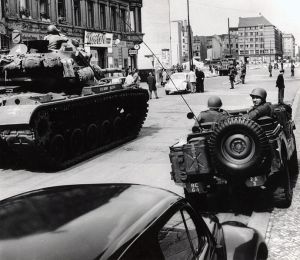
In the late 80s, when we still thought the Iron Curtain and the Berlin Wall were as good as eternal, my friend Matt Lieber and I, fairly fresh out of high school, traveled around Germany and got a visa for a few unforgettable hours in Communist East Berlin. We entered through Checkpoint Charlie (pictured above in 1961, during one of the many standoffs). Then we walked up the famous Friedrichstrasse toward the equally famous Unter den Linden.
I’ll never forget those first few blocks behind the Iron Curtain.
Crosstreets:
Krausenstrasse
Leipzigerstrasse
Kronenstrasse
Mohrenstrasse
Taubenstrasse
II)
Just a few years later, in 1993, I was back on that same stretch of that same street: Friedrichstrasse, between Taubenstrasse and Mohrenstrasse.
Except this time I was an unpaid intern for CNN, that (then-) unbeatable American, Western, Capitalist media success story. By sheer luck, n-tv, a German start-up that wanted to be, and indeed became, the German CNN, had just opened in the same building and CNN owned a part of it. In the utter chaos of n-tv‘s first weeks, I did all sorts of jobs for both companies that I was entirely unqualified for and benefitted hugely from.
III)
Now, many years later again, I will be back once more at that same stretch of that same street. This time (as of mid-June, 2012) I am Berlin Bureau Chief of The Economist. Our office is right at a corner that Matt and I walked past all those years ago.
When I visited the office the other day, before the actual move from Los Angeles, I loitered a bit on those blocks, looking for something familiar from the past.
Wasn’t this where that East German cop stopped Matt and me for jaywalking?
And wasn’t that where, in 1993, that god-awful East-Germanesque sausage snack bar was?
I simply couldn’t tell. Yoga, Starbucks, Gucci, banks, BMWs. Physically, the street had become aggressively 2012, and nothing else.
I remembered how somebody once told me about visiting, in 1978, a tiny fishing village north of Hong Kong. It was called Shenzhen. Three decades later he went back to try to find the spot where he stood. Well, you know.
But even that did not capture the feelings I had while standing again at that particular corner of the world. In my imagination, I rewound and fast-forwarded through life on that spot. From its Slavic time through its Prussian time, to its Wilhelmine and Twenties time, its Nazi time, its Cold-War time, its Wende time. Then I opened my eyes again.
V)
Why do people become journalists? For different reasons. But many, I am guessing, want to feel that they lived history.
This year and in the coming years, Europe seems likely to be making history again, and Berlin seems likely to play a big role in that history. If I do my job right, and even if I just do it mediocrely, I’ll see a good bit of it up close.
Let’s have a few minutes of fun tracing the genealogy of a story to illustrate the concept of archetypes — the Jungian idea that we tell each other the same timeless stories again and again, in infinitely many variations.
(My book is based on that idea: namely, that we see ourselves in the stories of others, whether they lived 2,000 years ago or 2 years ago, or whether they lived at all.)
On pages 140-142 of Hannibal and Me,I tell two versions of a short story. (This is the very end of the chapter called Tactics and Strategy in Life, which is about the fiendish difficulty of telling ends from means in life and the consequences of getting it wrong, as I hinted in this post for the Harvard Business Review.)
So I end the chapter with this:
A few years ago, one of those chain-letter emails landed in my inbox. It told the story of a fisherman who was lying in the warm afternoon sun on a beautiful beach, with his pole propped up and his line cast out into the water. An energetic businessman walked by.
“You aren’t going to catch many fish that way,” said the businessman to the fisherman. “You should work harder.”
The fisherman looked up and good-naturedly asked, “And what would I get for that?”
The businessman replied that he would catch more fish, sell them for more money, save the surplus, and invest in a boat and nets, which would let him catch even more fish.
Again the fisherman asked, “And what would I get for that?”
Somewhat impatiently, the businessman explained that he could then reinvest the even greater surplus and buy more boats and hire staff, becoming a small business and catching ever more fish.
Again the fisherman asked, “And what would I get for that?”
Now the businessman lost it. “Don’t you understand that you can become so rich that you never have to work for a living again? You could spend the rest of your days sitting on this beach, just enjoying this sunset!”
The fisherman’s eyes lit up. “And what do you think I’m doing right now?”
In the chapter, I then go on to tell another, and much, much older version of that story, which I’ll repeat in a minute. But here is what my cousin Bettina realized the other day as she was reading the above passage in my book: The story I was retelling from a chain email in fact derives from a short story by Heinrich Böll, the Nobel-Prize winning giant of postwar German literature.
Böll’s story, written in 1963, was titled:
Anekdote zur Senkung der Arbeitsmoral
I love that sardonic mock-bureaucratic tone. It translates into something like:
Anecdote for the Diminishment of the Work Ethic
Here is the German text, very simply and beautifully written. The Wikipedia page tells me that
The story, with its several adaptions, has been circulated widely on the Internet, and has been quoted in many books and scholarly papers. In one of the most popular versions, the tourist is an American (an MBA from Harvard in some versions), and the fisherman is Mexican.
Clearly, Böll’s story has a timeless kernel. So where might Böll himself have gotten the idea? (And by the way, he may not have realized where he got it, for we usually do not recall what influenced our ideas.)
Well, I think he got it from a story written about 2000 years ago about events more than 300 years before that. The author was Plutarch. The story was about Pyrrhus, the one who gave us “Pyrrhic Victories“.
You can compare it to the original here. But on page 141 of my book, I retell it this way (with anything in quotation marks directly sourced from Plutarch):
Pyrrhus was making preparations to invade Italy and attack Rome when Cineas struck up a conversation.
“The Romans, sir, are reported to be great warriors,” said Cineas. “If God permits us to overcome them, how should we use our victory?”
“But that’s obvious,” said Pyrrhus. “We will be ‘masters of all Italy’ with all its wealth.”
“And having subdued Italy, what shall we do next?” asked Cineas.
“Sicily,” replied Pyrrhus without missing a beat. “A wealthy and populous island, and easy to be gained.”
“But will the possession of Sicily put an end to the war?” asked Cineas.
“God grant us victory and success in that,” answered Pyrrhus, “and we will use these as forerunners of greater things; who could forbear from Libya and Carthage then within reach?” Once we have those, will anybody anywhere “dare to make further resistance?”
“None,” replied Cineas, which leaves us to “make an absolute conquest of Greece. And when all these are in our power, what shall we do then?”
Pyrrhus smiled and said, “We will live at our ease, my dear friend, and drink all day, and divert ourselves with pleasant conversation.”
“And what hinders us,” said Cineas, “from doing exactly that right now, without going through all these troubles?”
Pyrrhus suddenly looked “troubled” and had no answer. Then he went ahead and invaded Italy anyway — without success.
Patrick Hunt at Stanford University is a leading archaeologist and historian, and arguably the leading living scholar of Hannibal.
He has taken students to the Swiss Alps to figure out which pass Hannibal took. He has given a fantastic lecture series on iTunes U, which is in my bibliography. And he does much, much more, all of it fascinating.
As all of you know, I have never pretended to be ‘a historian’ — rather, I am (merely but proudly) a journalist and a storyteller who happens to love, and to reflect on, history. So I’m sure that I got some details wrong in the book, and Patrick could easily have pounced. But he looked at the big concept, at the story and the meditation, and he endorsed it. And that means so much to me.
From his review:
… Rarely do books mainly about history make such entertaining reading without diluting the complexities of world events that can turn on a literal moment from impending doom to brilliant success and vice versa. Surely Polybius, our best ancient source about Hannibal, would applaud Kluth’s book for psychological depth that matches its historical accuracy, like Polybius himself whose history is as much about why and how, the deeper analytics, as about what and when. Kluth deserves every kudo for this book that shows his new Hannibal research is not beating a dead horse but rather a startlingly fresh outlook on an old mystery.
Thank you, Patrick Hunt!
And thank you Christopher, for being even quicker than Google Alerts in pointing me to it.
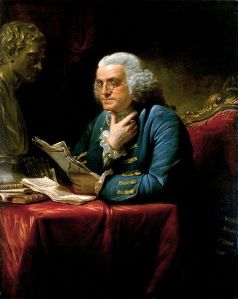
For the holidays, I’ll leave you with one of my favorite quotes, which is by Benjamin Franklin:
Genius without education is like silver in the mine.
And because all grand thoughts are timeless, they must re-appear in an eternal return.
So this quote, too, must have antecedents. Let’s work backwards in time, to savor even more of the same wisdom:
First stop: Song Dynasty
From my daughter, who is currently reciting the 13th-century Sanzi Jing (the Three-character Classic, a Confucian poem-treatise), I hear the beautifully rhythmic:
By Rome I mean Latin. Let’s see: to educate = ex-ducere = to lead out
Lead out? As in: get outwhat is already there, as in silver or jade? Where might that idea have come from?
Third stop: Socrates
We haven’t talked about Socrates for a while here on The Hannibal Blog. (Here are all my old posts about him. He is not in my book, by the way).
The old man had his own silver/jade/education theory: He called it (in the Meno and Phaedo) “anamnesis”. And he demonstrated it by … helping a slave to remember (= “teaching”) that the blue square below has twice the area of the yellow square:
The lesson
And now for Kluthian axiom number whatchammacallit:
Here is my table of contents, which gives you a sense of the structure of the book: For the most part we “age with” Hannibal, and also with Scipio, in the main storyline, so that we face the issues that arise at each stage of life.
In bullet points, I’ve put some of the people that come up in each chapter. You can try to figure out the context in which they appear, and why.
One. HANNIBAL AND ME
Hannibal
Me
(A bit of Carl Jung, tiny bit of Scipio and Fabius)
Two. THE INFLUENCE OF PARENTS
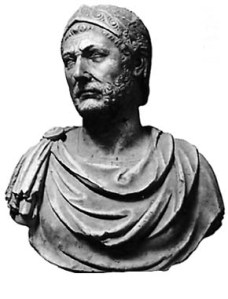
Hamilcar, Hannibal, Hasdrubal, Mago
Theseus
Barack Obama
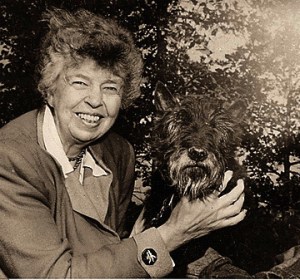
Eleanor Roosevelt
Amy Tan
(Gerhard Kluth)
Three. DO YOU NEED A GOAL?
Hannibal
Meriwether Lewis (and Thomas Jefferson, William Clark)
So now at last (with two months to go until launch on January 5th), I can start to open up a bit about what’s actually in the book.
The other day, my publisher and I had a conversation about some of the ideas. I’ve put a transcript of that chat up on this page.
We were just scratching the surface in that conversation. And that is becoming my chief difficulty in this process: Whenever anybody asks me anything about the book (such as: “What is it about?”), I want to answer with the whole book. Can’t do that.
So, if you feel so inclined, you might do me a favor: Tell me which bits of the conversation hit, move, stimulate, enrage or otherwise interest you.
That would be enormously helpful: From your reactions, I will try to figure out what the various “elevator pitches” might be. You know: my 10-second answer when some radio host interviews me about the book. As in:
Host: So, Andrew, you wrote a book about success and Caesar, is that right?
Andreas: Both success and failure, actually, and the main character is Hannibal.
Look at this beautiful map. It depicts the dramatically simplified life path that Hannibal probably took. And you’ll find it in the beginning of my book.
The mapmaker and copyright owner is David Lindroth, a cartographer who seems to specialize in historical, educational, fictional and other unusually interesting maps.
I first came across David’s name when I saw a different version of this map by him in The Ghosts of Cannae, a great book about Hannibal by Robert O’Connell. (It came out last year, after I finished my manuscript, so it was unfortunately too late to be one of my sources.)
So I called David and he made this map for me. We put in some of the battle sites and other places of interest in the book, including Hannibal’s sketchy meanderings in the eastern Mediterranean in his final years.





_drawing_29.gif "Meno_(Socrates)")

 )
)





 Hannibal and Me: life lessons from history