Croesus learns about success and happiness

800px-Claude_Vignon_Croesus

I mentioned that A.E. Housman might have got the idea for his poem, To An Athlete Dying Young, from his study of the classics, in particular Herodotus. I had one particular story from Herodotus in mind when I said that. It is the story of King Croesus.

(The story almost made it into my coming book about success and failure in life, but then it got a bit crowded and I cut it out.)

1) Croesus the happy

In the sixth century BCE there was a king named Croesus in Lydia (today’s Turkey). He was so rich that we still today say “rich as Croesus”. But he always wanted confirmation from others that he was indeed the richest, the most successful, the happiest man alive. Why would he need confirmation? One wonders. But people always do.

As it happened, Solon, the man who had given the Athenians their laws and who was the wisest man in Greece at the time, came for a visit. This was exactly the sort of man Croesus wanted to impress.

I paraphrase (the text is here):

Croesus: ‘Welcome Solon. You’re the wisest man in Greece. I’ve heard so much about you. Please take a tour of my palace and look at all the gold and silver, the women and slaves and fruit, and all my splendor. Isn’t it wonderful? Tell me: who is the happiest man in the world?’

Solon: ‘Tellus of Athens, sire.”

Croesus: [Blank look. Silence.] ‘Sorry, but… Who?’

Solon: ‘Tellus, sire. He was this guy who lived when his country was prosperous, and he had two sons and some grandchildren.’

Croesus [still uncomprehending]: ‘Right. So what? What does that have to do with anything?’

Solon: ‘Well, you see, he died on the battlefield, and the Athenians gave him a proper funeral. So he died knowing that everything was good in his life.’

Croesus [rather miffed, irritable]: ‘Well never mind. Who is the second happiest man in the world?’ [smiles and nods, leans forward]

Solon: ‘Cleobis and Bito.’

Croesus [jumpy, shocked]: ‘Who the hell are Cleovice and Vico?’

Solon: ‘Cleobis and Bito, sire. They were these two young lads in Argos. Their mom wanted to go to a festival but couldn’t find any oxen to pull her cart. So the two sons put the yoke on their own necks and pulled the cart to give their mother a ride. The whole town was watching and everybody loved them for it. Their mom was really proud. Later that night, both her sons fell asleep and never woke up. What a wonderful way to die.’

Croesus: ‘You’re supposed to be a wise man, Solon! What is this gibberish you’re talking? I asked you who the happiest man in the world is. Look around, for god’s sake. Look at me! What about me?’

Solon: ‘You? How would I know? You’re doing well right now. But wealth and success don’t last. And what comes next, nobody knows. I will know whether you were successful and happy after you die.’

Croesus thought Solon was a senile idiot and sent him home. Then he went back to enjoying his life.

2) Croesus the miserable

He fell from happiness in stages.

It started with a bad dream. In it, one of his two sons, his favorite, was killed by an iron weapon. Croesus immediately banned all iron weapons and tools from his palace. But his son soon got bored and went with his friends into the woods for a boar hunt. They cornered the boar and one man hurled a spear. It missed the boar and killed the prince. Croesus was devastated.

But he still had his kingdom, his wealth and another son, even though that son was mute. Even so, that was a lot to be happy about.

At this time, Persia was a rising empire in the east, and Croesus wanted to know his future. So he asked the oracle of Apollo some questions:

  • Will my surviving son ever speak? Answer: ‘You will rue the day when he speaks.’
  • Should I launch a preemptive war against the Persians? Answer: ‘If you march, a great kingdom will be destroyed.’
  • How long will I rule? Answer: ‘Until a mule rules over Persia.’

Apollo, you see, always said enough to be interesting and not enough to be helpful. (Ask Oedipus.) Croesus couldn’t figure out the bit about his son at all. He loved the second answer, since he was apparently fated to destroy the Persian kingdom. And he liked the third answer, since the Persians, as far as he knew, did not obey mules.

Off he went to war. The Persians won and stormed Croesus’ city, Sardis. A great kingdom was destroyed.

As the Persian soldiers were running through the streets to slaughter, Croesus took his son by the hand and ran for his life. One Persian grabbed Croesus and flashed his blade. Suddenly the mute boy screamed: “Do not kill him, for this is Croesus, king of the Lydians.” You will rue the day when he speaks.

So Cyrus, the Persian ruler, had Croesus, his defeated enemy, brought before him. Cyrus was half Mede, half Persian–a mutt. A mule.

A pyre was built, and Cyrus took his throne to watch the spectacle. Croesus was about to be burnt alive. The flames were already licking his feet.

Croesus on the pyre

Croesus on the pyre

3) Croesus the wise

Death was near, and Croesus suddenly thought of Solon. He started moaning:

“Solon, Solon, Solon!” “Solon, Solon, Solon!”

Cyrus sat up. What was this man muttering? This was not the name of a god. Just then it started raining. Cyrus looked up. Whatever Croesus was muttering seemed to be effective.

“Stop the fire. Bring him down. I want to ask him a question!”

Croesus was brought before Cyrus.

Cyrus: “Tell me what you were moaning.”

Croesus: “Solon, sire. He was a man who offered me wisdom and I spurned it.”

Cyrus: “What wisdom is that?”

Croesus: “He said to count nobody happy until the end is known.

Cyrus [thoughtful, empathetic, reflective]: “You may have spurned Solon then, but you seem to be a wise man now. I would be foolish to be the one spurning the wisdom now. I will let you live. I want you to be my adviser.”

Bookmark and Share

My first email (from 1994)

Carolyn Koo, a dear friend from college, just brightened my morning with a blast from the past. It’s one of my very first emails, which I sent to her on 18 April 1994 (!). I would have been in graduate school at the LSE at that time, and my email address was kluth@vax.lse.ac.uk. (Don’t you love it? One step away from Morse Code.)

Here is an excerpt from my email:

how uplifting to know that this works. I find it absolutely mindboggling to
think that we’re conversing around the world via binary light impulses
(or is it still analogue copper waves?) Would you be so kind as to smoke-
signal me some other addresses…?
Why that line just reproduced itself above I don’t know. I had pressed the
up cursor thing and this happened. It seems it will be a while before I can
work this thing.

As Carolyn said in today’s email, “as we become comfortable with a specific technology/application, it’s often hard to remember when we first started using it and how unwieldy it was at the beginning…. I thought it intriguing to come across this “record” of when it happened for you — especially since you’re such the iPhone-using, blogging technology maven now!”

Bookmark and Share

The athlete, or any victor, dying young

Housman

A.E. Housman

My wife was hanging out with a friend and former colleague, Edward Norton (not the actor, but his father), and they talked about my forthcoming book. The underlying idea of the book, remember, comes from a line in a poem by Rudyard Kipling: that triumph and disaster are impostors.

That made Ed think of another poem, written only 15 years earlier by another Brit, Alfred Edward Housman. It’s called To An Athlete Dying Young:

THE time you won your town the race
We chaired you through the market-place;
Man and boy stood cheering by,
And home we brought you shoulder-high.

To-day, the road all runners come,
Shoulder-high we bring you home,
And set you at your threshold down,
Townsman of a stiller town.

Smart lad, to slip betimes away
From fields where glory does not stay,
And early though the laurel grows
It withers quicker than the rose.

Eyes the shady night has shut
Cannot see the record cut,
And silence sounds no worse than cheers
After earth has stopped the ears:

Now you will not swell the rout
Of lads that wore their honours out,
Runners whom renown outran
And the name died before the man.

So set, before its echoes fade,
The fleet foot on the sill of shade,
And hold to the low lintel up
The still-defended challenge-cup.

And round that early-laurelled head
Will flock to gaze the strengthless dead,
And find unwithered on its curls
The garland briefer than a girl’s.

Just imagine, for a moment, that Hannibal had died just after his last great victory at Cannae, at the age of 32? Or that Meriwether Lewis had died just after his victorious return from the Lewis & Clark Expedition at that same exact age, 32?

Both of them would forever have joined the likes of Housman’s young athlete, of James Dean and JFK, of all those who are plucked prematurely at their peak and thus remain eternally youthful and victorious, successful and triumphant.

Instead, both Hannibal and Meriwhether Lewis ended up comitting suicide in rather different circumstances.

In another post, why I think Housman (who was a classicist) might have got his idea from Herodotus.

And thanks, Ed!


Bookmark and Share

The pitchforked anti-consumerist hordes

I never claimed to be original in fantasizing about the simple, uncluttered ‘barrel life’ of Diogenes. Far from it. I seem to be surfing on the Zeitgeist. The cult of ‘stuff’ is out, the cult of ‘less’ is in.

As always, there is a Cavalier and a Roundhead version of the meme.

Here is one example of the Cavalier version:

And here is one example of the Roundhead version, which is apparently going viral in the nation’s classrooms:


Bookmark and Share

More on complexity in American life

One theme in my ongoing ‘freedom lover’s critique of America‘ is that the sheer complexity of American life makes modern serfs out of many Americans.

It is in the nature of complexity that you cannot depict or chronicle it in one simple post. So I’ve had a go at American bureaucracy, at the tax system, at the healthcare system and so on. Now I come across this piece by Jason DeParle in today’s New York Times on the general issue of benefits in America. Excerpts with my emphasis:

As millions of people seek government aid, many for the first time, they are finding it dispensed American style: through a jumble of disconnected programs that reach some and reject others… Health care, housing, food stamps and cash — each forms a separate bureaucratic world, and their dictates often collide… Aid seekers often find the rules opaque and arbitrary. And officials often struggle to make policy through a system so complex and Balkanized.

Just one individual example:

A bureaucratic bungle compounded the woes of Ms. Johnson, who lost her job as a librarian at Magnolia Bible College in Kosciusko, Miss. Religious schools are exempt from unemployment taxes, so Ms. Johnson, 60, faced the recession without jobless benefits. She applied for food stamps and was denied because she had more than $3,000 in an Individual Retirement Account, though officials said she would qualify if the savings were in a 401(k). Finding the distinction illogical, Ms. Johnson searched the Internet and learned that Congress had just changed the law. As of October 2008, savings in either kind of retirement account are no barrier to food stamps. But state and county officials held firm, and a federal official sent an e-mail message supporting their outdated view. With the help of an advocacy group, the Public Policy Center of Mississippi, she finally traced the problem to an errant Web page at the Department of Agriculture. “To get maybe $320 of food stamps took an entire month of work,” she said.

I could paraphrase that last sentence about so, so many things here in the, ahem, land of the free.

Bookmark and Share

Free as Diogenes: a fantasy

800px-gerome_-_diogenes

One of my idols–and everybody has many and mutually contradictory idols–is Diogenes, the ancient Greek sage famous for living with no material possessions in a barrel.

I have to be careful about saying that because it might be misunderstood. Diogenes lived, quite deliberately, like a dog. Above, you see him with dogs. The Greek word for doglike, kynikos (as in, via Latin, the English canine) is the root of our word cynical. Diogenes was a cynic in the original and pristine sense.

So, yes, Diogenes defecated in public, masturbated in the marketplace and generally displayed the same unapologetic honesty towards others as, well, dogs do. I don’t intend to do any of those things, you’ll be reassured to know. So….

What’s the point?

My point, and the point of original cynicism, is to live a life that is:

  • simple
  • virtuous
  • honest
  • free

And there you have them, my favorite themes, especially simplicity and freedom.

Put differently, Diogenes and his crowd reacted against the complexity and dross of human society, something that I have been criticizing especially in American life.

The goal, you might say, is no entanglements; no bullshit; no striving for success as defined by the consumer society or power politics, because all of that only causes … suffering.

And with that last word, you see the connection that I make between Diogenes and the Buddha, Patanjali and Laozi (all of whom lived very roughly during the same ‘axial age’). They all believed in radical uncluttering and simplification as a way out of human suffering and into a higher form of freedom.

And so I hereby include Diogenes in my list of the world’s greatest thinkers. He was really a …

Greek Buddha

Calling Diogenes a Greek Buddhist is funny, of course. The three Asians I am comparing him to above (and others have made the same connection) communicated their insight in an Asian way: They retreated to some banyan tree or rode off on some water buffalo, kept themselves very clean, remained resolutely gentle towards others and wore that perennial smile that we Westerners eventually find somewhat annoying. (We do, don’t we?)

The ancient Greeks, by contrast, were confrontational, in-your-face, bring-it-on types. That was as much part of their Hellenism as their great art and culture. And in that way, they are recognizably Western–ie, like us.

But I believe the message of the cynics was the same as that of the Buddhists, Yogis and Taoists. And Diogenes delivered that message without ever preaching it, by simply living the example.

Diogenes looked past the vain and venal veneer of ‘civilized’ people around him and sought honesty instead–he carried a lamp around (in the picture above) to symbolize his search.

To stay simple and free, he volunteered for blissful poverty because he only wanted what he needed and we humans, as it turns out, need almost nothing. He had a wooden bowl to drink but then saw a boy drinking with his cupped hands and realized that he did not even need his bowl; so he threw it away and was happier for it. When Alexander the Great came to him (Diogenes being something of a celebrity by this time) and granted him any favor, Diogenes replied: ‘Yes, please, step out of my sunlight.’ (Alexander, being great indeed, was not offended but impressed. The two great men would die in the same year.)

387px-alexander_visits_diogenes_at_corinth_by_w_matthews_1914

Sounding like Einstein, Diogenes once said that

Humans have complicated every simple gift of the gods.

When asked where he was from, Diogenes was also the first person ever to say

I am a citizen of the world (cosmopolites)

Cosmopolitan, eccentric, cynical (in the good way) and free: That was Diogenes. Wouldst that I had the same courage to bid all this crap in life adieu to live merrily in a barrel somewhere. Perhaps someday I will.

Bookmark and Share

The violence of myth, the myth of violence

I am thinking about Cheri’s question: If children accept as natural the violence in the Greek myths and other old stories (Bible!), why do we adults reject it?

Part of the answer, I think, is in Steven Pinker’s talk, below. (It doesn’t show up in RSS readers.) It has to do with the stunning drop in violence in our human history. The ancients had violence all around them, so it entered their stories naturally. Even our great-grandparents still saw a lot more violence than we do, so they accepted it in their stories naturally. And we, as Pinker says, now have standards that have run ahead of actual behavior, so when we are being all grown-up and modern, we can’t deal with it anymore.

But the child within us ‘remembers’ the world of raw experience, before these standards. And, as Cheri has said, different people are childish to different degrees. The ‘child’ in my own personality is rather outsized, so perhaps that is why I connect to the old stories rather easily. (Emphatically not, however, to the vulgar and gratuitous violence in Hollywood).

Bookmark and Share

America seen from the Netherlands

At the end of this excellent piece by Russell Shorto, an American expat in Amsterdam, a Dutch author named Geert Mak says to him:

America is the land of the free. But I think we are freer.

Now, where have we heard this before? Oh, right, it’s how I started my ongoing ‘freedom lover’s critique of America‘, only I chose to say the same thing about Hong Kong vis-à-vis America.

Shorto does a very thoughtful and balanced job on some of the same themes I’ve covered in this series so far, including notions about inequality and healthcare. Compare, for example, the tenor of what I’ve been saying about oppressive American bureaucracy and what this American expat tells the author:

The amazing thing is that virtually every experience [here in the Netherlands] has been more pleasant than in the U.S. There you have the bureaucracy, the endless forms, the fear of malpractice suits. Here you just go in and see your doctor. It shows that it doesn’t have to be complicated.

Bookmark and Share

Sick and unfree in America

yellow_emperor

In ancient Taoist China, a well-off family would hire a doctor, pay him as long as everybody in the family was healthy, and stop paying him as soon as somebody got sick until that person was healthy again. This, as far as I know, was the last time that a society aligned the incentives in the healthcare industry properly.

By contrast, healthcare today is upside down: You don’t pay for the thing you want (health); you pay for service when the thing that you don’t want (sickness) comes around. Hypothetically, if you had two doctors, one Taoist and one modern, and if the Taoist were good enough at his job to keep you healthy, the modern doctor would not get paid at all!

I bring this up only as a little thought exercise to illustrate something important: Healthcare is not like other industries. If the product is muesli or ball bearings, it makes sense to talk about competitive markets and such. But if you’re dealing with an industry that is fundamentally upside down, you have to be careful about using trite concepts of economics.

Another way that healthcare is different: If there were large numbers of, for example, children in society that could not get muesli or ball bearings, we could live with it. After all, they can get corn flakes instead, and walk instead of using wheels. The “market failure” would not equate to a shameful indignity. By contrast, if children (and adults, for that matter) cannot get access to healthcare, it is a shameful indignity.

(Disclaimer: As with everything on The Hannibal Blog, the opinions in this post are mine and mine alone, and may or may not overlap with the views of my magazine, The Economist.)

Healthcare and freedom

I bring up healthcare only reluctantly in my ongoing ‘Freedom Lover’s Critique of America’. I’m not qualified to talk about it and it’s not my beat at The Economist. But I decided that it belongs into this series because America’s healthcare system is so different from those in all comparable countries, and because it has such a direct bearing on freedom.

That the system is dysfunctional is well known. I won’t rehearse the familiar list of failings (many uninsured; many underinsured, et cetera). Let me just point to a few features for the subsequent discussion:

  1. American healthcare is typically American in that is it bureaucratic and adversarial. The effect on patients is alienating and dehumanizing. At the precise moment when they are most vulnerable and dejected, they are expected to go to war against their insurance company on the 1-800 numbers and phone trees to contest pieces of paper they don’t understand. But they have to, because their insurance company will contest almost every single claim–for this is built into the system!
  2. American healthcare is also typically American in being uneccessarily complex, as America’s tax system is. I’m not talking about the medical side–that is complex everywhere, because our bodies are–but about the administrative side.

Does this limit the freedom of individual Americans? Yes, and let me just give one concrete example. A free society is one in which people feel free to move and to change jobs, among other things. But a great many Americans are afraid to change or quit jobs, because their healthcare coverage is tied to an employer. So healthcare can become yet another of the shackles that makes serfs out of many Americans.

More generally, the system’s dysfunction limits freedom because it robs so many Americans of dignity. And dignity is a prerequisite for freedom. Thomas Jefferson could write “life, liberty and the pursuit of happiness” only because he lived in a relatively innocent age, the Enlightenment. A more mature constitution of liberty, such as West Germany’s after the Holocaust, begins with

Die Würde des Menschen ist unantastbar–The dignity of each human being is untouchable.

So yes, healthcare belongs into any debate about whether a country can claim to be free or not. Now let’s figure out what sort of problem healthcare poses, in general and in America.

What kind of problem is healthcare?

When the ancient Chinese paid Taoist doctors to keep them healthy, healthcare was a cost of living, comparable to food and shelter. When we turned it around and paid doctors for managing our sickness, healthcare became an insurance problem.

And there are two traditions of modern insurance:

1) Lloyd’s of London

In 1688, rich toffs started hanging out in Edward Lloyd’s coffee house in London, near where the ships came in and maritime gossip spread. They began betting on which ships would make it to port with their cargo and which might sink. They called it ‘insurance’. It was really a higher form of gambling, with huge profits when the bets went well and huge losses when they went bad. This is the origin of the Anglo-Saxon view of insurance: as a profit-business.

2) Swiss mountain valleys

In Switzerland, going back to I-don’t-know-when, villagers got together to share risk. You might say they “collectivized” it, but don’t think that they were socialists. They were freely volunteering to pool their individual risks because they noticed something that we now call

the Law of Large Numbers

Say that a Swiss village had 1,000 houses. The villagers knew from historical record that, on average, one house would burn down every year. That house’s family would be devastated. Let’s put their loss at SF1,000 to make the math simple. The other families would suffer no loss at all, but they could not tolerate the indignity of letting one family suffer and lived in fear that they might themselves be next.

So they agreed, in free assembly, to pony up SF1 each for a SF1,000 fund. The SF1,000 then went to the one family whose house burnt down to make it whole.

What had they done? They had exchanged a

large but uncertain loss

for a

small but certain one.

They were able to do this thanks to the Law of Large Numbers, which says that an unpredictable risk becomes highly predictable when it is pooled with large numbers of similar, but unrelated, risks.

Caveats

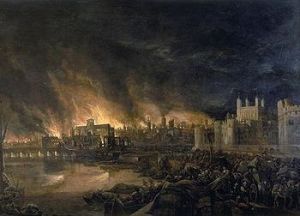
The Law does not work if the individual risks are correlated. The Great Fire of London in 1666 (below) happened because all of London’s thatched houses stood so close together that they were in fact one big house from the point of view of a flame.

350px-great_fire_london

The Law also does not work if adverse selection spoils the risk pool. For instance, say that some of the Swiss villagers had opted out of the pool because they had stone houses. Only those families with highly flammable houses would have entered the pool, but that would mean that the 1-in-a-1,000 ratio no longer applied (it would be much higher).

The Law also does not work if moral hazard changes the way people behave once they get insurance. If some villagers get the idea that, since they are now “covered”, they might as well set their houses afire, the system breaks down.

Finally, the Law works best for risks that are high in frequency, low in devastation. Fire is a good example. It does not work well for risks that are low in frequency, high in devastation. An extinction-causing meteor is a good example. (Who would charge whom what premium for what risk?)

Back to healthcare

And where does healthcare fit in?

  • First, it is very high in frequency (everybody gets injured or sick sooner or later) and low in devastation (usually only that one life is at risk). For most illnesses–diabetes, heart disease, etc–actuaries know exactly what percentage of the population as a whole will get sick in a given year.
  • Moral hazard is not a problem, because–loonies and rock stars excepted–people do not intentionally ruin their health just because they are insured.
  • Adverse selection is a problem, because risk, and the perception of it, changes over a lifetime. The young feel immortal and would opt out to save the buck (Swiss Franc) for a beer, leaving only the geezers to pay up.

Conclusions

Healthcare seems to be altogether unsuitable for a Lloyd’s of London (Anglo-Saxon, profit-driven) insurance culture, and perfectly suited for a Swiss-mountain-valley (risk sharing) insurance culture.

The prerequisite is that everybody in the pool must participate to avoid adverse selection.This, however, would require a mandate for the majority to coerce a few unwilling individuals, and that is something that (real) liberals do not like. But many liberals (and the Swiss are freedom lovers!) make this sacrifice because they understand that it is necessary: Dignity mandates that we look after the sick even if they have opted out of participating, so some people would become free riders.

There are two simple ways to get everybody into one risk pool subject to the Law of Large Numbers:

  1. Tax everybody a little bit (the equivalent of the SF1 per village family) to cover the proportion of people being sick every year, or
  2. make people buy their own insurance, rather as we require car insurance for drivers.

The first leads to a British or Canadian-style single-payer system. (Important: Notice that the government need only manage the funding of the care, not the care itself.) Since everybody is covered, there need be no paperwork for patients. I still remember when I was visiting Britain as a teenager with a soccer team and woke up unable to move my neck one day. I dragged myself to the street, got a taxi to a hospital, and, although I was not British, got fantastic care without signing a single piece of paper.

The second leads to a system of competing insurance carriers. This is fine, although there is one problem: What if you pay premiums to one insurer while you’re young, but then you switch to another insurer when you’re old? That would be adverse selection again (for the second insurer). But in a competitive system, patients would move in both directions, and might cancel one another out. Even so, there is slightly more paperwork for patients, since the care provider needs to reclaim the money from any of several insurers.

Notice that, either way, the economic burden is the same: Every citizen pays, whether through taxes or premiums, the same amount to participate in the risk pool.

America

And now, the American way: A bit of everything, mixed together and stirred. If you’re a veteran, you participate in huge risk pool. If you’re old (Medicaid) or poor (Medicaid), you participate in other risk pools. If you buy your own insurance, you can carry your coverage around, but you are paying much higher premiums because the insurer assumes adverse selection. If you’re employed, your company arranges coverage, but only as long as you work for it. If you are none of the above, you have no coverage and go to the emergency room when you’re sick, thus leaving the provider to hike everybody else’s costs to compensate for you.

Paper, paper, paper. No law of large numbers for society as a whole. Fragmentation. Confrontation between patient and insurer. Nightmare.

And if Obama goes on to do just the “politically feasible” thing–which, in America, is to add more “options” and complexity–it will get worse.

The way to bring freedom and dignity to America is to get rid of employer-sponsored insurance and to have either  one single government-run insurance pool or mandatory individual insurance for one privately-run insurance pool. Nothing else works.

Bookmark and Share

Complexity in the American drawer

Remote controls

This is only tangentially related to my ongoing ‘Freedom Lover’s Critique of America‘; but tangent does mean touching in Latin, so this does touch the topic:

I am staying in a very American sort of place: The owner has gone out of his way to provide “conveniences”, and in America that usually involves screens–nowadays of the flat-panel variety. They must be in every room, so that you don’t ever have to miss out. Other devices must be connected to the screens so that you need not compromise on your entertainment options. You must, you see, have choice. (More on the paradoxical effect of choice on freedom here.)

And so I opened a drawer. It turned out to be the mother lode of complexity metaphors in American life. All you need to enter this American paradise was contained therein. I thought of the number of remote controls, then the number of buttons, then the number of permutations. But I’m not that good at math.

I savored the irony, then closed the drawer and opened a book.

Bookmark and Share