Identity in the age of bureaucracy, continued

And apropos of our recent discussion about ‘bureaucracy and alienation in American life’, here is a footnote from China, just for perspective (my emphasis):

Chinese parents’ desire to give their children a spark of individuality is colliding head-on with the Chinese bureaucracy’s desire for order. Seeking to modernize its vast database on China’s 1.3 billion citizens, the government’s Public Security Bureau has been replacing the handwritten identity card that every Chinese must carry with a computer-readable one… The bureau’s computers, however, are programmed to read only 32,252 of the roughly 55,000 Chinese characters, according to a 2006 government report. The result is that Miss Ma and at least some of the 60 million other Chinese with obscure characters in their names cannot get new cards – unless they change their names to something more common.

What would Kafka say now?

Bookmark and Share

Frenemies: Freedom and equality

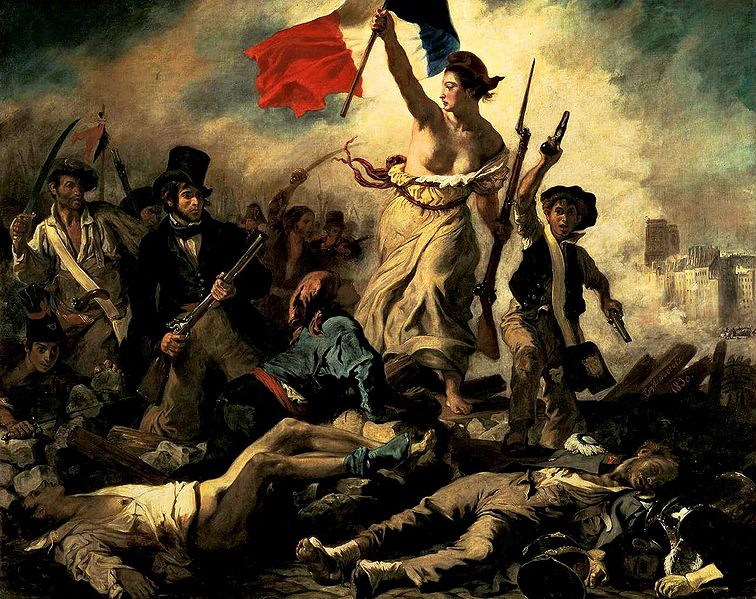
756px-eugene_delacroix_-_la_liberte_guidant_le_peuple

Marianne, above, did not flash her boobs to all those corpses for nothing. She did it for the trinity (as in the tricolore she carries) of liberté, égalité, fraternité. Let’s leave fraternity, which is a rather mushy notion, to one side. That leaves liberty and equality. Do those two belong together?

I knew I would have to address this issue sooner or later in my ongoing ‘freedom lover’s critique of America‘. But the fascinating debate in the comments below this post brought it to the fore. Fortunately, that comment thread neatly summarizes the entire spectrum, across the world and history, of views on the subject. As I see it, the three options are:

  • You can’t have freedom without equality.
  • You can’t have freedom with equality.
  • It’s complicated.

The Classical Liberal view

Broadly, classical liberals (as properly defined) are passionately in favor of equal opportunity and just as passionately against enforced equal outcomes, exactly as “Hizzoner” paraphrased Friedrich von Hayek here.

Which is to say: If you (ie, the government) predetermine that everybody will be the same (think the same, dress the same, drive the same car, live in the same house…) then nobody in your society can be free, if ‘free’ means being able to be yourself, ie different than others. Why create, why achieve, why risk, if the fruits of your effort and ingenuity will be confiscated (“redistributed”) in the name of equality?

I personally glimpsed the extreme form of just such a dystopia when I peaked into East Germany months before it crumbled (although I didn’t know that it would crumble, of course). They were all driving, or on the waiting list for, the same damn Trabi. And while I was ogling their Trabis, many East Germans were already flooding into the West German embassy in Hungary, trying to escape and eventually forcing their leaders to let the Berlin Wall crumble.

That same example, East Germany, also showed what Hayek correctly predicted would happen in reality in an ‘egalitarian’ society. As Orwell might put it: Some were more equal than others. The difference was that the ‘more equal’ ones didn’t use wealth to assert their supremacy but more nefarious means–party connections, or what the Chinese call guanxi. The resulting horror was captured intimately on screen here.

And so, to those of us, like me, who were devotees of Ayn Rand, the answer was clear. Equality is the enemy of individualism, and thus of freedom.

How it got complicated for Liberals

Even at the time, however, there were some contradictions that gnawed at me. Even in the ‘free world’, we were often invoking equality. For instance, democracy, which we (perhaps wrongly) associated with freedom seemed to be based on the equality of one citizen = one vote, even as capitalism seemed to be based on the opposite, ie unequal outcomes.

Then there was the bit about equal opportunity, which we were all supposed to be for. Well, this was messy, because, inconveniently, we were biological organisms and as such insisted on looking after our offspring. Anybody who ‘makes it’ devotes his entire life, and all his resources, to ensuring that his offspring get a head start. And who can blame him?

So if ‘we’ (the government) really wanted to preserve equal opportunity, we would have to get heavy-handed and stop ‘him’ from looking after his kids. We would have to stop him not just from sending his kids to better schools and doctors, but from reading his kids all those bedtime stories, paying for all those piano lessons and SAT prep courses, building all those Lego houses with them–ie, from doing all those things that give kids ‘unequal’ opportunity. In short, we would have to take his freedom away! Obviously, a non-starter.

The triumph of biology

And then I saw a documentary. I tuned in somewhere during the middle and never saw the title, so I can’t be sure it is this one, but it might be. It was based at least in part on Sir Michael Marmot’s Whitehall Study from Britain. Here is how I remember it:

Stress: It is not the same as pressure, which we all feel from time to time. Instead, it comes from ranking low in a hierarchy and lacking power over your own time, your own self (=not being free). You who are at the bottom are at the whim of others. You suffer. And not ‘just’ psychologically, but biologically. You tend to get fat in your mid-section, and your heart, blood vessels and brain change visibly, with entire neurological circuits shriveling up. Meanwhile, the brains and hearts of top dogs expand and thrive.

The most poignant moment came when they cut from our species, Homo sapiens, to monkeys. The researchers observed packs of primates, and sure enough: a monkey at the bottom of the hierarchy got fat in his mid section, had hardened arteries and heart walls and a a shriveled brain.

Equally poignant: One group of monkeys, led by particularly aggressive alpha males, played in a trash dump and was decimated by an epidemic. Another group, more female and egalitarian, moved in and absorbed the survivors of the first group. The egalitarian culture prevailed. And voilà, the health of the surviving monkeys from the first group recovered and improved! They were slim, their hearts and arteries pumped, their brains fired on all neurons.

Let’s take this one more step toward generalization: You recall that I criticized Ayn Rand for getting individualism wrong (which took me many years to figure out). Well, I now know how she got it wrong. She did not allow or understand how inviduals, when forming groups, pick up signals from one another that change who and what they are.

Watch this amazing TED talk by Bonnie Bassler as a mind-blowing illustration of what I mean. It is not about humans per se, but about bacteria. That’s right. Stupid, single-cellular strings of DNA and surrounding gunk. The trick to understanding bacteria (→all biological critters?) is to grasp how they chemically detect the presence of other bacteria, and then suddenly change their own chemistry. Upshot: No bacterium is an island.

The case of America

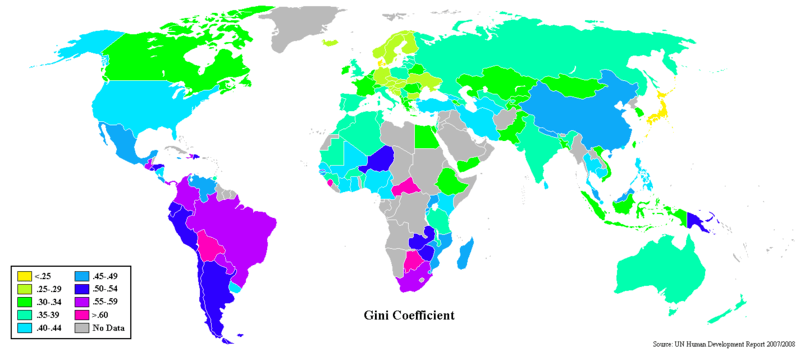
Let’s now look at America. Without getting into the academic weeds, there is a proxy for social equality called the Gini Coefficient. If the coefficient is 0, everybody has exactly the same; if it is 1, one person has everything, and everybody else has nothing. So countries fall somewhere in the middle between 0 and 1. Now look at this world map:
800px-gini_coefficient_world_human_development_report_2007-2008

The first thing you will notice is that the darkest blues and purples–ie, the greatest inequality–tend to be in poor countries, even in nominally “Communist” ones such as China. That’s because poor countries tend to be corrupt and feudal, with a few lords and many serfs. It is hard to consider these countries “free”.

But the second thing is more interesting. If you look at just the “developed” countries (let’s say those belonging to the OECD), you notice that one country stands out.

All the rich countries are in shades of yellow or green, meaning that they are fairly egalitarian societies. Only America is blue. America, in short, is the least egalitarian of all the developed countries.

And so? I’m not sure. The old Hayekian in me would chalk this up as a possible sign of more freedom in America than elsewhere. The new bacteriologist and epidemiologist in me wants to ring the alarm bell. This is not healthy! Sure, the Americans on top of the pecking order might show up at Party Conventions every four years and proclaim that ours is the freest country in the world. But many other Americans are simultaneously dying from their serfdom, whether they are aware of it or not.

For the time being, let’s consider freedom and equality neither friends nor enemies, but frenemies.

Bookmark and Share

Humor, education and creativity

You probably remember the old chestnut of Philosophy 101, Metaphysics: If a tree falls in a forest and nobody is there to hear it, did it make a sound?

Well, enjoy Ken Robinson’s twist on it, 14:40 minutes into the talk at the end of this post:

If a man speaks his mind in a forest, and no woman hears it, is he still wrong?

The talk is another great example of the British humor that I love and am often surrounded by at The Economist. But humor is best with substance, as a vehicle that delivers a serious point more memorably.

Does Robinson have such a point? Yes. It is:

Schools kill creativity.

As he says,

If you’re not prepared to be wrong, you’re never going to be original.

But we–first in our schools, then in our companies–stigmatize “mistakes”. We do, don’t we? Even on this blog, I am sometimes so worried about saying something stupid that I end up saying nothing at all. As Robinson says, we “educate people out of creativity.”

Well, let’s stop doing that, certainly here on The Hannibal Blog. Watch the whole thing:

Bookmark and Share

Tax day thoughts on complexity in American life

800px-boston_tea_party_currier_colored

April 15. Tax day. All over America today, people are amusing themselves with “tea parties“. And that is great fun, to be sure. Part of our creation myth is that the country started with a tax revolt, as we rugged individualists stood up to those imperial tyrants. So let’s put on our costumes and play.

But let’s then talk seriously about taxation as part of our ongoing ‘freedom lover’s critique of America‘. To do that intelligently, I feel I must remove one important distraction upfront:

I don’t believe we are overtaxed in America. I believe that some of us could pay even more. But the amount or rate of American taxation is not the problem.

What, then, is the problem? Make no mistake that there is a problem. America’s tax system is a scandal. It is incompatible with freedom.

The problem is complexity, and its effect, opacity.

Today I heard the IRS commissioner say on NPR that America’s tax code is four times as long as War and Peace. 5.5 million words, apparently. The wordcount, however, is a very abstract and bad way of grasping the complexity of the system. We don’t read the code.

The complexity begins hurting, and enslaving, us as we live–that is, as we participate in our society and economy, have children, work and save, and so forth. Young Americans probably don’t know what the fuss is about. That’s because they are not yet participating fully in society. Some adult Americans–probably the spouses of the one “doing the taxes” in any given household–might also feign surprise. That is because they have chosen not to inquire into this scandal. But they are fooling themselves.

The only legal American way to keep things simple in matters of tax paperwork and hassle is not to live. That’s the only way. Don’t work, save, have children, move, and so forth. (Above all, never ever contemplate hiring a nanny!) So I think we can agree that a country that torments its citizens just for trying to make their dreams come true (might I say, for “pursuing their happiness”?) is not … free!

Short meditation on complexity and simplicity

Regular readers of The Hannibal Blog already know how important simplicity is to me, in all things aesthetic, creative, or administrative. Simplicity to me accompanies freedom. I feel free when I am free of clutter.

But I also recognize that nature is full of complexity. and that complexity can be beautiful. However, it comes in three very different kinds:

  1. Natural. Our bodies, for example, are extremely complex. The two nervous systems, the immune system, each organ, each cell, each organelle within each cell–all these are beautifully and mysteriously complex. However, this complexity has evolved, and comes with a “user interface” that remains extremely simple. We do not compute how to attack a virus in our body or how to inhale, we just do it. The complexity is hidden.
  2. Manmade, but following the path of nature: Our cars, for example, are constantly getting more complex. I might have been able to fix a Model T, but I can’t begin to comprehend the 20-odd computers that together represent my Prius. However, just as our bodies hide their complexity from us with a simple user interface, my Prius hides its complexity, so that driving (and bluetoothing, GPSing, etc) is simpler than it was in a Model T. Such complexity is actually sophistication. It works for us, and thus is humane.
  3. Manmade, and going against the path of nature. This is the bad one. This is where our bureaucracies reside. They get inexorably more complex, as surely as entropy increases anywhere in nature, but away from sophistication and toward oppression. They are inhumane. Our tax system is the best (meaning worst) example.

Symptoms of denial

So they arrive, the W2s, W4s, W8s, the 10this and 10thats, the Schedules A, B, C, D, E, F, the worksheets and other papers, and above all, those truly weird, out-of-nowhere, can’t-even-indentify, forms of the sort that we just got and now have the pleasure of disputing and investigating.

People respond in one of three ways.

  1. Take deep breaths, fire up TurboTax and just do it. Those of us who are youngish tend to do it, because we are the do-it-yourself generation, or don’t trust that a tax preparer would do it as meticulously as we will, or actually want to understand (gasp) our affairs.
  2. Get an accountant, forward all that dreadful crap to him, sign whatever he produces, and push the whole thing out of our consciousness.
  3. Break down and give up completely, not filing at all.

In my opinion, 3 is the worst, 2 is the second-worst, and 1 is merely bad. Why? Because all those in Number 2 are fooling themselves. They are accepting that they cannot, and never will, understand their own relationship to government. They are acquiescing in a subtle form of serfdom.

Summary

We can say, speaking for adult Americans who participate fully in life, society and economy, that:

Nobody truly understands why they pay what they pay

The tax system, in short, has become a black box.

180px-blackboxsvg

Black boxes are profoundly and inherently illiberal. Propaganda about “lands of the free” is empty when you’re shouting it over black boxes. (And there are other black boxes in American life, to which I will get.)

Finally, recall my two comparisons to Hong Kong: 1) There, my tax return was two pages, counting the bilingual translation, and I understood exactly what it contained. 2) This despite Hong Kong not being a democracy. How intriguing. As it turns out, it is our peculiar American brand of democracy that has caused this mess.

Of that, and of the possible ways out of this mess, more in posts to come.

Bookmark and Share

Bureaucracy and alienation in American life

franzkafka

The Hannibal Blog continues its multi-post and cumulative ‘freedom lover’s critique of America.” In recent posts, I reflected on Hong Kong, and how very differently–read: freer–I felt when I lived there. Now I want to start exploring what it is that makes me feel unfree in America.

Let me define the direction of my posts (in the comments you can go wherever you please). I won’t be talking about America’s role in the world at large. I won’t be talking about whether or not the world owes America for saving it from totalitarianism in the past (it does). I’ll be discussing only what it feels like to be inside of America today, after having known life in other developed and comparable countries. More specifically, I will concentrate on what it feels like to interact with the organs of official America. (That individual Americans will comfort one another and make life livable is obvious, but no more so than in any other country.)

In essence, this becomes a discussion of American bureaucracy.

God knows other countries have a lot of it, and often more of it, than America. But America has a peculiar brand of it. It has many and overlapping bureaucracies. These share data but do so awkwardly and antagonistically. Democracy does not help but often hurts, because electoral politics (people campaigning in poetry, then governing in prose) add to these bureaucracies. America’s legal tradition, often praised, hurts too, because it is adversarial (as opposed to inquisitorial). It is based on the clash of two parties, each trying to win, with the hope that truth and justice are on the side of the winner. This pervades all of official life in America: You prepare for clashes, you arm for war, then climb down when possible. (Hong Kong also has an adversarial system, but without the rest of America’s bureaucracy.)

Let’s make this concrete. Watch Barry Schwartz talk about our loss of what he calls “wisdom”. It meanders a bit and will strike you as only tangentially relevant. But pay attention to some of the anecdotes. They are peculiarly American. In one, a father takes his son to a ballgame, buys him some lemonade, doesn’t realize that it is a brand that contains some alcohol, is observed by a guard who (yes, preparing for war, using the bureaucracies) calls an ambulance and the cops. The son ends up in the emergency room (procedures and rules are being followed, you understand) and is declared safe. One bureaucracy (something with “welfare” in the name) sends the child to a foster home for three days. A judge (in another bureaucracy, the court system) sends the son home, but now orders the dad to move into a motel. The ordeal goes on for two more weeks. All bureaucrats involved eventually say “we have to follow the rules”.

America is all about rules. It is the land of ever more disclosure statements, ethics training seminars, pieces of paper (often with a notice at the bottom about a “Paperwork Reduction Act”!).

Schwartz says these procedures and frameworks of officialdom are meant to “spare us from thinking”, to relieve us of spontaneous and moral judgment. They “assure mediocrity”, he says. To me, they contribute to making me feel less free.

Bookmark and Share

Freedom lessons from Hong Kong (2): democracy

408px-tallahaseepalmbeachballotbox1

How liberating

Recall, for a moment, the famous lad who went out one Friday night, ordered gin with orange juice and got tipsy. He went out again Saturday night, ordered vodka and orange juice and got tipsy again. He loved being tipsy so much, he went out and bought himself a whole liter of … orange juice.

Let’s now look at the role of democracy in freedom. Is it the gin or the orange juice?

Last time in this thread–an emerging ‘freedom lover’s critique of America‘–I shared with you my experience of living in Hong Kong as an instructive way into understanding life in today’s America. In brief: I felt freer in Hong Kong than anywhere else I have ever lived; I feel less free in America than anywhere else I have lived.

Even as my fingers still touched the keyboard, I started bracing myself for some inevitable rejoinders. Of which the first and most obvious is: Hong Kong is not a democracy, whereas America proudly is!

Coming clean

I once belonged to a salivating pack of expatriate journalists in Hong Kong who loved to scrutinize every Asian government we covered based on its minute-by-minute body language toward democracy.

  • More democracy = approve
  • Less democracy = disapprove

It was an evergreen topic for us, easy to pitch to an editor, easy to write, easy to be smug about. Hong Kong, during its suspenseful transition from British to Chinese rule, was a particularly good place for “democracy” stories. If an errant Falun Gong meditator from Ohio or Liaoning so much as got stuck in his Lotus pose, I was ready to suspect sinister interference from the Mainland.

On the Mainland, whenever I got stuck in an interview, I whipped out that word, democracy. In Taiwan and the Philippines, officials occasionally played the trick on me: They whipped out the word to buy time. After all, what else could I possibly demand as long as the place was, you know, democratic and thus surely free.

In America, George W. Bush was composing entire inaugural addresses around just two words–freedom and democracy–as a way of explaining wars and himself. Very few people called him on that particular association. The two do seem to go together.

Hell is other demos

Actually, they do not. They can, but they need not. In Foreign Affairs, twelve years ago, Fareed Zakaria coined two powerful memes: Illiberal democracy and liberal autocracy. (That’s liberal as properly used.) He simply observed that there are an awful lot of democracies–ie, countries whose governments are chosen in elections–today whose citizens are anything but free. And there are quite a few autocracies whose people are free. Hong Kong is one of them.

Another free (ie, liberal) autocracy in history was colonial America, before the British started imposing exotic new taxes. The king was far away and left the colonials alone. They had no say in government, but did not care because they were free to live their lives. I once read somewhere (if anybody could point me to the link, I would be grateful) that this was the freest period in American history.

Next came taxation. Then the call for none of it without representation. Then the constitutional convention. And how did our founding fathers approach the issue? James Madison, possibly thinking of ancient Athens, said that:

Democracies have ever been spectacles of turbulence and conflict; have ever been found incompatible with personal security or the rights of property; and have in general been as short in their lives as they have been violent in their deaths.

In general, the founding fathers believed Polybius: the best government balances monarchy, aristocracy and democracy. Without such balance, monarchy becomes tyranny; aristocracy becomes oligarchy; democracy becomes mob rule. Today, this skepticism about democracy lives on in a small circle of libertarians/liberals such as Ron Paul, who worry about “majoritarian” oppression.

If you read this to mean that I am against democracy, you have misunderstood this post. I am not necessarily against it. And yes, I do love Winston Churchill’s wit. I am merely pointing out that democracy can coexist or conflict with freedom. Some of us have got used to seeing the two together, like orange juice and vodka in a screwdriver, and have made an inappropriate association.

But democracy is irrelevant to our topic. The origin of freedom is to be found elsewhere. And we will look for it.


Bookmark and Share

Freedom lessons from Hong Kong (1)

From late 1999 to 2003, I lived in Hong Kong. In personal terms, I had some ups and downs there, but that is of no interest here. What’s interesting is that Hong Kong is the freest place I have ever lived in.

In Hong Kong, the authorities and bureaucracies leave you alone.

And this–being left alone–is one simple first definition of freedom. How much time do you spend defending yourself against weird paperwork that shows up in your mailbox? In America, a lot. In Hong Kong, at least when I lived there, almost none.

Let me summarize what I recall to be my interactions with Hong Kong bureaucracies (not counting the ones that I interviewed as a journalist):

  • I had to get my visa when I moved there, and to renew it once during my stay. Since I have two passports, I even made some paperwork mistakes that needed to be corrected. I personally showed up at the immigration agency each time. Total time spent in 4 years (filling out paperwork, waiting in line): 9 minutes!
  • I had to file Hong Kong taxes. (Not German or British taxes, since those countries do not harrass their former residents or citizens when they go abroad; but also American taxes, since the United States, like North Korea (!), asserts global jurisdiction over its citizens.) Total page count of my Hong Kong tax forms, including bilingual translations into English and Chinese: 2 pages! Number of boxes filled in with a money amount: 1! Estimated time spent in 4 years filling out my Hong Kong tax returns: 13 minutes!
  • Then, of course, there were all those other forms that I had to…. Oh, wait. No, there weren’t any. That was it.

Those of you living in America or the European Union, but especially America, might be starting to guess where this is going. Think about the crap that you get in your mailboxes, look at your file cabinets, weigh the paper of your correspondence with your bureaucracies. Read their tone (“on penalty of perjury”). Observe how bureaucratic and official America makes you feel.

Two questions:

  1. Do you feel free? (I am not asking you to enumerate the usual lists of freedoms in the plural–speech, press, association, etc. I am asking you how you feel. Beleaguered or free?)
  2. Do you understand your affairs and interactions with official bureaucracies? (I am not asking whether you can point me to the relevant file for each bureaucracy; I am asking whether you comprehend why your are paying this tax rate and not that, why this form showed up and not that, whether you have set up everything optimally or not, et cetera.)

I am guessing that quite a few of you are already inhaling to inform me that I could not have, should not have, must not have felt free in Hong Kong, that colony of first the British and then the Communist-Chinese empire. China! What about democracy?

Ah. Let’s re-examine that particular issue anon.

A freedom-lover’s critique of America

450px-anti-us_tehran1

Oh, puleeze

No, I am not “anti-American“, just to get that straight. Instead, as regular readers of The Hannibal Blog will know, I am a lover of freedom and individualist, and thus nominally aligned with America’s putative founding philosophy. And I am in the rare (although not that rare, nowadays) position of being simultaneously an insider (citizen) and outsider (dual citizen, long-time expatriate).

Hence my idea, half-baked at this point, to weave yet another thread into The Hannibal Blog. (None of the existing threads will be interrupted.)

In short: vignettes of American life, told from the perspective of an outsider on the inside. And yes, it would amount to a critique. But an educated, insightful, informed and witty critique, not the usual, frothy nonsense that you get from America-haters.

The basis of my idea is the this unholy symmetry:

  • America-haters around the world usually don’t know much about America and so end up sounding ridiculous to those of us who do.
  • America-lovers inside of America usually don’t know much about the rest of the world and so end up sounding ridiculous to those of us who do.

So, get ready. This will, in time, draw a new crowd of internet trolls eager to smear their graffiti into the comments during the commerical breaks on Fox or Al Jazeera. To the hard-core readers among you, I say: Steel yourself! You already know that the critique will, above all, not contain the old clichés.

Bookmark and Share

Forgetting to breathe

So here I have been, waxing philosophical about Patanjali, the great sage of Yoga, and his fundamental insights about the human mind.

Well, I’ve been a hypocrite. Because, as I have been noticing all this week, I am barely remembering to breathe. And breathing properly is the way to calm and clear the mind, as Patanjali taught us. So my mind, you can infer, is anything but calm and clear. I am too worried (about something that I may or may not share anon).

A few years ago, I took videos such as this one seriously, and actually did pranayama (breath exercises).

But paying attention to breathing is amazingly hard work. So, because I’m lazy, I gave up.

Then life pitches you a few tough ones, and off you go, breathing like a dog: shallow, top-of-the-lungs, in-out. You become a wreck.

It’s a pity that breathing, or the concentration that it requires, is such hard work. Otherwise, I might actually learn the lessons by Patanjali that I like to tout. Ironic.

Bookmark and Share

The two ways of being shocked

In the previous post I described two types (possibly archetypes) of people: Roundheads and Cavaliers. This post will only make sense if you read that previous one.

At the end, I invited you to guess which kind you are. Well, let me help you along a little bit.

Part I: Know one when you see one

Below is a famous clip from a famous movie. As writing has voice, so does film-making, and the voice in this clip is …. [you fill it in: either Roundhead or Cavalier]:

Now contrast that with this clip. Again, please fill in: The voice in in this clip is […]

Part II: Vote

[UPDATE: For an explanation of the poll below, see my comment.]


Bookmark and Share