If you don’t know what it is, give it a name

  • What is sleep?
  • What is an electron/photon?
  • What is money?

I find it forever fascinating how utterly clueless we (Homo Sapiens) are, about almost anything. A different sort of person marvels at how much we know, but I marvel at how little we know.

Which sort of person you are, I find, depends on how curious you are–ie, how easily satisfied that you know enough about something, anything. To oversimplify for the sake of some easy labels, the first sort might be called intellectual, the second practical. Every joke you’ve ever heard about intellectuals applies to me.

The most boring branch of college philosophy, as I recall hazily, is epistemology, the logos of episteme, ie knowledge. You read and write endless stupid essays on whether we really know that the chair we’re sitting on is a chair, whether we can be sure that we are not brains in a vat, and so forth. Able-bodied twenty-year-olds tune out and go to the keg party, as I did.

But there are infinitely more interesting questions to ask, and they get more fascinating with age. Today I want to give you a sample of just three. They have two things in common: 1) the practical types are likely to roll their eyes because, you see, the answer is too obvious to merit the question, and 2) nobody who does ask the question, least of all the experts, has the foggiest notion of what the answer might be.

800px-Puma_Sleeping1) What is sleep?

The practical person says ‘Make sure you get enough of it.’ Thank you, and I do. I’m really good at it, or I was until I had children.

But what is it we’re getting ‘enough’ of? With food, it’s easy to tell. Chemical energy goes in, changes shape into bodily functions and waste. But with sleep, it’s a mystery.

Some animals do it standing up, others lying down, some for minutes a day, others for months on end. All of us go through different phases in our sleep and we should probably have different names for each phase. We can measure some brain waves and chart them. We can follow people who don’t sleep enough and observe their immune systems and reaction times and such. We can, in short, describe what sleep does to us.

But can we say what it is? I’ve been asking some neurologists lately, and the answer is No. You can answer with semantic layers (“rest”, eg), but each layer leaves you more frustrated. We just don’t know. If we find out, that might be one of the greatest breakthroughs in human consciousness ever.

2) What is an electron/photon?

The practical person says ‘If this light switch works, you see the electrons and photons in action, okay?’ Indeed, he might whip out all sorts of measuring devices for both. But we didn’t ask what electrons and photons can do. We asked what they are.

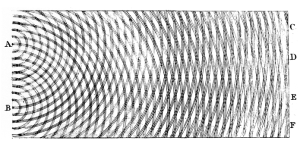
I love this example because it illustrates how we soothe our ignorance with labels. First we called “them” (we were/are not sure whether they are separate things or aspects of the same thing) waves. Waves, of course, are something we think we understand because we’ve skipped stones in ponds and all that. And somebody discovered that if you shoot electrons/photons through two slits, this happens:
Young_Diffraction

A wave pattern, in other words. Aha.

Then somebody else discovered that when you shoot electrons at a metal plate, photons are knocked out, like this:

132px-Photoelectric_effect.svg

Particles, in other words. Aha.

And so we have the answer: “wave-particle duality“. It is Orwellian in its beauty. Rather than admit that we don’t know what it is (a “bundle” of energy? A “quantum”?) we take two things we know and mix them together with a hyphen.

This example goes far beyond electrons and photons, by the way. We follow this approach with all subatomic particles–ie, we bash them together, see another flying off, and instantly … name it. Bosons, muons, leptons. My favorites are the quarks which can be (and I kid you not) up, down, top, bottom, charmed or strange. Those guys in the hadron colliders have a great sense of humor.
800px-BanknotesWhat is money?

I actually found myself in the amusing situation once of teaching (to a class of journalism students) a lecture on this question. What you do, in case it ever happens to you, is that you say you don’t know, but at a high intellectual level, for two hours.

Again, the practical person says ‘I know it when it’s in my bank account’, or describes things that money does.

It does three things, by the way: It acts as a

  1. medium of exchange (so we don’t have to barter)
  2. unit of account (so we can keep track of value)
  3. store of value (so we can save value over time, lest it rot as bananas do)

Great. We can describe other aspects of it. It has velocity. It has a multiplier effect. And so on.

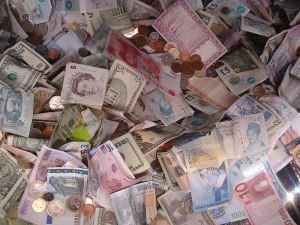
But what is it? It is not cowry shells, although it once was. It is not gold or silver, although it once was (and still is in many names for money, such as Geld or argent). But even though the queen promises to pay me x pounds of sterling, she would not actually give me any metal if I showed up at Buckingham Palace. Other times money is cigarettes (post-war Germany) or sex (ditto). Often it is just paper (above). But almost all of the time, nowadays, it is just debits and credits on a computer screen. (!)

The key moment for me occurred when I was talking to an economist about this, and finally he said:

you have to understand that all this money isn’t actually … there.

He meant it can go pouff if people don’t believe it’s there (see: etymology of credit). It can reappear when people believe it might be there.

And that may be the appropriate note to leave this post on, in the second year of our Great Recession. Everything you lost was … faith-based to begin with.

Bookmark and Share

The dignity of prisoners

From this quite fascinating piece about new architecture concepts for prisons (!): Written on a prison wall in this new compound in Austria, a line from the International Covenant on Civil and Political Rights reminds guards and inmates alike that

All persons deprived of their liberty shall be treated with humanity and with respect for the inherent dignity of the human person.

Could we please write that on every American prison wall?

Bookmark and Share

“Winning the peace”: Success defined

250px-Peace_sign.svg

So-and-so “won the peace,” my wife says to me. We say that often to each other. It has become part of our private spousal language, a shortcut to an expansive world of meaning. The context? Life, and success of the genuine, authentic, meaningful sort.

When I introduced Carl von Clausewitz as part of a little mini-series on strategy, I explicitly said that, in my forthcoming book and on this blog, I’m only using war as primal metaphor for the rest of life.

Failure is often the result of succeeding at the wrong thing (eg, choosing the wrong “battles” and “wars” to win, as Pyrrhus did). Ironically, success is therefore often the result of failing at the wrong thing, and thus having an opportunity to “return” to the right things.

But Success, capitalized, tends to be about being clear about what matters, about the ends you are ultimately pursuing in life, and then using little successes only as means. Means and ends. In short, it is about strategy as taught by Clausewitz. Those who Succeed in Life “won the peace”.

Bookmark and Share

One theory on why success leads to failure

Thanks to Justin Hendrix, for pointing me to this TED talk by Richard St. John, who says he spent a decade researching success.

For an entirely different approach to that same topic–and its corollary; why failure can lead to success–please read my book when it comes out.

Here goes:


Bookmark and Share

Let your TV set go black on Friday

138px-TV-icon-2.svg

On Friday the government is switching off analog TV broadcasting. My rabbit-ear set will go blank. I’ve known about it forever but, like millions, have not, er, bought my converter set, subscribed to cable, or whatever else the infomercial has been urging me to do.

Who are “we”? According to the FCC we are “society’s most vulnerable.” Elderly, handicapped, poor, fat, illiterate, and so forth. I’m sure that covers some of the millions. But not me, and not Knute Berger.

In this witty piece, he tells his story of how he and TV just sort of drifted apart, grew estranged and now decided to see other people. It is exactly what I would have said, had you asked me.

To tell the truth, my consumption of broadcast TV has been in a downward spiral for decades. Programming is often available online, and much local content, especially news, is dreadful… Cable TV holds out hope that there’s something wonderful just a few clicks away. I can waste hours in a hotel room just clicking through all the 100-plus cable channels, lost in an endless gyre of anticipation, hoping that something more than sports, cable shopping, movies you’d never rent, and TV preachers is a channel away… Which isn’t to say I won’t still watch TV: I can see Conan or Colbert highlights online, broadcast and cable clips at Huffington Post… I much prefer watching TV series on DVD, which allows you to avoid the ads and watch a whole season’s worth in a weekend… Of the 10 million or so households that aren’t ready for digital TV, a few will panic. But for me, I’m content just to let the old medium end like the Sopranos — with a fade to black.

Amen.

If Knute and I are, as I think, in the unmeasured millions, I will make another prediction: We will soon see a flowering of human culture and literacy, as we stop wasting our time on this shit and (re)discover thought, culture, the written word and creativity in all its new guises.

Bookmark and Share

Clausewitz on 9/11 and all that

A strategic moment

A strategic moment

What might Clausewitz say today about America’s double-war in the Middle East during this decade?

I was very tempted not to write a post on this. After all, in my forthcoming book I am ‘only’ using success and failure in war (ie, the one Hannibal and Scipio fought) as a primal metaphor for other contexts in life such as sports, love, business, relationships, exploration, reproduction, art and thought.

Ditto Clausewitz: I am interested in life strategy; but that is still strategy, and Clausewitz happens to be the sage on that subject.

(Incidentally, I’m impressed by the feedback I’ve gotten from that little post. Clausewitz is very topical, it seems. For instance, Mike Lotus emailed me to point out his recent roundtable on Clausewitz, which will become a book this fall.)

I am also aware that there is little to be gained from yet another analysis of where we went wrong in responding to 9/11. Everything has been said. Worse: in contrast to, say, the Korean War or the Second Punic War, our current wars are still going on and our society is still split, so it is too early to talk dispassionately about them.

But I’ve decided that if I bring up Clausewitz and strategy, I would be chicken not to take a stab at Iraq and Afghanistan. So here goes.

The situation as it appeared on September 12, 2001

Al-Qaeda attacked us; 3,000 of us are dead; 300 million of us are shocked, angry and scared.

1) From Al-Qaeda’s point of view

Student of Clausewitz?

Student of Clausewitz?

For Al-Qaeda, this was an ideal alignment of tactics and strategy: With little effort and cost, it caused disproportionate levels of terror (hence ‘terrorism’) in the Western world that appeared (politically and psychologically) certain to provoke us to go on an offensive. (Notice ‘an’, not ‘the’.)

Clausewitz believed that defense was much easier than offense, because whoever is attacking will eventually reach a ‘culminating point‘ point at which he is overextended and exhausted, and the defender can counterattack with devastating ease. So if we play offense and Al Qaeda plays defense, that helps them. (This is the opposite of what Cheney thinks.) Al-Qaeda was pleased.

Clausewitz also believed that, to win a war, you need to find your enemy’s center of gravity and defeat him there. Defeating him elsewhere is pointless or counterproductive. (For Clausewitz the obvious example was Napoleon‘s mistaking Moscow for Russia’s center of gravity, an error that was the beginning of his end.) Al Qaeda knew

  1. that its center of gravity was not one that we were trained or able to identify militarily, because it had no capital and no army that we could bomb; and
  2. that we were likely to miss its ultimate center of gravity, which is its support among Muslims at large.

Al-Qaeda might have believed (although we might be giving them too much credit) that our center of gravity was … us! If we could be terrorized into compromising our values then we might forfeit any appeal we might have for moderate Muslims around the world.

“War is nothing but the continuation of policy with other means,” Clausewitz said, and Al-Qaeda’s overarching policy was and is to defeat moderate or secular or Shia Muslims in Muslim countries. Any tactic (or means) that would weaken the moderates in those countries and strengthen the extremist Sunnis would therefore fit into its strategy (or end).

If we could be provoked into disarming (ie, no longer offering appealing values to moderate Muslims) and attacking the wrong center of gravity (=Napoleon to Moscow), then a Wahabi-Sunni caliphate, united against Shias and the West, would become more likely. Al-Qaeda would consider this victory.

2) From our point of view

Clause which?

Clause which?

For us, 9/11 was a wake-up call. There were people who were trying to kill us, and even though they had only box-cutters (and hence our planes) they might get nukes. We had to keep nukes and other WMDs out of their hands, and to keep our enemies out of our countries altogether. Strategically speaking, so far, so good.

Problem Nr 1: Offense or defense? Clausewitz said that defense was better. Even in this case, he might be right. After 9/11, there was a global outpouring of sympathy for America. In Europe, Asia, even in the Middle East, reasonable people were on our side. For Al-Qaeda, this might have been an early culminating point, an act of over-reaching that could have united us with our allies and even some enemies and estranged moderate Muslims from Al-Qaeda, thus leading to its defeat.

But defense was not an option, for reasons of domestic politics and psychology, and Al-Qaeda knew that. Hence…

Problem Nr 2: Since we were going on the offense, what was the enemy’s center of gravity? The difference between going on the offensive as opposed to an offensive is one of aim: if we hit, it’s the; if we miss, it’s an. So was the center of gravity

  • Osama?
  • Afghanistan?
  • Al-Qaeda everywhere and anywhere?
  • Its sympathizers anywhere?
  • Muslims?
  • The arms, ie the WMD, wherever they were, that might fall into Al-Qaeda’s hands?

You see the difficulty. As it turned out (but we could not have known that then), any item on the list above that seemed easy and straightforward subsequently turned out to be hard and elusive.

  • We thought we could get Osama quickly (but worried even then that he personally was not the center of gravity–correctly, I think). But here we are and he is, well, somewhere.
  • We thought we could do better than the Soviets, and as well as Alexander the Great, and just subdue Afghanistan. And we did. But then we didn’t. Or did we?

What we should have realized even then is that the center of gravity was the rest of that list.

  • “Al-Qaeda everywhere,”
  • “its sympathizers anywhere,” and
  • “Muslims”

were and are three disctinct but fluid and overlapping populations. If we were to “win over” Muslims, then there would be fewer sympathizers, and thus also fewer (new) members of Al-Qaeda.

What would that have entailed? Borrowing a bit from Lao Tzu, we might have done a lot less, because Al-Qaeda is so appalling to most Muslims. (Most of the people Al-Qaeda kills are Muslims.)

We might also have contemplated a full-fledged “Muslim Marshall Plan”, on the scale of the one that we brought to Germany and Western Europe after the war (against our then-new enemy, Communism). The earthquake in Pakistan and events like it were great opportunities, largely overlooked, to show them what we can be and what Al-Qaeda is not.

We did neither of those things. Instead, we got more active than Al-Qaeda, and blew up more than we built up. That was a strategic mistake, but not nearly as big as the following:

  • The arms (ie, the WMD)

No, I am not talking about merely getting our intelligence about Iraq wrong (as tragic as that was). At the time (defined as: after Colin Powell’s presentation to the UN) we all thought that Saddam was making WMD.

But so what? The strategist (Clausewitz) would step back and look at the overall situation:

  • a risk of loose nukes in the former USSR. Must secure as fast as possible!
  • Pakistan, which is Muslim and next to Afghanistan, having nukes. Must support and stablize country! Check back in often.
  • North Korea, which was on the verge of getting nukes, but still had our (IAEA) monitors inside the country. Must contain and engage! Otherwise consider pre-emptive strike!
  • Iran, which was far behind North Korea in progress toward nukes, domestically complex, our enemy but also Al-Qaeda’s enemy. Must attempt to turn into potential ally against Al-Qaeda!
  • Iraq, which was furthest behind, mostly dabbling in chemical and biological WMD (I’m still quoting what we thought then), which are infinitely less dangerous (harder to deliver, less lethal). Our enemy, but also Al-Qaeda’s natural enemy. Must attempt to turn into tool against Al-Qaeda!

I’m guessing that several of those points caused you whiplash (the bits in italics). But remember that the idea of Nixon going to China would have caused you whiplash too.

What we did not do, but should have done, is to think strategically about the world’s nukes. A clear hierarchy of danger existed, with North Korea at the top and Iraq not even on it.

What we also did not do, but should have done, is to think strategically about enemies and allies (as Nixon and Kissinger did). The biggest enemy was Al-Qaeda. Iraq and Iran were holding each other in check (thanks to Bush senior who, in a masterly and subtle gesture, pulled back in the first Gulf War just at the point that would allow Iraq to keep holding Iran in check.)

More importantly, Iran, being Persian and Shia, and Iraq, being secular and Baathist, were both natural enemies of Al-Qaeda. Duh!

I will never forget the day I came back from the slopes in Whistler on a ski holiday with my fiancee (now wife), turned on the TV and watched the news of North Korea kicking out our monitors. That was it. That was the moment I knew we had screwed up. (And we did not even know yet that Iraq had no WMD.)

Kim Jong-Il was watching what we were about to do to Saddam and decided to make a run for it–ie, for the nukes. Until we invaded Iraq, we had everyone in a tense stalemate: Saddam could not move and had monitors in every orifice, Kim Jong-Il had monitors, and Iran was worried about Iraq as much as us. After we invaded Iraq, North Korea and Iran called our bluff: We were not going to “pre-empt” anybody again.

The rest is history

  • We invaded Iraq and found no weapons, even as we watched North Korea get nukes and Iran follow close behind.
  • We weakened Muslim moderates in their own domestic debates against extremists by becoming what Al-Qaeda needed us to become: torturers, abusers of Muslims at Abu Ghraib, bombers of civilians. We gave them a Feindbild.
  • At home, once we realized we were not advancing our strategy–indeed, not even formulating it properly–we began confabulating other war aims. Suddenly, it was about “democracy”, and bringing it to a region at gun point. This was somehow going to solve everything. This is when I became disgusted.

Summary: We kept sympathy for Al-Qaeda alive longer than was necessary and allowed nukes to get into the hands of people who might yet trade them to Al-Qaeda. Strategically speaking, an utter disaster.

Fortunately, the story is not over yet and, with luck, we will look back at the Bush years as merely lost time, not an irreversible defeat.


Bookmark and Share

Why complexity matters

Dan Ariely

Dan Ariely

Regular readers of The Hannibal Blog by now know my fascination with complexity and simplicity as subjects in their own right. I’ve equated simplicity with beauty and genius, and I’ve decried the nefarious complexity (man-made, as opposed to natural) in such vulgar monstrosities as America’s tax code.

Now I’ve come across one of two TED talks (below) by Dan Ariely, a behavioral economist with an interesting life story (he was burnt in an explosion, recovered and used his agony to generate amazing research ideas.)

Here he talks about how awfully bad we are at making decisions, and how awfully confident we nonetheless tend to be that we make good decisions, indeed that we are the ones deciding at all. Much of the time we are not.

Most of the ‘choices’ we have to make in our lives are too complex. And often even a tiny bit of extra complexity puts us over the edge. We can’t handle it, so we become passive and ‘opt’ for the default, whatever that is. That means that somebody else (the one who set, deliberately or not, stupidly or not, the default settings) actually decides for us. As Ariely says,

it’s because we care, it’s difficult, and it’s complex, and it’s so complex that we don’t know what to do, and because we have no idea what to do we just pick whatever was chosen for us.

He shows this with examples from organ donors in Europe to health care to (my favorite, of course) a really stupid (or unbelievably cunning) marketing pitch that The Economist once ran.

Worth 17 minutes of your time:


Bookmark and Share

Clausewitz and you: Life strategy

Clausewitz

Clausewitz

It’s time to talk about tactics as opposed to strategy in life, because knowing the difference is crucial to achieving success, and avoiding disaster. And that, of course, is the topic of my book.

The person to know about in this matter (besides Hannibal and Scipio, of course) is Carl von Clausewitz, a Prussian (and later Russian) officer on the losing side against Napoleon. He also witnessed Napoleon’s disastrous retreat from Russia, which made a deep impression on him. Think of him as the equivalent of an adviser to Scipio or Fabius, the Romans on the losing side against my main character, Hannibal.

Clausewitz is without any doubt one of the great thinkers in world history, even though he is enigmatic and still confuses people to this day. The main reason for that is that he spent his career taking notes–hundreds and hundreds of pages worth–which he meant to consolidate into a coherent whole. But then he died of cholera, at the age of fifty-one. So his great treatise, Vom Kriege, “On War”, was not coherent. Even so, it is now considered the most profound work on strategy ever, thanks to the thoughtful analysis of people such as Kenneth Payne, Patrick Porter and David Betz at King’s College in London.

Let’s look at his most famous and controversial quote:

War is nothing but the continuation of politics (or policy) with other means.

Lots of mediocre minds have, over the years, worked themselves into a fury over the alleged cynicism of this quote, entirely missing its point and getting the meaning backward. Clausewitz was not saying that all politics is potentially like war, but that all war must remain subservient to political/policy objectives. This is subtle.

Elsewhere he had set up the basic tension in war: War can in theory be:

  1. absolute, or
  2. limited

In practice, all wars must be limited but simultaneously “want to” escalate. And here we get into Clausewitz’s wisdom:

Means vs ends

A tactical mind always and only wants to win the battle–whatever battle is being waged. (Remember Pyrrhus?) This is the mind that wants to escalate any war toward its absolute extreme. In future posts I will give some devastating examples of what this can lead to.

A strategic mind wants to win “the war” or, better yet, “the peace”! Battles are simply a means to an end. So it makes perfect sense to adjust your battle tactics not to the goal of victory but to the goal of achieving the kind of peace you ultimately want. This almost always introduces moderation and limitation into your tactics.

As with so many bits of profound wisdom, this is deceptively easy to shrug off. But consider how earth-shattering it was in its time. There was, for instance, a pompous strategist named Heinrich von Bülow, who defined tactics as “the science of military movement in the presence of the enemy,” whereas strategy was “the science of military movements beyond the range of cannon-shot of either side.” What banal and trivial drivel!

Now consider how earth-shattering Clausewitz’s insight can be for your own life: “The object of war,” he said, and I will add emphasis in bold:

as of all creative activity, is the employment of the available means for the predetermined end.

And here you see why I include Clausewitz in my pantheon of great thinkers: Simple, profound and specific, and yet expandable to other areas of life.

Have you ever “won” a fight with your lover only to feel that you’ve lost something far greater? “Won” a promotion only to feel that you’ve lost something? “Won” in a bout of office politics only to feel that you should not have entered battle to begin with?

Are you, in your life, confusing tactics with strategy, means with ends? You need some Clausewitz.

Bookmark and Share

Life in the taxi to Treasure Island

“If you absolutely need to put it in the GPS, please pull over,” I said from the back seat. “You’ll kill us if you do it while getting on the highway. Besides, I’ll guide you all the way.”

“Sorry, you’re right,” he said with a polite and embarrassed voice. “It’s just that I’m new to driving a taxi, and I feel more confident if she guides me.”

After an endless and grueling travel day, with tight meetings and rental cars and wrong on-ramps and security checks and delays and an unexplained nose bleed at the most inopportune moment, I had finally landed and was on my way home to wife and kids. Only minutes separated me from them now. I wanted to speed it up.

But I couldn’t help noticing the taxi driver. He looked Middle-Eastern, twenty-something, intelligent and curious, tastefully dressed, out of place outside the empty, dark Oakland airport terminal.

“I’ll show you the shortcut to the Berkeley hills,” I said from my back seat, talking to his rear view mirror. “It’ll come in handy for future rides.”

“Thanks. That would be nice,” he said, smiling back into the mirror.

“If you’re new to driving a taxi, what were you doing before?” I asked.

I had just finished The Grapes of Wrath on the plane, that classic about suffering and dignity in Great-Depression California. Was this–the life I saw in the rear view mirror–such a tale in the making?

“I moved here from Minnesota to take the bar exam,” he said. “But I failed. 55% failed. I was one of them.”

“Try again,” I said.

“I will,” he said. “The next one is in July. That’s why I took this job. It doesn’t pay much. But I spend so much time sitting in front of the airport that I get to study and read.”

“Can you pay your bills?”

“Not at the moment. They told me that Oakland canceled half its flights. And there are so many of us driving cabs these days. Plus, there is this cab monopoly in Oakland. You lease the car from them; they get paid no matter what. There’s nothing left over after expenses.”

The missed exit

“Shit,” I said. “I was so absorbed in our conversation that I missed the exit I was going to show you. We’re already in the port.”

“I’m so sorry,” he said. “I’m turning off the meter. This was my fault. I’m really sorry.”

“Don’t touch the meter,” I said. “I said I was going to guide you. There is one other exit we can take. I should have … There! Take that exit now…”

We were already in the chevrons of the exit. He would have one split second to decide whether to swerve out. He stayed the course. We went past it.

“I’m so sorry,” he said. “Now I’m turning off the meter. I feel terrible. This is embarrassing. I’m not good at this job yet.”

“Looks like we’re going over the bridge to San Francisco,” I said.

Philosophy between exits

For a few moments, as the car wound down the lonely turnpike through a dark and dangerous-looking Oakland port, we sat there silent. He felt terrible and did not want to be here, neither in the big sense–driving a taxi for a living–nor in the small sense–going to the wrong city with the meter off.

In the backseat, I felt annoyance rising. I had prepared mentally to be home now, kissing my children in their sleep. It would take a lot longer now. I had a headache and chapped lips. I did not want to be here.

Then I had a clarifying thought. This might well get a lot worse. My driver was terrified with embarrassment. We had, together, already compounded one mistake with a second–although he had saved us from something far worse by not swerving. If he remained mortified and I annoyed, we were likely to make several more mistakes now.

I thought of several of the characters in my book who met with disaster in life. Often, things had first taken a turn for the barely-noticeably worse, which they had found intolerable and made much, much worse, unnecessarily worse, irreversibly worse.

“You did the right thing back there,” I said. “You kept your cool. That was good driving.”

“I still feel terrible,” he said. “I’m paying the toll.”

“Never mind the toll,” I said, pressing a bill into his hand. “I know the flat rate between Oakland and my house. I’m paying that and a tip. Now let’s concentrate on not making this worse.”

He started fiddling with his GPS. “I’d feel better if I heard her talking to us.”

“There might be a way we could cut this short,” I said. “There is this little island, Yerba Buena or Treasure Island or whatever, between Oakland and San Francisco. I’ve never got off that exit, but I’m sure we could get around to the lower deck and head back to Oakland.”

“OK, if you think so.”

Silently, we took the exit onto the island.

The foggy windshield

“Thanks for being cool about this,” he said as we turned into a dimly lit hairpin turn. There was a cop car pulling somebody over. Otherwise, everything was black and empty now.

“I’ve done far worse in new jobs in my time,” I said.

We kept going. We had no idea where we were. He was leaning forward, hyper-alert, with all his adrenalin glands open. He was scared to take his eyes off the road. I noticed that our windows were fogging up and we could barely see. Would I humiliate and stress him by saying something?

“Is that our turn?” he asked.

“No idea,” I said. “Doesn’t look like a real street.”

Now we were down by the water. Everything was empty, except for a few people having some sort of get-together. Some boys, some girls. Tacky clothes. A stretch limo. Jewelry on the men. I looked in the rear view mirror and saw that my driver was scared.

“We missed it,” he said. “I’m doing a U-turn.”

“Sounds good,” I said.

We went back. The on-ramp to Oakland was closed and barricaded.

He stopped the car. We were all alone, under the bridge. I was scared now, because I could see that he was really agitated. I decided that I had a role in this. I would calm him and give him confidence, because he had to drive me home.

“Never mind,” I said. “Let’s go back again to the water and ask. Maybe we can find the treasure on the island.”

He gave me a nervous smile in the mirror, backed up and went back to the water.

“I’ll ask one of these guys,” I said. “No, I should probably do that,” he said. “Sure,” I said. He had dignity and I liked it.

I watched him exchange a few words outside, then he jumped back in.

“We can only go to San Francisco,” he said.

“That’s where we should have gone in the first place,” I said. “My mistake for taking the exit. By the way, your windshield is fogged up.”

“Oh, yes. Thank you.” He blasted the hot air onto the window and we moved off.

Finding the right turn

Soon we were back on the bridge, going to San Francisco. Away from our destination but relieved. It would take a while longer now, and I could see that he was afraid of making yet more mistakes, afraid that this night would never end.

“Let’s shut up completely and just concentrate on the road and the next turn,” I said.

“Yes. Thanks.”

Thanks? He really seemed grateful. I could see him relax. Perhaps he felt that I was taking the pressure off.

We stayed silent for a long time.

“I know the San Francisco exit like the back of my hand,” I said, “but I think you’d feel better hearing her.”

He smiled into the rear view mirror and then typed some Oakland address into his GPS from the device’s memory. That universal female voice that soothes all male drivers and never criticizes said “Prepare to exit on the right.”

Before long we were at last heading in the right direction. “You did great,” I said. “You kept your cool. There were actually about ten or twenty worse mistakes we could have made.”

“Thanks for saying that.”

“Why did you leave Minnesota?” I asked. “Is the recession even worse there?”

“I just thought there would be more opportunity here. I’m interested in immigration law and bankruptcy. I’m on file with all the temp agencies, but there are no legal jobs at all right now.”

“I can get out here,” I said in the Berkeley hills. I shoved a few bills into his hand, rolled together so that he could not count them right away. “A receipt please.”

He gave me receipt but did not fill it out.

“Good luck with the exam in July. You’ll be a good lawyer,” I said.

“Thank you so much,” he said. “So much.” He waved as I went up the hill.

Bookmark and Share

Become creative: Leave the country!

Adam Galinsky

Adam Galinsky

William Maddux

William Maddux

I’ve posted quite a bit about creativity, which fascinates me, but it had never occurred to me, until now, that living abroad could enhance it!

So it does, according to two psychologists: William Maddux and Adam Galinsky.

A colleague of mine wrote about their research in The Economist, and others have reported on it before.

Living abroad (as opposed to just traveling, say) makes people more open to new experiences, among other things, Maddux and Galinsky found. That in turn makes people more creative.

I’m thrilled to hear this, of course, because I have been a permanent expat almost all my life.

Other expats:

Indeed, let me add one more:

Hannibal: born in Tunisia; grew up in Spain; succeeded in France, Switzerland and Italy; failed in Tunisia; worked in Syria, Lebanon, Turkey, Greece and Armenia; killed himself in Turkey. Other expats may skip the last step.

Bookmark and Share