Grokking people: Cavaliers & Roundheads

Almost twelve years ago, when I joined The Economist, a kind and well-meaning colleague pulled me aside for an introduction to our culture. I had naively asked about an internal power struggle that had occurred many years before but involved some people who were still around. “Ah,” said my conversation partner, in a wry British way,

that’s when the Roundheads won the day.

“The what?” I asked.

Another colleague had overheard us and now joined in, closing the door to the hallway.

It doesn’t concern you, Andreas, because you’re not English. But it’s about Roundheads and Cavaliers.

You see, The Economist, being British–indeed English–has these two types within it, and out of this changing mixture comes the cocktail that is our culture.

I think my colleagues were wrong that this only concerns Englishmen. If you read on, I think you’ll agree that there are Roundheads and Cavaliers among, and inside, all of us.

Some historical context

The terms Roundhead and Cavalier go back to the English civil wars in the 1640s.

On one side were the parliamentarians, who wanted to get rid of the king. They were:

  • Puritan
  • angry, dour, outraged, earnest.
  • for Cromwell
  • a tad humorless

They also, at least in the beginning, liked to dress plainly and cut their hair short, which made their heads appear, at least to the other side, “round”. So their opponents called them Roundheads. Here is a good portrait of one:

Roundhead

Roundhead

On the other side were the royalists, who wanted, as the name implies, to keep the king. They were:

  • anything but Puritan, and indeed rather good at indulging
  • rather less good at being outraged, thanks to a certain inbred nonchalance
  • against Cromwell
  • flamboyant in style, and always ready to wink and chuckle at the insanity of it all.

Here is a good portrait of one (by the great Frans Hals):

Cavalier

Cavalier

I think you get the point. I mean, you must get the point. Just look at them.

Fast forward to today

Let’s not dwell on how the king lost his head and all that; these things happen. The reason these terms endured, at least in the English upper class, is that they describe types, and possibly archetypes.

The English brought these types to America. They sent the Roundheads to Massachussetts and the Cavaliers to Virginia. Both strands are still alive in America today. But the Roundheads won. Individual Americans may be one or the other, but American culture as a whole is reliably Roundhead:

  • earnest, literal
  • always ready to be outraged and indignant
  • not naturally given to irony

By contrast, in old England, and at The Economist in particular, the balance has tilted slightly toward the Cavaliers. These are cultures of irony, in which too much outrage and earnestness is, well, unseemly. (And yes, I think that’s why so many American Cavaliers like to read us; their home press makes them feel lonely, we make them feel at home.)

Add: subtlety

At this point, a number of you may be preparing to be, ahem, outraged. So let me introduce some nuance and preempt some misunderstandings (there’ll be a few anyway).

First, this is not about Left or Right. It’s about temperament. Let’s just take some examples from the right side of the spectrum:

Roundhead Cavalier
Thatcher Heath
DeLay Reagan

Second, it’s not either/or, whether in individuals or cultures. Rather, I think that Roundhead and Cavalier relate roughly as Yang and Yin do:

466px-yin_yangsvg

But, just as each of us is somewhat more Yang or more Yin, each of us also tends to be more Roundhead or Cavalier.

A generalist among generalists, I move on

A few of you have already noticed an unusual and almost personal rubric above my piece in the new issue of The Economist (the accompanying audio chat with Tim O’Reilly is here):

Our correspondent in Silicon Valley looks back before moving on to a new beat

So indulge me, please, as I say a few philosophical words about this idea of “moving on to a new beat”.

In a couple of weeks, I will indeed start writing about America’s West Coast generally–governance, economy, water and prisons, climate and immigration, Mexifornia and the Central Valley…. whatever strikes me as interesting. This will be my fourth beat in my twelve years at The Economist, for an average of three years in each beat. (And I do find it amusing that we journalists share the term beat with cops, hookers and drug dealers. There you go.)

As it happens, three years in a beat, give or take, is the unspoken and unwritten norm at The Economist. And isn’t that interesting? With a few notable exceptions that really prove the rule, we all move on every so often. I will go one step further: For over 160 years, our culture has been built upon moving on, thanks to an ingrained faith in generalism over specialization.

My former colleague Chris Anderson recently meditated on this tradition here. (I took over from Chris as Hong Kong correspondent in 2000, and Chris became editor of Wired Magazine soon after that.) Here, in Chris’s words, is roughly what happens to a journalist during a three-year period:

The first year after arriving to your new assignment was terrifying and exhilarating. It was a vertiginous learning curve, but you could ask dumb questions without fear and note that the emperor has no clothes.

In the second year, after the emperor had invited you in a few times to explain the subtle political dynamics that require him to go garbless for the ultimate good of the nation (but surely there were more important things to write about, such as his new elevated rail project), you would find yourself writing sophisticated analyses, traveling easily through the region, admiring your bulging rolodex and otherwise feeling very productive.

In the third year, you’d find yourself returning to stories with a certain cynicism and worldweary accounting of endless process. The elevated rail project has been delayed once again because of infighting within the opposition party. The emperor has no fiscal discipline. You understand everything all too well. It’s time to move on.

So let me offer a few stanzas in my own eulogy to generalism.

1) The avoidance of “capture”

What Chris described above is the subtle mechanism by which all sorts of professionals get “captured” by the wrong constituency.

To take a topical example, banking and insurance regulators get captured over time by the very bankers and insurers they are supposed to regulate, because they are going to fancy dinners with those types and their glamorous spouses, and not with the unglamorous account and policy holders who need regulators for protection.

I have never, personally, seen any journalist being unethical; instead, I see those journalists who consider themselves specialists being simply human. We all try to get close to our sources (politicians, CEOs, etc). And when we do get close to them, we tend to think of it as a scoop. We are flattered. Other journalists are jealous.

And lo, another specialist has been captured. Whom is such a journalist now visualizing as his audience when he or she sits down to write a piece? A reader who was not at the dinner/on the yacht/at the party? Nope. Although the specialist will deny it, he is now, ever so subtly, writing for the people he is supposed to be covering. After all, he needs to get invited back to more dinners/yachts/parties. He should have moved on long ago.

2) The freshness of fear

The wrong kind of fear leads to bad writing, as I have argued before, but the right kind of fear is a tonic for creativity. And believe me, a generalist knows fear. Taking a new beat is a terrifying experience. Each time I have done it, I felt as though I were stepping into a bee hive naked.

So you work extra-hard and you are always on edge (because, after all, you don’t know anything yet about the people you’re interviewing and the things you’re talking about).

And this is fantastic. You ask questions that make your interviewees gape. Bizarre questions, off-beat questions–questions that are either so illogical or so logical (as in obvious) that no specialist would ever dare ask them, even if he could conceive them to begin with. Now you know you’re in a good place!

3) New and unexpected associations

The generalist, if he is doing his job well, now makes unexpected lateral associations. As the specialists around him (still intimidatingly knowledgeable) stare at whatever fine print they’re staring at that week, the generalist connects things in other areas of life and the world and something new arises.

(This, by the way, is the definition of an idea or a thought: The brain does not create a new neuron; it hooks up existing neurons in a new synaptic pattern.)

4) Ability to “translate”

Specialists sooner or later start speaking the language of their specialization, to the point that they can no longer even tell that this language is foreign and must be translated.

While I was stationed in London, long ago, I was once sent off to Brussels to cover the European Union for three weeks. I showed up terrified and ignorant and wrote two good pieces in consecutive weeks. In the third week (week!) I felt excited because I thought that I now had a clue, and wrote a pompous article that mentioned a tension between the intergovernmental and supranational approaches to something or other. Everybody in Brussels uses those terms, and so I did too. My editor cut the piece to shreds, called me up and said ‘Thank God your three weeks are over. You’re coming home!”

Most specialists cannot talk intelligibly about their area of expertise. When they try to communicate with the rest of the world, it is a disaster. (The exceptions are rare, thus proving the rule, and easy to list: Paul Krugman in economics, Brian Greene in physics, Richard Dawkins in biology, etc.)

Coda: My three last beats and my book

In my own case, I now think I know why I did my past three beats (insurance, Asian business, technology) relatively well.

It was because I more than lacked expertise in each of these areas when I started: I was woefully, hopelessly and utterly unqualified! In 1997, I thought that insurance was unspeakably boring (which forced me to make it interesting.) In 2000, I thought that Asia was impossibly alien (which forced me to make it familiar). In 2003, I thought that technology was a curse on technophobes like me (which forced me to demystify and humanize it).

Put differently, all this was fantastic preparation for the book I’m now writing.

The idea is the result of a generalist’s lateral connections: A story about the ups and downs in all of our lives, told through historical characters.

Almost all of the characters in the book have their scholars and experts and specialists producing reams of expert biographies and histories at this very moment. My own qualification to write about any one of them amounts to zero.

A few of the publishers to whom I pitched the book idea noted this and asked, sensibly, ‘Why you, Andreas?’

I felt this was a very promising start.

Bookmark and Share

Rebecca, The Economist + The Sartorialist

The Sartorialist, not The Economist

+ Sartorialist, - Economist

I keep thinking about a young lady named Rebecca.

Rebecca was being interviewed in a short video at the beginning of a presentation at an event last week at Stanford University. The folks at the Knight Fellowship had teamed up with the Stanford Design School to explore cutting-edge future scenarios of journalism, and were staging a competition among three teams. Each team was to come up with one potential “next big thing” in media, to make a prototype, and then to present it to a panel of three judges. I was one of those judges.

So Rebecca appeared in that video at the start of the third presentation. She was, I think, an MBA student at Stanford, obviously super-bright and media-savvy, busy, ambitious, and all the rest of it. They asked her what her home page was. It was The Economist. So far so good.

She said a few more of the things that my colleagues and I tend to hear when people first discover that we work for The Economist. You know: global, intelligent, cosmopolitan, and things along those lines. Then Rebecca visibly got bored with her own bullshit.

So how much of The Economist do you actually read? her interviewer asked her.

Hardly anything, it turns out. And now Rebecca held forth: To be honest, she really only has The Economist as her home page because, well, that’s what one does in her circles. But she feels no connection to it at all. To her, the tone is that of some robot-like genteel alien preaching to her about what she should know for the next cocktail party. (As a good sport, I made sure that I was laughing and applauding loudest in the hall, for the record. Which was hard, because the hall suddenly seemed full of Rebeccas.)

Alright, continued the interviewer in the video, in that case, where does Rebecca go (if not, apparently, to her own home page)? She named a few sites. But the one she seems to “depend on” most, currently, is The Sartorialist.

And isn’t there a perfect symmetry to that? Officially The Economist, but really The Sartorialist. A site run by one man who

  • loves his subject–fashion in the world’s cosmopolitan cities
  • takes artful and intimate pictures
  • cares not a hoot about whether anybody agrees with his taste, and
  • is rewarded by a growing and steady following (largely from the same demographic as The Economist‘s) for precisely that authenticity.

On The Sartorialist site, Rebecca feels at home and intimate. On our site, she feels like a guest in some snobby show room, feeling (metaphorically) that she has to hold her pee until she finds a place where she is more comfortable asking for the bathroom.

So that’s what I’m thinking about. Here we are at The Economist–having powwows about the future, basking in our no-bylines eccentricities–while the Rebeccas out there politely keep us as their homepage, then bugger off to some other place that “gets” it. We would be foolish, and soulless, not to pay attention to Rebecca.

Bookmark and Share

The monomyth inside Heidi

422px-heidi_titel

Quite a while ago in my ongoing thread on storytelling, I told you about a fascinating theory that all stories (or at least all good and lasting stories) are really at some deep level the same story, because that is how we humans seem to be wired. This meta-story is the so-called monomyth. The idea goes back to Carl Jung’s ideas about archetypes but was made popular by Joseph Campbell.

Well, I was just reading Heidi to my daughter, in the original (Swiss) German. Don’t think that you can ever get too old for good children’s stories. We both had moist eyes at the end, but mine were moister.

What struck me is that Johanna Spyri’s great and simple and timeless tale is really, you guessed it, another version of the monomyth. So indulge me, please, as I “translate” the plot and characters of Heidi into the nomenclature of the monomyth. (Archetypes are in italics.) Here goes:

  • Heidi is, obviously, the hero–ie, heroine. She is a different hero than, say, Achilles or Odysseus, of course. She is an orphan, and thus the archetype of the vulnerable part in each of us. Her less-than-warm aunt wants to get rid of her and drags her up an Alp to the hut where Heidi’s cranky grandfather, or Öhi, lives.
  • We stay with our hero just long enough to become part of the scene and characters so that we never want Heidi (or ourselves) to have to leave. Heidi befriends Peter and they have fun herding the goats. Heidi thaws Öhi’s heart and he falls in love with her. Heidi brightens the darkness of a blind woman nearby whom she calls grandmother. Even the goats are besotted. Oh please, we readers want to scream, let nothing ever change!
  • But the monomyth kicks in: There is a call to adventure, which Heidi, like many heroes, tries to refuse. But go she must. A rich family in Frankfurt has a sweet daughter in a wheelchair who needs a companion. Heidi’s nasty aunt, smelling money, has already sealed the deal.
  • As our hearts break along with everybody’s else’s (even the little orphan goat’s), Heidi sets off and crosses several thresholds. These are physical, such as the descent from her Alp, the arrival in Frankfurt and the crossing of her new home’s threshold. Thresholds are reminders of liminality. We are on edge.
  • Heidi has now, willy nilly, accepted her call to adventure. She meets other archetypes. There is Fräulein Rottenmeier, the annoying (and annoyed) spinster who looks after Heidi’s charge, and who seems to be the anima, ie the dangerous woman who must be overcome. Heidi meets her new friend Clara, her ally. She meets Clara’s father, the understanding, powerful and sympathetic Wise Old Man.
  • Heidi overcomes adversity and trials. To everybody’s surprise, she learns to read, thus obtaining a boon to society (in addition to the boon of her presence). She is lonely and so homesick that she sleepwalks at night.
  • With the help of the Wise Old Man (Clara’s father, once he understands that Heidi sleepwalks out of sadness), Heidi returns from her quest. She passes the thresholds (and her liminal state) again, in the other direction.
  • She arrives home, and brings the boon of her quest back, thus completing the monomythical definition of a hero. She makes life worth living again for Öhi, for grandmother (to whom is now able to read books aloud!), for Peter and the goats. Oh, and for us.

Simple, universal, powerful: great story-telling!

Bookmark and Share

More primatology

The folks at 850 KOA, a Colorado news-radio channel, called me up this morning to chat more about friendship and human group size in the age of Facebook. Here is our conversation.

(If you’re just arriving, this is about a piece I wrote in The Economist called Primates on Facebook. I blogged about the back story here.)

Update: Cameron Marlow, whom I described as Facebook’s “in-house sociologist”, has now posted his back story with lots, lots more data and detail and analysis.

Bookmark and Share

In praise of wonderment

Amazing, isn't it?

Amazing, isn't it?

Cheri’s comment about my use of the word wonderment made me … wonder. And so, a brief paean.

Einstein (on page 387 of this biography), once said:

The most beautiful emotion we can experience is the mysterious. He to whom this emotion is a stranger, who can no longer wonder and stand rapt in awe, is as good as dead, a snuffed-out candle.

I’ve talked before about Einstein’s love of simplicity and his non-conformity as keys to his astonishing creativity. But I should have started with his famously child-like ability to wonder.

Wonderment is the origin of every creative act. The natural flow of Hmms leads to questions and inquiries that are usually never quite answered but become signposts on a great journey, a great story.

People sometimes ask journalists how we get our ideas for stories and I’ve never had a good answer. There is no shortcut, no ten-steps process, no secret vault. Instead, it always starts with simple–and yes, child-like–curiosity and wonderment.

An ability to wonder is of course also what the reader/listener/viewer of a story needs. If you don’t find your own life and its ups and downs somewhat mysterious, you probably won’t enjoy my book when it comes out.

So here’s to wonderment, and its official inclusion in our thread on story-telling. Every good story begins and ends with it.

Bookmark and Share

The nomadic reader

What a page turner

What a page turner

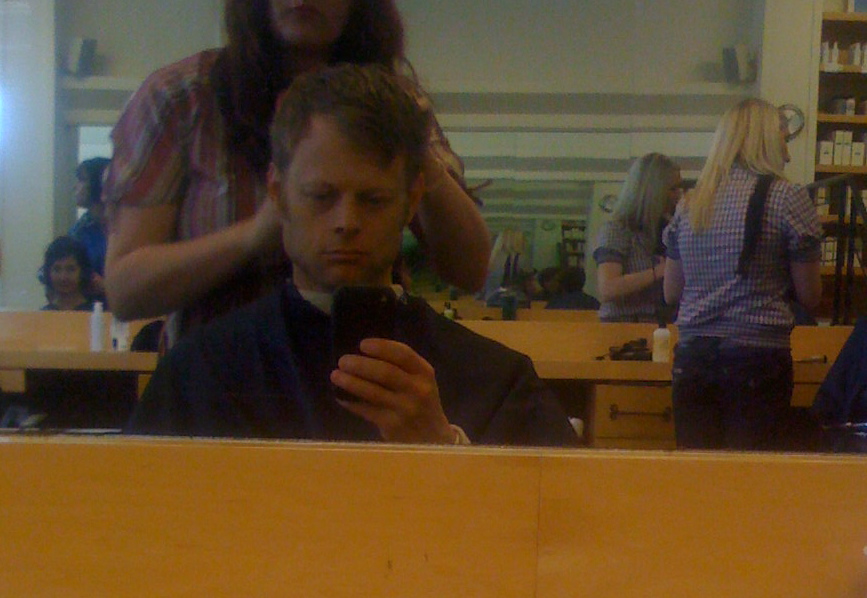
Here I am yesterday, reading a book on the new Kindle for iPhone app while, you know, being worked on. (My editor Tom and I must have been among the first to download the new app that day.) Later I got home, picked up my actual Kindle, the one I reviewed last month, and kept reading from the page I got to during the haircut (the two devices had automatically synced).

Now, this sort of think should make you think. It is the latest installment in what I called “the new nomadism” in The Economist last year. New behaviors and social contexts are arising out of, not so much new gadgets, but new expectations about connectivity. Big, very big, sociological change is afoot, I believe. And, of course, as an aspiring author I have much to contemplate on the topic of books in particular…

Bookmark and Share

Those who don’t get Twitter

I wrote about Evan Williams and his innovations, including the then-young Twitter, way back in 2007. And it’s my job to be up to date. But I must say that I just don’t … get it this time. Not the technology part, but the sociology. Why?

My editor feels the same way, and we feel guilty about it. So it came as a great relief to see that Jon Stewart is on our side.

Bookmark and Share

Primates on Facebook

I got 500 friends on Facebook

I got 500 friends on Facebook

A lot of bloggers are picking up my piece in today’s issue of The Economist on the possible bio-sociological conclusions to be drawn from Facebook data. A few examples are here, here, here, here and here.

The point of the piece: to add a tiny bit to the research debates about human group size.

Just a few words on the backstory of this article: I got the idea in December while chatting to Sheryl Sandberg, the COO (“chief operating officer”) of Facebook. We were just shooting the breeze when I thought of the Dunbar Number, one of my favorite talking points, and a conceit that I’ve used before. Robin Dunbar, an anthropologist, hypothesized that primates form groups to the extent that their brains can compute the many relationships among group members. I think what I like about it is the originality of extrapolating from the ratio of neocortex size to group size among other primates to Homo Sapiens.

Anyway, we all went off over the holidays, and when we came back from the break, Larry Yu at Facebook put me in touch with Cameron Marlow. He had got some complicated PhD title that amounted to, in his words, “computational sociology” and is now the “in-house sociologist” at Facebook. (Since Mr Crotchety and I think alike–great minds?–he serendipitously emailed me an article about the rise of computational social scientists that same week. If you don’t know Mr Crotchety, you haven’t been reading The Hannibal Blog enough.)

What I wanted from Facebook was numbers that might advance the debate on human group size. It was really difficult. Marlow and his team came back with one set of charts that I could not decipher without help. “Simpler“, I said, which will not surprise regular readers. Eventually, they produced a chart that I thought was simple enough.

Here it is: economist-median-network-size (Incomprehensibly, WordPress does not allow me to embed an PDF chart into my blog, so please click through.)

I like it. It shows three diverging lines: the blue for the number of people we track passively (by clicking on their profiles or status updates, say); the green for the number of people to whom we respond (by commenting on a status update, say) but who don’t respond back; and the red for the number of people with whom we communicate two-way (by chatting, emailing, exchanging wall posts, etc).

The conclusion: the more active or intimate the network, the smaller and more stable, no matter how many “friends” you have on Facebook. I wrote my piece around that chart.

To my surprise, my editor then took an extreme interest in gender differences. So I went back to Facebook and had Marlow produce another chart, this one: active-relationship-size-by-gender

It was still simple, but broke out the same information by gender. Yes, just as you thought, women are more social than men.

To my surprise, the editor didn’t go with any of the charts. What can you do? So I went back to Facebook to get actual numbers. (It was like getting blood out of a stone at this point.) And so we ended up putting those numbers in the text.

Long story short, the piece has no chart but it still gets the point across: No matter what technology you use, we still seem to interact with the same small number of people as ever before. Hence the rubric (subtitle):

Even online, the neocortex is the limit

Anyway, if you’re interested look at the charts and see if that gives you more ideas.
Bookmark and Share

Great thought: Continuous partial attention

The Hannibal Blog only pretended to close off the thread on great thinkers by anointing a winner (Patanjali). This is a blog about a forthcoming book (mine), but also about ideas, so I will keep highlighting the best thinkers I come across.

Today: Linda Stone, formerly a researcher at Apple and Microsoft, and now simply a thinker and a liver of life.

Her idea is called continuous partial attention. It has been the bane of our existence in the rich world for the past two decades, and it is not multitasking. The good news is that the age of continuous partial attention is almost over. I will explain below, but if you have time, watch Linda:

Let me flesh that out a bit with the notes from my interview with her in 2006. (I ended up quoting her, but only tangentially, in this concluding chapter of my Special Report on new media in The Economist.)

  • From about 1945 to 65, we lived in an era when we “we suppressed our creativity” in order to pay full attention to whatever we were doing. The cultural icon was I Love Lucy: she “talked on the phone with her whole body and did nothing else! Everything in that era was focused on company or family. You were committed. You stayed put.”
  • From 65 to 85, “we questioned authority and asked for creativity.” This era became “all about me and my personal expression.” We wanted freedom. Divorce went up, commitment down. We paid attention only if we saw a payback. And so we began multitasking. Our motivation was to become more productive so that we might have more opportunities in life.
  • From 85 to 2005 we became “narcissistic and lonely and reached out for connection“. Technology increasingly allowed us to be “always on” the network, via email, cellphones, WiFi etc. Our motivation shifted from creating opportunities to scanning for opportunity. So we began to pay continuous partial attention. Instead of Lucy, we had Seinfeld, talking on the phone while doing other things, such as making out with his girlfriend. He was not multitasking; he was paying partial attention in case something better came along.

This is the important but subtle key to understanding Linda’s idea. Continuous partial attention (think SMSing while you’re in a meeting) does not come from a desire to be more productive and efficient but from

desiring to be a live node on the network and fearing that you’re missing out on something.

Now the good news

Starting about now, says Linda, we are entering a new era. That’s because we are “overwhelmed” by technology, and

longing for protection and meaningful connections, quality over quantity.

So we consciously forgo some opportunities to savor others, such as dinner with friends. We reassert our power over technology and the network by making our gadgets filter our world to keep out the noise. As Linda says,

The real aphrodisiac in this next era is attention…. What we’re moving into is an era where we value ownership of our time” [and] “discover the joy of focusing”

Bookmark and Share