My mentors

Aristotle_tutoring_alexander_by_j_l_g_ferris_1895

Mentor was the wise old man whom Odysseus left behind to look after his son Telemachus while Odysseus went off to fight the Trojan War. Odysseus, of course, would be gone for twenty years in total, so Mentor played an important role in pointing Telemachus in the right direction.

Carl Jung later believed that Mentor was one of the archetypes in our collective unconscious, a character that appears in our dreams and in any good story. Think Obi-Wan Kenobi for Luke Skywalker.

Socrates mentored Plato; Plato mentored (well, at least taught) Aristotle; Aristotle mentored Alexander the Great (pictured above).

So I’ve been thinking about Mentors as I feel myself into the characters in my book. What roles does a Mentor have to play? What makes a bad mentor? And, of course, who were my mentors?

Good and bad mentors

Contrary to the Hollywood image, I don’t think that a good mentor necessarily needs to spend a lot of time with a young person. Instead, he or she is just somebody who shows up at crucial moments, takes a genuine and benevolent interest, and gives a fillip or advice where it is needed.

I am reminded of how David Williams, the first Westerner to study Yoga with Pattabhi Jois (in the 1970s!), once explained to me (as we were practicing yoga in David’s garage in Maui, with his Bernese Mountain Dogs running around us) the concept of guru. Gu means darkness in Sanskrit, Ru means light. So a guru is someone who “lights your candle” but then lets you go, indeed sends you off. An older person who passes himself off as a guru but tries to keep control over you, who lingers, is a fake guru.

My three mentors

Speaking only in the context of my writing career, I had three mentors, I believe.

Clive Crook

Clive Crook

1) Clive Crook

I first met Clive when I was twenty-two or so. I was out of work and confused about life and flew to London on a whim to “interview” with The Economist and the FT, even though I don’t recall having set up any actual appointments. I had the flu, and it was raining. I was down and out. Somehow I got into “the Tower”, as we call our 50s-style building in St. James’s Street, and into Clive’s office. He was perhaps economics editor at the time. He sat in a tiny office with stacks of books all around him that I thought would come crashing down on him any minute. To my shock, he didn’t call security but … talked to me.

Nothing immediate came of that, but many years later I was in some god-awful investment bank and fed up. I wanted out, and into journalism. I wrote Clive a letter. To my renewed shock, he remembered me and was now deputy editor. He invited me to sushi. Again, nothing came of it, but he said something might open up. He advised me to get out of that stupid bank and go to a small sweatshop magazine that was known to take young journalists with no experience. I did. Five months later, he took me out to sushi again. Then I joined The Economist. He saw something in me, and that’s why I have my job today.

Marc Levinson

Marc Levinson

2) Marc Levinson

As I said earlier, the job of a guru is not to stick around forever but to let go at the right moment. Once I arrived at The Economist–rather clueless, I should say–Clive stepped back and another editor, Marc Levinson, stepped up as a new mentor. He was very New York in a very British place. He had recently taken over the job of editing the finance section in the magazine, and was controversial. Some people said he was “dumbing the paper down” (he would have said that he was making it comprehensible and unintimidating.) And he was, by the occasionally evasive standards of British toffs, brash.

He certainly put me through the wringer. On Wednesdays, which are our deadline days (London time), I was occasionally close to tears as he made me re-write the piece I had just filed. He minced no words. “This anecdote is flat, take it out!” “You’re not ready to write this piece yet; go out and find something out!”

Over time, three things occurred to me. 1) He was tough in my face but supported me like a rock behind my back. This is the inversion of normal. People like that are a certain kind of nobility. Over time, I saw actual tenderness in his toughness. 2) While he often re-wrote my copy, he also often forced me to re-write my own. Again and again. He could have saved himself time by just doing it himself. He didn’t want to. He wanted me to learn. 3) I got… better!

Marc left The Economist and went home to New York, where he is the author of a fantastic book called The Box. And thus we parted ways. But if Clive discovered my potential, Marc made me fulfill it.

Orville Schell

Orville Schell

3) Orville Schell

Years later again, I arrived in California from Asia. One of the Sinologists I had always heard about in China was Orville Schell, who was now dean of the Journalism School at UC Berkeley. I sent him an email to see whether he might like to meet some time, and, to my surprise, immediately got a message back in which Orville invited me to lunch at the Faculty Club.

Some time after that, he invited me to … teach! This was amusing to me, because I considered (and will always consider) myself a learner. But hey. If Orville Schell asks me to teach a class, who am I to say No? I said Yes.

For two years, I was a teaching fellow at his school. Just as Clive and Marc had no reason to take an interest in me but did, Orville inexplicably included me in all sorts of events. Interesting people were always coming through, and Orville liked to take them to Chez Panisse for dinner. Very often, he invited me to come along. (My greatest regret is that the night that he took David Halberstam to Chez Panisse and was looking for me to invite me along, I was somehow not to be found. Halberstam died in a car crash the next day.)

As a good mentor, Orville also knew just when to step in forcefully with advice and when to bow out. Three years ago, before I had the idea for the book that I am now writing, I was approached with an unusual offer/opportunity. A literary agent who had researched me and liked my writing asked me to write a book about an extremely large and interesting organization (one that you all use every day). The money was good and to spice it up he had already arranged for exclusive and intimate access to the key individual, whose co-operation might make the book great. I was taken aback but very tempted. But something bothered me. I didn’t know what.

I went into Orville’s office and he immediately made time for me (!). He listened to the situation. Where I was unsure and hesitant, he was forceful and sure. “Don’t,” he said. “If you want to write a book about BLANK, then write it, but don’t take this deal. It will compromise you forever.” And if I didn’t want to write this particular book, well, why was I even contemplating it?

I knew that he was right on the spot. But Orville then grabbed me and led me into the courtyard, where Michael Pollan, author of the Omnivore’s Dilemma and other bestsellers, was mingling. Orville explained the situation, asked Michael to give his opinion, then walked away so that he would not influence the conversation. Michael said exactly the same thing.

And so, I learned a great deal about character, ethics, books, writing and life in one day.

Here is to Clive, Marc and Orville, to Mentor and to Aristotle. May every Telemachus find one at the right time!

Bookmark and Share

Lee Kuan Yew on Darwin and breeding

Lee Kuan Yew

Lee Kuan Yew

Just one quick follow-up to the last post on Darwin: I was reminded of a controversy from my days in Asia, involving Lee Kuan Yew, the “founding father” of Singapore. (Most Asian controversies seem to involve Lee Kuan Yew, if you look closely enough.)

He had once opined on the truly bizarre situation that humans have created today. Biologically and historically, the “fittest” (most adapted) members of a population are the ones whose genes (alleles) are most represented in future generations. Lee Kuan Yew, perhaps contemplating his own daughter, who was then a neuroscientist as intellectually impressive as she was single, observed that

our brightest women [are] not marrying and [will] not be represented in the next generation. The implications [are] grave.

Some of the fittest among us, in short, are voluntarily opting out of evolution. A biologically suicidal strategy, and thus worthy of study.

Bookmark and Share

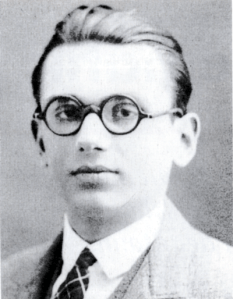
Great, if not greatest, thinker: Gödel

Gödel

Loyal readers of The Hannibal Blog are by now familiar with the wit of one Mr Crotchety who has already made cameos as a poet of Haikus, Senryus and Limericks. As soon as I began my series of posts in search of the world’s greatest thinker ever, Mr Crotchety began lobbying fiercely for Kurt Gödel as a candidate. Since we are now in the sub-series of posts on “honorable mentions”, I have invited Mr Crotchety himself to make the case for Gödel. Here it is, in Mr Crotchety’s words:

I am adding some additional criteria to the Great Thinker debate:

  • Do his/her great thoughts presently frame the basis of all other thoughts?
  • Do his/her great thoughts have anything to do with the meaning of life?
  • Did he/she go bonkers?

One of Gödel’s great thoughts is The Incompleteness Theorem. With respect to The Hannibal Blog‘s foremost criterion, the conclusion is simple (though not simply derived)… the First Incompleteness Theorem says that something can be true and unprovable. This is a very important conclusion for all of mathematics (hence, a great thought).

There is a conflict with the finite and infinite. No wonder Gödel went bonkers.* People who believe in the Bible and the Koran and the like must love this idea. Mathematicians must love this idea, too. Philosophers stay in business. Everyone is happy! Not only is it a great thought, but it inspires others to think great thoughts…

I’m tempted to go the route of some mystics and say that Gödel’s incompleteness theorem, like quantum mechanics**, is a paradox and really difficult to understand. Therefore it must have greater applicability (i.e., with respect to the meaning of life). I’m not prepared to go that direction, but it is good for the debate…

Notes and comment:

*Mr Crotchety refers to Gödel going “bonkers”. Apparently, he had an “obsessive fear of being poisoned” and “wouldn’t eat unless his wife, Adele, tasted his food for him.” In her absence, he refused to eat, “eventually starving himself to death.”

**Mr Crotchety likens the incompleteness theorem to quantum mechanics. Instinctively, this feels right. I am thinking of Werner Heisenberg and his famous Uncertainty Principle. It says that, in the context of observing sub-atomic particles such as electrons, it is impossible to observe with certainty both the position and the momentum of a particle. One suspects that what is true of the world at that little scale is also true of the world on our scale. So if Gödel reminds us that much of our “knowledge” will always remain “incomplete”, Heisenberg reminds us that much of our world is fundamentally “uncertain”. Simple and non-obvious: Great thoughts by great thinkers!

Bookmark and Share

The greatest thinker of all time

Man, right elbow on left knee is so uncomfortable. Rodin, you done yet?

Man, right elbow on left knee is so uncomfortable. Rodin, you done yet?

The Hannibal Blog is starting a short series of posts to figure out who the greatest thinker of all time was/is.

This is very tangentially related to my book, because some of the people I will feature–either to dismiss or to anoint them–may have lived lives or produced ideas that come up in my book (although I promise that the book is a very light read!).

But the main point is just to have some fun, and to clarify my own thoughts. It gives us a chance, for instance, to boil various thinkers and their ideas down to a digestible morsel, almost in the vein of the great Shit happens series that explains the world religions.

And, of course, The Hannibal Blog wants to hear from you. Feel free to propose/reject candidates for greatest thinker of all time starting now.

That said, I have already decided whom I will propose as the greatest thinker of all time. Stay tuned. It will surprise you.

Bookmark and Share

The conductor guru

I attended Google’s Zeitgeist conference again last fall, which is my second favorite conference after TED. And there was one session that blew me, and all of us in the audience, away as no other did.

Al Gore later said on stage: “I learned more about leadership in that half hour than in my entire career”.

Michael Pollan and I were raving about it, and I pointed out that the speaker did not even mention the word leadership the entire time. “It would have ruined it,” said Michael.

Who was that speaker? An Israeli conductor named Itay Talgam.

Notice that he encountered some audiovisual difficulties early on in the presentation. It did not matter. He never told us, he just showed us. Watch:


Bookmark and Share

Intelligence: Good servant, bad master

Intelligent? Me?

My favorite quote from B.K.S. Iyengar. (For the Yogis among you, I practice Pattabhi Jois‘ style, but that’s neither here nor there.)

Intellectuals tend to be arrogant. Intelligence, like money, is a good servant but a bad master. When practicing pranayama, the yogi [makes] himself humble and without pride in his intellectual attainments.”

Page 85 in this book.

Wu wei: doing by non-doing

Lao Tzu

One of the subtlest notions in my book is the Taoist idea of wu wei, or non-doing. It doesn’t come up often, but in one or two chapters, for two of the main characters and several of the minor ones, it is crucial. What is it?

The idea ultimately comes to us from Laozi, pictured riding away on his water buffalo above. (I’m using the modern Pinyin. You may know him as Lao Tse or Lao Tzu). He was the subtlest of all the philosophers of the Axial Age. He talked the least and said the most. That’s because the Tao is not understood by words.

Fine, but words are what a blogger has. So what is wu wei?

It is not: staying in bed and doing nothing.

It is (my definition): exerting the minimal effort in any situation in order:

  • not to interfere with the natural flow of things but instead
  • to go with the flow, as though “letting” things happen and harmonizing yourself with them.

There’s no need to get too philosophical about this. In my experience, sailors grasp the concept intuitively. How utterly foolish would you look trying to act against the wind! Instead, you tack through it in order to let it blow (suck, technically) you to where you want to go. You don’t interfere, you harmonize.

The same principle applies in all sorts of situations, small and large. Just think about your own life.

Thus wu wei becomes a vital ingredient for winning and success, its violation for failure and disaster. And so you have the relevance for my book thesis.


Milton Friedman on success

What is success?

According to Occam’s Razor, the simplest answers are the best, and Milton Friedman, the great economist, has this one:


In effect, he was describing people who achieve flow.


Success, the good life and “flow”

Aristotle, an early positive psychologist

Aristotle, an early positive psychologist

I consider myself–on the whole, give or take–lucky. That’s because I’ve been able to arrange my life in such a way that I spend a fairly large share of it doing something that both suits and pleases me: writing. When I write–whether for The Economist or my book, or even on this little blog–I tend to forget myself and become absorbed in the activity. This is a state that psychologists and new-agey types call flow.

Flow is really important, because it is the basic ingredient of “the good life,” as opposed to the “pleasant life” or the “meaningful life”.

I’m getting those terms from Martin Seligman, one of the founders of Positive Psychology. Watch this fascinating talk by him at the TED conference in 2004.

The premise of Positive Psychology is that traditional psychology has been one-sided by studying only miserable people and freaks and trying to devise ways of ameliorating their misery. Traditional psychologists did not study happy people and geniuses, and did not try to figure out what made these people so. Positive psychology does precisely that. It

  • studies strengths as well as weaknesses
  • tries to build strengths rather than ameliorate damage
  • tries to figure out what makes lives fulfilling

And so we get to the three kinds of “happy” lives: Pleasant, Good and Meaningful.

The pleasant life is about maximizing pleasures. Savoring good food and sex, enjoying sunsets, and so forth. This is great, but there are two problems. 1) The ability to enjoy pleasure is, perhaps surprisingly, hereditary. You’re born with a natural limit on your savoring. 2) Pleasure habituates. The first scoop of gelato tastes divine, the second good, the third fine, the fourth so-so, the fifth is mildly off-putting, the sixth leaves you sick of it forever.

The good life is the one Aristotle talked about a lot. It comes from achieving flow. Parenting, writing, gardening–whatever you’re doing, if you merge with an activity that you are good at, and you do that on a regular basis, then you lead a good life. If you are good with people and happen to be bagging groceries in a supermarket for a living, you can turn the bagging into a social occasion and achieve flow.

The meaningful life is when you use your strengths not just for flow but for something larger than you. Serving others, basically.

The “full life” is defined as having all three. In the context of my book, it might also be called: Success.