A lot about fathers

So I’m staring at the two books that have just dropped from the pile (a tall one) onto the floor, and they are titled: Faith of My Fathers (left) and Dreams from My Father (right).

“This boy is really doing his civic homework during an important election,” you may be saying. Actually, no. I’m doing research for (no surprises) my book.

You see, these two–Obama and McCain–made me think of my main characters, Hannibal and Scipio. No, it’s not because Obama is half African (I’ve explained here why I don’t think that Hannibal was “African” in that sense). No, it’s not because McCain has “something Roman about him”, as a friend of mine said, referring to McCain’s martial honor code. And it’s only a little bit because both pairs were formidable rivals and opponents.

It’s because Hannibal and Scipio, if they had written books, might well have given them the exact same titles.

Hannibal lived his life as he did, one could argue, because he inherited a “dream from his father,” Hamilcar. Hamilcar had fought the Romans in the First Punic War, and felt humiliated when Rome won, and wanted revenge. He even made Hannibal, when the boy was nine, swear an oath to keep the “faith of his father”. (100falcons has a nice write-up of it here.)

Scipio could have said the same. He had the same name as his father, Publius Cornelius Scipio, and fought in his father’s army against Hannibal, when Hannibal seemed invincible. His father and uncle later died in battle against Hannibal’s brothers, Hasdrubal and Mago. Scipio, too, was keeping the “faith of his fathers” when he rose at a precocious age to become Rome’s leader and last hope.

So, fathers clearly matter. Or perhaps only for sons? For Amy Tan, it seems to have been her mother who was the important early influencer.

Lots to ponder. Lots to ponder. The role of background in life choices, goal-setting, Success, failure….


Bookmark and Share

The suffering of Frida Kahlo

Frida Kahlo and Diego Rivera. Photograph by Carl Van Vechten at Wikimedia Commons

Kahlo and Rivera. Photo by Carl Van Vechten, via Wikimedia Commons

I popped into the Frida Kahlo exhibition currently at the San Francisco MOMA. Mainly, to see her piercing paintings–and boy, do they pierce–but also, at least in part, as research for my book.

A friend of ours, Erika Lessey Chen, had suggested Kahlo to me a year ago as a possible life-story to look into. I had told Erika that I’m interested in people whose success (triumph) somehow turned into failure (disaster), or whose failure somehow turned into success, à la Kipling’s impostors.

Does Kahlo fit my story-line? Mostly, I’m looking at characters such as Hannibal’s enemy and nemesis Scipio to illustrate how disaster at the right moment in a life can liberate a person–set free his or her imagination and creativity, and thus initiate a much bigger triumph in the future. People such as J.K. Rowling and Steve Jobs.

But disaster can have other effects, of course. There is the strength that comes from overcoming it. I’ve mentioned Joe Biden and Demosthenes in that context. Among the main characters in my book, the person who would personify that is Fabius, the old Roman senator who was the only one not to despair after Hannibal’s crushing victories.

And Kahlo? As I walked through the exhibition and looked at her absolutely harrowing self-portraits, I realized that she had done something else again with her own disasters: She had made the disasters themselves the success.

Here she was on a hospital bed in Detroit, her body writhing and bleeding, with a uterus and a fetus torn out of her. She painted it after yet another miscarriage. The people in the exhibition became very quiet in front of that one.

There she was bound in a steel corset with a broken spinal column, her entire body pierced with nails. In this painting, she is all pain and frustrated sexual desire.

Over there she is sitting in a double-self-portrait, after her marriage to Diego Rivera had failed. She is holding hands with herself, and simultaneously tries and fails to stop the bleeding of her heart. (All these paintings seem to be copyrighted, so I don’t want to show them here.)

What were her disasters? The first was polio, which she caught at age six, and which left her right leg atrophied. The second was a bus accident when she was eighteen. She broke her spine, her pelvis, and lots of other bones, and an iron handrail pierced her uterus, leaving her infertile. The third, arguably, was falling in love with Diego Rivera, whom she adored but who was never faithful to her.

In short: pain, infertility, loneliness. And to deal with it, she painted. And the painting made her into the most “successful” Mexican artist ever.


Bookmark and Share

Biden and Demosthenes: A tale of two stammerers

As I was watching Beau Biden (video below) and his father Joe at the Democratic Convention today, I was struck by a stunning parallel between Senator Biden’s remarkable life story and that of the ancient Greek orator Demosthenes.

Both were stammerers in their youth. Both were taunted for it with cutting nicknames–“dash” for Biden, since he left his words hanging with a dash; batalus for Demosthenes, which meant both asshole and stammerer.

But both defined themselves by overcoming this impediment, and thus turning their greatest weakness–speaking–into their greatest strength–oratory. Demosthenes went on to become the single greatest orator not only in Greece but in all of history. Statesmen from Cicero to Disraeli and Churchill looked to him for lessons in how to move a political audience with speech. Joe Biden, too, became an effective–and, if anything, a garrulous–senator and may now become vice president.

As always, it is how they overcame that is the story. Joe Biden’s story is all over the news this week. But you may not know Demosthenes’ story. Here is the brief version, as Plutarch tells it:

Once, after Demosthenes was once again laughed out of the forum of Athens for his slobbering, panting attempts at speech, he was walking in dejection around the port. An actor followed him and caught up. He asked Demosthenes to recite passages from Euripides and Sophocles. Demosthenes recited them. As soon as he stopped, the actor would deliver the same passage, but with full force and feeling, with gesture and emotion.

Demosthenes was so inspired that he built himself a sort of cave underground where he hid for months at a time, just practicing his speech. He shaved one half of his head, then the other, so that he would be too ashamed to come out. With laser-like focus, he stayed in that dungeon and worked on his tongue, his vocal cords, his gestures, his cadence, his logic.

Eventually he came out of his cave and set his hurdles higher. He recited speeches while running up hills. He went to the shore and orated against and over the breaking waves. When even that became easy, he put pebbles under his tongue and then enunciated over the roaring surf. Here he is, as the painter Jean Lecomte du Nouÿ imagined him:

In time, he became the greatest orator, and then the greatest statesman, of his country and time, Athens in the fourth century BCE. It would be Demosthenes who roused the Athenians against the menace of Philip of Macedon, the father of Alexander the Great.

Were the early failures, setbacks and shortcomings of Joe Biden and Demosthenes impostors, in Kipling‘s sense? Do they belong in my book, which is about how the two impostors, triumph and disaster, work? Stammering, for Biden or Demosthenes, was not a liberating event, as failure was for Steve Jobs, J.K. Rowling, or Hannibal’s nemesis, the great Scipio. Their stammer was more like a gauntlet that life threw before their soul. Success in life can be about picking such gauntlets up and then going deep, way deep, to find the strength.


Bookmark and Share

Hannibal’s life in eight minutes

Well-made YouTube video (meaning: hewing closely to Polybius and Livy) about Hannibal’s life, by Wolfshead:

Interesting moment of interpretation: why Hannibal, in this version, chose not to take Rome itself, which was the single biggest decision of his life. “We are not animals,” he says here.

(Also: did I detect stirrups on the cavalry? Maybe not. There weren’t any in those days.)


Bookmark and Share

Which Bhagavad Gita?

“With no desire for success, no anxiety about failure, indifferent to results, he burns up his actions in the fire of wisdom. Surrendering all thoughts of outcome, unperturbed, self-reliant, he does nothing at all, even when fully engaged in actions.

There is nothing that he expects, nothing that he fears. Serene, free from possessions, untainted, acting with the body alone, content with whatever happens, unattached to pleasure or pain, success or failure, he acts and is never bound by his action.” (BG, 4.19-26)

Boom. Could anybody say it better? Who do you think did say it? Rudyard Kipling, whose two impostors are the seed of my entire book?

Actually, it was Krishna, in conversation with Arjuna, on the eve of an 18-day battle that would kill about four million (!) and which only eleven men would survive. Here are Arjuna and Krishna, his charioteer, in between the opposing armies just before the battle, as Krishna reveals to Arjuna the two crucial secrets to our lives: how to know and do your duty, and how to live.

I’m talking, of course, about one of the greatest poems (books, texts) ever written, the Bhagavad Gita, or “song of God”. It is a relatively short song inserted into a huge (!) epic story, the Mahabharata, which is several times the length of the Bible, or of the Iliad and Odyssey combined.

I’ve been re-reading the Gita in several translations while researching one chapter in my book. Why? Because Hannibal faced the same dilemma that Arjuna faced, when he broke down sobbing before the great battle, a battle that he suddenly did not want to fight at all, but which, as Krishna made him realize, he could not not fight. So Arjuna faced the same conundrum that Hannibal and Scipio faced: how to get into the right frame of mind to live life.

Oh, wait a minute. Did I say that Hannibal was in the same situation as Arjuna? I meant, that we all are in the same situation as both Arjuna and Hannibal. That is the point of the Gita, and also (more humbly) of my book.

Now, for those of you who love the Gita, I thought I’d do a quick review of the three translations and commentaries I’ve recently re-read. That way, maybe, I can help you choose the one that’s right for you.

The Gita is a poem in the original Sanskrit, and the translation that best preserves the beautiful, easy, fluid feel of a poem is the Bhagavad Gita by Stephen Mitchell (Three Rivers Press). The opening quote above comes from his translation.

A slightly less beautiful but perhaps more helpful and accessible translation is The Bhagavad Gita: A Walkthrough for Westerners by Jack Hawley (New World Library). The title sounds as if it were a sort of “For Dummies” version, but it’s not. It’s intelligent, and editorializes a bit whenever the words in the poem mean something very different from the same words in our ordinary language.

Then, of course, there is the intimidating two-volume brick God Talks with Arjuna: The Bhagavad Gita by Paramahansa Yogananda (Self-Realization Fellowship). That is the kosher version among yogis, because it’s academically and intellectually thorough. I’ve tried several times to get through it and failed. If it’s beauty, ease and enjoyment you’re looking for, don’t pick this one. But….

do pick this one if you have even the slightest interest in a deeper understanding of the Gita. For example, the thing to get about the poem is that there are two battles going on: the external one involving four million warriors and elephants and chariots; and the internal one that we all wage every day. Paramahansa Yogananda is great at the genealogy of all the people in the war, so that you realize, for example, that Arjuna and his four brothers are the intelligent and higher parts of our mind, who are fighting 100 cousins, who are the powerful but lower parts of our mind, such as anger, desire, greed, and so forth.

Enjoy.


Bookmark and Share

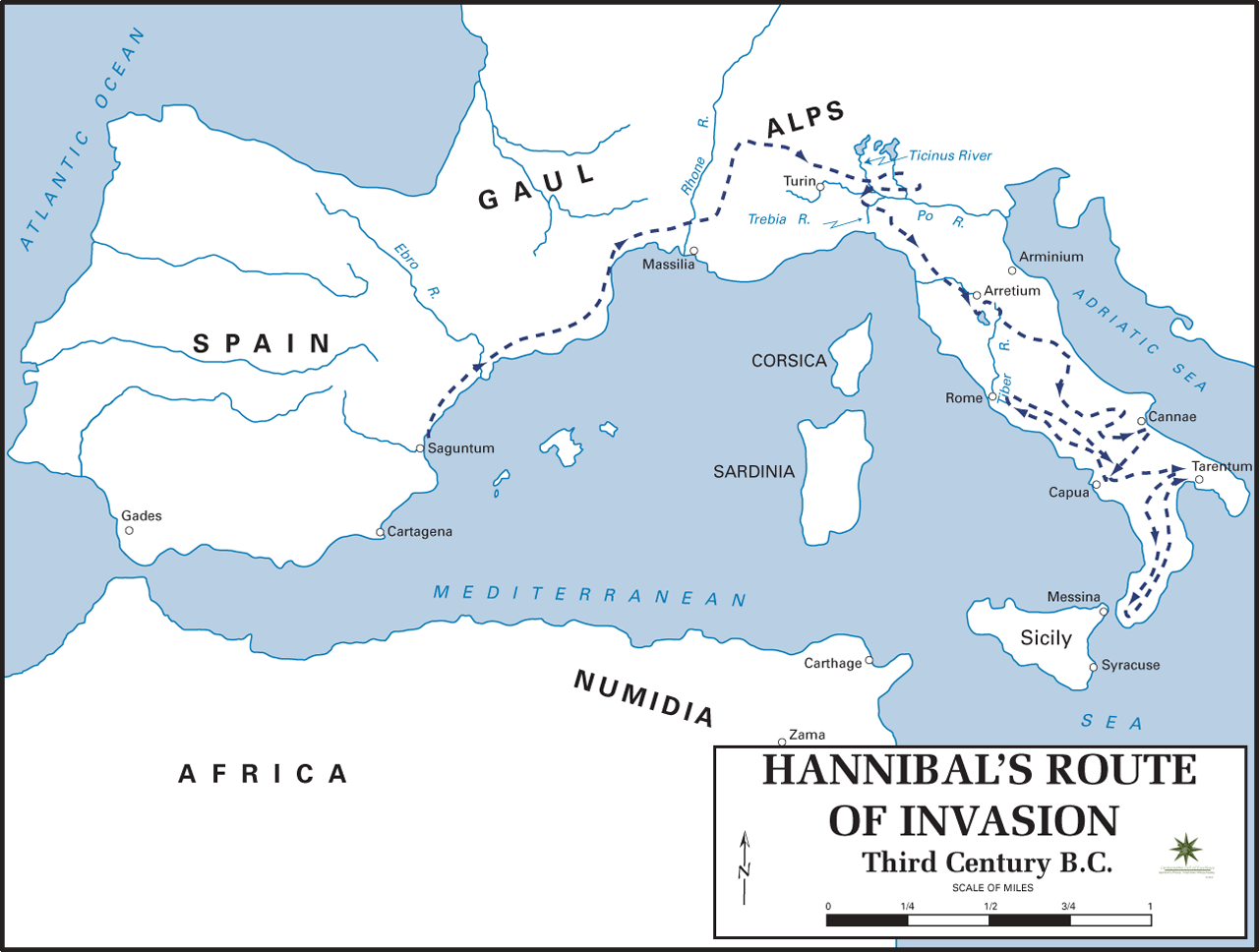
The map of Hannibal’s march and life

Join me for a moment in having fun with this map below.

It comes to us, via the Wikimedia Commons, from Frank Martini, a cartographer in the Department of History at the United States Military Academy.

There are two ways of looking at this map–one obvious and one surprising and cheeky–and I will avail myself of both. Bear with me. First the map, and the obvious:

What we see here, obviously, is the western Mediterranean at the time of the Second Punic War (the “Hannibalic War”). Notice Carthage at the tip of northern Africa (in today’s Tunisia); Cartagena or “Little Carthage” in Spain, which I mentioned in an earlier post; Gades, which is today’s Cadiz; Saguntum (Sagunto), which was ethnically Greek; Massilia (today’s Marseilles), also ethnically Greek; Turin (Torino) which was not yet party of “Italy” but part of Gaul; and Ariminum (Rimini), the Roman colony at the edge of their frontier with the Gauls.

Now look at Hannibal’s march itself. In 218 BCE he crossed the Pyrenees and into Gaul. The line casually crosses the Rhone, even though this involved one of the most colorful operations in history (of which more in a later post–think elephants on rafts), and then, equally casually, crosses the Alps (of which much, much more in later posts).

You then see where Hannibal won his famous victories, at the Ticinus (more of a skirmish), at the Trebia, at Lake Trasimene and at Cannae. And then you see the line of his path getting…. confusing!

Now the less obvious way of looking at this map: Squint! As you squint, look only at the line of the march. It is a fitting life trajectory for Hannibal himself. It rises early and steeply, peaks, then declines and loses itself completely in a confused and erratic hairball.

How would you draw the map if it were proportionate to time, rather than distance? The entire stretch from Cartagena to Cannae, his greatest victory, took a little over two years. All the twists and turns after Cannae (there were actually far too many to draw on a map) took…. fourteen years!

After those fourteen years, Hannibal lived another nineteen years until he committed suicide, but most of that took place on a different map, in the eastern Mediterranean.

And yet, if you read the existing histories, you would think that 90% of Hannibal’s life took place in those initial two years.

Those years are the impostor years. The next thirty-three are the story of how and why he realized that his triumphs had been impostors. And this, in my book, is where his life becomes universal and directly relevant for our own lives today.

Now, let’s have even more fun and turn the map around:

Now you have, more or less, the life trajectory of the Romans, in particular Fabius and Scipio, my two other main characters.

Kipling’s impostors, you see, visited with them in mirror image.

Why and how did all this happen over all those decades? In exactly the same way as it happens to most of us in our much smaller(-seeming) lives, it turns out. That’s why I’m writing a book about it.


Bookmark and Share

The Narcissism of John Edwards: Impostor Success or Failure?

In my first preview of one of Kipling’s two impostors, triumph, I casually nodded to hubris as the most obvious mechanism that turns success into disaster, then went on to give another example that I thought was a bit subtler.

And now John Edwards forces me to come back to hubris. In case, you’ve been behind the moon, we now know that he cheated on his wife. More interestingly, we have now heard why he thinks he cheated. The key phrase in his mea culpa to ABC’s John Woodruff, was this: Becoming a “national public figure”, he said:

fed a self-focus, an egotism, a narcissism that leads you to believe you can do whatever you want, you’re invincible and there will be no consequences.

We always knew, of course, that Edwards had a narcissist in him, at least since we watched him preening here:

Narcissus, at least in Ovid’s version of the myth, was the handsome youth who fell in love with his own reflection as he bent down to drink from a stream, and then wouldn’t touch the water lest he ruffle the beautiful image in it, and so died of thirst. So it goes, as Vonnegut would say. Impostor beauty, as we might paraphrase.

So narcissism is slightly different from hubris, although Edwards conflates the two. Hubris is the classical Greek notion that power and success make people arrogant, and that this arrogance then invites disaster. Think Ken Lay, Eliot Spitzer, et cetera. And now, John Edwards?

Maybe, maybe not. I’ll give you one contra and one pro. The contra is Steven Berglas, a specialist in “narcissistic disorders” at Harvard Medical School for many years, who writes here that Edwards is kidding himself, and that it was in fact Edward’s failure to become Vice President in 2004 that is to blame:

I feel that Edwards had a need to re-assert his power and his masculinity (via an affair) because of his history of believing that his entire self-worth derived from success. Had Edwards not “proved his potency,” I feel he would have suffered ego-annihilation when he failed.

The pro comes from research by Cameron Anderson at Berkeley’s Haas School and Adam Galinsky at Northwestern, who found that perceived power does make people excessively optimistic and blind to risk. In one of their experiments, they discovered that those participants who were more powerful were less likely to use condoms. Who says academics never have fun?


Bookmark and Share

Two great Russians

Aleksandr Solzhenitsyn has died, and his happens to be one of the lives I’ve been researching for one chapter of my book. (Lots of reversals between disaster and triumph, obviously, including some non-obvious and subtle ones.)

This won’t make sense out of context, but I’m pairing him not only with Hannibal but also with another great Russian, Mikhail Gorbachev, although I’m just starting my research about him.

Can anybody recommend any great biographies of Gorbachev, especially ones that include his years since power–ie, his time in relative obscurity?

In the comments or by email, please. (The form underneath this page sends me an email.)


Bookmark and Share

It’s a stretch to write a book…

… especially when your children are on your back, and a full-time job, and …..

How does Tom Standage make it look so easy?


Bookmark and Share

Impostor Success, Part I: The Nobel Prize and pontificating windbags

After that digression (not the last, rest assured) about books in general, back to the book. I still haven’t introduced my main characters–Hannibal, Fabius and Scipio–but instead I’ve given two examples, Steve Jobs and J.K. Rowling, of failure being an impostor. Let me now give you an example of Kipling’s other impostor, triumph–because the book is emphatically about both impostors, just as a book about night must also be about day.

The immediate and obvious category that jumps to mind is hubris, the theme that so fascinated the ancient Greeks. Hubris is that arrogance which brings down the successful and powerful, from Xerxes the Persian to Ken Lay of Enron or Eliot Spitzer or … take your pick. So, because it’s so obvious, let’s not take an example of hubris. Instead, let’s take a more subtle example: The Nobel Prize.

Paul Samuelson is an economist who won that prize, in 1970, and who, thirty-one years later, reflected on the institution. Alfred Nobel, a Swedish chemist and inventor, had established the prize in 1895 to recognize the best work done in a given field and thereby to “subsidize and support the young winner’s research efforts for the rest of his life.” By rewarding success, in other words, the prize was meant to create even more success.

Instead, says Samuelson (emphasis is mine):

the reverse of Nobel’s wish is what actually happens. After winners receive the award and adulation, they wither away into vainglorious sterility. More than that, they become pontificating windbags, preaching to the world on ethics and futorology, politics and philosophy. At circular tables, where they sit they believe to be the head of the table…

Breaking it down another level of nuance, Samuelson goes on:

An acquaintance of mine in biology regarded his Nobel year as the worst one in his life. Being a research wet-lab worker, he hated the press interviews and hoopla. Others I’ve known have gloried in it: so to speak they sported their bauble on the January subway. One wife of a physical scientist attributed her divorce to the Nobel Prize. (Her spouse has not recorded his opinion.) …

Not to get too deep about this, but can we agree with Samuelson that the Nobel Prize is a) a personal triumph for its recipients and b) probably, if not certainly, an impostor? For today, I just leave you with this delightful phrase: pontificating windbags. Ever met any?


Bookmark and Share