I’m crushed: Only 3 out of 5

As you know by now, I’m a humor snob. So I’m gutted to discover, after taking the New Yorker‘s test for advanced readers, that I only scored three out of five. Being a Yoga snob as well, the last one threw me off. But even with that allowance, I’d only be four out of five. And so my Friday morning begins with a crisis.


Bookmark and Share

My bibliography

Before I start, a snapshot of the overall structure of my bibliography: It’s the same as the structure of the book. That is to say, there is one overarching story–that of Hannibal and Scipio–and then each chapter introduces other lives from other times that fit what was happening in Hannibal’s life in this chapter.

This means that I have in effect two bibliographies: One, a classic library on ancient history–specifically, the Punic Wars. The other, an eclectic and perhaps unfathomable collection of biographies, psychology and philosophy to illustrate certain themes.

Stay tuned.

The headbanger swim teacher

David White, my daughters swim teacher

David White, my daughter's swim teacher

You’ll need a healthy sense of irony and the surreal and quirky to enjoy this one. It’s a brief multimedia rumination on 1) fatherhood, 2) authorship and 3) the clash of the two.

Background information:

1) I took this past week off, ostensibly for vacation, but really to work on the book, because I feel so close to finishing it. Yeah, right.

2) I had agreed, for the entire week, to drop off and pick up my daughter from pre-school, while my wife stays with the baby, and then to drive my daughter to a sweltering suburban valley where a fantastic swim school is giving her a crash course. After all, I’m on vacation, right? And I can still blog and write my book, right?

Well, here is a “day in the life” of the aspiring young author:

  • Wake up by being kicked out of bed by daughter, who was not supposed to be in this particular bed to begin with, then discovering that she peed on the bed just out of spite.
  • Gulp down coffee while discovering that there is no muesli or other acceptable breakfast, because nobody in the family has had time to go shopping for weeks.
  • Kiss wife and baby goodbye while wrestling rebellious daughter into car and turning on, for first of many times on this day, the CD of Die Maus.
  • Drop off daughter, hurry back to “write book”, but only after clearing out email inbox of 634 new messages and RSS reader full of 131 new posts, checking 8 new voice mails…
  • Give up after 23 emails, without having written a sentence of the book, to pick up daughter and drive to swim school
  • Sit by eerily placid poolside in suburban California watching David White play with daughter in the pool, succeeding skillfully at getting her to dip her cheeks and nose in the water.
  • Discover that David White, gifted swim teacher and cool guy, is actually lead singer of heavy-metal band Heathen.
  • Drive back, listening to CD of Die Maus again, having memorized all two hours of it by now.
  • Arrive back to discover that dishes need to be done, and that the day is over
  • Repeat five times, until “vacation” is over…


Bookmark and Share

Uncle Lulu

That guy with the cigar on this West German stamp from 1987 is my great-uncle, Ludwig Erhard, or “Onkel Lulu” in our family.

Why is he on this blog?

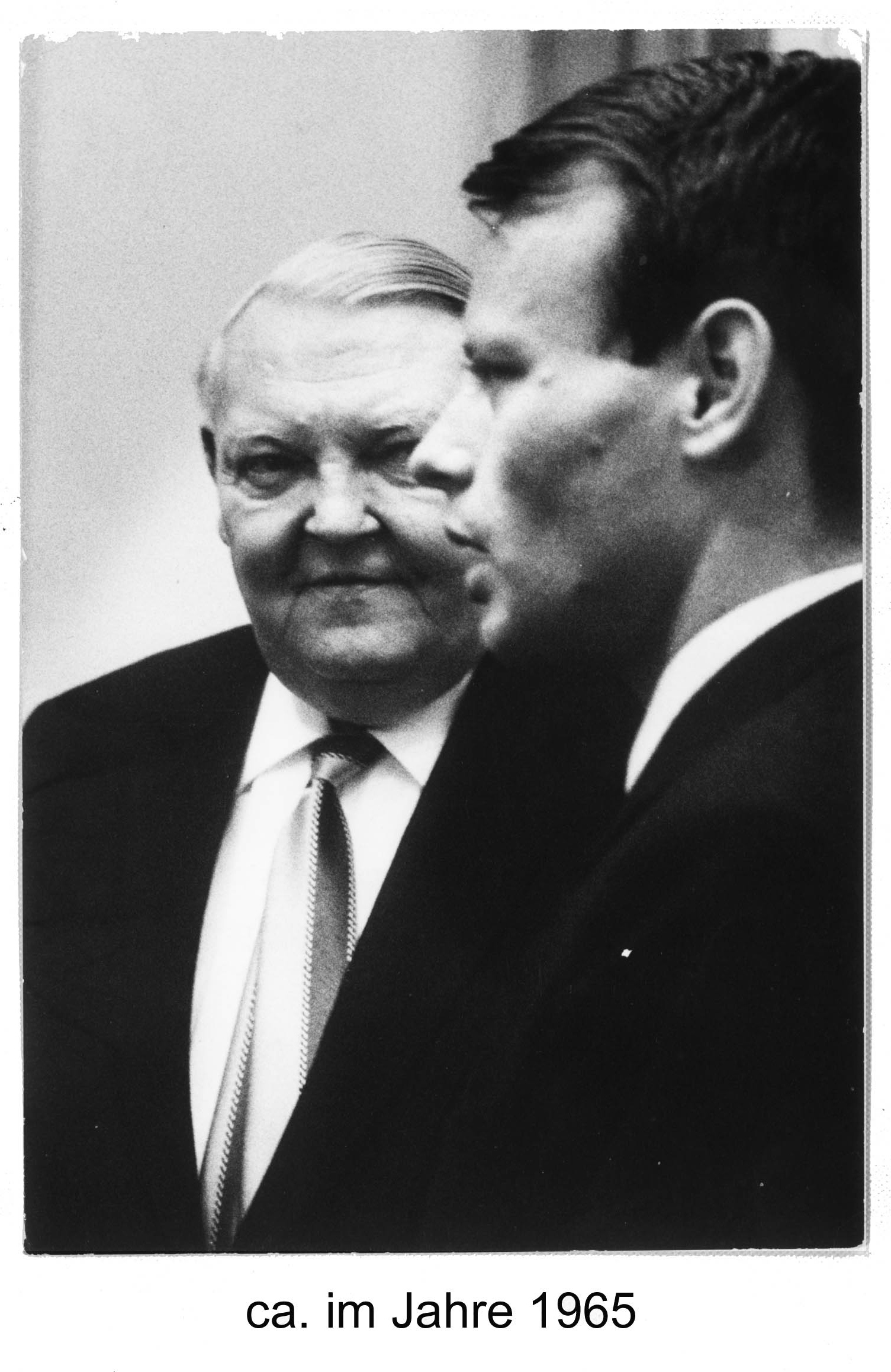
Newspaper cutting of my dad and his uncle

Newspaper cutting of my dad and his uncle

Because is life is one of those I trace in my book, to show that that what happened to Hannibal and Scipio happens to all of us, one way or another.

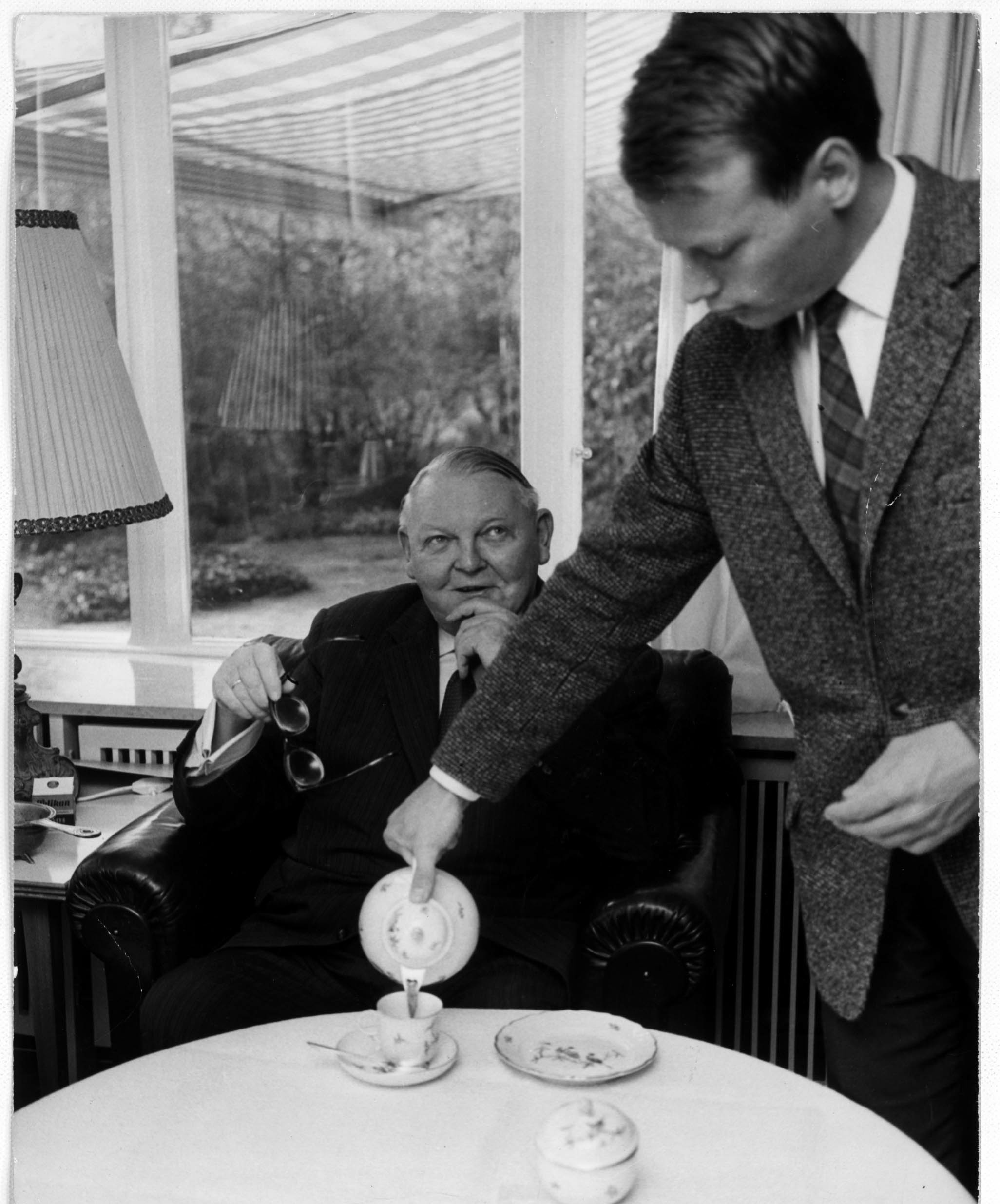
My dad pouring tea for his uncle, the chancellor, in the 60s

My dad pouring tea for his uncle, the chancellor, in the 60s

In Germany and continental Europe, Ludwig Erhard is a household name. In America, he is not, but should be. He is famous for being a founding father of post-war (West) Germany, its first economics minister, the father of its currency (the Deutsche Mark), and then its second chancellor (ie, prime minister). He is credited with causing the stunning economic growth of the 1950s, sometimes called (but not by him) an “economic miracle”. And he is probably the most steadfast proponent of freedom, tolerance and open and fair markets in German history.

Dad and Lulu again

As my father’s uncle and godfather, he practically raised my father after my grandfather died. I only met Lulu when I was very small (he died in 1977). He liked to hide Easter eggs for me in his steep hillside garden by the Tegernsee, an Alpine lake south of Munich. His influence lives on, in Germany, in our family, and now in my book.

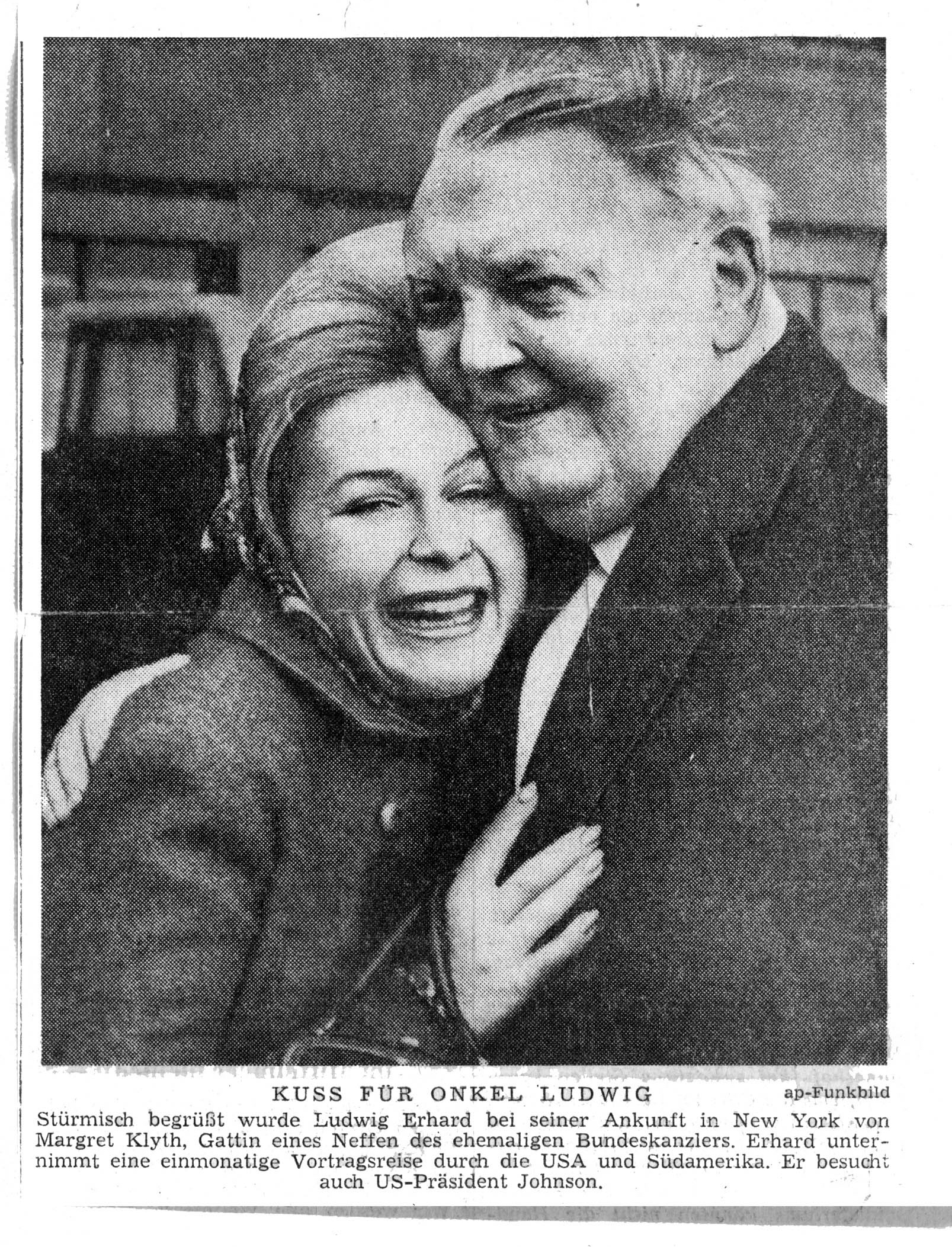
My mom with Lulu in New York, where I was born

My mom with Lulu in New York, where I was born

Why truth is in stories

“What is truer than truth?”, asks writer Isabel Allende at the very beginning of her TED talk, below. “Answer: The story.”

How similar to Amy Tan (still from the same interview that I quoted from in my last two posts):

I think that’s why I’m a storyteller. I take all these disparate events and I have to connect them. I have to make them seem inevitable and yet surprising and plausible. That’s what I think life is like, too. I have the luxury to do exactly what it is we all need time to do, and that is just think about the mystery of life.

And how similar to a less poetic author, Dan McAdams, a psychology professor at Northwestern who has

a life-story theory of identity, which argues that modern adults provide their lives with a sense of unity and purpose by constructing and refining self-defining life stories or “personal myths.”

It’s all about the story, in other words. Human beings remember and understand things only insofar as they learn them in a story.

The absence of such a story is what, in my opinion, limits so many non-fiction books. They have an idea or a thesis, but don’t wrap it into a story. So people read until they get the basic idea, then drop the book at page 50. After all, once you “got it”, why waste your time?

In my book, I’m trying to do the opposite. It is non-fiction, but true stories can be more suspenseful and surprising than fiction. And there is an idea, but it comes out through the story.

This is also my main rebuttal to my mom so far, who worries incessantly that I am giving away too much of my secret sauce in this blog, for some anonymous villain to steal it all. What, I keep thinking, would he (or she) steal? The idea without the story? Good luck. As Allende said, you need the story to get the truth. So, mom, for now I’ll keep blogging. Let me know what I’ve overlooked.
Bookmark and Share

A bit more on Amy Tan

Well, I’m still researching Amy Tan–and I’m still being deliberately coy about exactly which aspect of her life will make it into my book–and I keep coming across all these other interesting things she has said.

From the same interview as in the previous post, here she is talking about success and failure, making them sound rather impostor-like:

And here she is describing how she found her authentic voice:

At first I tried to write fiction by making up things that were completely alien to my life. I wrote about a girl whose parents were educated, were professors at MIT. There was no Joy Luck Club, it was the country club. I tried to copy somebody’s style that I thought was very clever. I thought I was clever enough to write as well as these people and I didn’t realize that there is something called originality and your own voice.

One day, after being told one of these stories didn’t work, I thought, “I’m just going to stop showing my work to people, and I’m just going to write a story. Make it fictional, but they’ll be Chinese-American.” What amazed me was: I wrote about a girl who plays chess and her mother is both her worst adversary and her best ally. I didn’t play chess, so I figured that counted for fiction, but I made her Chinese-American, which made me a little uncomfortable. By the end of this story I was practically crying. Because I realized that — although it was fiction and none of that had ever happened to me in that story — it was the closest thing of describing my life. Of the feelings that I had, of these things that my mother had taught me that were inexplicable or had no name. This invisible force that she taught me, this rebellion that I had. And then feeling that I had lost some power, lost her approval and then lost what had made me special. It was a magic turning point for me. I realized that was the reason for writing fiction. Through that, this subversion of myself, of creating something that never happened, I came closer to the truth. So, to me, fiction became a process of discovering what was true, for me. Only for me.

I went to a writer’s workshop. I met a wonderful writer there named Molly Giles. She looked at my work and said, “Where’s the voice? Where’s the story? There’s so many things that are happening that are not working, but there’s a possible beginning… So maybe you should think about this question, what is your voice?” That’s a question I still ask myself today as a writer.


Bookmark and Share

Our election, Napoleon, and that map again

Remember that famous and superb map of the impostor success that I wrote about the other day? Well, it depicted Napoleon’s invasion of Russia, and how it went from triumph to disaster, which is one of the twin themes I explore in my book. There is a famous picture of Napoleon’s retreat. And now The New Yorker has updated it just in time for the remaining presidential debates:

The New Yorker

The New Yorker


Bookmark and Share

Churchill on well-disguised impostors

My book is about Kipling‘s notion that success and failure, or triumph and disaster, can be impostors. That does not mean, of course, that all triumphs and all disasters are always impostors. But to say that wittily, we really need ole Winston.

Churchill, as it happens, lived a life that in many ways illustrates Kipling’s impostors, but that’s for another post. Here is today’s anecdote:

After the Brits voted him out of office in the 1945 election (as a Thank You for winning the war–talk about impostor!), his wife said to him that this defeat might be a “blessing in disguise.”

“At the moment,” Churchill replied, “it seems quite effectivley disguised.”


Bookmark and Share

Pyrrhic victories

Heard about my victory?

Heard about my victory?

You’ve heard of Pyrrhic Victories, which are defeats disguised as triumphs–in other words, Kipling-esque impostors of the sort that I will be describing in my book. But do you know why they are called that?

It’s thanks to Pyrrhus, who is well worth five minutes of your time.

Pyrrhus was the ancient world’s equivalent of a dumb jock whom all the girls loved, who bashed the equivalent of Budweiser cans on his forehead and beat up the enemy football team but never quite figured it all out.

Put differently, he was the King of Epirus in northern Greece, and wanted to be like Alexander the Great, who died a couple of generations before him. (Pyrrhus in turn died a generation before Hannibal was born.) He wanted to be a hero and to conquer. Basically, that’s all there was to it. And he was great at it–brave, courageous, strong. Plutarch says that once, when he was thought dead on the battlefield, he just got up and cleft an enemy soldier in two pieces with one blow of his sword.

One day, an opportunity came up: Tarentum, a Greek city in southern Italy that was fighting the Romans, invited Pyrrhus to come over and fight Rome on their behalf. Pyrrhus was thrilled. As he was preparing to leave for Italy with his army and his war elephants (sounds a lot like Hannibal, doesn’t it?), he had a conversation with the wise Cineas. This is one of my favorite exchanges in antiquity. Here is Plutarch’s version:

Cineas: If we beat the Romans, what should we do next?

Pyrrhus: Why, then we’ll be masters of all Italy.

Cineas: “And having subdued Italy, what shall we do next?”

Pyrrhus: “Sicily.”

Cineas: “But will the possession of Sicily put an end to the war?”

Pyrrhus: “We will use that as the forerunners of greater things” such as Libya and Carthage. Would anybody resist us after that?

Cineas: “None,” for then we can take Macedon and even all of Greece. “And when all these are in our power what shall we do then?”

Pyrrhus: “We will live at our ease, my dear friend, and drink all day, and divert ourselves with pleasant conversation.”

Cineas: “And what hinders us now, sir,” from doing exactly that?

At this Pyrrhus was nonplussed. But left for Italy anyway!

Next, he had his Pyrrhic victories. He beat the Romans, but each time he lost so many men and gained so little that once, when congratulated on yet another victory, he sighed: “Another such victory over the Romans and we are undone.”

Eventually, as he was wont, he got distracted. There was another opportunity for glory in Sicily, so he sailed around a bit there and bashed a few heads. You can see on that map what that trip (dare I say his life?) looked like.

Courtesy PIOM, via Wikimedia Commons

Courtesy PIOM, via Wikimedia Commons

In any event, Sicily also failed to make him happy, so eventually he made his way back to Greece.

Once home, he kept fighting wars here and there. I mean, it’s a hard habit to kick! His end came as it had to come (irony alert): He was in the middle of some vicious street fighting in a Greek city, when an old woman on a rooftop dropped a tile, which landed on his heroic pate and knocked him dead. So it goes, as Vonnegut would say.

Have you ever been a Pyrrhus in your life? Do you know any Pyrrhuses?
Bookmark and Share