The fun theory of life

As a dad, I have learned that the only (or at least best) way to get my children to do anything at all–to brush their teeth, eat their greens, jump into bed–is to turn the loathsome activity in question into … fun.

Perhaps the greens must become attacking naughties with shrill voices that want to fly into the mouth but keep missing and splattering. Suddenly, the little mouths are wide open, practically lunging for those mischievous little greens.

And as a former and frequently relapsing kid myself, I have learned that the only (or at least the best) way to get myself into a creative and productive mode is also to turn the loathsome activity in question (setting up interviews, doing research….) into … fun.

So I am delighted to see, and fully endorse, this research project that tries to elevate fun to a design principle. It appears to be a Volkswagen-funded undertaking in Sweden

dedicated to the idea that something as simple as happiness is the absolute easiest way to get people to change.

Video 1: How to get people to use the stairs

Video 2: How to get people to throw their trash into the bin

Thought experiment: Extensions

So now I am thinking: What else could be made fun with proper, more humane design?

  • doing taxes?
  • doing jury duty?
  • going to the doctor?
  • being at the airport?
  • Recycling?
  • Conserving (water, energy …)?

I refuse to exclude anything. It’s all a matter of how much one is willing to imagine. My kids are teaching me to raise the bar.

Bookmark and Share

Clinton, Newsom and their fathers

Newsom-lede

On Monday I found myself standing on a chair, peering over the baying pack of television crews to see Bill Clinton endorse Gavin Newsom for governor of California. For some odd reason (the PR handlers explained it to me, but it was too stupid to reproduce here) they chose the space between shelves in the library of a community college in Los Angeles for the occasion. My cheek was pressed into the sign 808.8, which seems to be children’s literature in the Dewey Decimal system. Go figure.

I have met Newsom several times before, and have experienced Clinton twice at conferences (TED and Google’s Zeitgeist). As I was observing these two men, I could not help but think of their fathers, as I will explain in a minute.

First, though, the reason my thoughts went that way: their (arguably endearing) vanity.

Bill Clinton, who was allegedly there to endorse (ie, make look good) Newsom, spoke for 22 minutes, mainly about green technology and so forth, before letting Newsom get in about 11 minutes of thanking and campaigning. This is par for the course. I remember somebody asking Clinton a purely rhetorical question at Zeitgeist, and Clinton dissecting the question into three parts, then delivering an exegesis worthy of a State of the Union on each. The man, God bless him, cannot help himself. He must hold forth.

So does Newsom. He admires Clinton and spent a good part of my first conversation with him, three years ago, talking about the political and rhetorical lessons he has drawn from Clinton.

Here is how that meeting, with my editor and myself and Newsom at a San Francisco cafe, went: Newsom came in and started talking about baseball. Realizing that neither my editor nor I seemed to have a clue about that sport, he switched effortlessly to … cricket. (The EconomistBrits…) Seeing that we knew nothing about that sport either and were geeky, wonky boffins, Newsom made another seamless transition and settled into … geeky, wonky politics arcana. He seemed liberated, as were we.

His eyes, I remember noticing, had bright circles of brown, yellow and green. He blushes very easily (as Clinton does). When there are women in the room, as there were when I met Newsom again a few months ago at the offices of Twitter, he preens very self-consciously, as if we were all at a high-school prom. The women notice this and like it.

In any case, both are very gifted and intelligent. Newsom, like many dyslexic people, has learned to overcompensate for his reading difficulties with other mental disciplines and is quick on his proverbial feet. He oozes Clintonian charm.

Their fathers made them

On to their fathers. Some of you may recall that, as part of my book research, I have been pondering the role of parents in the early stages of a young man’s (or woman’s) personality development. Obama and McCain both defined themselves against the (mostly abstract) idea of their fathers. Doug Wead, a presidential historian, has even put forth various theses that absenteeism by fathers somehow makes their sons more presidential.

Well, that’s what I was pondering as the 808.8 was jabbing into my cheek.

Clinton never knew his father, who died before Clinton was born. Clinton instead took the name of his stepfather, whom he recalls as an abusive drunk.

Newsom’s father separated from, and then divorced, Gavin’s mother when Gavin was a boy. His father was around, but the roles were apparently strained.

The quack psychologist in me would hypothesize that these father gaps left both men chronically insecure, permanently eager to win over and impress other people and to stay in their favor. In short, their fathers made them politicians.

Bookmark and Share

From sex to enlightenment in six small steps

ChakraDiagYou’ve heard of the seven chakras mentioned in the Yogic texts. They are energy centers along the spine often depicted as wheels.

I hesitate to bring them up because, well, the topic gets a bit touchy-feely and new-agey. Suffice it to say that one does, during pranayama (breath control) and the higher four of the eight stages of Patanjali’s Ashtanga yoga concentrate intensely on these chakras, perhaps visualizing them in their rainbow colors.

In this post I will not try to prove or disprove that the chakras exist. Instead, I would simply like to point out that Western culture seems to have the same concepts, especially if one views them more metaphorically than literally, as more mythos than logos.

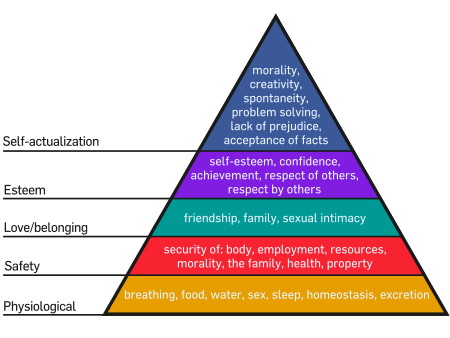
Compare the hierarchy of chakras in the human body to the left to the hierarchy of needs as described so famously by the American psychologist Abraham Maslow to the right. Remarkably similar, aren’t they?

450px-Maslow's_Hierarchy_of_Needs.svg

I believe the idea is the same.

In the yogic vocabulary, the root chakra above the anus (essentially in the male prostrate) and the sacral chakra just above it (near the female ovaries) govern our most basic drives: individual survival (eating, excreting etc) and genetic survival (sex).

Maslow lumped these together in his ‘physiological’ needs at the bottom of his pyramid. He believed that if somebody is choking you and you are not getting oxygen, breathing is the only need you care about. Once you can breathe again, you may notice that you are thirsty. Once you have drunk, you may notice that you are hungry. Once you have eaten, you may notice that you desire. And so on.

The next chakra (going upwards) is the yellow solar plexus just below the navel. In the yogic conceit, this governs our will to power. (So I sometimes think of the sacral chakra as Freud and the solar plexus as Nietzsche.) Maslow calls these “security” needs, but you notice that they involve what we consider the trappings of power: money, property, status, and so on.

Now we get into the higher or ‘nobler’ chakras.

In the yogic vocabulary, the first of these is the green heart chakra, which governs deep, selfless, non-sexual love (not Aphrodite but Hestia, if you will). Maslow calls these the ‘love and belonging’ needs for friendship, family and intimacy. Even the color corresponds. (Which is interesting: Green = envy in the West but love in the East.)

The blue throat chakra in Yoga governs intellectual clarity, the ability to communicate, creativity and so forth. This is where artists, scientists, writers and orators draw their inspiration. Maslow calls these ‘esteem’ needs, which is the reward of such things.

Yoga then distinguishes between two more chakras: the third eye behind the brow which is indigo and the source of inner peace and meditative calm; and the crown (depicted in the Western tradition as a halo) just above the head which is the area that is energized during enlightenment (ie, very rarely for most of us).

Maslow lumps them together under “self-actualization”, which is arguably the goal of life and the definition of success. Maslow studied biographies (as I did for my book), and developed a theory about what sort of qualities people have who self-actualize. Perhaps that’s why they called his approach “Jewish Buddhism” at Esalen. 😉

More about self-actualization anon.

Bookmark and Share

“Ought” vs “is”: Socrates and Callicles

Socrates

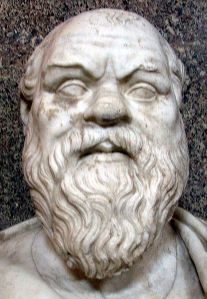
One of the most momentous conversations in history you’ve never heard about took place between Socrates and a man named Callicles, and is recorded in Plato’s Gorgias. It is a surprisingly moving portrayal of a man who tries to describe the world as it is but, upon prompting, reveals how much he yearns for the way it ought to be. Although it took place 2,400 years ago, the conversation is timeless and very modern. I think it describes many of us today.

Lions and sheep

As usual, Socrates is going around asking people to define “justice” and to expose, as was his wont, their confusion and ignorance. Callicles decides to have a go.

He proceeds to give a sort of genealogy of the concepts just and unjust. The law of nature is that the stronger and better dominate the weaker and worse. The lions feast on the sheep. That is natural justice. (Compare: Thucydides, writing at about the time the dialogue would have taken place, about the genocide of Melos.)

The weak, the sheep, don’t like that, of course, so they get together and call what the strong do unjust. By implication, what they themselves do is just. Collectively as a herd, the sheep want to dominate the lions. So whereas nature is on the side of the strong and the lions, convention is on the side of the weak and the sheep.

Influence on Nietzsche

To many of you, this rings a bell. Yes, this is where Nietzsche got his ideas for his Genealogy of Morals. Nietzsche took his metaphors of lions, sheep, herds, slaves and so forth from Callicles, then spun his theory. It was that the sheep banded together to invert the natural concepts of good and bad, strong and weak, motivated by a festering rage for which Nietzsche used the French word ressentiment.

Relevance to Darwin

Socrates being Socrates, of course, he goes on to needle Callicles about the precise meaning of words in order to poke a hole in his argument. He asks Callicles to clarify the terms “better” and “stronger”. Are they the same?

Callicles has to admit that they are not. And off they go, debating what that means.

Today, of course, we know that Callicles was looking for a better word: not strong or good but  fit. Not fit as in ‘toned from the gym’ but as in ‘survival of the fittest’. The fittest, according to Darwin, are not the strongest or the best but the most adapted.

The law of nature that Callicles refers to is therefore evolution. It is the tautological observation that those who are better adapted to the prevailing circumstances will leave more of themselves (ie, their genes) behind than those who are worse adapted.

Gibe at democracy

Callicles and Socrates go on to mock democracy (Athens was an even more direct democracy than America is today). Democracy to them is the inversion of nature, the herd of sheep ruling the lions, the weak dominating the strong, the inferior getting their revenge on the superior.

Yearning for what ought to be

But the dialogue between Callicles and Socrates becomes more moving than anything Nietzsche did with it. That’s because during the conversation it becomes clear that Callicles is a sophisticated and sensitive man who’s trying to describe how the world is while simultaneously being sad about it and yearning for how things ought to be.

He’s confused and bitter, about many things. He’s angry at Socrates for needling him, but also because he already foresees (correctly, of course) that the democratic herd of sheep will condemn the lion Socrates. And he hates himself for having to suck up to the herd, to the Athenians, to make his living.

He also hates seeing the fit succeed whether or not they are also good. In other words, he has the ideal of justice in his head as though it were an archetype. Like most of us, he’s frustrated. That’s all that Plato definitely establishes in this dialogue.

Mythos and logos: Armstrong v Dawkins

Richard Dawkins

Richard Dawkins

Karen Armstrong

Karen Armstrong

I admire people like Albert Einstein and Carl Jung (both characters in my book) who were able to feel awe. They retained their ability to be amazed by the world, and derived out of that amazement what Abraham Maslow called “peak experiences.”

I also admire people like Richard Dawkins (and of course Charles Darwin) who are able to use the precision-scalpels of their minds for clear thinking and shocking insight. Eg: Evolution. Eg: No God.

Like Einstein, I don’t really see combat between the one attitude and the other, between the left brain and the right, the yang and the yin. I especially like what happens when the two are well connected.

So I very much enjoyed this little contest in the Wall Street Journal (thank you Cheri) between Karen Amstrong, a religious scholar I have a lot of time for, and Richard Dawkins, the world’s most famous atheist. They were both asked: “Where does evolution leave God?”

Dawkins, true to take-no-prisoners form, answered:

The kindest thing to say is that it leaves him with nothing to do, and no achievements that might attract our praise, our worship or our fear. Evolution is God’s redundancy notice, his pink slip.

Armstrong responded brilliantly too, by avoiding the embarrassing efforts of certain people to deny the evidence of evolution and instead going a level deeper, into topics dear to The Hannibal Blog: story telling, mythology, and archetypes:

First Armstrong concedes that

Richard Dawkins has been right all along, of course—at least in one important respect. Evolution has indeed dealt a blow to the idea of a benign creator, literally conceived…. No wonder so many fundamentalist Christians find their faith shaken to the core.

But then she expands the topic:

Most cultures believed that there were two recognized ways of arriving at truth. The Greeks called them mythos and logos. Both were essential and neither was superior to the other; they were not in conflict but complementary, each with its own sphere of competence. Logos (“reason”) was the pragmatic mode of thought that enabled us to function effectively in the world and had, therefore, to correspond accurately to external reality. But it could not assuage human grief or find ultimate meaning in life’s struggle. For that people turned to mythos, stories that made no pretensions to historical accuracy but should rather be seen as an early form of psychology; if translated into ritual or ethical action, a good myth showed you how to cope with mortality, discover an inner source of strength, and endure pain and sorrow with serenity…

(Note 1: Logos is one of those Greek words that can be translated in several different ways. Viktor Frankl, as you recall, translated it as meaning, and named his approach logotherapy after it.)

(Note 2: The complementarity of mythos and logos is the stylistic assumption behind the book I am writing. It is non-fiction (logos) but–or so I hope, and so the editor believes–reads like myth. That’s because I feel that ideas, even logical ones, require stories for their telling.)

Bookmark and Share

Frankl: He who has a WHY can bear any HOW

Despair = Suffering – Meaning

So Viktor Frankl says in the video above, summarizing his theory of logotherapy, which I’ve read at greater length in his book Man’s Search for Meaning. In other words, if people suffer but see meaning in their life, and even in their suffering, they do not despair, as he himself did not despair when he was in Auschwitz and other concentration camps.

He is therefore, as he also says in this video, the anti-Sartre. Sartre and the other existentialists believed that we have to accept the meaninglessness of our existence. I, in my black-turtleneck and Gauloise phase (everyone has one), used to think that was cool. But Frankl thinks it is nonsense.

Or rather, he thinks that it is unhealthy and unhelpful. Hence logotherapy, which

focuses rather on the future, that is to say, on the meanings to be fulfilled by the patient in his future. (Logotherapy, indeed, is a meaning-centered psychotherapy).

He calls it logotherapy because

Logos is a Greek word which denotes “meaning.” Logotherapy, or, as it has been called by some authors, “The Third Viennese School of Psychotherapy,” focuses on the meaning of human existence as well as on man’s search for such a meaning.

According to logotherapy,

this striving to find a meaning in one’s life is the primary motivational force in man. That is why I speak of a will to meaning in contrast to the pleasure principle (or, as we could also term it, the will to pleasure) on which Freudian psychoanalysis is centered, as well as in contrast to the will to power on which Adlerian psychology, using the term “striving for superiority,” is focused.

Speaking of the will to power, Frankl likes to quote Nietzsche:

“He who has a why to live for can bear almost any how.” I can see in these words a motto which holds true for any psychotherapy. In the Nazi concentration camps, one could have witnessed that those who knew that there was a task waiting for them to fulfill were most apt to survive.

Those people who do see meaning in their lives, says Frankl, are able to

transform a personal tragedy into a triumph, to turn one’s predicament into a human achievement.

And here you see how this is relevant for my book, which is about the two impostors, triumph and disaster.

Critique

I want to agree with Frankl, but the trouble starts when he describes how he applies his approach to actual therapy. To me it sounds like semantic trickery. He meets desperate people and tries to change their attitude, but really he only does some conceptual gymnastics and calls that meaning.

Once, an elderly general practitioner consulted me because of his severe depression. He could not overcome the loss of his wife who had died two years before and whom he had loved above all else. Now, how could I help him? What should I tell him? Well, I refrained from telling him anything but instead confronted him with the question, “What would have happened, Doctor, if you had died first, and your wife would have had to survive you?” “Oh,” he said, “for her this would have been terrible; how she would have suffered!” Whereupon I replied, “You see, Doctor, such a suffering has been spared her, and it was you who have spared her this suffering—to be sure, at the price that now you have to survive and mourn her.” He said no word but shook my hand and calmly left my office. In some way, suffering ceases to be suffering at the moment it finds a meaning, such as the meaning of a sacrifice.

I don’t doubt that the old man, out of love for his wife, preferred to bear the pain of being the survivor so that she did not have to. But his wife was still gone. His job (surviving her) was done. Pointing out that he had saved her pain did not give him meaning for his life from that point forward.

So my critique of logotherapy is really the same as my critique of religion: Sure, it might be helpful to see meaning (= believe in God), but that does not mean that there actually is meaning (=God). Sartre might be right after all.

That said, I am impressed enough with Frankl to include him in my pantheon of great thinkers.

Bookmark and Share

How not to burn out sexually: Nina Hartley

Nina Hartley

Nina Hartley

For my piece in the current issue of The Economist, I had the pleasure of talking to, among other people, the equivalent of Meryl Streep in the porn industry: Nina Hartley. She is 50 and says she loves sex more than ever, on camera or off. She has been at it (the camera part) since 1984.

A somewhat unfortunate part of my job, as I am increasingly discovering, is that the most interesting parts of my research and my conversations often fall well outside the realm of what can make it into my articles. Yes, of course, readers might care about how the porn industry is doing. But they’re human so they must also be curious about, well, sex. After all, it’s not everyday that you get to talk to somebody who does it for a living.

In my case, I was just a tad shy for the first few moments. It helped that I have never “consumed” Nina’s “content” so I had no visuals to distract me. Still: How would I talk to somebody who views having sex as I view writing?

It turned out that Nina was very easy and very interesting to talk to. The conversation ranged just as it would have ranged with anybody else. Our health care debate drives her “mad.” California can’t govern itself. That sort of thing.

Performing sex on camera, she said, is

a highly paid form of blue-collar work… sort of like farm labor.

Everybody is an independent contractor and there are no benefits. No benefits. It’s important in such a conversation not to reach for the double entendres.

About the porn industry, Nina was somewhat nostalgic and sentimental. In the 80s, when she started, it was apparently a glamorous sort of thing. The product was hard to get and had rarity value, the production took place in a subculture that considered itself revolutionary. There was a frisson, a pioneer spirit, a certain excitement.

Now it’s seedy, cheap, everywhere. She wouldn’t start again today if she were young now.

So why is she still in it?

In large part because she actually likes the sex, she told me. She thinks that women increase their sensitivity in middle age. At least that is happening to her.

My enjoyment of sex has increased, but for most [performers] it goes down, especially the men.

I asked her if she meant that doing it on camera makes people “numb.” Sometimes, she says. Many performers stop having sex in their private lives altogether. The men basically have to, since they couldn’t have private sex, then perform as well the next day on camera, and any hint of “having trouble” might kill their career. But they also genuinely lose interest.

Nina sees her role now as “mentor” as well as actress, so she counsels the young performers not to let that happen.

Frankly, it amazes me that it–burning out–hasn’t happened to her. She must be a modern Aphrodite.

Bookmark and Share

Meaning in suffering: Frankl on Auschwitz

BIRKENAU

I promised to ruminate on Viktor Frankl’s book Man’s Search for Meaning.

First, for those of you who have not read the book, a quick overview:

The book is short and easy to read. It has two parts:

  1. In Part I, Frankl talks about his own survival in Auschwitz and several other concentration camps, and his psychological observations about himself and others during that time.
  2. In Part II, Frankl gives an overview of his psychiatric theory, which is called logotherapy, and which his observations about camp life were meant to prove/affirm.

As for Part I, I recommend it for everybody. I believe it is a timeless piece of writing, all the more so for its brevity and simplicity. In a compassionate, measured and compelling writer’s voice, Frankl gives us a view of what it was like. His tone is the opposite of shrill or sensationalist. He makes especially the “ordinary” details of this extraordinary experience unforgettably vivid.

And he gives order to his account. In particular, he describes the mental stages that inmates like himself went through.

Shock

First there was shock. Frankl particularly emphasizes how he found it hard to part with a manuscript that he was carrying with him when he was being admitted to Auschwitz. It already contained his complete logotherapy theory–and thus a large part of what he considered to be the meaning of his life–and having to surrender it was his first big shock.

Apathy

Then there was apathy. Apathy is usually a bad word nowadays, but Frankl shows us how it was a necessary reaction for survival. Consider this passage (Kindle locations 388-93), in which he is looking out of a window in his cottage at a dead man:

The corpse which had just been removed stared in at me with glazed eyes. Two hours before I had spoken to that man. Now I continued sipping my soup. If my lack of emotion had not surprised me from the standpoint of professional interest, I would not remember this incident now, because there was so little feeling involved in it. Apathy, the blunting of the emotions and the feeling that one could not care any more, were the symptoms arising during the second stage of the prisoner’s psychological reactions, and which eventually made him insensitive to daily and hourly beatings.

Meaning

And then there was the issue of meaning. Inmates had one of two reactions:

  1. Some inmates saw no meaning in their suffering and in their lives anymore. Those inmates eventually gave up. They might one day be seen smoking the cigarette butt they had been hoarding while lying in their feces on the bunk, not intending to get up again, consuming their last pleasure while resigned to dying.
  2. Other inmates, including Frankl, saw or found meaning in their suffering and had a chance at survival. Frankl found meaning, for instance, in the ideas that had been contained in the manuscript that was now lost, and that he now had a duty to resurrect by surviving the camps. And he found meaning in the idea that his wife, also in the camps and perhaps dead, might still be alive and need him.

In Frankl’s words (locations 1168-70):

A man who becomes conscious of the responsibility he bears toward a human being who affectionately waits for him, or to an unfinished work, will never be able to throw away his life. He knows the “why” for his existence, and will be able to bear almost any “how.”

Here he talks about one moment when he felt his wife’s presence (locations 632-41):

I was again conversing silently with my wife, or perhaps I was struggling to find the reason for my sufferings, my slow dying. In a last violent protest against the hopelessness of imminent death, I sensed my spirit piercing through the enveloping gloom. I felt it transcend that hopeless, meaningless world, and from somewhere I heard a victorious “Yes” in answer to my question of the existence of an ultimate purpose. At that moment a light was lit in a distant farmhouse, which stood on the horizon as if painted there, in the midst of the miserable grey of a dawning morning in Bavaria. “Et lux in tenebris lucet”—and the light shineth in the darkness. For hours I stood hacking at the icy ground. The guard passed by, insulting me, and once again I communed with my beloved. More and more I felt that she was present, that she was with me; I had the feeling that I was able to touch her, able to stretch out my hand and grasp hers. The feeling was very strong: she was there. Then, at that very moment, a bird flew down silently and perched just in front of me, on the heap of soil which I had dug up from the ditch, and looked steadily at me.

Captivity in liberation

And then, for the lucky ones like himself, there was the challenge–yes, challenge–of liberation. Most inmates found it very hard to be set free at last. Many had lost their moral fiber, their personality, their optimism, their humanity in the camps and were now at a loss, unable to enjoy freedom.

Here are just a few insights worth pondering:

Humor: It’s necessary.

From locations 670-73 and 681-85:

Humor was another of the soul’s weapons in the fight for self-preservation. It is well known that humor, more than anything else in the human make-up, can afford an aloofness and an ability to rise above any situation, even if only for a few seconds. I practically trained a friend of mine who worked next to me on the building site to develop a sense of humor.

The attempt to develop a sense of humor and to see things in a humorous light is some kind of a trick learned while mastering the art of living. Yet it is possible to practice the art of living even in a concentration camp, although suffering is omnipresent. To draw an analogy: a man’s suffering is similar to the behavior of gas. If a certain quantity of gas is pumped into an empty chamber, it will fill the chamber completely and evenly, no matter how big the chamber. Thus suffering completely fills the human soul and conscious mind, no matter whether the suffering is great or little. Therefore the “size” of human suffering is absolutely relative.

Humanity: Not guards versus inmates but decent men versus indecent

This is surprising, perhaps, but Frankl did not observe the camp as Nazis versus Jews, or guards versus inmates, but as decent versus indecent.

Among the guards he saw some decent men along with the indecent. And among the prisoners, he saw some of the most indecent, in particular the ones they called the “capos”–inmates who had made themselves complicit with the guards for personal favor and who were often the most sadistic men in the whole camp.

The primacy of attitude

What made some prisoners resilient and others not? In a word, attitude.

Loc. 973-74 and 981-82

Everything can be taken from a man but one thing: the last of the human freedoms—to choose one’s attitude in any given set of circumstances, to choose one’s own way.

The sort of person the prisoner became was the result of an inner decision, and not the result of camp influences alone.

With the wrong attitude, a prisoner saw life as pointless, meaningless:

Loc. 1056-61

It became easy to overlook the opportunities to make something positive of camp life, opportunities which really did exist. Regarding our “provisional existence” as unreal was in itself an important factor in causing the prisoners to lose their hold on life; everything in a way became pointless. Such people forgot that often it is just such an exceptionally difficult external situation which gives man the opportunity to grow spiritually beyond himself. Instead of taking the camp’s difficulties as a test of their inner strength, they did not take their life seriously and despised it as something of no consequence. They preferred to close their eyes and to live in the past. Life for such people became meaningless.

But with the right attitude, prisoners saw a positive opportunity even in a concentration camp:

Loc. 1065-67

Most men in a concentration camp believed that the real opportunities of life had passed. Yet, in reality, there was an opportunity and a challenge. One could make a victory of those experiences, turning life into an inner triumph, or one could ignore the challenge and simply vegetate, as did a majority of the prisoners.

Obviously, there is a lot more to say about Frankl and logotherapy, but let’s pick that up in another post.

Death in Tehran: a story about fear

I’ll have much more to say about Viktor Frankl’s book Man’s Search for Meaning, which I recently finished reading. But today just one little story that Frankl, a psychotherapist who survived Auschwitz, tells in the book.

He calls it Death in Tehran (Kindle locations 846-51) and uses it to suggest that we are often our own worst enemies, that our very fear of something can make it come about:

A rich and mighty Persian once walked in his garden with one of his servants. The servant cried that he had just encountered Death, who had threatened him. He begged his master to give him his fastest horse so that he could make haste and flee to Teheran, which he could reach that same evening. The master consented and the servant galloped off on the horse. On returning to his house the master himself met Death, and questioned him, “Why did you terrify and threaten my servant?” “I did not threaten him; I only showed surprise in still finding him here when I planned to meet him tonight in Teheran,” said Death.

American attitudes toward prisons

My policy, as most of you know by now, is not to link to my pieces in The Economist week after week, unless there is a special reason, because that would be, well, tedious and annoying.

So why link to my piece in the new issue on California’s prison overcrowding?

To make two separate and unrelated points:

1) the importance of length, once again.

It always amazes me, after all these years, how short most of our pieces in The Economist are. The pieces inside the regular “sections” are called “notes” in our nomenclature. Because we have fixed (paper-issue) layouts that determine article length, most notes are either 500, 600 or 700 words. For this note, I asked for 700 words, was told to make it 600, and the final piece ended up at 520.

That’s in effect a blog entry. Most people don’t realize how much harder it is to write a short article than a large article. The folks at the New Yorker can blather on and on (“On an overcast Monday afternoon, I strode across Fifth Avenue to interview John Smith, ….”). We have to get to the point. There should be some nuance, some color, and we should cover the main bases, but all in … 500 words!

It’s friggin’ difficult. Then the readers show up in the mostly infantile comments section below the articles, invariably accusing us of utter ignorance, if not downright malice, because they know (or imagine) one little detail that was not in the 500 words.

Beyond that, of course, the brevity often hurts me, the writer. Invariably, I do research for every piece until I am satisfied that I know the subject well enough. I could easily then fill a few thousand words. So much therefore gets left on the cutting floor.

Which brings me to my second reason for linking to this week’s piece…

2) The shame, the horror of America’s prisons and Americans’ attitudes toward them

Among the things I left on the cutting floor were some of the numbers that Barry Krisberg at the National Council on Crime and Delinquency bounced around with me (mostly 2005 numbers):

  • Most people know that America has the highest incarceration rate in the world, but did you know just how much higher? America locks up 732 people out of every 100,000. The G7 countries, which should be the appropriate comparison for America, lock up 96 people for 100,000. The country in the world that comes closest to America is Russia, yes Russia, where the number is 607.
  • Was there ever a country for which we have numbers that surpass America’s current incarceration rate? Yes, says Barry, and it was …. the Soviet Union during the years of Stalin’s Gulag!!!
  • America has about 5% of the world’s population but 23% of its prisoners.
  • America also has by far the highest ratio of prisoner to each kind of crime. What that tells you is that there is not more crime in America that would justify more imprisonment.

And on and on. In short, Americans love locking people up. They do not see any irony at all in claiming, often loudly when in the company of Europeans, to be “the freest country in the world” while robbing more individuals than any other country does of their freedom, their dignity, their rights. (This distorted understanding of freedom is what I have been exploring in my thread on America.)

I should add at this point that I have rehearsed the inevitable “debate” that usually ensues enough times that I can confidently predict every objection.

Allow me to give you a sample of the most typical “conservative” opinion on the matter. It is a reasoned, Republican-mainstream opinion taken from one of California’s conservative blogs.

In it, we discover the underlying assumptions that nowadays make America the exception among comparable countries:

The demand by federal judges to provide civilized health care to prisoners is

…forcing us to provide better medical care to prisoners than most law abiding citizens receive…

This is ironic because this particular argument tends to come from people who object to providing health care to those law-abiding citizens as well. And it is telling because its sets the tenor for all subsequent arguments, summarized neatly in this passage:

The only danger [prisoners] face is from each other, really bad people, that is people who have no respect for themselves, their neighbors, or for the rules, can be difficult to live with, without question, but that cannot be avoided.  Prison is for bad people, to keep bad people away from good people so that the bad people cant hurt the good ones.

And here you have it in a nutshell. The conservative and prevailing American attitude toward incarceration is based on:

  • vengeance in the Old-Testament style, not on rehabilitation, which is the assumption that prisoners must at some point be brought back into society. In effect, prisoners become outcasts, with no hope of atoning and changing and playing a productive role in society. Result: the world’s higest recidivism rate, 70% in California.
  • Refusal to see nuance: Nobody, and I mean nobody, is arguing that there are no bad people, no crazy people, no dangerous people that must genuinely be kept out of our neighborhoods. But what about the people who are in there for stealing socks, for smoking dope, for all the many misdemeanors that have increasingly been prosecuted as felonies to please the “tough-on-crime” electorate? There are many non-violent people who have simply made a mistake and end up brutalized in prison.
  • Meanness, lack of compassion. Nuff said.

The reality is that prisons contain:

  • bad people
  • average people who have done bad things but can and want to change their ways
  • and even some good people who have got caught up in a fundamentally unjust system

But in our overcrowded and barbarous prisons, they are all thrown together, so that good people become bad and bad people become worse, and society loses by turning away from justice and civility.

Back to the sample opinion. If you approach the entire topic from the point of view that those in the system are all bad, that they deserve to be brutalized and do not deserve protection in prison, then, and only then, can you conclude, as this commentator does, that

There is nothing wrong with our prisons.


Bookmark and Share