The leopard and the baby baboon

image

I have been puzzling over, and moved by, a scene from Eye of the Leopard, a film by Dereck and Beverly Joubert, a handsome couple (above) who are quite the up-and-coming wildlife-documentary makers.

It is the second clip in this video, called “Unlikely Surrogate”.

The “plot”, as provided by Mother Nature (and as narrated by Jeremy Irons):

A leopard hunts a baboon mother, kills her and begins to drag her up on tree for the feast. Suddenly, something wriggles, and it is the one-day old baboon baby that was clinging onto her mother and now falls out.

The leopard pauses. … It does not know how to react. It watches the baby for hours. Then it gently picks the little primate up with its fangs and carries it further up to the tree to safety from other predators. The leopard licks and comforts the baboon baby whose mother the cat has just killed. The baboon baby recognizes the kindness and snuggles into the leopard’s chin. They cuddle for hours together against the cold. Then the leopard moves back down to eat the baby’s mother.

You can study biology, Darwin, evolution. You can hypothesize why this trait is passed on and not that trait. You can throw around fancy terms, such as cross-species altruism. And just when you’re feeling reassuringly scientific, nature reminds you of her eternal, sublime, moving mystery.

Bookmark and Share

Let the post office atrophy (and change)

I’ve been meaning to offer an entirely unrelated aside regarding my mail box. Yours too, for that matter. I’d love it if the dang thing were gone, completely gone, retired into some landfill where the telex machines and vacuum-tube radios are rusting.

This will never actually happen, I realize, even though it now seems that the trend is in that direction. Which is to say: snail mail is obsolete. The volume of mail (chart, bottom right) started dropping before the recession, at about the time when most of us started having boadband internet. And I predict it will keep falling, just more slowly, when the recovery starts. Senators are contemplating cutting the loss-making Post Office’s service. I say: Make it once a week, then once a month.

I personally (as opposed to my wife and my kids!) get very close to zero mail. All our bills are electronic now, all my private and soulful communications are digital or in-person.

The only thing that comes into my mail box is:

  • junk mail, a genre in which America outdoes every other country that I am familiar with. Verdict: 👿
  • All the paper crap that America’s countless, overlapping and nasty bureaucracies churn out, such as jury-duty summons and IRS spam. Verdict: 👿
  • Tangible gifts by grandparents and fans to my son and daughter. Verdict: 😛 (But many of those things come by FedEx and UPS)
  • The occasional post card or letter from a friend who has still not sussed out that I’m OK, really OK, getting these things electronically. Verdict: 🙄

Snail mail gets soaked, lost and bent. I constantly carry important letters that were put into my mailbox in error to the neighbors. I rarely get any coming the other way: Does the carrier only make mistakes for others, or am I not getting something important? Either way, this would not happen with electronic communications.

Then let’s talk about our addresses as identifiers. How passé is that? People move (as I just have) and most of the stress in a complex country such as America is not hauling boxes but updating and untangling the dozens of databases of banks, DMVs, insurers and other authorities. Folks, this is not necessary. We use email addresses and passwords as identities online. That, and perhaps a new and improved (meaning safer) Social Security number, should be all the bureaucrats need from us.

Young people have already dropped their landline phones for mobile phones and skype, which are, well, mobile and personal. Landlines are silly. And so are mail boxes.

Rebuttal

As Solid Gold Creativity reminds us, (and thanks for pointing me to the chart), there is a certain sensual and sentimental value in the post. An old tradition, yet another of the many, is under threat.

I’m not against sensuality. Indeed, I love and need to touch some information in marked-up paper form. But that is not at risk! As I argued in the similar context of the “dying” newspapers, no old medium ever goes away when new media arrive. Instead, the old media change context.

When cars showed up, we did not kill horses. (Paul Saffo and I have had fun trying to verify our guess that there are more horses in America today than there were in 1850.) But we don’t take the horse to the Wal-Mart. We take the horse to the Polo Game or the ranch or the Lipizzaner stables. It’s a classy thing nowadays. The context is fun. That (ie the change from mundane uses to rewarding ones) is a positive change.

The same will happen to the post. We already have FedEx and UPS for things we care about. Well, the post office can start being as good as they are. Cut out the junk mail and perfunctory admin crap, and deliver–occasionally or at haste for a premium–only the good stuff. That would be progress.

Bookmark and Share

Letting go, in small ways and big

800px-Saimiri_sciureus-1_Luc_Viatour

One way to catch monkeys–or so I once saw in a documentary–is apparently to dig a hole in the ground just big enough for a relaxed monkey hand to go in and just small enough for a monkey fist not to come out.

Then you put some goodies in the hole and wait. The monkey then catches itself. It sticks its hand in, grabs the goodies, makes a fist and refuses to let go, even as it sees the hunters casually sauntering up to take it in.

Primates, in short, have a problem with letting go, and that’s how this relates to The Hannibal Blog‘s current thread on stuff. I rarely, these days, find anyone prepared to argue that clutter/stuff is a good thing. Nor, however, do I know a lot of people who have actually done anything about it. It may be that I hang out primarily with primates.

It’s our (ie, primates’) loss, because this not letting go is what makes us so miserable. That’s true in the context of physical stuff piling up, but also of mental clutter.

The Dalai Lama, at the end of this conversation, says that

True happiness doesn’t mean trying to acquire things, so much as
letting go of things.

Not coincidentally, therefore, a primary meditation technique consists of trying to let thoughts go. You sit still and observe dispassionately what pops into your mind. You don’t try to suppress bad, mean, nasty, stupid thoughts, because that would only make them come more–eg, you would feel guilty and angry about not ceasing to feel guilty and angry.

Instead, you “label” the thoughts (‘Aha, anger again.’) and then let them pass out, replaced by whatever comes next.

It’s quite surprising how much crap shows up this way. Even more surprising is that after a while of doing that, the parade of thoughts slows down. Eventually, it might even come to complete stillness, which is how Patanjali defines yoga (union). At that point, you have indeed let go.

So: stuff, clutter, things, illusions, attachments: it’s all there to be let go. Unfortunately we have evolved to hold on to it. Hence passion, literature, civilization, stories … and misery.

Bookmark and Share

Stuff and sex: It’s a female thing

160px-Female.svg180px-Male.svg

The elephant in the room whenever you’re discussing stuff and clutter is sex.

(That’s sex as in gender, although our style guide at The Economist urges us to use gender only for words and sex for people. So the gender of ein Mädchen is neuter, whereas her sex is female.)

I believe we can stipulate that:

women need and keep and hoard, and cannot let go of, stuff much more than men do

Is this controversial? It shouldn’t be. It’s mostly women I’ve talked to who have said as much. If you go into a random house and count things, the odds are that “hers” outnumber “his” (although that need not apply to total weight or size, of course). It’s women who agonize over getting rid of things, not men.

(To pre-empt a Larry Summers situation, this is the time to remind everybody that I’m making a statement about averages and statistical dispersion. Of course, there are individual men who keep more stuff than individual women.)

So the question is: Why?

  1. One possibility is our hunter-gatherer past, which accounts for almost all of our time as a species. Whereas Neanderthal men and women hunted together, our ancestors sent the men to hunt and the women to gather, and benefited from this division of labor. A hunting party travels light. The less you carry the more fiercely you will wield what you do carry, and the more likely you will be to bring your prey back, which is the point. Stuff would only interfere. By contrast, gathering is about stuff, the collecting of it.
  2. Another possibility is that the nesting instinct shows up in females even outside of pregnancy, though perhaps to a lesser extent. Get a male (we’re not necessarily talking about our own species) to build a nest, then fill it up. All the way up. Don’t drop anything.
  3. The previous two points might just add up to a third possibility: That women have a stuff brain but men don’t. I read research somewhere (which applies eerily in my case) that men are usually better at, for example, such tasks as rotating an imaginary object in space, whereas women are better at remembering and locating objects in a crowded drawer that is briefly opened and shut. Men can’t find anything, women seem to find everything. (When I need something, I usually ask my four-year old daughter, and she always knows.)


Bookmark and Share

Entropy in your home, life, body and mind

Like Fritjof Capra, I instinctively see Eastern philosophy and Western science as yin and yang. They rarely disagree and usually reinforce each other, the East using the vocabulary of metaphor, the West that of empiricism. So indulge me as I apply this instinct to my current thread on stuff.

The Feng Shui view is that stuff, ie clutter, blocks the flow of energy (qi) in your house and, since you are not ultimately separate from the space around you, in you.

The relevant Western analog is that clutter wants to increase all by itself. You have to expend energy to keep your stuff from spreading, multiplying, breaking, rotting.

This idea is called the Second Law of Thermodynamics. “Clutter”, in the argot, is entropy, the amount of disorder in a system. Disorder will increase as surely as water flows downhill (from a high-energy state to a low-energy state). The “system” in question can be:

  • your body, in which entropy manifests as aging and breaking,
  • a glass of warm water that cools (trading the “order” of warmth here and cold there for the “disorder” of lukewarmth everywhere)
  • your house or home office as it mysteriously gets submerged in stuff,
  • the entire universe (which is incredibly bad news for us, since there is no other system that we can decamp to), and
  • almost anything else.

Now, you might object that you can make water flow uphill, and you can warm a glass of water even in a cool room. Yes. But the key insight is that this takes energy, which must be added into the system. You have to pump, or boil, et cetera.

Hence the dilemma of stuff: First the clutter increases, thus (according to Feng Shui) blocking our energy, which is thus unavailable to reverse the cluttering, and so the shit–sorry, stuff–just happens.

Bookmark and Share

The changing nature of wealth: stuff is out

800px-Claude_Vignon_Croesus

Let’s return to Croesus for a moment. That’s the guy who gave us the phrase “rich as Croesus” and who learned the hard way about the ups and downs of life. Today I want to use him, the richest of the rich, to begin a brief meditation on wealth, as a way of understanding our modern problem with stuff. Because stuff is what we’re trying to figure out in this thread.

It used to be that wealth was a thingy thing, a state of having lots of stuff, especially stuff that others wanted and did not have. Let’s savor for a moment a brief passage from Herodotus, in which he dwells lovingly on the details of Croesus’ stuff/wealth. This was the porn of the fifth century BCE.

Croesus, in this passage, wants to impress the Delphic oracle, so he gives it lots of stuff:

three thousand of every kind of sacrificial beast, and besides made a huge pile, and placed upon it couches coated with silver and with gold, and golden goblets, and robes and vests of purple…. The king melted down a vast quantity of gold, and ran it into ingots, making them six palms long, three palms broad, and one palm in thickness. The number of ingots was a hundred and seventeen, four being of refined gold, in weight two talents and a half; the others of pale gold, and in weight two talents. He also caused a statue of a lion to be made in refined gold, the weight of which was ten talents…

On the completion of these works Croesus sent them away to Delphi, and with them two bowls of an enormous size, one of gold, the other of silver… Croesus sent also four silver casks, which are in the Corinthian treasury, and two lustral vases, a golden and a silver one… Besides these various offerings, Croesus sent to Delphi many others of less account, among the rest a number of round silver basins. Also he dedicated a female figure in gold, three cubits high, which is said by the Delphians to be the statue of his baking-woman; and further, he presented the necklace and the girdles of his wife.

Necklace and girdles? That sounds like the junk we just got rid off at the yard sale.

This, in other words, was the age of things, of stuff. Almost all people had extremely little of it, so to get any stuff at all was a stroke of fortune, and immediately imposed the need to hoard it and the anxiety of losing it. When you gave people gifts (and I’ll have more to say about gifts in another post), you gave things/stuff, because that’s how worth and sacrifice was defined.

All that is over, at least for the middle and upper classes of the rich countries today. (If you’re reading blogs, you belong to that set.) Our wealth is no longer thingy/stuffy. If anything, an excess of things is a mark of poverty. Any household today, even a trailer in Appalachia, is filled with gadgets that would have made Croesus green with envy.

What has taken the place of things? Two things:

  1. Time. We have so little of it, and so much stuff, that the exchange rate between the two has shifted hugely toward time. If you have money/things but no time, you are poor. Time is now one definition of worth and sacrifice, so when you really want to give a special gift, you give your time. You volunteer, or you spend a few hours of totally focused playtime with your children, or you take time to talk, really talk, with a friend/lover.
  2. Experiences. While the people in the Appalachian trailer haul in more TVs and fridges and toasters, the wealthy now buy themselves and their children experiences. Education is the big one, and that includes piano and tennis lessons, the trip to Europe and the Louvre. In my twenties, wealth was having hiked the Annapurna Circuit, say, or having sat in on a session of the House of Commons. Now, in my thirties, wealth is giving my children the experience of snow in the winter, seawater in the summer, and so forth.

So stuff is obsolete. Out of date. Unnecessary. Not worth anything. Which raises the question: Why do most of us hang on to it anyway, ruining their Feng Shui and making themselves miserable? I’ll try to tackle that anon, but I’m sure you’ve all got your ideas, so let’s have them.

Bookmark and Share

Stuff = Dead space: The Feng Shui view

335px-Feng1shui3

As a way of getting deeper into our new thread on stuff, here is a basic way of understanding why clutter is so bad for you: it “kills” space and blocks the flow of energy around your house and in your mind.

That’s how a Feng Shui guy explained it to me when I lived in Hong Kong.

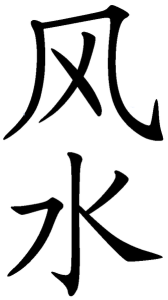
Feng Shui, if you’re new to it, means wind water (characters above), which is entirely unhelpful in understanding what it is. It’s the ancient Chinese version of geomancy–figuring out how to place buildings, furniture and other features of interior and exterior living in such a way that they make us feel healthier, more energetic and positive.

Feng Shui shares the fate of most things Eastern that are becoming fashionable in the West. That is: there are all sorts of quacks and weirdos eager to sell it to you as modern snake oil. If you know somebody who suddenly put mirrors, crystals and fish tanks all over his house, he probably became a Feng Shui victim.
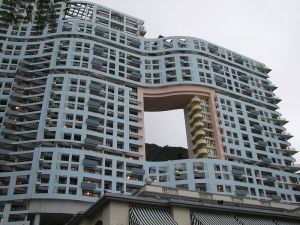
800px-RepulseBay_holeOn the other hand, if you encounter buildings such as this (right behind a great beach I used to go to), you know you’re in Hong Kong. In this case, Feng Shui (ie, the hole that allows better energy flow) makes for idiosyncratic local architecture.

But if you’re lucky, you meet an expert who treats Feng Shui as the subtle application of common sense. I was lucky.
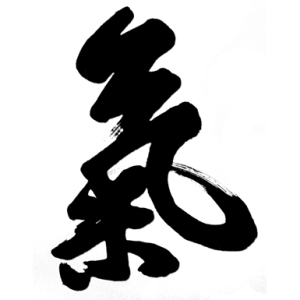
Ki-hanjaLike Chinese medicine (and indeed Indian Ayurveda), Feng Shui tries to optimize the flow of vital energy, or qi.

That qi is the ki in Aikido and the chi (different transliteration) in Tai Chi and the qi in Qigong. In Sanskrit it is called Prana. It behaves a little like electric energy, as it flows between a positive and a negative “pole”, Yang and Yin. When they stick needles into you in acupuncture, they are using the tiny conductors to amplify the flow of qi along certain conduits (called meridians in Chinese medicine, nadis in Ayurveda and Yoga).

What, you may be asking, does any of this have to do with stuff?

Stuff = dead energy

The way this Feng Shui master explained it to me, clutter in your home or office blocks the flow of qi in that space. The space becomes not just dusty but in effect dead.

Think of a corner of your house, or a drawer or a basement or a tabletop, that is hopelessly cluttered with stuff. (I’m using stuff to mean extraneous things here.) You don’t even want to look into that direction because it makes you feel bad. It reminds you that you should clean it up. Perhaps it reminds you of things on your to-do list that you never did because you didn’t want to, and now they’re piling up in that corner. Perhaps there are really important or useful or sentimental things hidden underneath that crap, but how would you ever know, without digging through it? Just thinking about all this makes you …. go somewhere else–anywhere else–and run away from the clutter once again.

And so your house becomes deader and deader with each cluttered corner. You walk through it as through a graveyard. The constricted space constricts your thoughts, perhaps your breathing (in Sanskrit, Prana means both breath and qi.)

So, to you hoarders: It’s not true that storing stuff costs nothing. It costs you more than any accountant could tally up.

Bookmark and Share

Discussing stuff while getting rid of it

IMG_5787

In preparation for this new thread on stuff, I spent much of the day talking and thinking about it at the perfect venue for this sort of thing: a yard sale.

Friends of ours were having one and invited us to piggyback on theirs, so we had a “multi-family” purge on a sun-baked California street corner. My daughter was scotch-taping the signs up around the neighborhood (which is why they are knee-level for a tall adult), and then I hauled our crap, I mean stuff, onto that lawn. And people bought it.

It was cleansing. The families hung out and talked about this odd tyranny of stuff. The other family was getting dirty looks from the mom/mother-in-law, who is a bit of a hoarder and couldn’t quite believe what we were giving away. My friend was walking out with something or other, allegedly a thing of beauty, and his mother-in-law interrupted her phone conversation to raise her eyebrows and say: “That was a wedding present from [so-and-so], you know.”

He chortled. It was his dang wedding, and a fun one, and it’s his dang marriage, and a good one, so where is the law that says he must forever junk up his house with crap, I mean stuff, that he never wanted in the first place?

The ladies did, however, share how hard it often has been for them to part with their stuff. The other mom had already tried dumping the baby things once, and said she was overcome by a sort of “nausea” and had to stop. This time, fortunately, she was ready.

The lads had no memories of any psychosomatic stuff-parting pains to report.

Bookmark and Share

New thread: A Theory of “stuff”

800px-EastNOAp06Carpile12

I have found myself, to my considerable surprise, doing some deep thinking about stuff. As in: Crap. Things. Knick knack. Papers. All that.

The occasion was a move–the before, during and after. My wife and I have been having to confront the cumulative load of stuff in our house and lives, stuff that has to be stored, then moved in order to be stored again. (Irony, anyone?)

If you are a regular reader and remember my feelings about, say, Diogenes or simplicity, or my utter loathing of clutter and complexity, you can pretty much figure out how I feel about stuff.

My wife does not disagree–and fortunately loves me for my eccentricities–but she is nonetheless

  1. female and
  2. not me.

This places her in a sufficiently different vantage point to produce some fascinating and highly entertaining discussions between us and ideas that I want to share with you in subsequent posts.

So I’m starting a new thread (ie tag) called stuff. Talking about things per se would be boring, so we are talking about things only in order to find out more about life and clutter, Feng Shui and simplicity, fear and serenity, and these sorts of things.

As regular readers know, this does not mean that any other ongoing threads–such as the ones on storytelling, the great thinkers, America, Socrates or, of course, Hannibal–will be interrupted, only that yet another one will be woven into them.

Prepare to get stuffed.

Bookmark and Share